the hydro tunnel
p. 50 · Read in the full issue
Western Samoa
Light at the end of the hydro tunnel
The opening of the Samasoni hydro station in mid-February marked the completion of the first major hydro project under Western Samoa’s current Hydro-Development Master Plan Report. The plan was prepared by an English firm of engineering consultants, Mander, Raikes and Marshall.
The master plan has been fulsomely praised by the European Development Fund which is financing many of the hydro projects through grants.
It said: ‘Owing to its geographic and climatic conditions, and to the skill of its infrastructural decisions, Western Samoa might more easily overcome strains in the field of energy than many other developing countries, as the energy prob lem was defined at a very early stage for the benefit of the country and its population.’
The significance of the country’s hydro-development plan cannot be over emphasised. According to Bruce Holland, financial con troller for the Electric Power Corporation, in 1980 petroleum products ‘were the single largest category of imports into West ern Samoa. Petroleum products cost the country $9 551 700, or 16.6 percent of the total im ports’. In comparison, total ex ports were $l5 828 000. Thus,
some 60.3 percent of export earnings were spent on pet roleum imports for that year.
Before the commissioning of the Samasoni hydro (total ca pacity 1650 kW) only 20 per cent of the country’s electricity was provided by hydro. After Samasoni, 49 percent will be thus provided. In terms of money saved, this will come to approximately $1430 000 a year at today’s prices, equival ent to a reduction in diesel imports of 580,000 gallons.
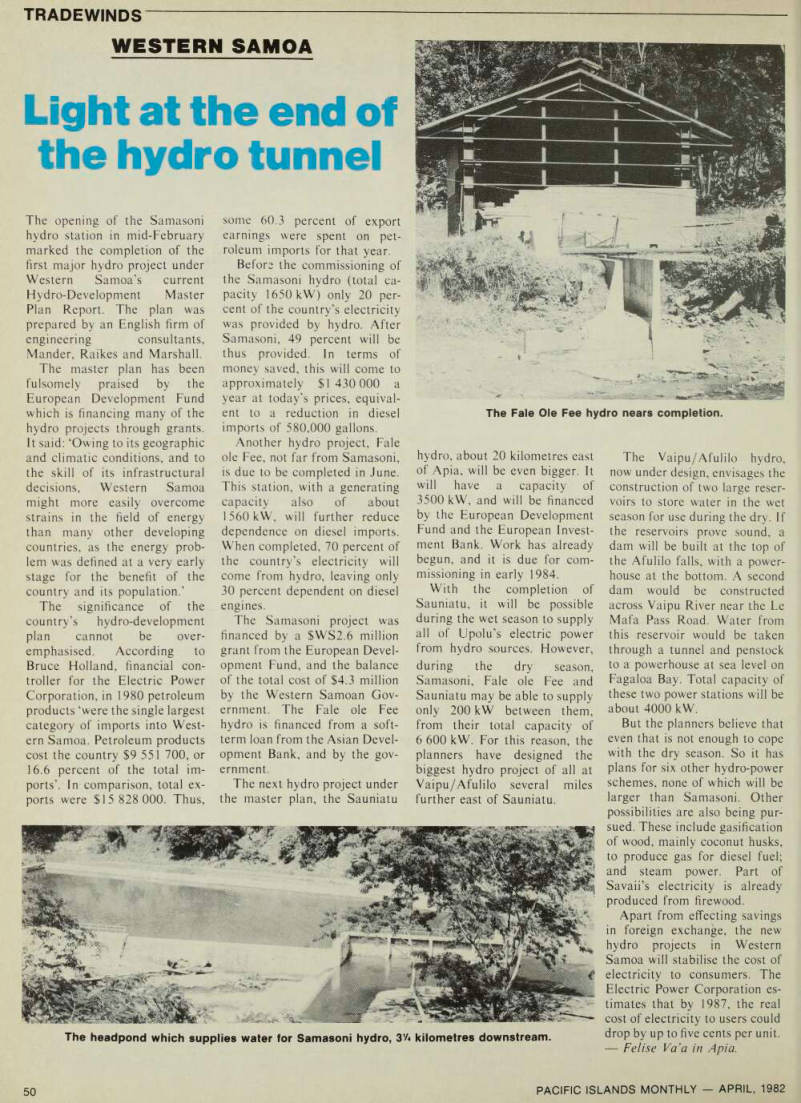
Another hydro project, Fale ole Fee, not far from Samasoni, is due to be completed in June.
This station, with a generating capacity also of about 1560 kW, will further reduce dependence on diesel imports.
When completed, 70 percent of the country’s electricity will come from hydro, leaving only 30 percent dependent on diesel engines.
The Samasoni project was financed by a SWS2.6 million grant from the European Devel opment Fund, and the balance of the total cost of $4.3 million by the Western Samoan Gov ernment. The Fale ole Fee hydro is financed from a soft term loan from the Asian Devel opment Bank, and by the gov ernment.
The next hydro project under the master plan, the Sauniatu
hydro, about 20 kilometres east of Apia, will be even bigger. It will have a capacity of 3500 kW, and will be financed by the European Development Fund and the European Investrnent Bank. Work has already begun, and it is due for commissioning in early 1984.
With the completion of Sauniatu, it will be possible during the wet season to supply aP of Upolu’s electric power from hydro sources. However, during the dry season, Samasoni, Fale ole Fee and Sauniatu may be able to supply only 200 kW between them, from their total capacity of 6 600 kW. For this reason, the planners have designed the biggest hydro project of all at Vaipu/Afulilo several miles further east of Sauniatu.
The Vaipu/Afulilo hydro, now under design, envisages the construction of two large reser voirs to store water in the wet season for use during the dry. If the reservoirs prove sound, a dam will be built at the top of the Afulilo falls, with a power house at the bottom. A second dam would be constructed across Vaipu River near the Le Mafa Pass Road. Water from this reservoir would be taken through a tunnel and penstock to a powerhouse at sea level on Fagaloa Bay. Total capacity of these two power stations will be about 4000 kW.
But the planners believe that even that is not enough to cope with the dry season. So it has plans for six other hydro-power schemes, none of which will be larger than Samasoni. Other possibilities are also being pur sued. These include gasification of wood, mainly coconut husks, to produce gas for diesel fuel; and steam power. Part of Savaii’s electricity is already produced from firewood.
Apart from effecting savings in foreign exchange, the new hydro projects in Western Samoa will stabilise the cost of electricity to consumers. The Electric Power Corporation es timates that by 1987, the real cost of electricity to users could drop by up to five cents per unit.
Felise Va’a in Apia.
The headpond which supplies water for Samasoni hydro, 3¼ kilometres downstream.
The Fale Ole Fee hydro nears completion.