in the SPARTECA
p. 49 · Read in the full issue
Thrust and parry in the SPARTECA debate
For Australia and New Zea land, one of the most important issues raised at the February conference on Australia and the South Pacific was trade. The discussion of it, in particular of SPARTECA, the South Pacific Regional Trade and Economic Co-operation Agreement, clearly reflected the polarised views evident at the conference.
Accusations of Australian neo colonialism and self-interest were frequently heard.
SPARTECA is an agreement between Australia, New Zea land and the countries of the South Pacific Forum (although not all signed it immediately) which came into operation on January 1, 1981. That agree ment, which eased Australian and New Zealand import re strictions on Pacific goods, was an attempt to alter the massive trade imbalance which exists between them and the countries of the South Pacific. For in stance, in 1980-81 Fiji took $A 169.6 million worth of Aus tralian imports. In the same period Australia imported goods valued at $16.2 million from Fiji.
Politicians on both sides of the Tasman have hailed the agreement as a breakthrough.
Opening the February confer ence, the Australian Minister for Foreign Affairs, Tony Street, called it a positive step towards helping the island countries overcome the trade imbalance.
In his assessment of it, lan Taylor from Australia’s depart ment of trade and resources, said the 12 months it had been in effect was not long enough for major changes in trade patterns to have emerged. But there have been export successes for instance, plywood and ap parel from Fiji, and coconut cream from Western Samoa. ‘Clearly the scope for future success is there. Exploitation of the preferences offered lies in the hands of Australian and Pacific businessmen,’ he said.
But the scope is clearly not there, according to the assess ment of Dr William Sutherland of the University of the South Pacific. His criticisms reflected those, often muffled but increas ingly audible, from regional leaders such as Fiji’s Prime Minister Ratu Sir Kamisese Mara.
Sutherland said: ‘Ratu Mara’s statement reflects a fairly widespread concern in the region that SPARTECA might turn out to be simply another brand of neo-colonialism, just another device which, good intentions notwithstanding, con tinues to tie the islands of the region in a subordinate way to their metropolitan neighbours Attempts to improve Australia-South Pacific re lations through SPARTECA will be doomed to failure unless the Australian Government ac tively takes steps to put teeth into the agreement and this involves, among other things, confronting Australian dom estic interests with what SPAR TECA must achieve.’
The agreement could not be allowed to degenerate into window-dressing, he said, anu called for the Australian Gov ernment to revise its major counter-productive provisions.
The agreement requires that for manufactured goods to have free access they must have at least 50 percent content derived from a Forum country or countries, including Australia.
This restriction is far too strin gent a qualification for Island products, given that the level of industrialisation is low,’ he said.
It should be reduced to a level the Forum island countries can meet themselves, with Austra lia, its companies ‘now better placed than ever to entrench their position of dominance even further’, excluded from the list of countries of origin.
New Zealand and Australia have different systems covering free access of goods. New Zealand has a negative list of
goods which cannot enter freely. Australia has two posi tive lists goods with unre stricted duty-free access, and those subject to duty and limits on quantity. Those lists, which run to 26 pages, may look impressive. But, asked Sutherland, how useful to the Island states is access for cider, rubber rainwear, soya sauce or porcelain, to give just a few examples. Import restrictions should be dropped for com modities that the Islands are willing and able to produce, he said.
The criticisms of SPAR TECA raised by William Sutherland and the Australian Government defence of it are typical of much of the confer ence the thrust, mostly from those from the Island nations, often guarded, usually polite;
the official parry.
Sue Green.
• A three-man delegation from the New Zealand Manufac turers Association has been in Fiji on a trade-fostering survey under SP ARTEC A arrange ments. Association’s assistant director Wayne Coffey says he expects much good to come from the visit.
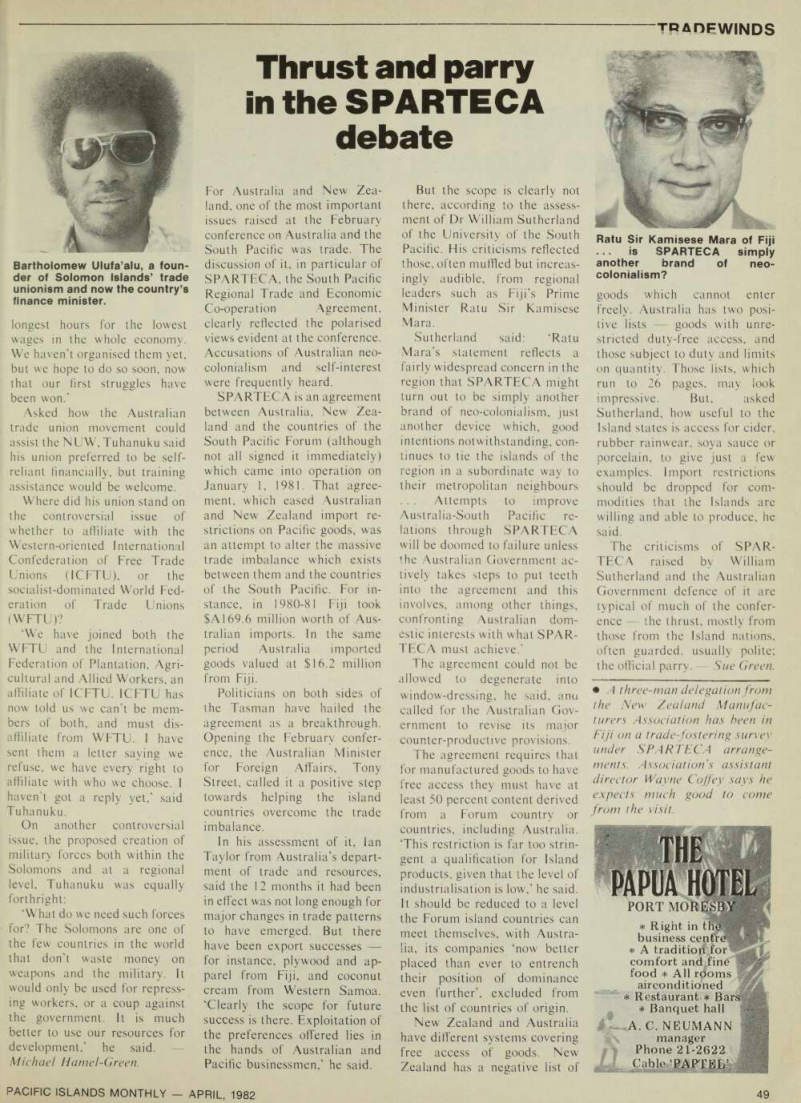
Ratu Sir Kamisese Mara of Fiji
... is SPARTECA simply
another brand of neo colonialism?