Solomons
pp. 47-49 · Read in the full issue
Workshop hears of unionism in Solomons
Trade union issues did not rate highly on the agenda of the February conference in Can berra on Australia and the South Pacific. Only one Pacific trade unionist was invited, and no lime made available for him to address the conference as a whole.
This was surprising in the light of recent initiatives towards regional trade union co operation culminating in May last year a conference in Vanuatu which established the Pacific Trade Union Forum.
The Pacific unionist invited was Joses Tuhanuku, the force ful young secretary-general of the Solomon Islands’ National Union of Workers. In a well attended workshop that in cluded Australian trade union ists, academics, aid organis
ation workers, and public ser vants, Tuhanuku led a lively discussion on the role of trade unions in Pacific countries, drawing on his own union’s experience. ‘ln our traditional village fife, we didn’t need trade unions,’
Tuhanuku told the workshop. ‘No one was over us, we worked only to meet our own needs.
Now, with foreign-based com panies in the timber, copra and fishing industries, we are work ing for employers. People from different villages and islands find themselves together. The union overcomes the local rival ries and wins belter conditions for all.' Founded in 1975, Tuhan uku’s National Union of Workers was organised as a single union that would cover all
kinds of workers. ‘We only have 16 000 workers in the whole Solomons, and over 10 000 are members of our union. Unions based on single industries would have been 100 small to be effec tive,' he said.
How successful was the NUW? Did the government and employers accept it?
The finance minister in the present government was one of the union’s founders,’ Tuhan uku replied. ‘We formed the National Democratic Parly to represent our interests politi cally, and now we feel we have a voice in the government.’ ‘The employers, well, they still don’t accept us, but they have to negotiate with us, we have forced that on them.’
A large proportion of the workshop participants were women, and Tuhanuku was pressed as to what his union was doing for women workers. ‘We do have many women members, but they do not like to gel involved in organising. We are trying to encourage them,' Tuhanuku said, ‘Many women are domestics, working the
longest hours for the lowest wages in the whole economy.
We haven’t organised them yet, but we hope to do so soon, now that our first struggles have been won.' Asked how the Australian trade union movement could assist the NUW, Tuhanuku said his union preferred to be self reliant financially, but training assistance would be welcome.
Where did his union stand on the controversial issue of whether to affiliate with the Western-oriented International Confederation of Free Trade Unions (ICFTU), or the socialist-dominated World Fed eration of Trade Unions
(Wftu)?
‘We have joined both the WFTU and the International Federation of Plantation, Agri cultural and Allied Workers, an affiliate of ICFTU. ICFTU has now told us we can’t be mem bers of both, and must dis affiliate from WFTU. I have sent them a letter saying we refuse, we have every right to affiliate with who we choose. 1 haven't got a reply yet,’ said Tuhanuku.
On another controversial issue, the proposed creation of military forces both within the Solomons and at a regional level, Tuhanuku was equally forthright: ‘What do we need such forces for? The Solomons are one of the few countries in the world that don’t waste money on weapons and the military. It would only be used for repress ing workers, or a coup against the government. It is much better to use our resources for development,’ he said.
Michael Hamel-Green.
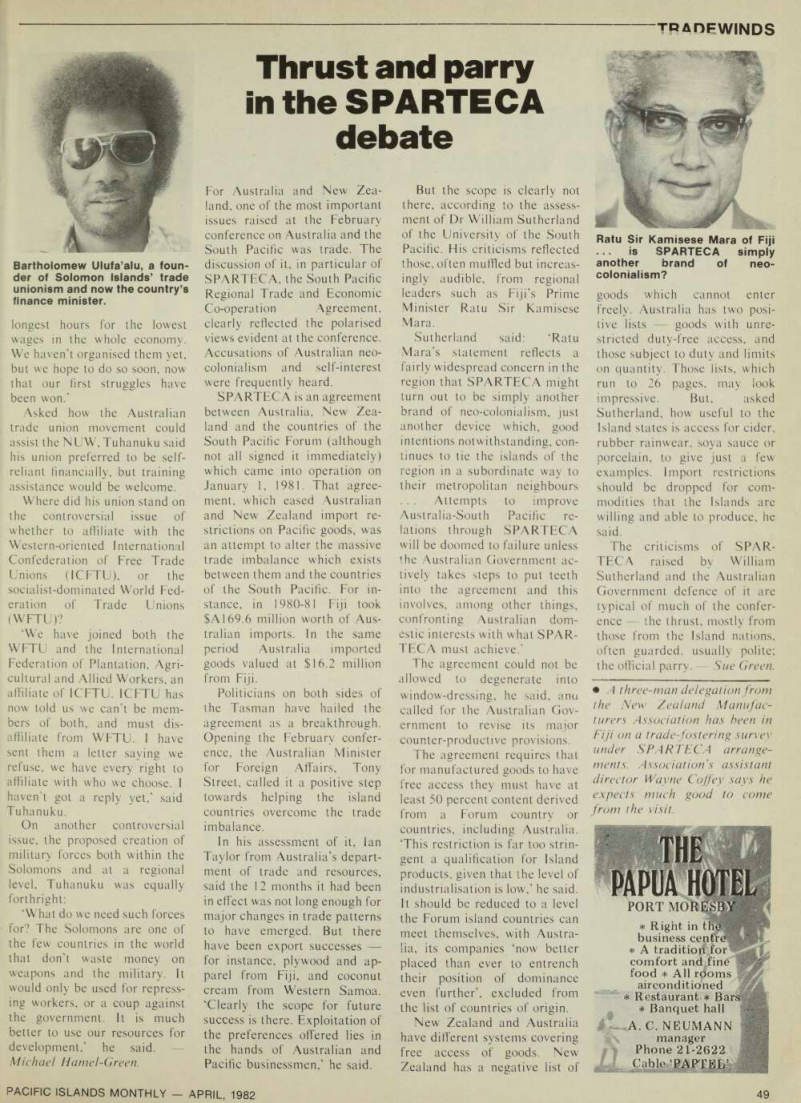
Bartholomew Ulufa’alu, a foun der of Solomon Islands’ trade unionism and now the country’s finance minister.