BP and the Pacific: What it does,
pp. 43-47 · Read in the full issue

Trade
Winds
BP and the Pacific: What it does, and what it is planning to do
P.C. BEST, chief executive officer of Burns, Philp & Co Ltd, gave a major paper at the Australia and the South Pacific conference at the Australian National University on February 18-19. The text appears below. Supporters and critics of his paper alike agreed that Mr Best responded with the maximum effect to the sometimes sharp questioning which followed delivery of his paper.
At the outset I would like to applaud the initiative of the Centre for Continuing Edu cation of the Australian National University, together with the Foundation for the Peoples of the South Pacific (Australia), in organising this conference. The aim of bringing together a cross-section of people from government, univ ersities, aid groups and the business sector is an admirable one, especially since 1 believe that there are serious gaps in mutual understanding of the aims and aspirations of each group and a great deal of scope for closer co-operation I shall return to this point later in this paper. 1 have been invited to speak on the subject ‘Australia’s Economic Relations with the Pacific - An Australian Busi ness Perspective’. Here I come to a slight difficulty in relation to my own company, Burns Philp. It is true that Burns, Philp & Company Limited, the parent company of the group, is an Australian public company, with an overwhelming pro portion of its shareholders being Australian residents, and with group headquarters in Sydney.
However, in relation to its South Pacific operations Burns Philp is much more of a Pacific based company than an Austra lian based company. Although its Pacific operations are co ordinated from Sydney by a Pacific Sector office, they do not have a great deal in common with Burns Philp’s Australian operations, either in types of activities engaged in, or in the way business is done. In both Papua New Guinea and Fiji there are substantial locally held shareholdings in the Burns Philp operating companies, and
there are local boards with directors who are local citizens in most countries.
To give an example of our unusual position, an Australia- PNG Business Co-operation Committee was formed re cently in Australia. We are members of this committee, of course, but are relatively much more prominent at the Port Moresby end, representing PNG business interests in re lation to Australia.
In short, therefore, in putting the point of view of Burns Philp, I am tending to put it from the perspective of South Pacific based business with strong Aus tralian connections, rather than from a chiefly Australian busi ness with some interests in the South Pacific. I hope my Aus tralian business colleagues at tending this conference will bear with me in this.
While on the subject of Burns Philp, and before I go on to offer some suggestions about what might be done about Australia’s economic relations with the Pacific, I would like to summar ise very briefly the scope of the
activities Burns Philp is en gaged in. With an investment in the Pacific Islands worth nearly $2OO million and total turnover of over $250 million. Burns
Philp’s operating activities com
prise:
Merchandise: • Retail Department Stores/ Supermarkets • Wholesale operations based on bulk sea-fed distribution warehouses • Agency operations with links to Burns Philp’s worldwide international trading operations.
Automotive Distribution: • Passenger and commercial vehicles • Heavy Industrial and agricultural equipment • Spare parts. • Service.
Shipping and Transport: • Coastal shipping operations • Ships agencies • Stevedoring • Customs and Forwarding • Transportation • Retail Travel Agents.
Industrial: Processing/Manufacture of a wide range of activities in various locations, including: • Cordial manufacture and bottling • Packaging (flexible) • Low-cost modular housing • Coconut oil production • Soap manufacture • Biscuit manufacture • Timber treatment and processing
• furniture manufacture • Steel fabrication • Glass and mirror processing.
Plantations: • Cocoa and copra • Some cattle.
Previous speakers will have talked about the current econ omic situation in the South Pacific. I can only say that from a business point of view the short to medium-term future is depressing. We have a series of small countries with rapidly expanding populations and commodity-oriented economies, extremely vulnerable to the vagaries of world commodity price fluctuations over which they have no control. In bad times, as at present, there is a chronic shortage of export in come and hence a reliance on aid which I am sure would be considered at least as undesir able by the recipients as it is by the donors.
Efforts have been made in the last decade by Pacific Islands Governments (with some co operation from the Australian Government) to improve the balance of payments by such measures as: Tourism promotion: This at first proved highly successful in balance of payments terms, but since 1974 has suffered from the escalation of fares resulting from oil price increases and from lack of local profitability. It also has the drawback of being, like commodity prices, highly volatile as a source of income and needs international pro
Mr Best
Co-founder, the late James Burns
motion to be successful, and, therefore, expatriate participation.
Import substitutions: Local industries have been set up, especially in Fiji, behind a variety of protective tariffs.
Unfortunately local demand has often been so small that the industry concerned is chronically uneconomic, and the foreign exchange gains through buying imported raw materials rather than imported products are offset by the higher prices paid for such small quantities.
Local ownership: The story of Air Pacific and to some extent the Pacific Forum Line reflect the desire to channel ‘invisible’ earnings back to Islands econ omies. No one can question the worthi ness of the aspirations underlying such ventures. Yet they have not so far been able to demonstrate, along with their counterparts, much commercial success.
Access to the Australian market: There have been arrangements for some years for easing access to Australia of Pacific products (notably under PATCRA for PNG products), and the recent SPARTECA agreement was an imaginative step forward at government level. At commercial level, problems are still being encountered in taking advan tage of the concessions. To take one example timber products: while there is plenty of Pacific Islands timber suitable for use in Australia, there are problems of quality control, size of orders and shipping costs to be overcome. We in Burns Philp know this because we are trying very hard to market Fiji and PNG timber through our Australian timber distribution outlets. However, such prob lems exist to be solved and we are confident of being able to do so. 1 believe that the only long term panacea for the problems of the South Pacific is the old fashioned remedy of economic growth and development, how ever funded. Only growth can enable these economies to rise above the vicious circle of poverty, fluctuating commodity prices and undue dependence on aid. Without such growth there will be no future for Australian or Pacific Island based companies.
How is the growth to come about? 1 believe that real growth can only come about through the entrepreneurial en ergy of companies exposed to the disciplines of marketplace.
Without such discipline, growth will be a highly artificial plant, feeding on the fertiliser of aid but liable to wither when aid is withdrawn.
There are legitimate fears about the side-effects of too rapid growth in developing countries the possible erosion of traditional values, the creation of rich elite separated from the mass of the people, the drift to the main towns from the villages, with attendant unem ployment and lawlessness, the
squandering of limited wealth on unnecessary Western con sumer goods and some limits are, of course, desirable. On the other hand, it can be argued that to some extent these trends are inevitable, and we should prepare ourselves to face them squarely and overcome them rather than merely deplore them.
What is often not appreciated as readily as it should be is that creation of economic growth is extremely hard work, and that privately funded entrepreneurs, whether local or foreign, even if they display a few warts, need as much encouragement and as little hindrance in the form of controls as possible (other than normal safeguards against anti social and criminal activity).
The great consolation is that if they fail, it is their own money which they are losing, rather than the taxpayer’s.
I list here several directions which we in Burns Philp believe to be desirable in promoting economic growth in the South Pacific, and what we as a company are trying to do about it.
Development of Secondary Industry: Despite most manu facturing operations in the Pacific being fundamentally uneconomic on account of their restricted volume and remote location, local industry is still desirable in selected fields. We find that the greatest problem is to recruit and hold the highly paid technical skills (usually expatriate) needed to run such small operations. We seek to overcome this problem by es tablishing industrial divisions
managing groups of activities so that while individual activities may be too small to be econ omic, the group will be viable, and a higher level of manage ment and technical skills is available; also to select a prod uct range which uses local materials, has export potential and/or scope for setting up ancillary units elsewhere in the Pacific, and does not depend too heavily on specialist long term expatriate staff.
Rationalisation of Manufac turing Operations: The prob lems relating to the uneconomic nature of many manufacturing/ import substitution operations in the Pacific could be allevi ated by a greater rationalisation of basically uneconomic manu facturing activities to produce economies of scale. For example, if two countries have a demand for both biscuits and soap, is it not better that one sets up a biscuit factory and the other a soap factory, and each allows duty free access to the product of the other? This concept has echoes of the complementation policy of the Association of Southeast Asian Nations (ASEAN), and fore shadows the eventual formation of a Pacific economic com munity. I believe that the South Pacific Bureau of Economic Co operation (SPEC), lacks teeth in this direction.
Agricultural and Natural Resource Development: Devel opment of secondary industry may be desirable, but the real scope for genuine economic advancement must lie in agri cultural and natural resource development. Flere the land
tenure issue is an enormous problem to be overcome. From an expatriate business view point there is also the difficulty of setting up a project in remote rural areas which is unlikely to have a positive cash flow for several years. Control by mod ern management techniques is difficult and expensive. Such projects are more easily em barked upon when they are “add ons” to existing well controlled operations based in more sophisticated locations.
Access for Pacific produced Primary and Secondary Indus try Products to Australia: This issue was covered earlier. It is strongly supported by Burns Philp.
Intra-Regional Trade: Intra regional trade in manufactured goods can be complemented by a rationalisation of primary products trade. For instance, it seems a pity that PNG had to develop a sugar industry when sugar is so plentifully available in Fiji. Could not PNG have found another commodity or product which was needed domestically and could also be exported to Fiji in exchange?
I ntra-Regional Shipping: The major current barrier to greater intra-regional trade is the absence of a regular and frequent shipping service be tween Island countries. The Pacific Forum Line routes are chiefly between New Zealand/ Australia and the Islands.
Burns Philp has a concept of a shipping line running exclus ively within the Pacific and linking only Pacific countries on a more or less east-west axis from say Pago Pago to Lae it would not extend to Australia/ New Zealand/USA. The major shipping lines would bring freight to one or two venues only in the Pacific (which should suit them) and the pro posed line would in effect act as an intra-Pacific freight service it should complement rather than compete with the Pacific Forum Line. Much time and energy has been spent by my company in preparing a feasi bility study. 1 believe it can certainly be made to work but, of course, it will need the active co-operation of several shipping companies and of governments
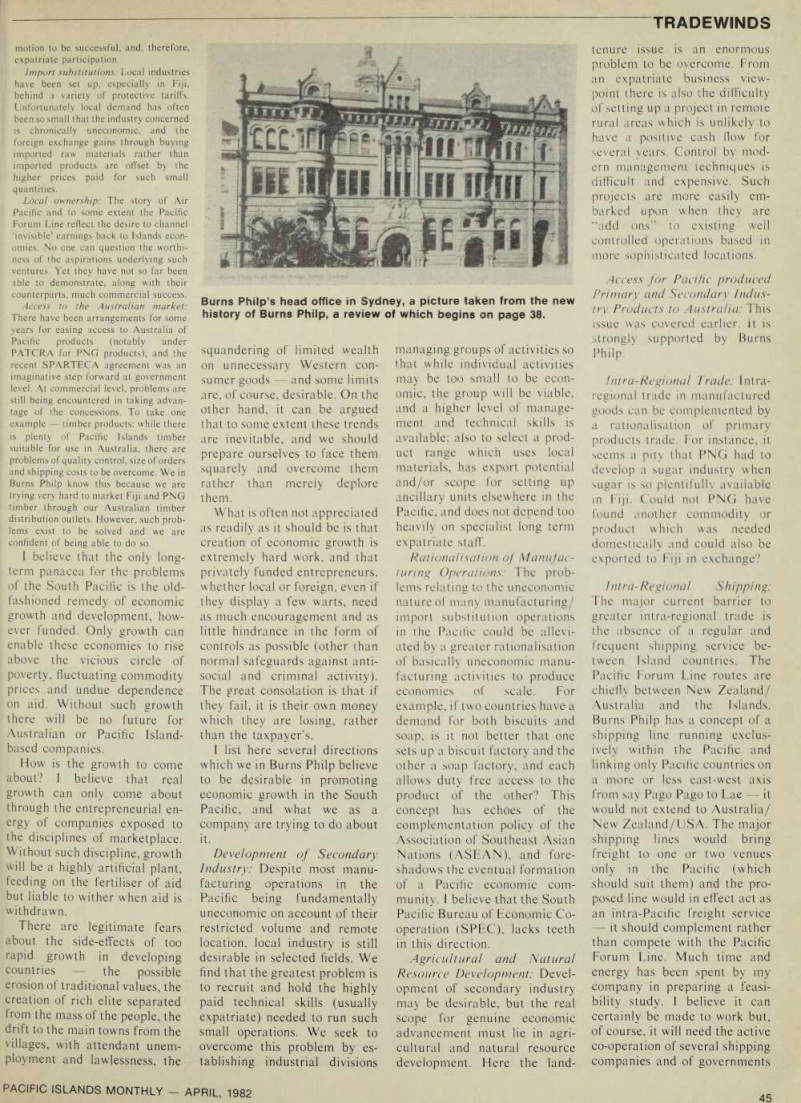
Burns Philp’s head office in Sydney, a picture taken from the new history of Burns Philp, a review of which begins on page 38.
to become effective.
Tourism Development: Al though tourist dollars are very welcome and Burns Philp is playing its part in promoting Australian tourism in several Pacific countries, it is not easy to see a very great growth or expansion in the next few years.
Accelerated Training in Management and Artisan Skills: I recognised earlier that economic growth in developing countiies had its dangers, but concluded that since change was eventually inevitable, it was best to face it squarely and prepare for it. Nowhere is this more necessary than in edu cation and in training of local citizens. Burns Philp is playing a leading role in this: for example, expenditure at the rate of well over $1 million per year is being incurred in PNG.
There is a great deal of wastage and we don’t expect to get a real return for 10 years, but there’s self-interest, albeit enlightened, in our approach, since an ex patriate costs us more than twice as much to employ as a local citizen.
Local Equity Participation: If entrepreneurial and manage ment skills are to be developed, they must have access to invest ment funds. Some kind of local share market to tap local pri vate savings must be encour aged. We in Burns Philp have tried to encourage this trend, but have not yet made much progress, most local sharehold ings being still in the hands of
development banks/investment
corporations. For high technology manufacturing ven tures we have looked to a three way partnership between Burns Philp, local shareholders, and the supplier of the technology.
Greater Co-operation be tween Governments and Private Business: While government business relations in the Pacific are much better than in some parts of the world, 1 believe that in such relatively small com munities there are further op portunities for responsible part nership to promote economic growth. Business must accept that elected governments are accountable lo the electorate and must occasionalK take ac
tion which appears inimical to business. What business seeks from government is stability, reliability and plenty of ad vance consultation and warning of expected changes, so that impact of adverse measures can be mitigated.
Better Communication be tween Business and the Aca demic World: While universites (both in Australia and in the Pacific) and the business sector clearly have different roles to play in stimulating economic growth, it sometimes appears that they approach the same problems in total isolation from each other, perhaps for fear of becoming mutually contami nated! I believe that the universities have a great deal to offer lo business, in having available trained talent in re search expertise which businesses often chronically lack. At the same lime univer sity research studies might sometimes be a lot more rel evant and useful if they covered subjects which had been comissioned and lo some extent paid for by a business. 1 ap
preciale the need lo maintain the ideal of academic detach ment in the search for truth, but it is surely important also that if their conclusions are accepted studies should, where possible, lead lo action and it is usually only private business entrepreneurs who are prepared to take such action.
Finally, let me say a word in defence of the much maligned multinational company as an agent of economic growth and improvement in economic re lations between countries in the South Pacific. The dominating exploitative role of which MNCs are sometimes accused is much exaggerated. In this regard I would draw your atten tion to a recently issued paper from the University of the South Pacific on the ‘lmpact of Foreign Direct Private Invest ment on the Fiji Economy’ by R.T. Carslairs and R. Deo Prasad.
It would be foolish to say that MNCs (including Australian MNCs) operating in the Pacific have always been totally en lightened. but it should also be
remembered that they can learn and adapt from their mistakes like everyone else, and are doing so. Above all, they are subject to the disciplines of manage ment in the international mar ketplace. Through MNCs, an increasing number of South Pacific people arc being trained to manage operations which truly have to compete on an international basis. This is surely superior to managing a scries of ‘sheltered workshops’ which may have to increasingly rely on aid for survival.
In Burns Philp, with a pres ence in most Pacific countries, we feel we arc uniquely well placed to help along lhe*course of economic co-operation in the South Pacific (and it is in our interest to do so). Through our buying offices around the world we can help to secure belter terms for individual countries’ purchases.
I think we all agree that a prosperous, largely self supporting South Pacific is in Australia’s interest just as much as that of the peoples of the Pacific themselves.