Yachts
pp. 55-61 · Read in the full issue

Marcia Davock
reports from Solomon
Islands:
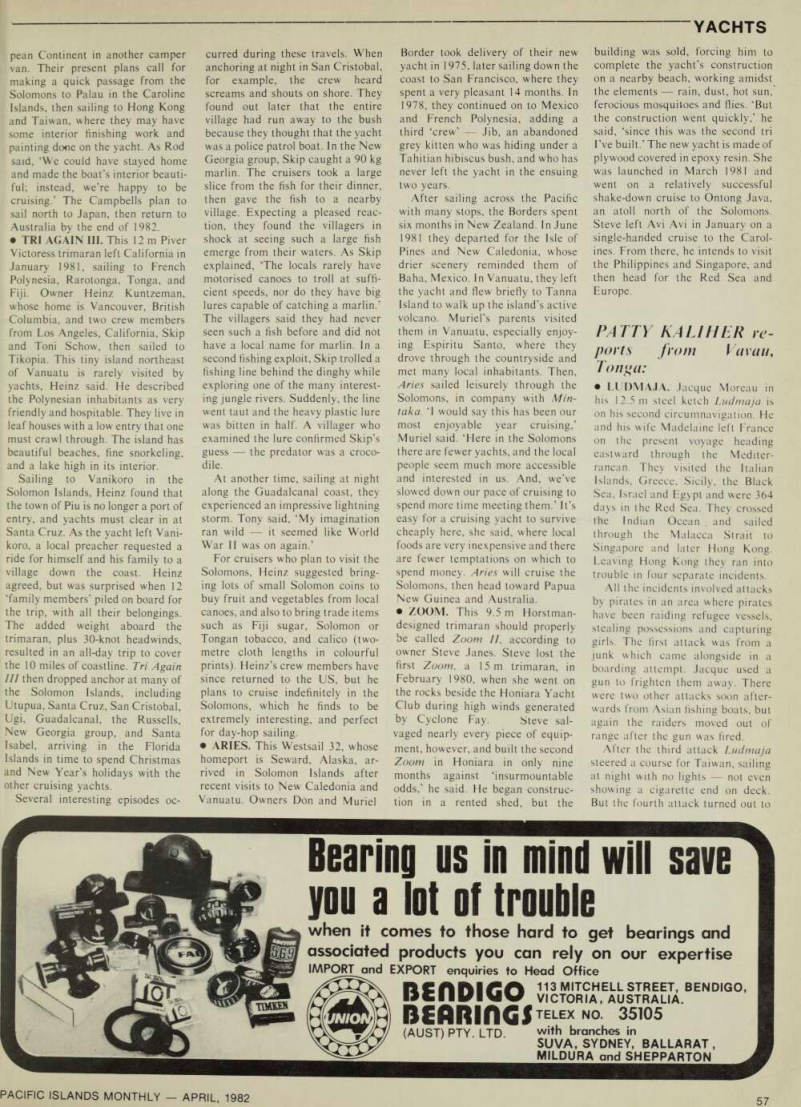
• Gloria Maris. Delmer
(Stoney) and Joyce Stone have been moored at Avi Avi aboard their Chinese junk for the last two years.
The yacht is tucked into a corner near the Avi Avi Marina, a small shipyard and the bay’s only com mercial enterprise, owned by Moses Razak. When Joyce and Stoney arrived, few yachts had ever visited this protected anchorage and the marina business had only just com menced. The marina provides haul out facilities and a well-equipped machine shop. Stoney felt the bay would be an excellent place to work on the boat, to go diving and snorkeling, and to get to know the local people. ‘And ever since,’
Stoney said, ‘we’ve been happy with the choice.’
From this location, Joyce con ducts her ‘gunkholers’ net’ on the 20-metre amateur radio band for maritime mobiles and land-based stations. The net meets daily at 1000 GMT on 14.327 megahertz.
Joyce’s call sign is H44KR and Stoney’s is H44GM.
The Stones ordered their Chinese junk from Hong Kong, and picked it up in 1971. With a crew of seven, they sailed it back to their homeport, Guam, where they had lived for many years. In 1974 Stoney retired from his position as a supervisory fire-fighter for the US Navy. Soon afterwards Joyce left her position as a Navy librarian, and they began cruising in 1977. They sailed first to Palau, on the ‘slow boat to China’ or ‘3O tons of junk’, as they affectionately call their 15 m motorsailer, with its 2.5 m draft and 4.5 m beam. The boat has three masts, is junk-rigged, and is equipped with such comforts as an aft cockpit capable of seating a party of 20, a washer-dryer, a freezer, a microwave oven, and a photographic darkroom.
The Stones stayed 20 months in Palau, taking friends scuba diving to see the island’s rich marine life, and collecting shells, old bottles, glass, and wartime relics. ‘We investigated old caves with earthen ware pottery shards from early Palau inhabitants, we explored sunken ships and trekked through the jungle looking for old guns and communication station remains,’
Stoney said. They donated their
collection of artifacts to the Palau Museum. Joyce wrote an article on antique glass and the techniques of glass-making for the museum’s handbook.
They sailed to Papua New Guinea, where Stoney had been based in World War 11. In Madang, they enjoyed a seven-month stay, travelling along the PNG coast by motorcycle. They also set up a shell dredging apparatus on their dinghy to better examine and photograph the liny seashells that interest them.
Then they cruised New Britain and Bougainville Islands, and the West ern Solomons, arriving in Avi Avi in the Florida Island group two years ago.
• Koo-Ee-Lung. This 11.3 M
multi-chine steel cutter left its homeport of Metung, Victoria, Canada, in August 1979, with Allen Creighton and Dorothy Rogers aboard. They cruised the Australian east coast, then departed for New Zealand on Christmas Day 1979.
During the Tasman crossing, they experienced continuous headwinds, plus Cyclone Paul’s winds of 70 to 80 knots. Another cruising yacht with four people aboard was lost during this storm, Allen said. Koo ee-Lung took 21 days for the passage, tacking nearly 1850 miles to cover the rhumb line distance of about 1150 miles.
Allen and Dorothy spent the next 16 months in New Zealand, alter nating cruising with touring in an old van. They described NZ as a tourist paradise, the scenery magnificent and the people hospit able. In April last year they cruised to Fiji, experiencing frustrating calms, then another storm with estimated 80-knot winds. They spent four months cruising Fiji island groups, including an unusual trip through the southeastern river valleys of Viti Levu. ‘The river cruising was one of our highlights,’
Dorothy said, ‘although it’s not recommended to yachts drawing more than five feet.’ Later, they participated with 10 other yachts in the Coconut Cup Fun Race, a cruisers’ race from Malololailai, Fiji, to Port-Vila, Vanuatu, spon sored by the Fiji Musket Cove Yacht Club. There were prizes for each yacht in this relaxed race, which promises to become a popular annual event, Allen said.
After cosmopolitan Vila, Koo-ee- Lung visited the outer islands of Vanuatu, then cruised in company with Shearwater to islands in the Solomons. In Utupua, they had the opportunity, with Shearwater’s help, to successfully pull two cruis ing yachts off an interior reef on which they had run aground simul taneously while motoring directly into the sunlight. Thereafter, Koo ee-Lung and Shearwater called at several out-of-the-way Solomon
Islands, and participated in local sing-sings, bazaars, and dances. As Allen said, ‘The more remote the island, the more fascinating our experiences were.’ Future plans call for returning to Malaita, visiting islands in the Solomons Western Province, then continuing to Papua New Guinea, where Allen was stationed during World War 11.
Eventually they will cruise leisurely back down the Australian east coast, arriving home to the Gipps land Lakes district ‘in a few years’. • CHUKLVN. This Brandlmyer 12.5 m ketch, constructed of ply wood sheathed in fibreglass, was built by owners Carl and Lynne Turnau in Vancouver, British Col umbia. The Turnaus’ first cruise in 1975-1977, took them down the American coast to Mexico, then to Costa Rica, French Polynesia, Hawaii, and back to Vancouver.
Departing on her second voyage in August 1979, Chuklyn returned to Polynesia and proceeded west wards, stopping at major island groups enroute to New Zealand. In NZ the yacht was caught in Keri keri flooding, along with Bokonon and Mintaka (PIM Jul ’Bl p 67).
Departing NZ in May 1981, the Turnaus hove to two days later in a storm with gusts to 70 knots and high seas. They arrived safely in New Caledonia, then cruised Vanu atu and portions of Solomon Islands. A highlight of their recent cruising included an idyllic anchor age on Hiu Island (Banks Islands, Vanuatu), where they were the first yacht to arrive since 1975. But their most unusual experience was visit ing the agricultural fair at Norsup Bay (Malakula, Vanuatu), when members of the Big and Small Namba tribes came down from the bush country to display their pigs, cows, giant yams and taro, and to discuss farming methods and par ticularly limber conservation tech
niques. The Nambas arrived wear ing their traditional dress penis wrappers, elaborate headdresses, and exotic paint and body adorn ments prepared for the dancing and string band contests that fol lowed the fair. In addition to the usual ukeleles and guitars, one of the most interesting band instru ments was a ‘washtub bass’ made from a sturdy cardboard box rimmed in metal strips, with a long string to pluck. As Lynne said, ‘We were only a handful of yachties among a couple hundred very colorfully dressed bush-dwellers, who performed their traditional songs and dances. It was an exotic experience we'll never forget.’ The Turnaus plan more cruising in the Solomons and Papua New Guinea, and then a visit to Australia. • MASSEQUI. Rod and Chris Campbell, whose homeport is Port Stephens, New South Wales, left Australia in November 1981, bound for Japan. The Campbells sold their home insulation business, which had expanded to the point where they found themselves commuting between Newcastle and Sydney, and often working 16-hour days.
They bought their Adams 14 m multi-chine steel cutter in October 1980 after previously owning two smaller yachts. The first was a 7.5 m sloop, on which they spent their first cruise to Queensland in 1974, ‘ex periencing terrible blows, a knock down, and lots of lime hove-to,’ Rod said. The second boat was a 10 m fibreglass sloop which they fitted out and later sold in NSW.
The Campbells, who are in their early 30s, are confirmed travellers.
They have backpacked most of Indonesia, Southeast Asia, and Japan; they spent several months touring the US in a camper van (‘the beautiful national parks were the totally unexpected highlight of all our travels,' Chris said); then they toured London and the Euro
Showing her colours, Gloria Maris lies at anchor. - Roderica Laymon picture.
pean Continent in another camper van. Their present plans call for making a quick passage from the Solomons to Palau in the Caroline Islands, then sailing to Hong Kong and Taiwan, where they may have some interior finishing work and painting done on the yacht. As Rod said, ‘We could have stayed home and made the boat’s interior beauti ful; instead, we’re happy to be cruising.’ The Campbells plan to sail north to Japan, then return to Australia by the end of 1982. • TRI AGAIN 111. This 12 m Piver Victoress trimaran left California in January 1981, sailing to French Polynesia, Rarotonga, Tonga, and Fiji. Owner Heinz Kuntzeman, whose home is Vancouver, British Columbia, and two crew members from Los Angeles, California, Skip and Toni Schow, then sailed to Tikopia. This tiny island northeast of Vanuatu is rarely visited by yachts, Heinz said. He described the Polynesian inhabitants as very friendly and hospitable. They live in leaf houses with a low entry that one must crawl through. The island has beautiful beaches, fine snorkeling, and a lake high in its interior.
Sailing to Vanikoro in the Solomon Islands, Heinz found that the town of Piu is no longer a port of entry, and yachts must clear in at Santa Cruz. As the yacht left Vani koro, a local preacher requested a ride for himself and his family to a village down the coast. Heinz agreed, but was surprised when 12 ‘family members’ piled on board for the trip, with all their belongings.
The added weight aboard the trimaran, plus 30-knot headwinds, resulted in an all-day trip to cover the 10 miles of coastline. Tri Again 111 then dropped anchor at many of the Solomon Islands, including Utupua, Santa Cruz, San Cristobal, Ugi, Guadalcanal, the Russells, New Georgia group, and Santa Isabel, arriving in the Florida Islands in time to spend Christmas and New Year’s holidays with the other cruising yachts.
Several interesting episodes oc
curred during these travels. When anchoring at night in San Cristobal, for example, the crew heard screams and shouts on shore. They found out later that the entire village had run away to the bush because they thought that the yacht was a police patrol boat. In the New Georgia group. Skip caught a 90 kg marlin. The cruisers took a large slice from the fish for their dinner, then gave the fish to a nearby village. Expecting a pleased reac tion, they found the villagers in shock at seeing such a large fish emerge from their waters. As Skip explained, ‘The locals rarely have motorised canoes to troll at suffi cient speeds, nor do they have big lures capable of catching a marlin.’
The villagers said they had never seen such a fish before and did not have a local name for marlin. In a second fishing exploit. Skip trolled a fishing line behind the dinghy while exploring one of the many interest ing jungle rivers. Suddenly, the line went taut and the heavy plastic lure was bitten in half. A villager who examined the lure confirmed Skip’s guess the predator was a croco dile.
At another time, sailing at night along the Guadalcanal coast, they experienced an impressive lightning storm. Tony said, ‘My imagination ran wild it seemed like World War II was on again.’
For cruisers who plan to visit the Solomons, Heinz suggested bring ing lots of small Solomon coins to buy fruit and vegetables from local canoes, and also to bring trade items such as Fiji sugar, Solomon or Tongan tobacco, and calico (two metre cloth lengths in colourful prints). Heinz’s crew members have since returned to the US, but he plans to cruise indefinitely in the Solomons, which he finds to be extremely interesting, and perfect for day-hop sailing. • ARIES. This Westsail 32, whose homeport is Seward, Alaska, ar rived in Solomon Islands after recent visits to New Caledonia and Vanuatu. Owners Don and Muriel
Border took delivery of their new yacht in 1975, later sailing down the coast to San Francisco, where they spent a very pleasant 14 months. In 1978, they continued on to Mexico and French Polynesia, adding a third ‘crew’ Jib, an abandoned grey kitten who was hiding under a Tahitian hibiscus bush, and who has never left the yacht in the ensuing two years.
After sailing across the Pacific with many stops, the Borders spent six months in New Zealand. In June 1981 they departed for the Isle of Pines and New Caledonia, whose drier scenery reminded them of Baha, Mexico. In Vanuatu, they left the yacht and flew briefly to Tanna Island to walk up the island’s active volcano. Muriel’s parents visited them in Vanuatu, especially enjoy ing Espiritu Santo, where they drove through the countryside and met many local inhabitants. Then, Aries sailed leisurely through the Solomons, in company with Min taka. ‘I would say this has been our most enjoyable year cruising,’
Muriel said. 'Here in the Solomons there are fewer yachts, and the local people seem much more accessible and interested in us. And, we’ve slowed down our pace of cruising to spend more time meeting them.’ It’s easy for a cruising yacht to survive cheaply here, she said, where local foods are very inexpensive and there are fewer temptations on which to spend money. Aries will cruise the Solomons, then head toward Papua New Guinea and Australia. • ZOOM. This 9.5 m Horstman designed trimaran should properly be called Zoom 11. according to owner Steve Janes. Steve lost the first Zoom, a 15 m trimaran, in February 1980, when she went on the rocks beside the Honiara Yacht Club during high winds generated by Cyclone Fay. Steve sal vaged nearly every piece of equip ment, however, and built the second Zoom in Honiara in only nine months against ‘insurmountable odds,’ he said. He began construc tion in a rented shed, but the
building was sold, forcing him to complete the yacht’s construction on a nearby beach, working amidst the elements rain, dust, hot sun, ferocious mosquitoes and flies. 'But the construction went quickly,’ he said, 'since this was the second tri I’ve built.’ The new yacht is made of plywood covered in epoxy resin. She was launched in March 1981 and went on a relatively successful shake-down cruise to Ontong Java, an atoll north of the Solomons.
Steve left Avi Avi in January on a single-handed cruise to the Carol ines. From there, he intends to visit the Philippines and Singapore, and then head for the Red Sea and Europe.
Patty Kali Her Re
ports from V avail,
Tonga:
• Ll DMAJA. Jacque Moreau in his 12.5 m steel ketch Ludmaja is on his second circumnavigation. He and his wife Madelaine left France on the present voyage heading eastward through the Mediter ranean. They visited the Italian Islands, Greece, Sicily, the Black Sea, Israel and Egypt and were 364 days in the Red Sea. They crossed the Indian Ocean . and sailed through the Malacca Strait to Singapore and later Hong Kong.
Leaving Hong Kong they ran into trouble in four separate incidents.
All the incidents involved attacks by pirates in an area where pirates have been raiding refugee vessels, stealing possessions and capturing girls. The first attack was from a junk which came alongside in a boarding attempt. Jacquc used a gun to frighten them away. There were two other attacks soon after wards from Asian fishing boats, but again the raiders moved out of range after the gun was fired.
After the third attack Ludmaja steered a course for Taiwan, sailing at night with no lights not even showing a cigarette end on deck.
But the fourth attack turned out to
be the most frightening when two raiding boats attempted to hem in the yacht. Ludmaja managed to get out of the way again, and once abeam of the northern tip of Taiwan there was no further trouble.
The crossing from Japan to British Columbia, Canada, took 55 days. They then explored the west coast of North America, leaving Mexico for the Marquesas, Tuamo tus and Tahiti. Ofer Halevey joined the crew in Papeete and the trip to Rarotonga and Vavau was pleasant.
From Vavau Ludmaja will continue on to New Zealand. The Moreaus hope to have seen the last of the pirates and Jacque says there are already plenty of grey hairs in his red beard. • RUADH. This means red in Gaelic and was the original colour of this 9 m fibreglass cutter built in New Zealand. Bruce and Fiona Martyn have been living aboard Ruadh for six years. Gus Wilson joined them when they left Ohope Wackalone in New Zealand and sailed to Nukualofa in June last year.
They spent a couple of weeks in Tongalapu helping a Tongan family build a sailing dinghy with ma terials they had brought from New Zealand. After exploring Vavau they plan to visit Fiji, Vanuatu, Solomon Islands, the Great Barrier
Reef, Papua New Guinea, Java and eventually South Africa. • ANTARES 11. This 12.5 m fibreglass ketch was bqilt in France and the Stork family, Jean Claude, Troudel and sons Phillipe and Fredrick sailed from France in 1978. They visited Madiera, the Canary Islands, Africa, West Indies, Antilles, Venezuela, Panama, the Marquesas and Tahiti before coming to Vavau.
In Tahiti Phillipe left the boat to attend school, but the younger Fredrick continues to sail with his parents.
Ant ares ITs arrival in Vavau was on a Saturday morning and it was unable to clear with the authorities until Monday afternoon. It was a frustrating three days. From Vavau the Storks will continue on to New Zealand. Australia and then back to France to complete a circumnavi
gation.
• OSPREY. This 12.5 m mahogany sloop was built in Oxford.
Maryland, USA, by Ralph Wiley.
She originally had a centreboard, but after the centreboard was damaged in an Atlantic storm, the owners. Peggy and Dan Van Gin hoven, had a marine architect design a keel for her. Peggy and Dan have owned Osprey since 1971 but went for only short cruises in the Atlantic until 1977 when they
wintered in Florida and from there sailed to the Bahamas, Haiti and the San Bias islands. From Panama they visited Galapagos, the Mar quesas, Tahiti and the Societies, Pago Pago, Apia and Vavau.
The Van Ginhovens like lei surely cruising, staying as long as a year in one place. But this recent passage covered three countries in two months and they hope to explore Fiji and New Zealand.
From New Zealand they plan to continue their circumnavigation
very slowly.
• Seahorse V. This 14.5 M
Mapleleaf fibreglass sloop built on an ariex core hails from Vancouver, British Columbia, Canada. The Stratton family, six in number, left Canada in June 1979 and sailed to Alaska, then explored the American and Mexican coastlines before set ting out for the Marquesas, Tuamo tus, Tahiti, Borabora, Raiatea, Moorea, Suwarrow, American Samoa, Vavau, Fiji and New Zea land where they spent the 80-81 hurricane season. All the sailing was good until after the eight-day pass age from Fiji to New Zealand.
When Seahorse V left New Zealand to sail to Vavau the Strattons made the mistake of leaving on a Friday. A storm hit them just off New Zealand, with winds of 50 knots and gusts up to 77 knots. The jib blew out and broke a shackle and a shroud, the steering went out and below deck a window popped out, filling one cabin with water. Then the bilge pumps failed.
The list of broken gear goes on and on. As a last resort, a bottle of gin was sacrificed to Neptune and almost immediately the sea calmed and wind dropped. The rest of the
ten day trip was made under ideal
sailing conditions.
After making repairs to Seahorse
the Strattons thoroughly enjoyed
Vavau and continued to American Samoa, Wallis, Fiji and back to New Zealand for the summer.
Jane Deridder Re
ports from Kerikeri ,
New Zealand:
• TAKU. Pausing in New Zealand for a few months before continuing on toward Japan is Taku, an Allan
Pape design English-built Cutty
hunk 41. The glass and wood ketch is cruising home for Dom Degnon and Celia Lowe of Boston. The name Taku which means north wind in the Eskimo tongue, caused some hilarity in Samoa where it apparently means break wind. The language differences also puzzled English teacher Dom in New Zea land. When Kiwi shipwright Dick Mcllvride examined Taku’s hull during haulout and remarked on its ‘right proper nick’, Dom searched in vain for a non-existent dent in the hull.
When cruising from place to place, particularly in areas where there are no distinct seasons such as there are in America, time appears to go by much tpo fast, Dom feels.
In an attempt to slow down the passage of time, Dom and Celia have chosen to spend longer times in fewer places. They will tour New Zealand in a 1965 car they have bought for the purpose. ‘And the colossal number of people now cruising never ceases to amaze me.
There were 115 to 120 yachts in Suva when we were there,’ Dom said.
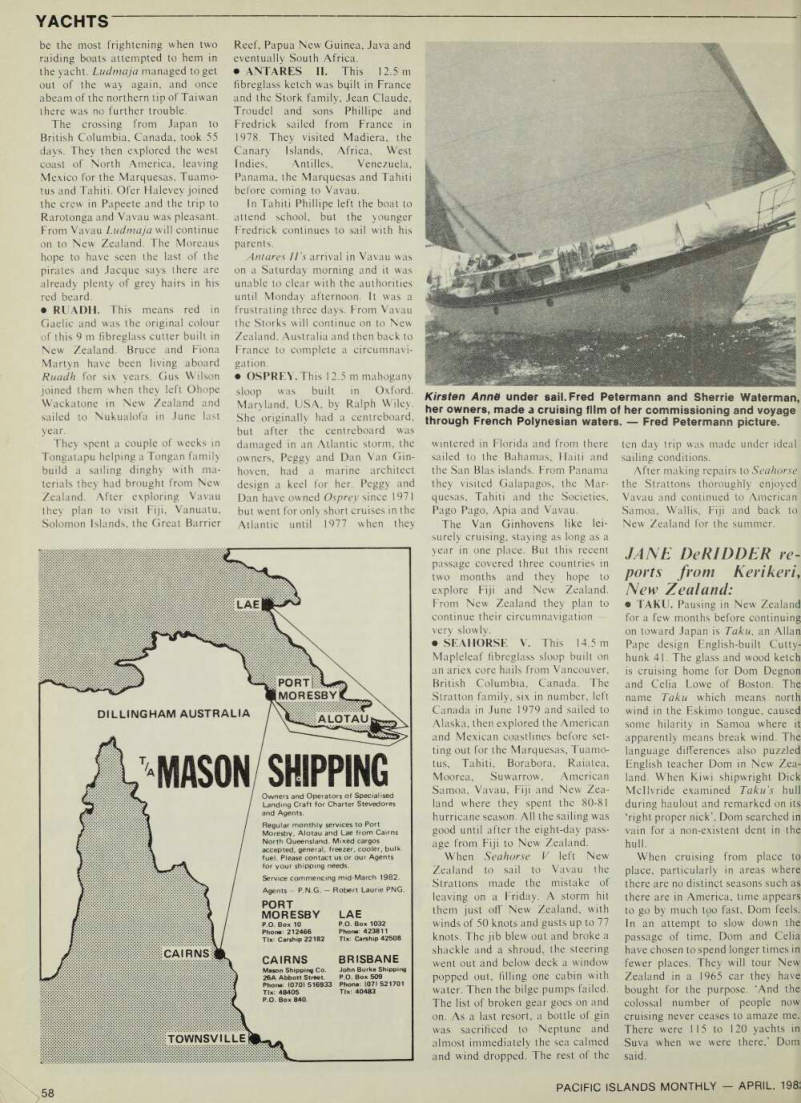
Kirsten Anne under sail. Fred Petermann and Sherrie Waterman, her owners, made a cruising film of her commissioning and voyage through French Polynesian waters. - Fred Petermann picture.
• Kirsten Anne. Fred
Petermann and Sherrie Waterman designed the layout and interior details for the luxuriously appointed and equipped Transpo 49 yacht Kirsten Anne. Petermann person
ally supervised the building in
Taiwan, and the commissioning was done in USA at Dana Point, Cali fornia. Petermann, a Los Angeles film director and commercial cine matographer, with Sherrie his as sistant, made a movie of the com missioning and voyage of the Kirsten Anne through the Marquesas, Tahiti and Moorea.
From New Zealand, Sherrie and Fred flew back to California to
organise the editing and marketing
of their cruising film. While cruis ing, even when they are not filming,
they are always thinking of subject
matter for future films, Sherrie said. • NERISSA. As a lad, Chip Jordan lived and cruised on his family’s John Alden yawl, Enchanta, for five years. Now, with his wife Martha, Chip is cruising the Pacific on his own 12 m one-off Bill Garden de sign ketch, Nerissa. Chip’s elder brother is also a seafarer. He only recently sold his steel schooner, Albatross, in Samoa. Now the youngest Jordan brother will join Nerissa for the cruise home to San Francisco via Hong Kong and/or
Japan. Chip will probably swallow
the anchor for a while to go to law school. When Martha returns from visiting her family in Alabama she will find the 1968-built Nerissa has a new iroko-kauri cabin sole, newly painted and varnished interior join ery, a solid fuel Dickenson heater, and a below decks shower pan, among other improvements. • KORAL 11. Marek and Jolanta Jarechi, originally from Katowice, Poland, call Koral II ‘part of a
natural progression’. During their
15 years in Canada, they have owned half a dozen vessels of increasing length beginning with a 4.5 m sailing boat. Now they are sailing in Koral 11, a red-hulled 10 m steel vessel of Van De Staadl design. They sailed direct from Victoria in Canada to the Mar quesas, covering the voyage of more than 4000 miles in 37 days. With them was their son Tom, now in his ninth year of schooling and continu
ing to study by British Columbia
correspondence lessons.
Unlike many of the cruising fleet, they do not carry ham radio. Merek, who worked for many years with the Ministry of the Environment in Vic toria, values simplicity and indepen dence. He says that to make amateur radio contacts while cruis
ing is ‘like swimming and always
being tied to the shore’. Though the Jarechi family plans to be back in Victoria for Tom’s next school year
(Sept ’B3) they are already planning
their next boat and their next blue water voyage. • SUMITRA. The 11 m cutter Sumitra (goddess of friendship in Sanscrit), Dick and Heimke Webb’s home for the past several years, spent some weeks in the Bay of Islands, New Zealand. Dick and Heimke built the glass sandwich airex foam core cutter on their property on Vancouver Island, Canada, beginning by clearing the land to build the shed. Their book shop, the Blue Heron in Comox, British Columbia, funded the oper ation. Sumitra, an Endurance 35 designed by Peter Ibold, was the winner of the 1971 cruising design award and features such attractions as inside steering.
The Webbs say ‘lt’s always the people who make it hard to leave a place. We were adopted by a Ton gan family. Same thing in Raiatea and in Rarotonga. That’s what cruising is all about the people.’
The Webbs have left Sumitra temporarily to enjoy a camping and hiking holiday in New Zealand. • ALRISHA. Alrisha was the star which was on the horizon the hour Gene Kozier was born. Besides being his birth star, it is the name of Kozier’s Fraser 40, a Vancouver registered 12 m cutter. The Fraser 40 original concept was dreamed up by five pilots sailing back from the Victoria-Maui Race. Vancouverites Joanne and Gene Kozier (picture p6l) built the vessel themselves in their spare time eight or more hours a day on top of their jobs.
They launched her before she was completed, then, frustrated to dis cover ‘the tool I always wanted was always at home’, Gene moved her back home again for another six months. Alrisha’s anchor is a 15 kg Bruce anchor. The anchor, with its unusual configuration, was devel oped for North Sea oil rigs. Bruce anchors are widely used now by
fishermen, and increasingly by
cruising yachtsmen attracted by the tremendous holding power for light weight.
PAUL RYSAVYreports
from Rarotonga, Cook
Islands:
• REMEMBER. A 20.5 m Van Der Meer-designed ketch arrived in Rarotonga in November. She is a charter vessel registered in Jersey, England, and owned by a British firm, Smile Charters. Skipper of this luxurious vessel is Belgian Hugo Premer, and his sole crew is Annie Trayaud, from France. The chef, who is usually on board, was to join the couple in a few months.
Remember arrived here from Borabora with a group of American passengers, and the ketch seemed likely to remain berthed in Avatiu harbour until mid-December, ’Bl.
She was then to sail to New Zealand
for the hurricane season and continue on in 82 to Australia, Thailand, Singapore, the Seychelles 7“ . r and South Africa, picking up charters on the way. • VELEDA. A London-registered ketch measuring 19.5 m on deck was also berthed in Avatiu harbour in mid-November. She is owned by a German businessman who spends approximately eight weeks a year on the boat. His paid crew consists of skipper Andrew Pack, Martin Brooke, Maureen Kroeger and Mary von Quere. The ketch was built in 1935, and her age is apparent through a number antique items on board, such as a bathtub and brass taps. Skipper Andrew Pack is taking Veleda around the world, and since leaving England in 1979, the ketch has visited
Germany, the Mediterranean, the Caribbean (for a year and a half), Venezuela, Colombia, Panama, the Galapagos, the Marquesas, Tuamotus, the Societies, and Rarotonga. From here Veleda made directly for Auckland where she will be put on the slips for some repairs. After the hurricane season, the itinerary includes Fiji, Papua New Guinea, Indonesia, the Red Sea, Cairo, the Mediterranean and then either England or Germany.
The skipper and crew expect to be sailing for another two years at least.
Gene and Joanne Kozier in New Zealand after sailing their Fraser 40 cutter Alrisha from
Canada. - Jane DeRidder pic
ture.