Jean-Marie Tjibaou on New Caledonia’s goals
pp. 35-37 · Read in the full issue

New Caledonia’s goals
A leading figure in the New Caledonian Independence Front, Jean-Marie Tjibaou, was in Canberra in February to address the international con ference ‘Australia and the South Pacific’. Vice-president of the political party Union Caledonienne, member of the New Caledonian Territorial As sembly, the popular and pro gressive mayor of Hienghene, and a regular member of del egations to Paris and to the French President, Mr Tjibaou is also internationally known for his contribution to the under standing of Melanesian culture, in particular for his organis ation of the Melanesian Festival of 1975, ‘Melanesie 200’.
Before flying out of Canberra Mr Tjibaou responded to ques tions from BARRY SHINEBERG on the future status of the territory of New Caledonia.
Q. Would you comment on the political situation in New Caledonia, and on the steps that are being taken to move the country along the road to decolonisation?
J-M.T; I think it is very important to distinguish be tween the steps to be taken by the Independence Front and those of the French Socialist Government, which came to power last year.
As far as we are concerned, what we claim is independence, and Kanak independence. In other words our basic point of reference is the Kanak people.
It’s for that reason that we speak about Kanak indepen dence. For us Kanak indepen dence is a nationalist concept, although our opponents often accuse us of being racists when we speak of an ethnically-based independence. In 1982, we will continue to work to mobilise our people around the claim for our independence, that is to say around the claim for regulating our own affairs and the control of our future. For that, we have two particular campaigns in the coming year. 1 speak as a
representative of my party, Union Caledonienne the other parties in the Indepen dence Front have their own programmes for mobilising the people.
In the first place, the mission this year from the countries of the South Pacific Forum con sisting of Fiji Prime Minister Ratu Sir Kamisese Mara, the Papua New Guinea Foreign Minister Noel Levi, and the Tongan High Commissioner in London Inoke Faletau, to French President Mitterrand, is most important to us in our campaign. I think that Mr Mitterrand will be able to speak more clearly to them as rep resentatives of governments than he can to us, who are only representatives of political par ties. Our demand, which the mission is pressing, is that France should be the leader in this campaign to put New Caledonia on the agenda of the United Nations Committee for Decolonisation.
That is our point of view.
Now, the French point of view could be quite different. As far as we are concerned, we are endeavouring to convince the countries of the South Pacific, the Forum countries, as well as the French Government, just how important it is for us to have our case taken up by the Committee of Decolonisation in 1982 so that the way can be opened up for national indepen dence in 1983.
The second major event for us in 1982 will be our cel ebration, on 24 September, at the time of the anniversary of the French annexation of New Caledonia. This celebration has been wrongly interpreted as a Unilateral Declaration of National Independence on our part. It is nothing of the kind.
However, it is an important stage in our campaign for inde pendence in which the different regions of the country will celebrate the acquisition of rights for which we have fought for a long time and to which the
French State has now acceded.
We have gained control at the regional level over the resol ution of land problems, the establishment of businesses and industries, including mining, and over immigration. These are important achievements for us. They cannot be taken away from us. The only possibility is further progress.
The achievement of land rights is basic for us at the municipal and regional levels, and from the point of view of financial transactions. The con cept of Kanak independence is based on the land. For us land is not simply an object of com merce it is above all the basis of our homeland, the foundation on which our aspirations for national independence are built.
Clearly, you can’t determine questions of independence on a ship or in an aeroplane. Inde pendence is something which emerges from the soil, from a territory. It is in this sense that land claims, though they may be put forward by families or clans, are of vital concern for our Kanak nation.
To summarise, the move towards independence depends on us and it depends on France.
We have pointed out to the French Government that we, Kanak representatives, have taken a responsible attitude.
We do not believe in mixing responsibilities. We believe the French Government has its responsibilities just as the countries of the South Pacific Forum also have their responsi bilities in this debate. We be lieve that either the French Government or the United Nations should issue an official declaration opening the way for the Kanak people to achieve their independence.
Q. What in a general way is your scenario for Post- Independence?
J-M.T.: The moment Nation al Independence is declared, the Kanak people will acquire a nationality which we hope would be open, with entries
and exits. Certainly, when we speak of exits there are those who say that we want the power to send people packing, to expel them. 1 would emphasise that the power over entries and exits is above all the power to welcome a power which the Kanak people have never exer cised. The people who came to New Caledonia from overseas have been imposed on our people, imposed on us by the French Government.
At the moment, immigration comes within the competence of the French State. We have no say in the matter. But from the moment that the Kanak people gain official recognition we will negotiate the entry of those who accept Kanak nationality, of those who accept that the Kanak people, whom we con sider as the sole rightful people of New Caledonia, are the people who have the right to welcome others.
We have supporters who understand our struggle and have worked with us, who are in favour of Kanak nationality for Kanaks, but who wish to retain their French nationality. They will stay in the country. There are even former political leaders who have stated, though not publicly, of course, that they are in favour of Kanak Independence, under which they will remain French citi zens.
We are also actively consider ing the question of economic decolonisation, the decolon isation of the economy, the establishment of new adminis trative institutions, and their
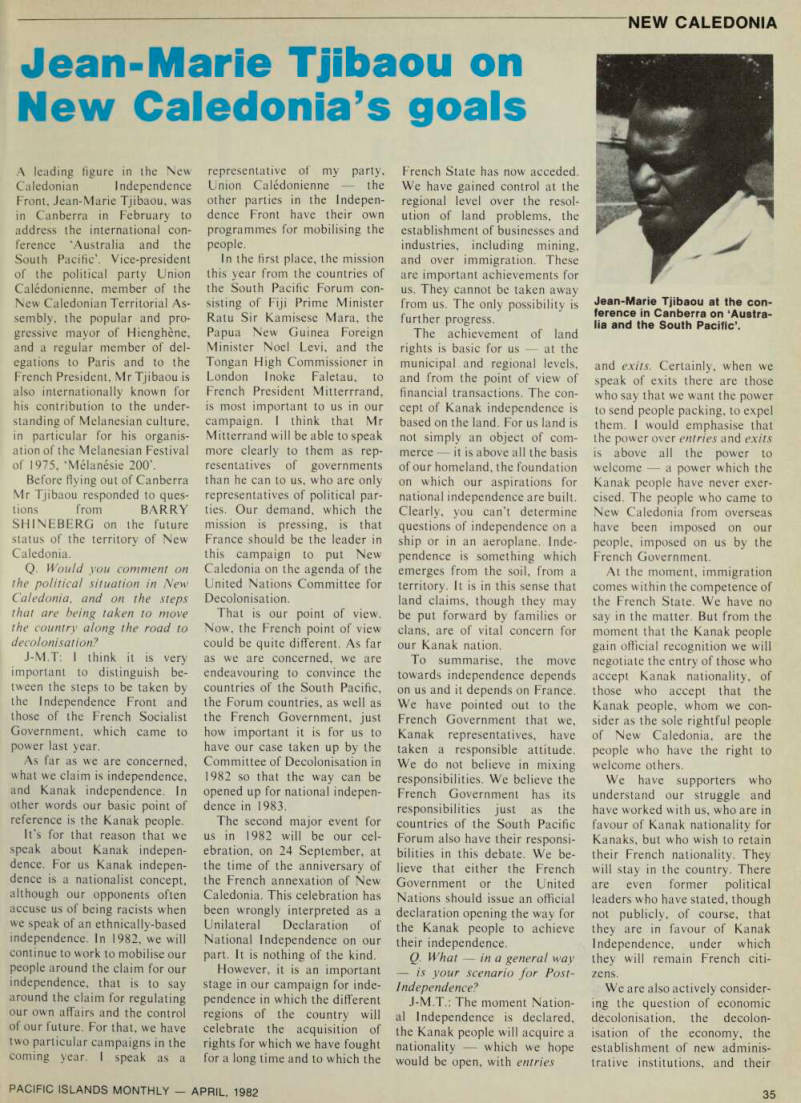
Jean-Marie Tjibaou at the con ference in Canberra on ‘Austra lia and the South Pacific’.
suitability for our particular needs.
We want such discussions to be put on a formal basis. When we speak of Socialist Kanak Independence, we want insti tutions which reflect the Melanesian approach to their heritage, their property and their resources. Equally there is a Melanesian appproach to the management of their patri mony, to small or medium-sized enterprises, and there is Melanesian way of viewing the distribution of work, welfare, social services and care for the environment so that the country may have a soul which comes from itself and not from elsewhere.
There is also a lot to be done to decolonise the minds of the people, and this concerns not just us Caledonians, but it still remains a problem for the Pacific people as a whole, I feel.
So that’s the independence scenario from our point of view Q What is the point of view of the French Government on the immediate future of New Caledonia?
J-M.T.: I don’t know. At the moment, the government has taken many of our demands into account. In both national and international arenas, France speaks of introducing measures for removing social inequalities, for less unemployment, for more welfare, for improvements in the environment, and so on.
In these matters, we support the government. Indeed, the measures the government has introduced reforms affecting land, cultural projects, credit systems for economic develop ment and administrative changes those we, too, envis age as part of our framework for independence.
The only, but the most im portant, aspect missing from this programme is the ultimate destiny the French Goverment proposes for us. Is it towards France, or is it in the direction of a Kanak nation? The French Government will not be explicit on this point. One day it will express its opinion. At the moment we have decided on a truce. We await the implemen tation of their proposed re forms.
Q. Has there been a consider able change in opinion in New Caledonia since May 10 of last year?
J-M.T.: What is most notice able in New Caledonia is the changed political climate. It is a great relief for us no longer to be under suspicion, no longer to be continually pursued by the police, by the intelligence ser vice (renseignements gen'er aux), by the gardes mobiles, every time that we have a demonstration.
Q. What is happening among the people themselves? How are they reacting?
J-M.T. I would say that there are more and more people who are opening up, who are openly discussing indepen dence. Some contact us in order to obtain further explanation.
The way we are talking is not new it dates from the elections of 1979. The young people started speaking about Kanak independence in 1969.
So it is a discussion that already has a history in New Caledonia.
But the ears of people were closed, their hearts and minds
were not open. I think that now people are more ready to listen to what we are saying.
There are also people who have always refused to admit the legitimate claims of the Kanak people and have joined up with the PNC (Parti National Caledonien). To my way of thinking, this party is rather like the white putsch in Santo whose history has already been written.
Q. Some comments by way oj conclusion?
J-M.T.: 1 would like to say that if the claims of the Kanak people are not met, we will continue the struggle. We have our responsibilities but at pres ent. the prime responsibility for decolonising rests with the col onial power, the French Social ist Government. We are hope ful, because we have confidence in the Socialist Party. The government has other preoccu pations of course, but we have good contacts with the Socialist Party, and with the Communist Party also, and we are confident that history is on our side.