The BP 'History' : Great, but
pp. 38-41 · Read in the full issue
Books
The BP 'History' : Great, but where's the lighter side?
The History of Burns Philp: The Australian Company in the South Pacific. By Kenneth Buckley and Kris Klugman.
Published by Burns Philp and Co Ltd. Distributed by Angus & Robertson. PO Box 290, North Ryde, Australia, 2113.
No ISBN supplied. Price 5A14.95, or $17.95 including postage anywhere within the South Pacific.
After one false start and a considerable amount of backing and filling. Burns Philp and Co Ltd has at last brought forth the story of its first century or part of it, since Volume I, now released, covers only the years 1883-1914. Volume ll,covering the rest, is not due for publica tion until next year, 1983 being the 100th anniversary of the incorporation of the company.
Why two biles at the cherry are necessary is a bit of a mystery, as Volume I is by no means a large tome. The pres ent chairman of the company, J.
D. O. Burns, says in reference to this in his foreword that the company ‘didn’t want a book that was 100 fat’.
He also says that Volume 11 will ‘probably take the history up until the end of the Second World War’, as an account of the company since that time is best left to someone writing in the 21st century.
Let’s hope he’s kidding. Rev olutionary changes have oc curred in the BP company in the past 38 years, and the story of its first 100 years won’t be complete without some account of them. The BP upper echelons have always been coy to the point of phobia about publicity
of any sort, and one gets the impression from the foreword that, even yet, neither the family nor the Top Brass takes kindly to baring the company’s immortal soul. That being so, doing it in two instalments is probably as much as they can stomach.
In the early 19705, BP en gaged the late Charles Bateson, an established writer, to pro duce the history. At the time it was believed that early records were scanty, but Bateson proved this to be wrong, devot ing a couple of years to dredg ing them up from Australia, the Pacific Islands, London and elsewhere, and literally filling a small basement in Sydney head office with the result. He had also drafted half a dozen chap ters of the proposed book when he died suddenly. The whole project went into cold storage for some time. But in the late 1970 s two Sydney University academics. Professor Kenneth Buckley and Mrs Kris Klugman, undertook to do the job.
They started off anew and the result is a thoroughly pro fessional job, full of infor mation, although if any former Pacific BP-walcher goes looking within its covers for the lighter side of the company’s history and, after all, neither it nor its Islands personnel were immune from local influences they can forget it. Nor do the personalities of the chief characters emerge as anything but two-dimensional with the possible exception of Walter Lucas, who was described as ‘foul-mouthed’, mostly it seemed because he used the favourite Australian adjective ‘bloody’.
The only grin this reviewer got out of the whole story came at the last page where Lucas describes how he got the near hulk SS Moresby resurrected and provisioned at Sydney at the outbreak of World War 1 and finally to Rabaul with supplies for the Australian
force that had taken the town from the Germans. Lucas was subsequently seconded to the Australian Expropriation Board, which took over German plantations in New Guinea and disposed of them to Australians.
But that story does not come within the scope of Volume I.
One of the problems in fleshing-out these early BP characters is that on paper they all behaved like a lot of canny Scots, and emerge as personalities only via snippets of reports or business letters.
James Burns dominated the company until his death and thus Volume 1 as well, and he appears to have destroyed let ters addressed to him person ally. Letters that have survived are from Burns to others to his partner Philp in the early years, and later to P. G. T.
Black, accountant, chief inspec tor and later general manager of the company.
Although the company was not incorporated until 1883, Burns and Philp separately and together had had successful careers for at least a decade before.
Burns, then not quite 17, had migrated to Australia with his elder brother in 1862. They came modestly endowed by their family in Edinburgh and settled in Queensland, the elder brother setting up as a storekeeper on his own account, and James initially as a jackaroo on outback properties before joining his brother in 1867. That same year gold was discovered at Gympie and young James immediately went there to open a branch store for J. & J. Burns.
Although Queensland goldmining and agriculture were to form the original basis of the BP empire, the brothers’ partnership effectively came to an end in 1869 when their father died and it was decided that young James should return to Edinburgh to clean up the estate. He did not return to Brisbane until 1872 and from
then his fortunes took a new direction.
He built a store in Townsville on his own account the same year, began servicing the min ing fields of Ravenswood, Char ters Towers, the Palmer River, etc.
Burns had already met Robert Philp who, as a 10-year old, had migrated with his parents from Glasgow in the same year as the Burns brothers arrived in Brisbane. In 1874 James Burns offered Philp a job in Townsville at £250 per an num, with the prospect of a partnership later on. For the next two years they worked together, not only consolidating their business partnership but cementing a firm personal re lationship, although they differed considerably in charac ter.
Burns was the canny, Edinburgh Scotspyterian, sold on the work ethic, energetic, far-seeing, and with his feet on the ground. Philp was much more given to adventures and personal speculations that oc casionally backfired.
It was Philp who launched the partnership into recruiting Pacific Islands labour for the Queensland canefields against the better judgment of Burns, who, while he had no moral scruples about it, was convinced that it could generate far more problems than it was worth, and by the mid-1880s, was instru mental in withdrawing the firm from it altogether.
It was Philp who involved the firm in another cause celebre in 1 877, at a time when Burns was in London, by acquiring a whaling ship, Costa Rica Packet, and despatching it with its master. Captain John Bolton Carpenter, into Malaysian waters to search for whales.
Before anything was ac complished, Carpenter came across an abandoned proa off one of the Indonesian islands and a couple of damaged cases of liquor were taken from it.
Subsequently, at Ternate,
Carpenter was arrested by Netherlands officials who wanted to charge him with piracy but could not find sufficient evidence to try him.
Meantime, Costa Rica Packet was abandoned by her crew, taken to Singapore and sold for £l3OO.
News of the Dutch treatment of Carpenter caused something of an international incident. BP demanded £25 000 in compen sation, and the governments of New South Wales, Britain and the Netherlands were involved before the case was finally settled in 1897.
It was the final appearance of BP in the whaling business, but the Carpenters were in the Pacific to slay. Captain J. B.
Carpenter had five sons, three of whom were eventually em ployed by BP. One, Waller Randolph, after serving the company at Thursday Island and elsewhere, became man ager of Robbie Kaad and Co, which BP had taken over at Levuka, Fiji. He resigned in 1913 over a difference of opinion on business tactics and set up his own business in Fiji the beginning of the W. R.
Carpenter & Co empire in the Pacific that was to develop into BP’s chief rival.
Philp became a full partner of Burns in 1876 but resigned from active participation in the business in 1892, devoting his time to Queensland politics, twice becoming Premier.
Burns moved to Sydney in 1877 and established a branch there, leaving the Queensland end in Philp’s care. Burns Philp and Co Ltd was incorporated in Sydney in April 1883 with a nominal capital of £250 000 in £1 shares. Of the shares issued originally. Burns held 43 per cent, Philp 21 percent, John Walsh, a Cooktown merchant, 8 percent, BP executives Adam and James Forsyth 9 percent between them, principals of Mcllwraith, McEacharn & Co, London, 8 percent, and a num ber of parcels of shares went to senior employees of BP.
By the end of the 1880 s the company had branches in Townsville, Normanton, Burketown, Thursday Island, Cairns, Charters Towers, Syd ney, Brisbane and London. It was engaged in merchandising,
insurance, its own shipping, and was agent for the powerful Australian shipping company, Australasian United Steam Navigation Co, (AUSN).
It was also taking part in the Torres Strait pearling industry, owning luggers and recruiting Japanese divers from there. It was natural that it should shortly become involved in sup plying the small European com munities in the new British protectorate of New Guinea (Papua).
In 1826 BP agreed to run a mail steamer from Thursday Island to Port Moresby twice monthly for a government sub sidy of £5O per month in the mistaken belief that there would be opportunities to trade for copra, beche-de-mer, etc, along the Papuan coast. When it was found that trading oppor tunities were nil, Burns was soon complaining that the ser vice was useless to them unless they could acquire property in the territory. This was not forthcoming so BP withdrew from the Thursday Island- Moresby service in 1888, hav ing lost about £3OOO.
Within months, however, the company inaugurated a new service, this time with a sailing schooner, from Cooktown to Moresby and Samarai, with a monthly subsidy from the New Guinea administration of £BO.
The service was soon extended to supply the Methodist and Roman Catholic missions in New Britain, and, in the early 1890 s, BP was able to buy out Moresby’s pioneer storekeeper, Andrew Goldie, and a smaller trader in Samarai. Their future in New Guinea was thus as sured. Already the company was taking an interest in the New Hebrides where rivalry between the Roman Catholic and Presbyterian missionaries was resulting in much compe tition for New Hebridean souls, and where national rivalry be tween French and British was no less heated.
The Rev John Paton of the Presbyterian Mission cam paigned strongly for annexation of the New Hebrides by Britain but when this effort failed, was more successful in persuading Victoria and New South Wales to subsidise shipping services.
As independent states, Victoria subsidised the Union Steamship Co of NZ to the tune of £l2OO per annum, and NSW subsi dised the AUSN to the same amount, later doubling this for an inter-island service for the Hebrides.
As agents for AUSN, Burns Philp thus got its foothold in the group, Burns following this up by gathering together a group of Australian businessmen to form the Australasian New Hebrides Company (ANHC) which subsequently bought about 80 000 acres of land in the New Hebrides for the
customary trade goods of the day. ANHC also began trading around the group in the Truganini, the old steamer AUSN employed on the Sydney-Hebrides service.
But although ANHC offered leases of blocks of plantation land to prospective Australian settlers on easy terms, there were few, if any, takers. The odds against succeeding against entrenched French interests were too great.
During the depression of the 1890’s, the NSW Government withdrew its subsidy and the ANHC was forced to charter the much smaller Croydon in order to maintain its services.
Troubles continued to multiply, however, and in 1897 the ANHC was wound up. Burns Philp taking over all its assets and liabilities, thus gaining its base in the New Hebrides.
Later the land that had been acquired was given by Burns to the Australian Government, ap parently on the theory that this would do something to counter French influence in the group.
Successive Australian Govern ments nonetheless contrived to do nothing about this gift land.
"About this time’, say the authors, "the records of Burns Philp begin to mention two employees who were later to be very prominent in the company.
One was Joseph Mitchell who joined BP in 1891 ... In 1895 he was sent to Vila to be manager of ANHC . . . follow ing the liquidation of that
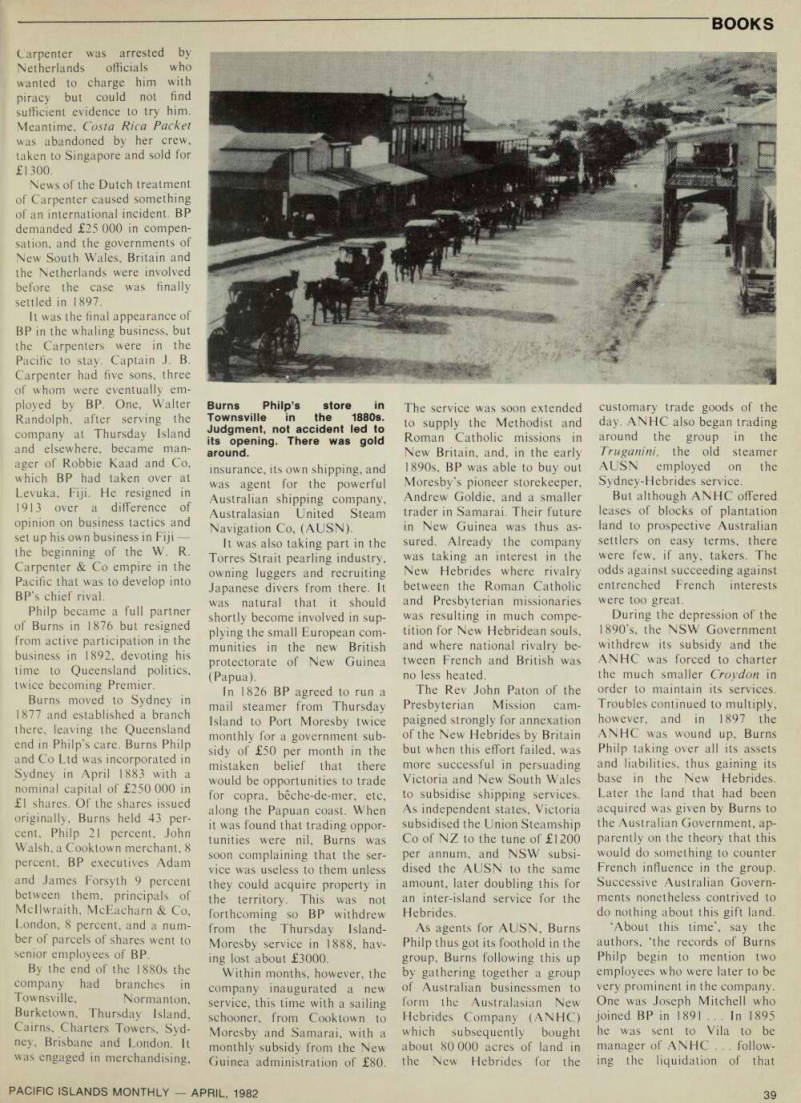
Burns Philp’s store in Townsville in the 1880s.
Judgment, not accident led to its opening. There was gold around.
company he became manager of BP s Island Department (in Sydney) . . . The second person ality to emerge was Walter Lucas who was engaged by BP in 1893 to work as supercargo on the Croydon in New Hebrides waters. Three years later he was transferred to the Titus in the Solomons.’
In the years since its forma tion the company had come up against lough competition from the subsidised German shipping company Norddeulscher Lloyd and the Dutch KPM: from French interests in the New Hebrides and New Caledonia; from Lever Bros in the Solomons, from CSR in Fiji, and merchants and shipowners at home in Australia. Although it had not won every battle it had won often enough, had survived and prospered, and, on the eve of the new century, was ready to take one more step in consolidating its position in the Pacific the acquisition of plantations.
With this in view, the BP board formed the Solomon Islands Development Co (SIDC) in 1908 and bought, on Lucas’ advice, Tetipari Island off New Georgia, another large area at Tctere on Guadalcanal, and two established plantations at Waggina Island in Manning Strait. The idea was to lake on Lever Bros at its own game and in this the company was encour aged by Resident Com missioner Woodford who fell that there were advantages in having BP counter Lever’s, who not only dominated local copra production but much else be sides.
SIDC was established with a nominal capital of £lOO 000 in shares of £ 100 each. Of the 608 shares issued initially, the parent company look 100, and the rest were taken up by individuals, including Burns himself, Adam R. Forsyth, and Lucas. SIDC subsequently ac quired other plantation land in the group.
In 1910, BP promoted another plantation company, acquiring about 15 000 acres of land in the Shorlland Islands, some of it through J. M. C.
Forsaylh, son of Queen Emma Kolbc. The following year BP formed Choiseul Plantations
Ltd (CPL) with the original purpose of acquiring plantation land on Choiscul, in the British Solomons Islands Protectorate.
But in 1912 the British Govern ment changed the Solomons’ land tenure system and the method of acquiring it, and CPL switched its attention to German Bougainville where freehold land could still be bought direct from the indigenes.
The shareholding of Short land Island Plantations and of Choiscul Plantations Ltd fol lowed the same system that had been employed in SI DC that is, BP look a large parcel of shares, but the majority remain ing were divided up between James Burns, and friends and executives of the parent com pany.
CPL acquired about 2500 acres at Soraken on the west coast of Bougainville, and in 1913 were given permission by the German authorities to pur chase a further 10 000 acres on Buka/Bougainville.
Burns Philp then had to wail until the end of the coming war, when the old German colony became an Australian man dated territory, before it could acquire further plantations in this area.
The outbreak of World War I
in 1914 saw BP looking away from Queensland, which had been the basis of its early fortunes, and firmly towards the Pacific which was to occupy its attention between the wars. At that stage James Burns had reason to be pleased with what he had accomplished. As the authors say: ‘The development of the com pany in three decades from its formation in 1883 was remark able. From initial bases in Queensland and Sydney, the company had spread to all Australian states except Tasmania, as well as overseas.
By 1914, besides Sydney and London offices, there were 23 branches, 13 in Australia, three in the Solomons, two in Papua, two in Java, one each in the New Hebrides, Tonga and Western Samoa, plus a subsidi ary company in Fiji and a depot in the Gilberts . . . There was also the Wyben Pearling Fleet (in Thursday Island).' It employed about 1000 Europeans and an unknown number of Islanders. It had a board of directors of half a dozen, including Sir James Fairfax of The Sydney Morning Herald and Baron Inchcape in London, but there was no doubt that the company was run by the executives at home base in
Sydney, especially by Burns himself, assisted by Adam Forsyth, R. J. Nosworthy, P. G.
T. Black and W. H. Lucas.
They took the decisions; the board rubber-stamped them.
Unlike the situation during World War 11, the First War, apart from early minor skirmishes in German colonies, did not directly affect the South Pacific. Burns Philp continued to prosper through it and used it as a springboard to leap off to bigger and better things in its aftermath. But that is a story that presumably will occupy the Buckley and Klugman team in Volume IF Volume I is illustrated with old photographs, reproduction of which is generally so bad most appear as black blobs, while the captions of many might just as well have been left out. For example: ‘Loading bananas’, which shows a row of human silhouettes standing on a spit of land. How, when, where or why, we may ask. Or a group of nine men and one woman with a caption that merely says: ‘On board Titus, Sunday morn ing, 1898.’ Whoever was re sponsible for the production of this book that is, seeing it through the printer could surely do better than that. -
Judy Tudor.
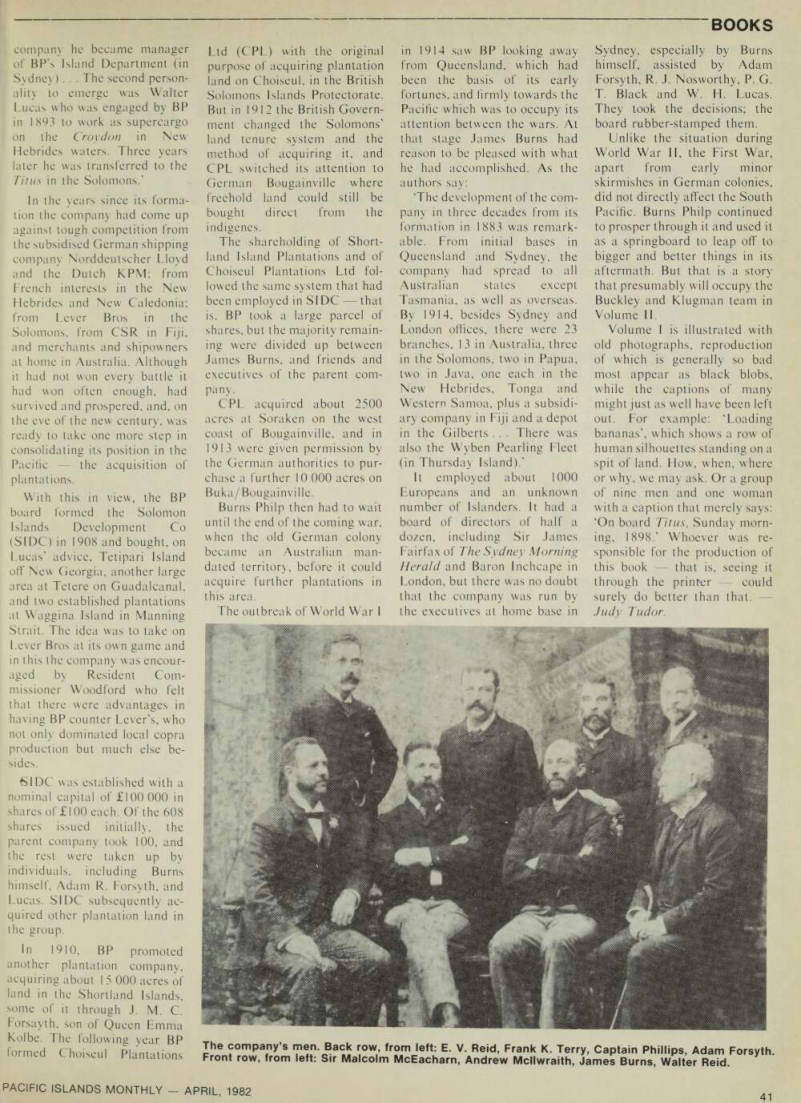
The company’s men. Back row, from left: E. V. Reid, Frank K. Terry, Captain Phillips, Adam Forsyth.
Front row, from left: Sir Malcolm McEacharn, Andrew Mcllwraith, James Burns, Walter Reid.