Tikopia, the very East paradise
pp. 32-33 · Read in the full issue

very East paradise
When the young New Zealand anthropologist Raymond Firth in July 1928 first stepped ashore on Tikopia, in the Santa Cruz group, Solomon Islands, he did not know it, but he had arrived at a place whose name would be forever linked with his.
On this tiny island eight by five kilometres he found to his surprise and delight a Stone Age Polynesian people who still worshipped their old. pagan gods, and totally ignored the use of money.
The image he skilfully conjured up in his major work. We, the Tikopia, which has long been on required reading lists in anlhroplogy departments of universities throughout the world including the USSR is such that the island has ever since been described in the popular press as the last unspoilt paradise of the Pacific.
Having just visited Tikopia for the third lime in five years on the floating extension school known as the MS Lindblad Explorer, we are happy to be able to report that the now world famous doyen of anthropologists. Sir Raymond Firth, would slilll feel very much at home on the island today.
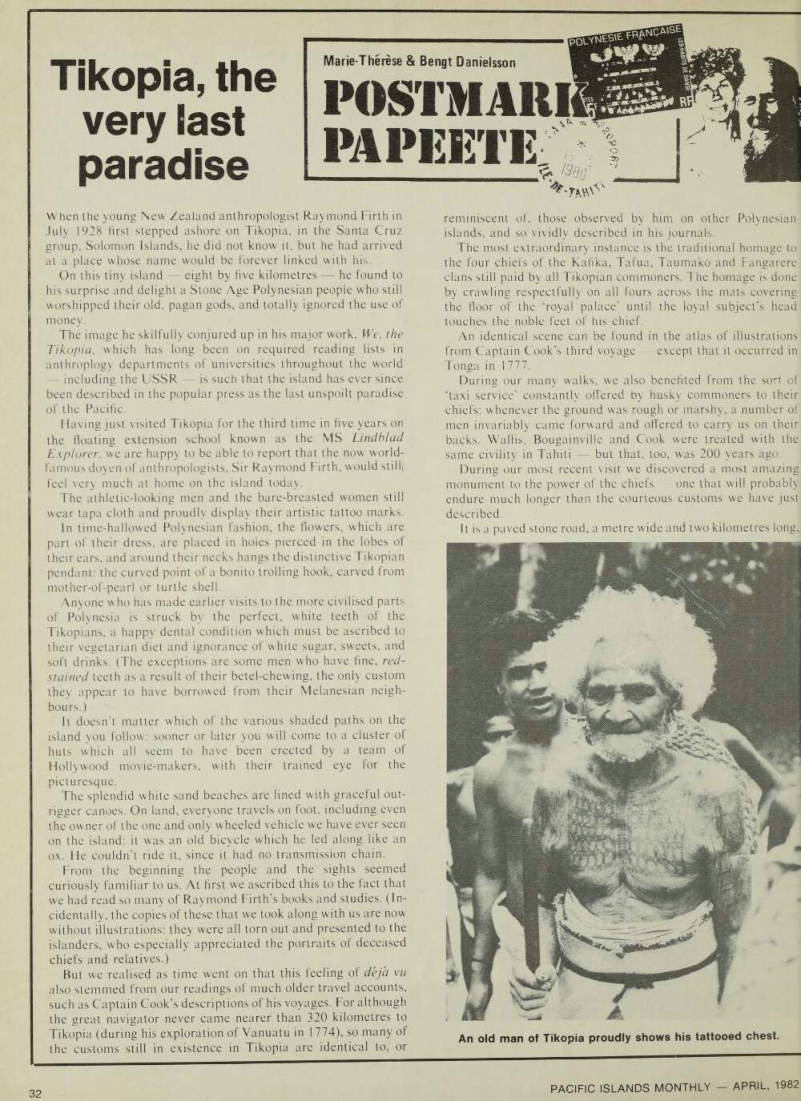
The athletic-looking men and the bare-breasted women still wear tapa cloth and proudly display their artistic tattoo marks.
In time-hallowed Polynesian fashion, the flowers, which are part of their dress, are placed in holes pierced in the lobes of their ears, and around their necks hangs the distinctive Tikopian pendant: the curved point of a bonito trolling hook, carved from mother-of-pearl or turtle shell.
Anyone w'ho has made earlier visits to the more civilised parts of Polynesia is struck by the perfect, while teeth of the Tikopians, a happy dental condition which must be ascribed to their vegetarian diet and ignorance of while sugar, sweets, and soft drinks. (The exceptions are some men who have fine, red stained teeth as a result of their betel-chewing, the only custom they appear to have borrowed from their Melanesian neigh bours.) It doesn’t matter which of the various shaded paths on the island you follow: sooner or later you will come to a cluster of huts which all seem to have been erected by a team of Hollywood movie-makers, with their trained eye for the picturesque.
The splendid white sand beaches are lined with graceful out rigger canoes. On land, everyone travels on foot, including even the owner of the one and only wheeled vehicle we have ever seen on the island; it was an old bicycle which he led along like an ox. He couldn’t ride it, since it had no transmission chain.
From the beginning the people and the sights seemed curiously familiar to us. At first we ascribed this to the fact that we had read so many of Raymond Firth’s books and studies. (In cidentally, the copies of these that we took along with us are now without illustrations: they were all torn out and presented to the islanders, who especially appreciated the portraits of deceased chiefs and relatives.) But we realised as time went on that this feeling of deja vu also stemmed from our readings of much older travel accounts, such as Captain Cook’s descriptions of his voyages. For although the great navigator never came nearer than 320 kilometres to Tikopia (during his exploration of Vanuatu in 1774), so many of the customs still in existence in Tikopia are identical to, or
reminiscent of, those observed by him on other Polynesian islands, and so vividly described in his journals.
The most extraordinary instance is the traditional homage to the four chiefs of the Kafika, Tafua, Taumako and Fangarere clans still paid by all Tikopian commoners. The homage is done by crawling respectfully on all fours across the mats covering the floor of the ‘royal palace’ until the loyal subject's head touches the noble feet of his chief.
An identical scene can be found in the atlas of illustrations from Captain Cook’s third voyage except that it occurred in Tonga in 1777.
During our many walks, we also benefited from the sort of Taxi service' constantly offered by husky commoners to their chiefs: whenever the ground was rough or marshy, a number of men invariably came forward and offered to carry us on their backs. Wallis, Bougainville and Cook were treated with the same civility in Tahiti but that, too, was 200 years ago.
During our most recent visit we discovered a most amazing monument to the power of the chiefs one that will probably endure much longer than the courteous customs we have just described.
It is a paved stone road, a metre wide and two kilometres long,
An old man of Tikopia proudly shows his tattooed chest.
i al the fool of the huge cliff that juts like a sugarloaf out of the middle of the narrow south coast, between the lagoon and the Roto crater lake. its purpose is to permit easy access to the last village, Namo, at the foot of the 400-metre high mountain that occupies the north-eastern half of the island.
The so-called ara metua on Rarotonga is justifiably admired as a splendid example of the collective engineering achievement of a small Slone Age tribe. The ara metua on Tikopia testifies to even greater building skills, and certainly represents an even greater human effort. It also offers more beautiful views, since it hugs the shore of the lake.
How is it that the Tikopians alone of all the Polynesian peoples have managed to preserve their culture almost intact?
All who have tried to answer this most intriguing question have, of course, pointed to the extreme isolation of the island, and to the lack not only of harbours but even of a sheltered anchorage. This answer certainly has great merit.
But it must also be remembered that the isolation of the island is not only measured in the number of nautical miles separating it from the nearest European-style commercial centres 220 to Santa Cruz, and 640 to Honiara but is also, and perhaps even more importantly, due to the simple fact that captains of trading vessels have never bothered to visit Tikopia because the people there had nothing to sell, and consequently no money with which to buy European goods either.
True enough, there are quite a few coconut palms on Tikopia.
But copra production is nil, since the islanders eat and drink all the nuts. Similarly, they consume all the yams, sweet potatoes, manioc roots and other crops they manage to grow on the mountain slopes around the crater lake. Until now, production has kept pace with population growth, and famines have only occurred when hurricanes have destroyed the gardens. This happened, for instance, in 1952-53, when 17 people are reported to have died of starvation.
But the present population stands at 2200, which is 900 more than during Raymond Firth’s first field work in 1928-29.
Considering that a third of the island’s total area of roughly 30 square kilometres is taken up by mountains, and another third by the crater lake, one marvels at the Tikopians’ capacity for survival. But there is a limit to it, and that limit has certainly been reached.
The only solution to the problem so far tried has been migration, and there is now a Tikopian colony of 250 on Russell Island, and a much smaller one on Vanikoro. The purely demographic problem can undoubtedly be solved in this manner for several generations to come. But there is a price to pay in the form of a gradual loss of cultural values. Many of these migrants will naturally come back to Tikopia for shorter or longer periods (if not for good), and bring with them all sorts of new articles, plants, animals and ideas which will mean that the islanders’ unique ‘proto-Polynesian’ way of life will slowly change, and perhaps in the end be totally destroyed.
While waiting for the inevitable, however, Tikopia today is still a ‘paradise island’ without peer anywhere in the Pacific. So let us only add a final word of warning for those of our readers who might want to get away from the burdens and worries of their drab, civilised existence.
Don’t jump on the first plane or ship heading for Solomon Islands. You will never be allowed to settle on Tikopia, and the SI Government is extremely reluctant even to grant foreigners permission to make a brief visit to the island.
However galling this restrictive policy may seem to those who dream of an earthy paradise, it is certainly in the best interest of the islanders. Or, as a Honiara government official once put it: ‘The Tikopians are a happy people, because they have no malaria, no snakes, and no foreigners. Let us keep it that way.’
Marie-Therese and Bengt Danielsson.