Australia and the Islands: A mutual
pp. 11-15 · Read in the full issue

Conference: Australia & The South Pacific
Australia and the Islands: A mutual trust, a mutual watchfulness
PIM Associate Editor
Malcolm Salmon
attended the conference on 'Australia and the South Pacific’ in Canberra on February 18-19. His report begins on this page.
The organisers planned a con ference of 120 registered, paid up participants. They finished with 250, with freeloaders boosting the numbers in and around the conference hall to 300 or more at some sessions.
That in brief is the story of the ‘Australia and the South Pacific’ conference held at Burgmann College, Australian National University, Canberra, on February 18-19.
Sponsored by the ANU’s Council for Continuing Edu cation, and the Australian sec tion of the Foundation for the Peoples of the South Pacific, the conference indicated a growing Australian public awareness of the importance and the problems of the country’s relations with the Pacific Islands. It offered some faint hope that the days when Australian public attitudes to the Islands are as Australian Foreign Minister Tony Street remarked in opening the confer ence ‘largely shaped by the novels of James A. Michener’ may at long, long last be numbered.
As a measure of the drawing power of the conference and of the web of diverse power interests enveloping the South Pacific region the following Canberra embassies and high commissions coughed up their SASO to send a representative: the United States, the Soviet Union ( it cost them $lOO, because they sent two), Japan, China, France, Canada, Italy and Chile. ‘Locals’ like Papua New Guinea, Fiji and New Zealand were also there. A representative of India’s minis try of communications (not the high commission) was in attend ance.
Australia’s department of foreign affairs demonstrated its interest by sending no fewer than 20 of its officers.
If Islanders were outnum bered by non-islanders in the conference overall, they played a prominent part in the work of
leading off conference dis cussions: they were among the principal speakers in opening seven of the 11 full sessions, and served as convenors at five of the 11 workshops.
Those involved in this leader ship work were from Solomon Islands, Western Samoa, Fiji, Tonga, New Caledonia and Palau.
Grappling with their subject, speaker after speaker toyed with various ways of expressing the precise quality of the re lationship between Australia and the Island states of the South Pacific.
There were references to ‘metropolis’ Australia, which, if the Greeks who coined the word
are to be believed, makes Aus tralia a kind of ‘mother city’ to the Island states, at the centre of some sort of vast oceanic countryside. There were other, quite direct, uses of the parent child metaphor.
There was a ‘Siamese-twin’ image employed, and geometry was called in to give us a ‘centre’ (Australia) and a ‘per iphery’ (the Islands). And so on.
One speaker, scrupulously ac knowledging his debt to Pierre Trudeau’s description of Canada’s relations with the United Slates, said the Islanders’ experience in re lations with Australia was like that of ‘a man in bed with an elephant’. ‘When the elephant turned over or sneezed or snored it had quite an unsettling effect on the other occupant of the bed,’ said he. (The same speaker, Epeli Hau’ofa of Tonga, added: ‘I think some people would prefer to liken our relationship to the courtship between Beauty and the Beast
. . With exquisite Polynesian politeness, he refrained from telling his audience which was which).
The conference planners cast a wide net, with virtually every aspect of the subject touched upon in one form of meeting or another.
No resolutions were adopted.
Presumably the aim was to achieve what is sometimes called a ‘Pacific-style consen sus’ a very elusive animal indeed. Certainly, it was not caught and put on display at the end of this conference.
As in any international con ference held in any country, whatever the subject, the locals fought their own battles the ones they were fighting the week before the conference, and the ones they will be fighting the week after.
So, among Australians at the conference, the environ mentalists (‘greenies’ to their detractors) fought the devel opers (‘money-grubbers’ and worse to those who don’t like them). ‘Anti-nukes’ did battle with ‘pro-nukes’, ‘radicals’ clashed with ‘conservatives’, and so on. Mostly the battles had a demonstrable connection with Island concerns, but some times they did not.
One that did was the under ground and largely silent, war waged by the International De velopment Action group who, throughout the conference, diligently ‘flogged’ their anti- Burns Philp booklet, A Touch of Australian Enterprise: The Vanuatu Experience, under the noses of the several executives of that company including chief executive officer Philip Best who were present. But at the end of the day honours were about even. No doubt the IDA people sold a lot of copies of their booklet. For their part, the BP men remained unflappable, and indeed won plaudits from many for their tireless attendance at confer ence and workshop sessions.
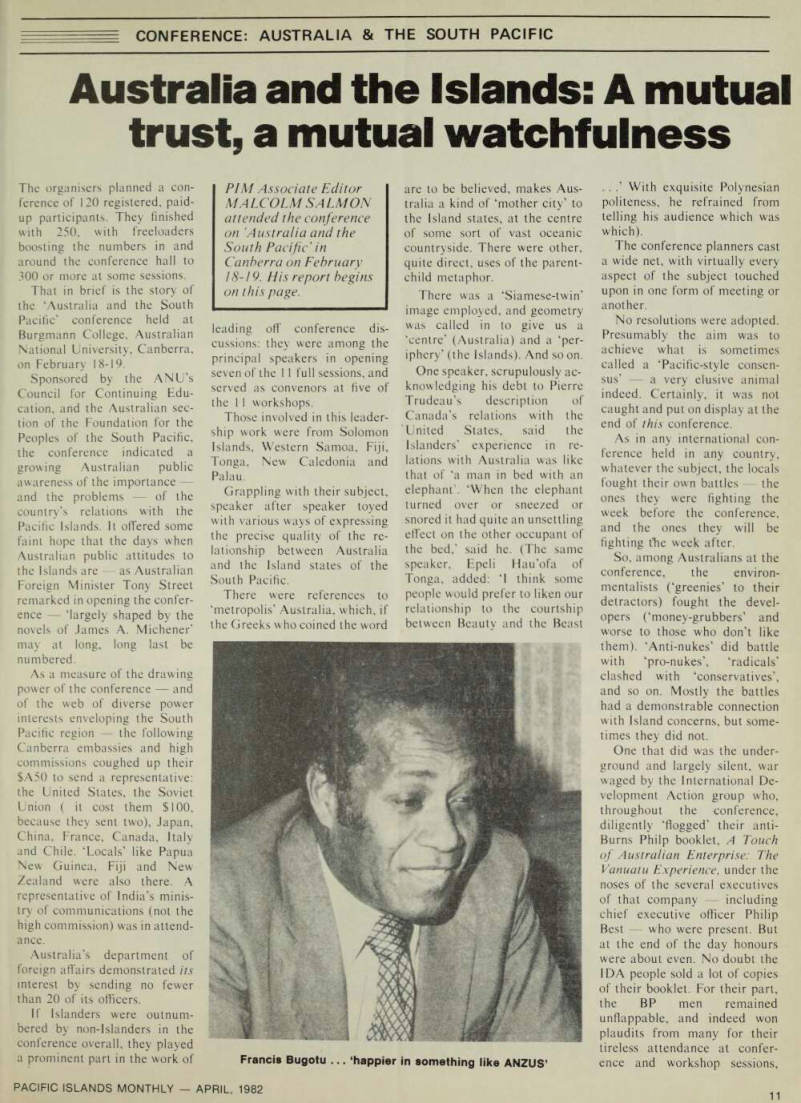
Francis Bugotu ... ‘happier in something like ANZUS’
whether they directly con cerned them or not.
It wouldn’t have been Austra lia and it most certainly wouldn’t have been Canberra if some good old-fashioned party-politicking hadn’t reared its head at some stage.
In one of the two summing-up statements at the close of the conference, Alan Matheson, representing the Labor Party oriented Australian Council of Trade Unions, claimed that the extreme brevity of Foreign Min ister Tony Street’s speech and stay at the conference provided a true measure of the import ance attached to the South Pacific by Australia’s Liberal- National Country Party govern ment.
This sally brought a sharp protest to the organisers from representatives of the depart ment of foreign affairs, who claimed that 10 minutes was all that had been allotted by the organisers for the Street speech.
The organisers later confirmed that this was so.
Mr Matheson made a much more serious point when he said later on in his summing-up remarks; ‘.. . there was no doubt in the minds of many participants that Australia was increasingly be ing incorporated into US mili tary and strategic designs and systems for the region. ‘Any new direction for Aus tralian relationships with Pacific Island nations will de pend on the degree to which Australians can spend as much time discussing a “nuclear-free zone’’ within its own boundaries as it does a “nuclear-free Pacific”. ‘The time is coming when it will be the nuclear issue within Australia that will determine Australian relationships with its Pacific neighbours. ‘For many Pacific Islanders Australia represents the begin ning of the nuclear cycle. To them it is little more than hypocritical to be talking of a nuclear-free Pacific while con tinuing to supply uranium to countries such as Japan, France and the USA’.
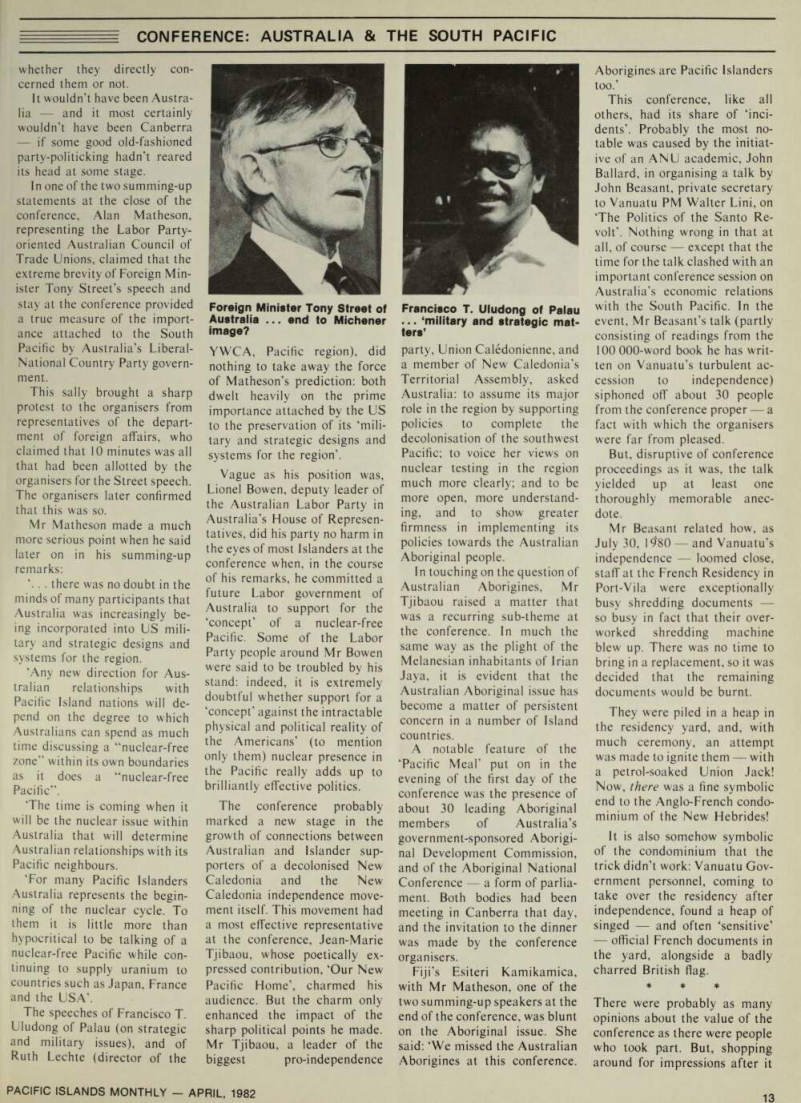
The speeches of Francisco T.
Uludong of Palau (on strategic and military issues), and of Ruth Lechte (director of the
YWCA, Pacific region), did nothing to take away the force of Matheson’s prediction: both dwelt heavily on the prime importance attached by the US to the preservation of its ‘mili tary and strategic designs and systems for the region’.
Vague as his position was, Lionel Bowen, deputy leader of the Australian Labor Party in Australia’s House of Represen tatives, did his party no harm in the eyes of most Islanders at the conference when, in the course of his remarks, he committed a future Labor government of Australia to support for the ‘concept’ of a nuclear-free Pacific. Some of the Labor Party people around Mr Bowen were said to be troubled by his stand: indeed, it is extremely doubtful whether support for a ‘concept’ against the intractable physical and political reality of the Americans’ (to mention only them) nuclear presence in the Pacific really adds up to brilliantly effective politics.
The conference probably marked a new stage in the growth of connections between Australian and Islander sup porters of a decolonised New Caledonia and the New Caledonia independence move ment itself. This movement had a most effective representative at the conference, Jean-Marie Tjibaou, whose poetically ex pressed contribution, ‘Our New Pacific Home’, charmed his audience. But the charm only enhanced the impact of the sharp political points he made.
Mr Tjibaou, a leader of the biggest pro-independence
party, Union Caledonienne, and a member of New Caledonia’s Territorial Assembly, asked Australia: to assume its major role in the region by supporting policies to complete the decolonisation of the southwest Pacific; to voice her views on nuclear testing in the region much more clearly; and to be more open, more understand ing, and to show greater firmness in implementing its policies towards the Australian Aboriginal people.
In touching on the question of Australian Aborigines, Mr Tjibaou raised a matter that was a recurring sub-theme at the conference. In much the same way as the plight of the Melanesian inhabitants of Irian Jaya, it is evident that the Australian Aboriginal issue has become a matter of persistent concern in a number of Island countries.
A notable feature of the ‘Pacific Meal’ put on in the evening of the first day of the conference was the presence of about 30 leading Aboriginal members of Australia’s government-sponsored Aborigi nal Development Commission, and of the Aboriginal National Conference a form of parlia ment. Both bodies had been meeting in Canberra that day, and the invitation to the dinner was made by the conference organisers.
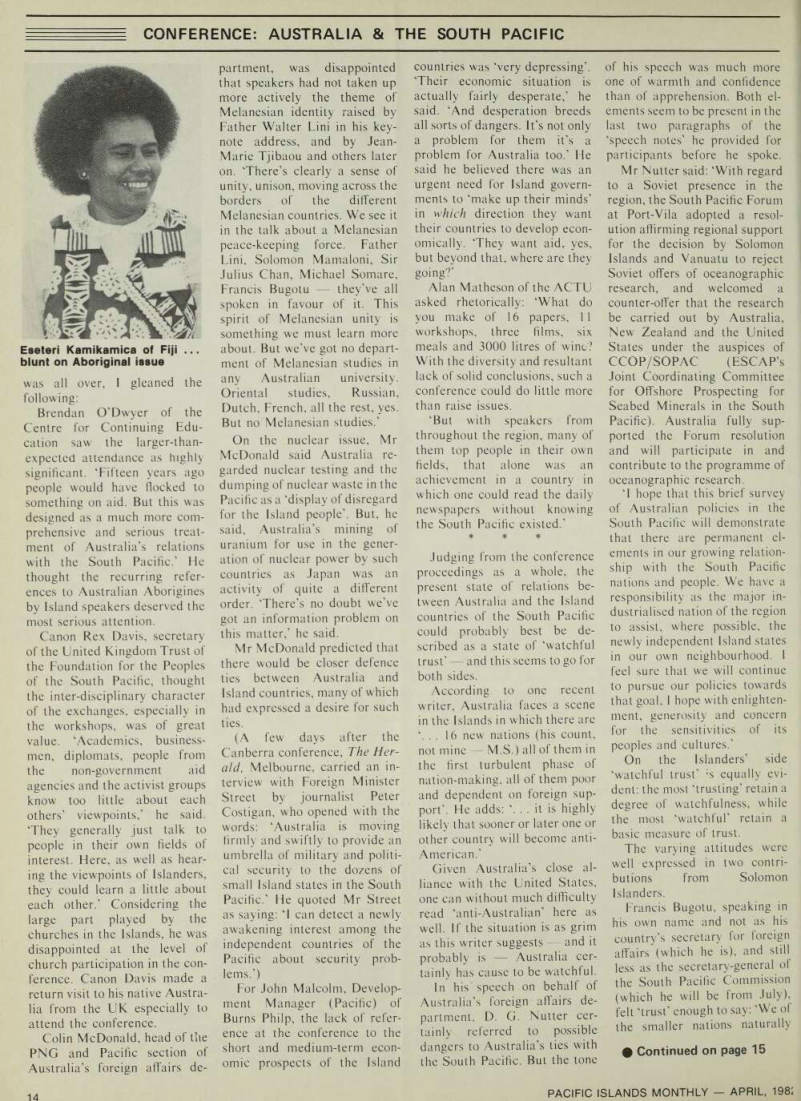
Fiji’s Esiteri Kamikamica, with Mr Matheson, one of the two summing-up speakers at the end of the conference, was blunt on the Aboriginal issue. She said; ‘We missed the Australian Aborigines at this conference.
Aborigines are Pacific Islanders too.’
This conference, like all others, had its share of ‘inci dents’. Probably the most no table was caused by the initiat ive of an ANU academic, John Ballard, in organising a talk by John Beasant, private secretary to Vanuatu PM Walter Lini, on ‘The Politics of the Santo Re volt’. Nothing wrong in that at all, of course except that the time for the talk clashed with an important conference session on Australia’s economic relations with the South Pacific. In the event, Mr Beasanl’s talk (partly consisting of readings from the 100 000-word book he has writ ten on Vanuatu’s turbulent ac cession to independence) siphoned off about 30 people from the conference proper a fact with which the organisers were far from pleased.
But, disruptive of conference proceedings as it was, the talk yielded up at least one thoroughly memorable anec dote.
Mr Beasant related how, as July 30, — and Vanuatu’s independence loomed close, staff at the French Residency in Port-Vila were exceptionally busy shredding documents so busy in fact that their over worked shredding machine blew up. There was no time to bring in a replacement, so it was decided that the remaining documents would be burnt.
They were piled in a heap in the residency yard, and, with much ceremony, an attempt was made to ignite them with a petrol-soaked Union Jack!
Now, there was a fine symbolic end to the Anglo-French condo minium of the New Hebrides!
It is also somehow symbolic of the condominium that the trick didn’t work: Vanuatu Gov ernment personnel, coming to take over the residency after independence, found a heap of singed and often ‘sensitive’ official French documents in the yard, alongside a badly charred British flag. ♦ ♦ ♦ There were probably as many opinions about the value of the conference as there were people who took part. But, shopping around for impressions after it
Foreign Minister Tony Street of Australia ... end to Michener image?
Francisco T. Uludong of Palau ... ‘military and strategic mat ters’
was all over, I gleaned the following; Brendan O’Dwyer of the Centre for Continuing Edu cation saw the larger-than expected attendance as highly significant. ‘Fifteen years ago people would have flocked to something on aid. But this was designed as a much more com prehensive and serious treat ment of Australia’s relations with the South Pacific.’ He thought the recurring refer ences to Australian Aborigines by Island speakers deserved the most serious attention.
Canon Rex Davis, secretary of the United Kingdom Trust of the Foundation for the Peoples of the South Pacific, thought the inter-disciplinary character of the exchanges, especially in the workshops, was of great value. ‘Academics, business men, diplomats, people from the non-government aid agencies and the activist groups know too little about each others’ viewpoints,’ he said. ‘They generally just talk to people in their own fields of interest. Here, as well as hear ing the viewpoints of Islanders, they could learn a little about each other.’ Considering the large part played by the churches in the Islands, he was disappointed at the level of church participation in the con ference. Canon Davis made a return visit to his native Austra lia from the UK especially to attend the conference.
Colin McDonald, head of the PNG and Pacific section of Australia’s foreign affairs de
partment, was disappointed that speakers had not taken up more actively the theme of Melanesian identity raised by Father Walter Lini in his key note address, and by Jean- Marie Tjibaou and others later on. ‘There’s clearly a sense of unity, unison, moving across the borders of the different Melanesian countries. We see it in the talk about a Melanesian peace-keeping force. Father Lini, Solomon Mamaloni, Sir Julius Chan, Michael Somare, Francis Bugotu they’ve all spoken in favour of it. This spirit of Melanesian unity is something we must learn more about. But we’ve got no depart ment of Melanesian studies in any Australian university.
Oriental studies, Russian, Dutch, French, all the rest, yes.
But no Melanesian studies.’
On the nuclear issue, Mr McDonald said Australia re garded nuclear testing and the dumping of nuclear waste in the Pacific as a ‘display of disregard for the Island people’. But, he said, Australia’s mining of uranium for use in the gener ation of nuclear power by such countries as Japan was an activity of quite a different order. ‘There’s no doubt we’ve got an information problem on this matter,’ he said.
Mr McDonald predicted that there would be closer defence ties between Australia and Island countries, many of which had expressed a desire for such ties. (A few days after the Canberra conference, The Her ald, Melbourne, carried an in terview with Foreign Minister Street by journalist Peter Costigan, who opened with the words; ‘Australia is moving firmly and swiftly to provide an umbrella of military and politi cal security to the dozens of small Island states in the South Pacific.’ He quoted Mr Street as saying: ‘I can detect a newly awakening interest among the independent countries of the Pacific about security prob lems.’) For John Malcolm, Develop ment Manager (Pacific) of Burns Philp, the lack of refer ence at the conference to the short and medium-term econ omic prospects of the Island
countries was ‘very depressing’.
Their economic situation is actually fairly desperate,’ he said. ‘And desperation breeds all sorts of dangers. It’s not only a problem for them it’s a problem for Australia too.’ He said he believed there was an urgent need for Island govern ments to ‘make up their minds’ in which direction they want their countries to develop econ omically. ‘They want aid,, yes, but beyond that, where are they going?’
Alan Matheson of the ACTU asked rhetorically: ‘What do you make of 16 papers, 11 workshops, three films, six meals and 3000 litres of wine?
With the diversity and resultant lack of solid conclusions, such a conference could do little more than raise issues. ‘But with speakers from throughout the region, many of them top people in their own fields, that alone was an achievement in a country in which one could read the daily newspapers without knowing the South Pacific existed.’ * * * Judging from the conference proceedings as a whole, the present state of relations be tween Australia and the Island countries of the South Pacific could probably best be de scribed as a state of ‘watchful trust’ and this seems to go for both sides.
According to one recent writer, Australia faces a scene in the Islands in which there are ‘. . . 16 new nations (his count, not mine M.S.) all of them in the first turbulent phase of nation-making, all of them poor and dependent on foreign sup port’. He adds: ‘. . . it is highly likely that sooner or later one or other country will become anti- American.’
Given Australia’s close al liance with the United States, one can without much difficulty read ‘anti-Australian’ here as well. If the situation is as grim as this writer suggests and it probably is Australia cer tainly has cause to be watchful.
In his'speech on behalf of Australia’s foreign affairs de partment, D. G. Nutter cer tainly referred to possible dangers to Australia’s ties with the South Pacific. But the tone
of his speech was much more one of warmth and confidence than of apprehension. Both el ements seem to be present in the last two paragraphs of the ‘speech notes’ he provided for participants before he spoke.
Mr Nutter said: ‘With regard to a Soviet presence in the region, the South Pacific Forum at Port-Vila adopted a resol ution affirming regional support for the decision by Solomon Islands and Vanuatu to reject Soviet offers of oceanographic research, and welcomed a counter-offer that the research be carried out by Australia, New Zealand and the United States under the auspices of
Ccop/Sopac (Escap’S
Joint Coordinating Committee for Offshore Prospecting for Seabed Minerals in the South Pacific). Australia fully sup ported the Forum resolution and will participate in and contribute to the programme of oceanographic research. ‘I hope that this brief survey of Australian policies in the South Pacific will demonstrate that there are permanent el ements in our growing relation ship with the South Pacific nations and people. We have a responsibility as the major in dustrialised nation of the region to assist, where possible, the newly independent Island states in our own neighbourhood. 1 feel sure that we will continue to pursue our policies towards that goal, 1 hope with enlighten ment, generosity and concern for the sensitivities of its peoples and cultures.’
On the Islanders’ side ‘watchful trust’ ; s equally evi dent: the most ‘trusting’ retain a degree of watchfulness, while the most ‘watchful’ retain a basic measure of trust.
The varying attitudes were well expressed in two contri butions from Solomon Islanders.
Francis Bugolu, speaking in his own name and not as his country’s secretary for foreign affairs (which he is), and still less as the secretary-general of the South Pacific Commission (which he will be from July), felt ‘trust’ enough to say: ‘We of the smaller nations naturally
• Continued on page 15
Eseteri Kamikamica of Fiji ... blunt on Aboriginal issue
feel more security-conscious and would feel more secure if we were part of an organised pact such as the ANZUS.’
But this did not prevent him from chiding Australia for distancing itself from the region in many respects, or from call ing for more Australian action to correct the glaring imbalance of trade with such countries as his own.
Mr Bugotu’s compatriot, Joses Tuhanuku, secretary- gen eral of the Solomons’ National Union of Workers, who chaired the session on Australia’s econ omic relations with the Pacific, opened proceedings with the words; ‘The discussion will be on Australia’s economic re lations with Pacific, or, more precisely, Australian imperial ism.’
But even Mr Tuhanuku seemed to be signalling that he did not regard Australia as ‘all bad; he smiled as he uttered the dread pejorative.
For one side as for the other, the problem is to find ways by which, without abandoning watchfulness, the element of trust in the relationship may be strengthened in other words, to prevent at all costs the state of ‘watchful trust’ from degenerating into one of sus picion, or worse.