New strong push for a two-party
p. 15 · Read in the full issue
system in Papua New Guinea
STUART INDER reports from Port Moresby on a new debate in Papua New Guinea on the creation of a two-party system as a possible answer to the persistent failure of the existing party-political system to work adequately. Interest in the problem is such that a call has gone out for the existing parties to move swiftly and form themselves into two strong parties even before the next elections, due to be held in June.
There is growing concern in Papua New Guinea that the continued failure of the party political system could bring political chaos to the country.
Urgency of the debate has been highlighted by the fact that PNG goes to the polls in the next few months, with all the ingredients for continued instability in government still intact.
The debate was launched by
Prime Minister Sir Julius Chan in the dying hours of the second parliament in late February when he pressed for consti tutional changes. It’s been fol lowed by a public appeal from Cecil Abel, a former politician, for candidates to form a two party system for the elections, and to agree to go to the people if a government should fall.
The voters must mobilise to force all candidates to agree to conditions that will rescue this country from certain disaster,’
Abel says in one of the two PNG national newspapers, the Papua New Guinea Post- Courier. The paper has invited electors to take part in a national debate in its columns.
Public concern arises from the fact that PNG’s govern ments since independence have been coalitions, as no party has had the numbers to govern in its own right. The present Chan government comprises four small parties.
But there is little party loy alty in PNG and no leader can depend on support for long, as politicians chop and change their allegiances, often on the promise of a better deal else where.
The result has been, at best, confused government, and, at worst, inefficient, ineffective government as key politicians blatantly demand favours for their loyalty. The size of Chan’s Cabinet 27 reflects this need for political pay-offs.
Under both Somare and Chan, government has been continually distracted by specu lation on whether it can survive, with the result that insufficient planning gets done and the roots of development problems are not tackled.
Among the weaknesses that have caused this state of affairs is the constitutional require ment that parliament can move a vote of no-confidence against
a government six months after it has taken office, yet a leader of government cannot ask the governor-general to dissolve parliament.
A coalition which falls from a no-confidence motion is simply replaced by another group which itself could fall from a no-confidence motion six months later.
The scenario could continue for four years of the five-year life of parliament, and Sir Julius Chan’s worry is that this could start to happen, and government would be virtually impossible in PNG.
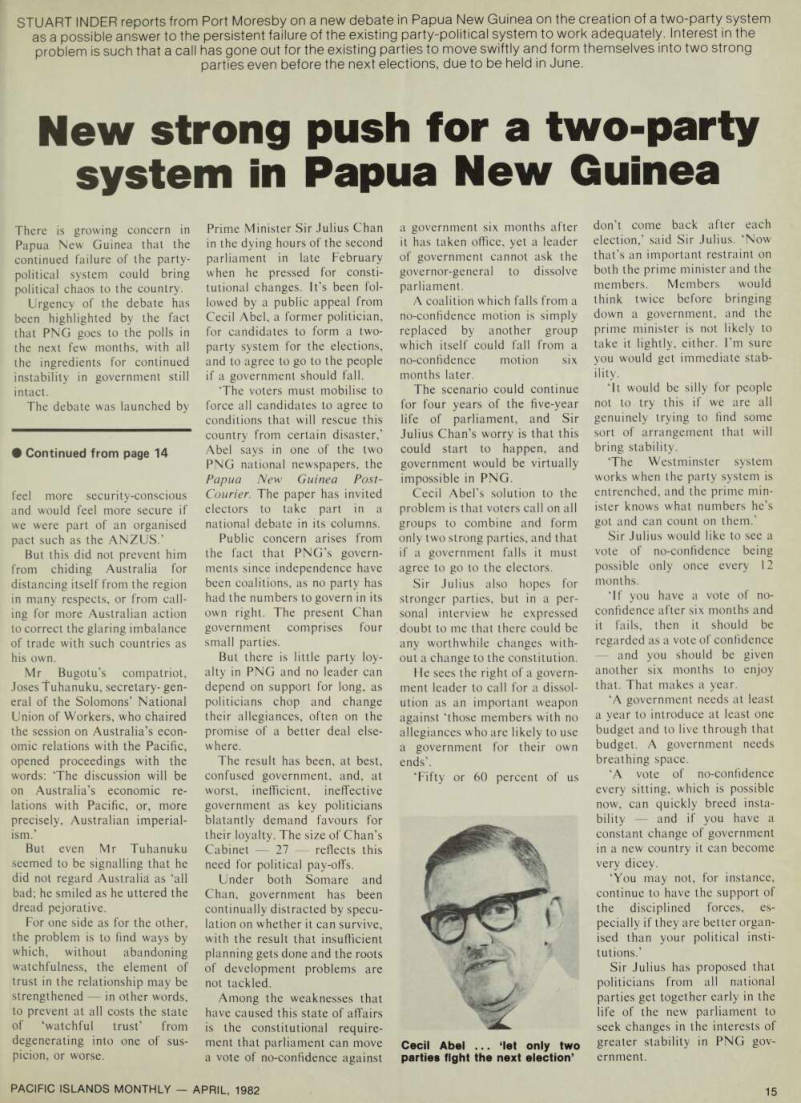
Cecil Abel’s solution to the problem is that voters call on all groups to combine and form only two strong parties, and that if a government falls it must agree to go to the electors.
Sir Julius also hopes for stronger parties, but in a per sonal interview he expressed doubt to me that there could be any worthwhile changes with out a change to the constitution.
He sees the right of a govern ment leader to call for a dissol ution as an important weapon against ‘those members with no allegiances who are likely to use a government for their own ends’. ‘Fifty or 60 percent of us
don’t come back after each election,’ said Sir Julius. ‘Now that’s an important restraint on both the prime minister and the members. Members would think twice before bringing down a government, and the prime minister is not likely to take it lightly, either. I’m sure you would get immediate stab ility. ‘lt would be silly for people not to try this if we are all genuinely trying to find some sort of arrangement that will bring stability. ‘The Westminster system works when the party system is entrenched, and the prime min ister knows what numbers he’s got and can count on them.' Sir Julius would like to see a vote of no-confidence being possible only once every 12 months. ‘lf you have a vote of no confidence after six months and it fails, then it should be regarded as a vote of confidence - and you should be given another six months to enjoy that. That makes a year. ‘A government needs at least a year to introduce at least one budget and to live through that budget. A government needs breathing space. ‘A vote of no-confidence every sitting, which is possible now, can quickly breed insta bility and if you have a constant change of government in a new country it can become very dicey. ‘You may not, for instance, continue to have the support of the disciplined forces, es pecially if they are better organ ised than your political insti tutions.’
Sir Julius has proposed that politicians from all national parties get together early in the life of the new parliament to seek changes in the interests of greater stability in PNG gov ernment.
Cecil Abel ... ‘let only two parties fight the next election’