Healthy
pp. 7-9 · Read in the full issue

Letters
Healthy feasters of old Nauru
Regular attenders at Islands celebrations would not have been surprised by the extract from News Drum, describing a lavish feast in Solomon Islands, in your ‘lslands Press’ section (Dec ’Bl p 49).
I have been very interested in the history of Nauru, and re cently came across an article written by a clergyman named Delaporte, in 1920. His report on a feast in Nauru might just take some beating. He wrote: ‘At one feast, at a time when the Island population was about 1000, a feast was given and all Nauruans were invited. Three hundred and sixty-five pigs, 25 000 fish, 50 bags of rice and 50 tins of flour were required to satisfy the appetites of the feasters.’
Such feasting appears to have been beneficial. Writing of Nauru in The Rabaul Record at about the same time as Delaporte, E. Stephen ob served: ‘The natives are a fine race of people. They have very little disease amongst them.
The men are of very fine physique, as also the women, many of the latter being really pretty, mostly with luxuriant hair and beautiful white, even, teeth, of which they are very careful. You very seldom see a badly proportioned man or woman and they always have a smile and greeting for every body, that being the reason why the Island is called Pleasant.’ (It was Captain John Fearn of the British ship Hunter who was the European discoverer of Nauru in 1798 and who named the Island Pleasant Island because of its attractive appearance.)
(Professor)
Paul Zimmet
Melbourne Vic Australia Those Kiwi cops
again
I am a psychologist who en joyed the rare opportunity of working in Papua New Guinea for six and a half years, return ing to live in New Zealand at the end of 1978.
My reply to N. J. Bullock’s claim (PIM Dec ’Bl p 9) that
‘our police force acted with admirable restraint in the face of extreme provocation during the recent Springbok tour of New Zealand’ is to state that in the face of a racist tour support ing apartheid, which the majority of New Zealanders objected to on moral grounds, the New Zealand police com missioner should have told the prime minister that the police force would not be used to police the tour. The Rugby Union, with or without the prime minister’s intervention, would have had no option but to call the tour off.
Instead, on September 12, 1981, at Eden Park, I stood with among others three high school teachers and a social welfare officer, none of us law-breakers or being provocative, in the front line of the Tutu No. 2 protest group. Two of us ended up later in Auckland Hospital after being viciously batoned, to be joined by defenceless con cerned citizens, including middle-aged women, following episodes in which riot squads with lethal long batons went literally ‘out of control’. I was proud that so many concerned, caring, and informed New Zealanders had the guts to face up to this sort of officially sanctioned thuggery on the deeply moral issue of racism.
Your other statement that
‘the majority of law-breakers in New Zealand are of Polynesian descent’ works against your naive assumption that we can teach the Aussies anything on racial matters as it, to me, indicates clearly both historical and contemporary racism and imbalance of opportunity.
Michael Earle
Havelock North New Zealand
Holiday travel
as pilgrimage
I read with interest the review of Cynthia Biddlecomb’s book, Pacific Tourism: Contrasts and Expectations (PIM Feb ’B2 p 39).
Especially pertinent to our position was a reference to the last chapter which apparently suggests ‘that the churches themselves should organise tours, stressing the concept of pilgrimage, as well as rec reation.’
Your readers may be inter ested to know that this idea has already been put into practice.
We are currently associated with Crossways Travel of Syd ney in sponsoring tours to Tahiti (in late June) and Vanuatu (in November), with the concepts that Cynthia Biddlecomb suggests. In fact, these are only two of a large number of such tours that Crossways are setting
up to Tahiti, Vanuatu, New Caledonia, Fiji and Tonga.
I would be happy to supply more information, as I am sure Crossways Travel (210 Pitt Street, Sydney) would.
Thank you for the wealth of information you continue to provide from the Pacific region each month.
Rev John Wyndham
Pacific Renewal and Outreach Ministries Belfield NSW Australia
Correction upon
correction ...
I would like to make a correc tion to your description of your cover picture for December, 1981.
The statement that the Spirit of the Dead shown in the picture comes from Vanicolo, Milne Bay Province, is incor rect. It actually originates in Rabaul, in the East New Britain Province of Papua New Guinea, where it is part of the people’s traditional dancing and custom.
Levi B. Takua
Panguna NSP Papua New Guinea Sorry, but reader Takua may by now have noticed a correc tion in our February issue (p3j where we explain that the December cover picture was not taken in PNG at all, but at Vanikoro in the Santa Cruz Group, Solomon Islands. Still, perhaps we can comfort our selves with the thought that similarities crop up all the time in the customary ways of peoples throughout Melanesia.
Editor.
Who knew great
uncle Willy?
I am researching my family history and am anxious to find out more about a great-uncle of mine, Captain John Lawrence William Rawson, who spent many years living around Papua New Guinea and Solomon Islands.
He was born at Helensville,
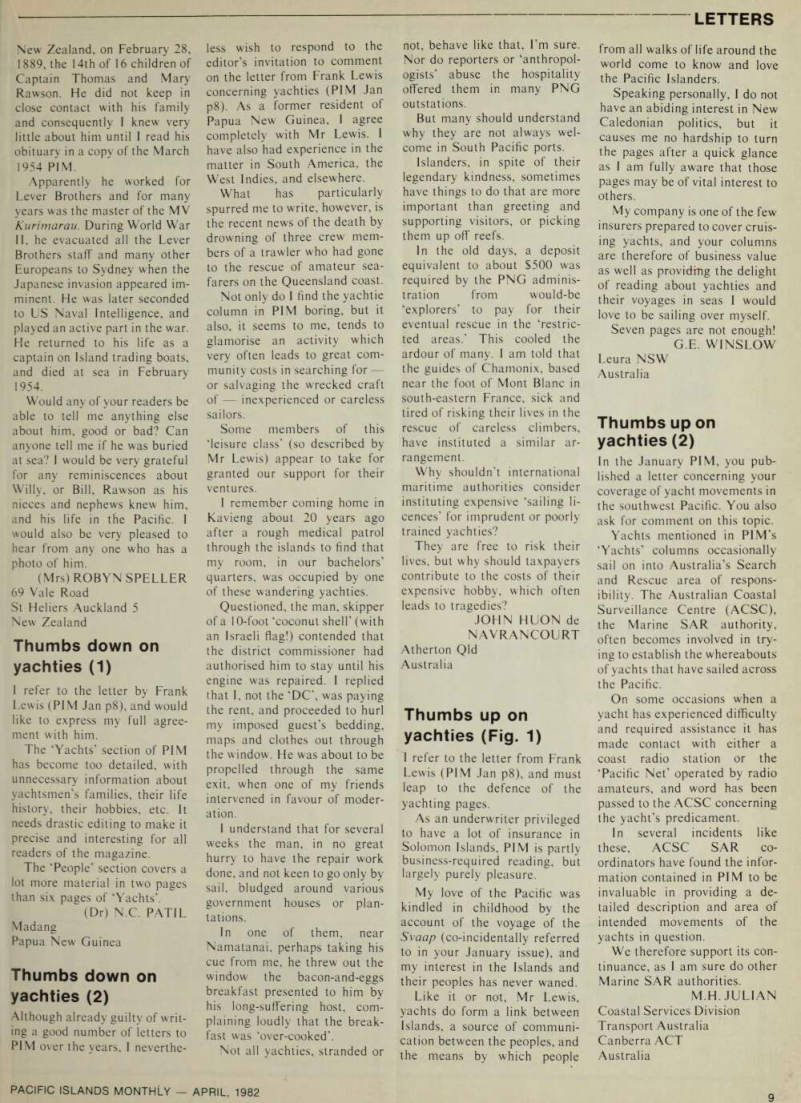
The Nauruans don’t have the feasting habit on their own: the above Islands’ spread was put on by Queen Salote to mark the first day of Queen Elizabeth’s visit to Tonga in December, 1953.
New Zealand, on February 28, 1889, the 14th of 16 children of Captain Thomas and Mary Rawson. He did not keep in close contact with his family and consequently I knew very little about him until I read his obituary in a copy of the March
1954 Pim.
Apparently he worked for Lever Brothers and for many years was the master of the MV Kurimarau. During World War 11, he evacuated all the Lever Brothers staff and many other Europeans to Sydney when the Japanese invasion appeared im minent. He was later seconded to US Naval Intelligence, and played an active part in the war.
He returned to his life as a captain on Island trading boats, and died at sea in February 1954.
Would any of your readers be able to tell me anything else about him, good or bad? Can anyone tell me if he was buried at sea? I would be very grateful for any reminiscences about Willy, or Bill, Rawson as his nieces and nephews knew him, and his life in the Pacific. I would also be very pleased to hear from any one who has a photo of him.
(Mrs) Robyn Speller
69 Vale Road St Heliers Auckland 5 New Zealand Thumbs down on
yachties (1)
I refer to the letter by Frank Lewis (PIM Jan p 8), and would like to express my full agree ment with him.
The ‘Yachts’ section of PIM has become too detailed, with unnecessary information about yachtsmen’s families, their life history, their hobbies, etc. It needs drastic editing to make it precise and interesting for all readers of the magazine.
The ‘People’ section covers a lot more material in two pages than six pages of ‘Yachts’.
(Dr) N.C. Patil
Madang Papua New Guinea Thumbs down on yachties (2) Although already guilty of writ ing a good number of letters to PIM over the years, I neverthe
less wish to respond to the editor’s invitation to comment on the letter from Frank Lewis concerning yachties (PIM Jan p 8). As a former resident of Papua New Guinea, I agree completely with Mr Lewis. I have also had experience in the matter in South America, the West Indies, and elsewhere.
What has particularly spurred me to write, however, is the recent news of the death by drowning of three crew mem bers of a trawler who had gone to the rescue of amateur sea farers on the Queensland coast.
Not only do I find the yachtie column in PIM boring, but it also, it seems to me, tends to glamorise an activity which very often leads to great com munity costs in searching for or salvaging the wrecked craft of inexperienced or careless sailors.
Some members of this ‘leisure class’ (so described by Mr Lewis) appear to take for granted our support for their ventures.
I remember coming home in Kavieng about 20 years ago after a rough medical patrol through the islands to find that my room, in our bachelors’ quarters, was occupied by one of these wandering yachties.
Questioned, the man, skipper of a 10-foot ‘coconut shell’ (with an Israeli flag!) contended that the district commissioner had authorised him to stay until his engine was repaired. I replied that I, not the ‘DC’, was paying the rent, and proceeded to hurl my imposed guest’s bedding, maps and clothes out through the window. He was about to be propelled through the same exit, when one of my friends intervened in favour of moder ation.
I understand that for several weeks the man, in no great hurry to have the repair work done, and not keen to go only by sail, bludged around various government houses or plan tations.
In one of them, near Namatanai, perhaps taking his cue from me, he threw out the window the bacon-and-eggs breakfast presented to him by his long-suffering host, com plaining loudly that the break fast was ‘over-cooked’.
Not all yachties, stranded or
not, behave like that, I’m sure.
Nor do reporters or ‘anthropol ogists’ abuse the hospitality offered them in many PNG outstations.
But many should understand why they are not always wel come in South Pacific ports.
Islanders, in spite of their legendary kindness, sometimes have things to do that are more important than greeting and supporting visitors, or picking them up off reefs.
In the old days, a deposit equivalent to about $5OO was required by the PNG adminis tration from would-be ‘explorers’ to pay for their eventual rescue in the ‘restric ted areas.’ This cooled the ardour of many. I am told that the guides of Chamonix, based near the foot of Mont Blanc in south-eastern France, sick and tired of risking their lives in the rescue of careless climbers, have instituted a similar ar rangement.
Why shouldn't international maritime authorities consider instituting expensive ‘sailing li cences’ for imprudent or poorly trained yachties?
They are free to risk their lives, but why should taxpayers contribute to the costs of their expensive hobby, which often leads to tragedies?
John Huon De
Navrancourt
Atherton Qld Australia Thumbs up on
yachties (Fig. 1)
I refer to the letter from Frank Lewis (PIM Jan p 8), and must leap to the defence of the yachting pages.
As an underwriter privileged to have a lot of insurance in Solomon Islands, PIM is partly business-required reading, but largely purely pleasure.
My love of the Pacific was kindled in childhood by the account of the voyage of the Svaap (co-incidentally referred to in your January issue), and my interest in the Islands and their peoples has never waned.
Like it or not, Mr Lewis, yachts do form a link between Islands, a source of communi cation between the peoples, and the means by which people
from all walks of life around the world come to know and love the Pacific Islanders.
Speaking personally, I do not have an abiding interest in New Caledonian politics, but it causes me no hardship to turn the pages after a quick glance as I am fully aware that those pages may be of vital interest to others.
My company is one of the few insurers prepared to cover cruis ing yachts, and your columns are therefore of business value as well as providing the delight of reading about yachties and their voyages in seas I would love to be sailing over myself.
Seven pages are not enough!
G.E. Winslow
Leura NSW Australia Thumbs up on
yachties (2)
In the January PIM, you pub lished a letter concerning your coverage of yacht movements in the southwest Pacific. You also ask for comment on this topic.
Yachts mentioned in PI M’s ‘Yachts’ columns occasionally sail on into Australia’s Search and Rescue area of respons ibility. The Australian Coastal Surveillance Centre (ACSC), the Marine SAR authority, often becomes involved in try ing to establish the whereabouts of yachts that have sailed across the Pacific.
On some occasions when a yacht has experienced difficulty and required assistance it has made contact with either a coast radio station or the ‘Pacific Net’ operated by radio amateurs, and word has been passed to the ACSC concerning the yacht’s predicament.
In several incidents like these, ACSC SAR co ordinators have found the infor mation contained in PIM to be invaluable in providing a de tailed description and area of intended movements of the yachts in question.
We therefore support its con tinuance, as I am sure do other Marine SAR authorities.
M.H. Julian
Coastal Services Division Transport Australia Canberra ACT Australia