discovered, in tiny specks
pp. 45-49 · Read in the full issue

Travel
Cook Islands: Civilisation discovered, in tiny specks
American writer JOHN B. HART and his wife not long ago visited the (for them) far-off Cook Islands. What they found, they found to be good. In the following report, Mr Hart strongly suggests that many of his compatriots should go there too and seems prepared to wager they’d enjoy the experience as much as the Harts did.
‘Here in Cook Islands,’ Captain Rio explains, ‘Nature is good, very kind. Always warm, plenty food from land, sea too. Easy life.' But don't worry yourself if you’re not exactly certain where in the world these idyllic islands are located.
The truth is, most other people can't quite pinpoint the Cooks on the globe either. And many an experienced geogra pher needs a magnifying glass even to look for these tiny specks of civilisation.
The 15 coral atolls and vol canic islands known as the Cooks (once called the Hervey Islands) stretch almost 1300 kilometres from north to south.
And they are broadly scattered over almost 2000 square kilo metres below the equator.
To find the capital island of Rarotonga, look 3000 nautical miles south of Honolulu, 600 southwest of Tahiti, and 750 southeast of Samoa. Or, if you prefer working from the bottom of the map upward, Raro is 1600 nautical miles northeast of Auckland. And the part volcanic, part-coral scenic isle of Aitutaki is only 140 nautical miles further north.
Though populated by some 18 000 friendly English speaking people, most of the alluring Cook Islands are rarely visited by outsiders. Only Rarotonga and Aitutaki really cater to travellers at all. But that doesn’t mean for a minute that the rest of the Cooks aren’t worth seeing. For folk who are curious about life in the South Seas, quite the contrary is true.
Discovery of the Southern Cooks (two atolls and seven islands) is credited to Captain Cook in 1773. Later on, the crew of Bligh’s Bounty is said to have had a quick look at them also.
The northern Cooks (five atolls and one island) were seen by Europeans much earlier Rakahanga by Quiros in 1591,
and Pukapuka in 1595 by Mendana.
Long before contact, how ever, Polynesians had been call ing both these hospitable groups of rock, sand, and coral home sweet home for more than 1000 years. Cook’s meticulous journal referred to the many similarities in language and customs between these people and the Maoris of New Zea land. He also likened them to Tahitians. So, soon after the London Missionary Society, led by the Reverend John Williams, swooped down to convert yet another simple island culture.
To reach the Cook Islands today, fly Air New Zealand from Auckland or Tahiti, Polynesian Airlines from Tahiti or Western Samoa. Not nearly as adventurous as the oldtime Solent flying boat that served the famed Coral Route a quar ter of a century ago, perhaps.
But certainly more comfortable than vintage cargo-passenger boats that still even now wallow through the Cooks occasionally.
You land at Rarotonga’s modern international airport between the mountains and the sea. Smiling representatives of the island's 9000 residents im mediately begin to make you feel most welcome, despite the fact they have always been isolated from our ‘other world’ of hustle and bustle.
Spectacularly beautiful, green Rarotonga is only 32 kilometres around, but plenty enough to combine much of the simple charm of bygone times with the changing values of
society today. The refreshingly clean unpolluted natural en vironment remains as always a lush tropical garden of colour ful trees and flowers on all sides.
Weather in the Cooks is mostly warm and sunny, provid ing a vigorous agricultural econ omy (fruits, vegetables, copra), with a mild year-round growing season. Minor temperature differences may be the reverse of your own, remember.
Warmer and wetter months are December to March, when even an errant hurricane may briefly appear. From April until the end of October, it is cooler and drier than the rest of the year.
Accommodation for visitors
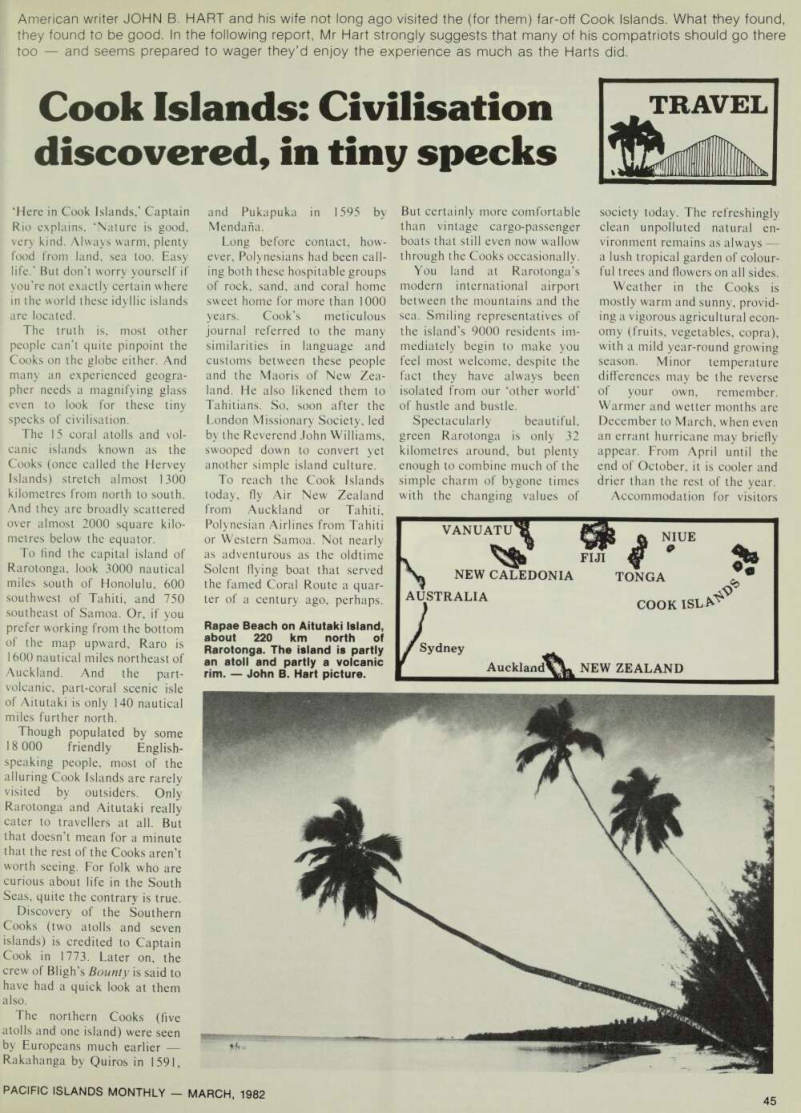
Rapae Beach on Aitutaki Island, about 220 km north of Rarotonga. The island is partly an atoll and partly a volcanic rim. - John B. Hart picture.
to Rarotonga ranges from de lightful housekeeping units like Alex and Metua Moreland’s Orange Grove Fodge, or Colin and Shirley McNeil’s Little Polynesian, to moderately priced larger places like the lively Tamure Resort and the swinging Beach Hotel, up to the expensive new Rarotonga Hotel a world-class complex of 100 air-conditioned rooms stun ningly situated.
When my wife and I arrived, islanders Don and Mii O'Bryan kindly offered us a ride into town where we rented a shiny small car. After recommending a new five-store shopping centre nearby, and pointing out an infamous watering hole (shades of Quinn’s Hut in old Papeete) known as the Banana Court, Mii introduced us to the oceanfront Kii Kii Motel close in to Avarua village.
And, thanks be to Tangaroa, Don mentioned the unique trop ical atmosphere of ‘a first-class little steak house and bar’ hidden away in the village of Titikaveka. Known as the Vai Ma, it’s run by a congenial Aussie, Dave Rose, and his pretty Polynesian bride, Diana.
One’s fondest memory of Rarotonga will always be the unfailing courtesy of everybody one meets. And you’ll recall many other unexpected pleasures besides.
For one, the a capella singing at the lovely and historic Christian church was as ‘heavenly’ as Judge J.J.
MacCauley had told us it would be. For another, the lovely
lagoon and peaceful islets off Muri Beach at Ngatangiia vil lage were even more pictur esque than we were told by our friends, the Symes, at their Muri Era store. From right here the legendary ‘Great Canoe Fleet’ sailed ages ago, migrat ing southwestward to populate New Zealand.
Also worthy of mention is the mysterious inland stone-paved Road of Toi which is, according to local artist Rick Welland and his wife Gwen, ‘an intriguing reminder of a much earlier culture’.
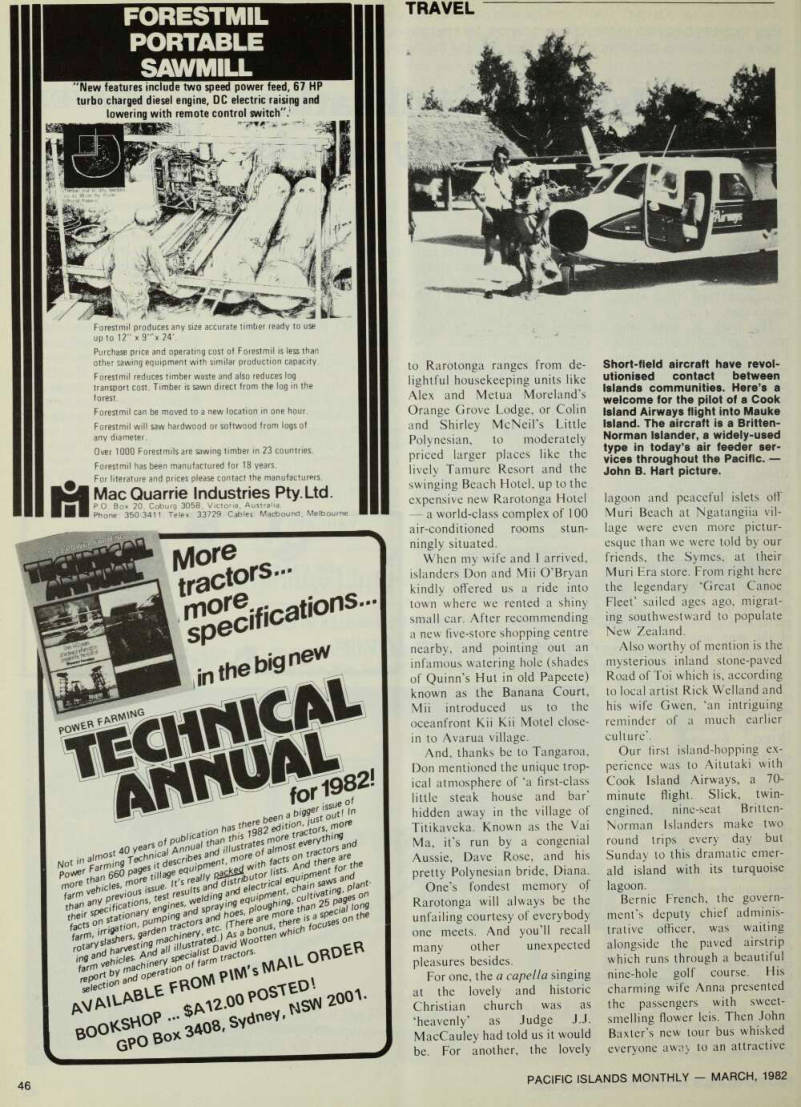
Our first island-hopping ex perience was to Aitutaki with Cook Island Airways, a 70minute flight. Slick, twin engined, nine-seal Britten- Norman Islanders make two round trips every day but Sunday to this dramatic emer ald island with its turquoise lagoon.
Bernie French, the govern ment’s deputy chief adminis trative officer, was waiting alongside the paved airstrip which runs through a beautiful nine-hole golf course. His charming wife Anna presented the passengers with sweet smelling flower leis. Then John Baxter’s new tour bus whisked everyone awa> to an attractive
Short-field aircraft have revol utionised contact between Islands communities. Here’s a welcome for the pilot of a Cook Island Airways flight into Mauke Island. The aircraft is a Britten- Norman Islander, a widely-used type in today’s air feeder ser vices throughout the Pacific. - John B. Hart picture.
group of cottages under leaning coconut palms beside the la goon.
The Rapae Motel is operated for the Tourist Authority by a capable couple named Harold and Rima Browne. They pro vide simple, efficient dining and bar service and comfortable lodging within walking distance of the main village of Arutanga.
The beach offers outrigger canoeing and snorkelling. On Fridays, Island Night dinner dances and entertainment bring islanders and guests together for a fun evening. Don’t miss it.
From the Rapae, daily tours of the huge 14-kilometre-long Aitutaki lagoon are run by Captain Rio (a retired Manihiki pearl-diver) and his youthful First Mate, John. A reef island
picnic stop, complete with swimming and snorkelling, is included in addition to sightsee ing. Truly a worthwhile trip.
Passengers learn how easily ship-wrecked sailors can survive on uninhabited sandy atolls. ‘Here on One-Foot Island,’ Rio claims, ‘man can get everything free. Plenty fish live in lagoon and plenty coconuts grow on
land. Good food everywhere.' As proof, he tossed an anchor and chain to a clump of coral protruding from the warm clear water and pulled our cabin cruiser in close enough for John to step onto the rocky forma tion. In less than five minues, a bucketful of huge choice chow der clams had been prised loose.
On Aitutaki itself, one hears
more unusual facts of life: the vast lagoon furnishes more sea food than the 2500 residents can possibly consume; if an owner’s pig roots up another person’s taro patch, the offend ing animal may be killed and butchered as a fine in payment of damages; coconuts cannot be sun-dried to make copra or mynah birds will eat up the
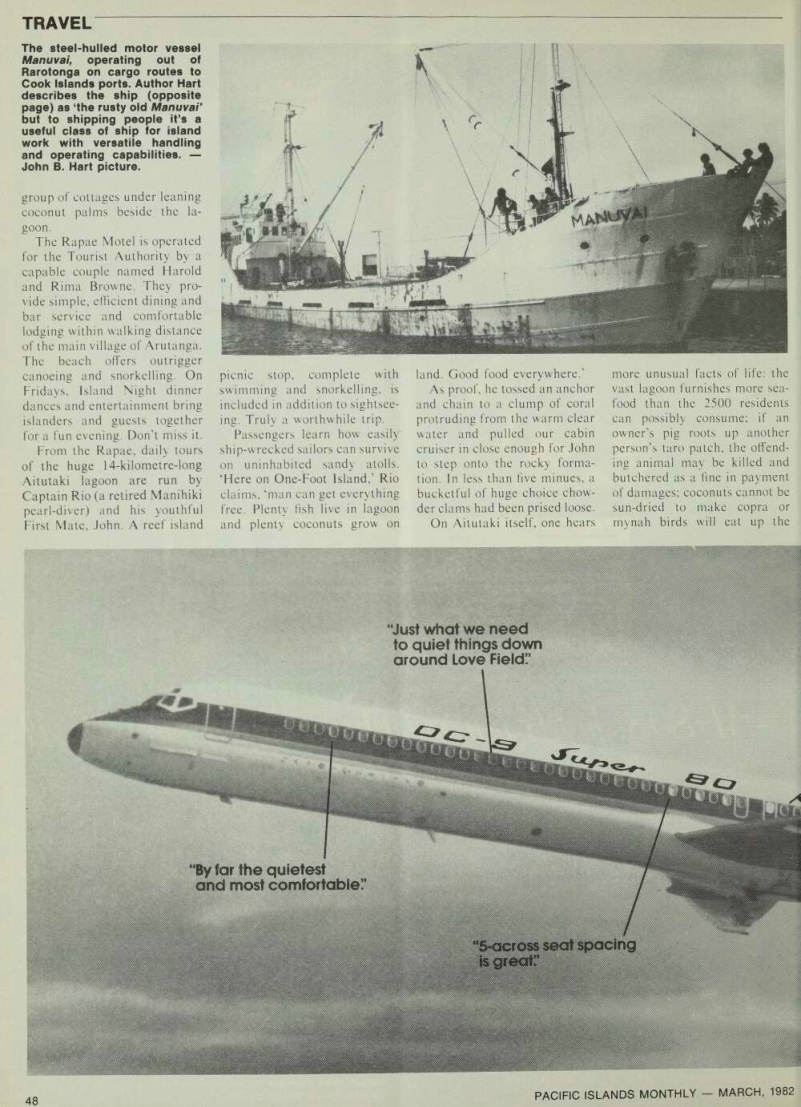
The steel-hulled motor vessel Manuvai, operating out of Rarotonga on cargo routes to Cook Islands ports. Author Hart describes the ship (opposite page) as ‘the rusty old Manuvai ’ but to shipping people it’s a useful class of ship for island work with versatile handling
and operating capabilities. -
John B. Hart picture.
whole crop, so the oil must be extracted in iron ovens fuelled with coconut husks.
Cook Islands Airways and Air Rarotonga both offer ser vice to most islands in the southern Group. They use grassy airstrips levelled by the residents themselves on Aliu, Mauke, Miliaro, and Mangaiia.
Also, local inter-island trading vessels make overnight trips to these same outliers. Since none supply regular rooms for visi tors yet. the Tourist Board on Ram recommends guest houses to stay in.
There’s no scheduled service to atolls in the Northern Group now. But plans are pending for Cook Islands Airways to use a 3000-metre runway on Penrhyn Island constructed by US troops during World War 11.
For the adventurous it’s poss ible to book an economical freighter voyage to remote northern villages aboard Cap tain Don Silk’s rusty old Manuvai. Other than by private yachts (a few are usually moored in Raro’s Avatiu harbor) such a copra schooner is
the only transport available to places like Palmerston, Suwarrow, Pukapuka, Penrhyn, Manihiki and Rakahanga.
Deck passengers provide their own food and bedding, while cabin customers eat with the crew. Again, the Tourist Board can suggest guest houses should you wish to leave the ship overnight once in a while during its long three-to-four week trading trip.
The Cook Islands govern themselves under an easy-going democratic system in free as sociation with New Zealand.
The Prime Minister, Sir Thomas Davis, is a noted intel lectual who holds medical de grees from universities in both New Zealand and Australia, and from Harvard in the USA.
In 1971, after 20 years of service as a medical officer with America’s space programme, he returned to enter politics on the very island where he was born. In a few short years he rose to the top of his new profession, and has since been knighted by the Queen.
A ‘must-read’ book about
Davis’s earlier life is Doctor To The Islands. Extremely well written by Lydia Davis, it has become a blue-water classic among cruising yachtsmen.
To enrol at Harvard, mariner Tom and his young family sailed their own 14-metre ketch all the way across the Pacific from New Zealand to Peru, through the Roaring Forties in wintertime. They then shaped a course northward to Boston along the west coast of South
America, through the Panama Canal, and up the Atlantic side of the United States.
The accompanying list of worthwhile (though not easy to find) books about the Cooks, might be of value to interested readers. So, instead of merely wondering in which part of what ocean the tiny islands may be found, learning more about them might encourage you to ‘see things for yourself some day just as we did.
Book Author Publisher Date An Island To Oneself Neale Collins of Auckland 1975 Isles of The Frigate Bird Syme Michael Joseph of London 1975 The Book of Puka- Puka Frisbie Century Co of New York 1929 Sisters In The Sun Pcrcival Robert Hale, Ltd, London 1973 The Lagoon is Lonely Now Syme Millwood Press, Wellington 1978 Today Is Forever Hillas Doubleday & Co, New York 1964 Island Of Desire Frisbie Doubleday & Co, New York 1944 Doctor To The Islands Davis Little Brown & Co, Boston 1954 National Geographic.
Usa
Shadbolt Volume 132, No 2, August 1967