Tahiti, as the early
pp. 43-44 · Read in the full issue

explorers saw it
Early Tahiti: As the Explorers Saw It 1767-1797. By Edwin N.
Ferdon. Published by the Uni versity of Arizona Pcess, Tucson, Arizona, 1981. 371 pp + xvi. Cloth, 5U529.50, paper back, 5U512.50. ISBN 0-8165-0708-2 (cloth), ISBN 0-8 / 65-0720-1 (pbk.).
A curious facet of Pacific schol arship is that a good number of academics who start their ca reers as anthropologists, botan ists, geographers, archaeol ogists and what not finish up as practising historians. They usually don’t explain why they leave their own fields.
Three such scholars whose names come to mind are Douglas Oliver, former pro fessor of anthropology at Harvard University; Oskar Spate, foundation professor of geography at the Australian National University; and Saul Riesenberg, who recently re tired as curator of ethnology at the Smithsonian Institution, Washington. All have produced substantial works on the history of the Pacific in recent years.
These latter-day historians have recently been joined by Edwin N. Ferdon, an American archaeologist, who admits that he swapped to history because his own discipline did not tell him enough about the Polynesian past.
Ferdon, now 68, was a mem ber of Thor Heyerdahl’s Norwegian archaeological ex pedition to Easter Island and the East Pacific in 1955-56. He had never worked in Polynesia before, and he soon found that it was ‘one thing to excavate the remains of prehistoric Polynesians’ and ‘quite another to recreate the life that orig inally made the shell and bone artifacts, built the ceremonial structures of stone, and oc casionally carved statues out of native rock’.
To try to find out what life in pre-European Polynesia was like, Ferdon turned to the re cords of the British, French and Spanish explorers who visited Tahiti at frequent intervals be tween its discovery by Captain Wallis in 1767 ana ihe arrival of the first Protestant missionaries
in 1797. To fill in occasional gaps, or to ‘illustrate historical changes through time’, Ferdon also dipped into the records of the early missionaries.
After seven years of intermit tent research, during which he scoured his sources with great diligence, Ferdon has produced an attractive, useful and highly readable volume on what the explorers saw in Tahiti from 1767 to 1797.
The book is divided into a dozen sections which cover such subjects as the physical features and dress of the Tahitians, law and order, the supernatural world, daily life, tapa-making, birth, marriage and death, etc,
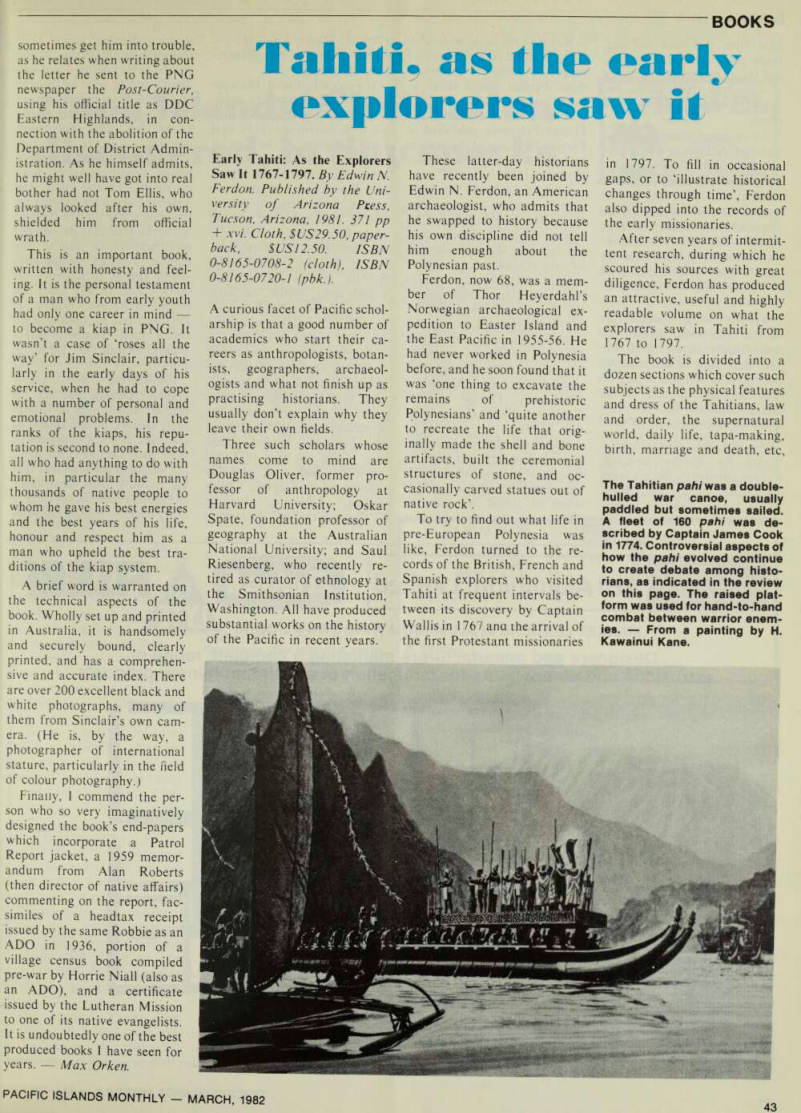
The Tahitian pahi was a double hulled war canoe, usually paddled but sometimes sailed.
A fleet of 160 pahi was de scribed by Captain James Cook in 1774. Controversial aspects of how the pahi evolved continue to create debate among histo rians, as indicated in the review on this page. The raised plat form was used for hand-to-hand combat between warrior enem ies. - From a painting by H.
Kawainui Kane.
food from the land and sea, trade and transport, warfare, and the effects on the Tahitians of European trade goods, im ported plants, animals and ideas.
As an introduction to ancient Tahitian culture, or as an easy way to track down scattered references on many different subjects, Ferdon’s work can be warmly recommended. Even those who are already familiar with the literature he cites will be stimulated by his discussions on various subjects, if not always convinced by his con clusions.
Ferdon’s work, however, has several unfortunate defects. All undoubtedly derive from the fact that most of his research was done in Arizona where he was associate director of the State Museum for 17 years until his retirement in 1978.
As Arizona is scarcely a centre for Pacific research, Ferdon apparently did not learn until it was 100 late that Oliver, in his Ancient Tahitian Society (published in 1975), was aiming
to do much the same as Ferdon himself, based on a much wider range of research materials.
Also, Ferdon seems never to have learned of the massive bibliography of Tahiti and French Polynesia published in Paris in 1967; nor of the present reviewer’s The Lost Caravel (Sydney, 1975).
Lack of access to the bibli ography meant, among other things, that Ferdon did all of his research in blissful ignorance of the fact that the most compre hensive account of early Tahiti is that contained in the so-called journal of James Morrison of the Bounty , published in 1935.
Moreover, through missing this item, Ferdon never learned that Morrison’s work was the princi pal source of the ethnographic appendix in James Wilson’s A Missionary Voyage to the Southern Pacific Ocean (Lon don, 1799).
As a result of these omissions, Ferdon constantly attributes in formation to the missionaries who arrived in Tahiti in 1797 when its author was actually Morrison, who was there in
1789-91. Where dates are im portant, Ferdon’s work is there fore misleading.
If Ferdon had read The Lost Caravel before going to press, he might not have glossed over his own statement (p 19) that some Tahitians at the time of contact had white skins, that others were said to be almost like Europeans, and that two women were singled out as having blue eyes and reddish curly hair. Ferdon might also have found a satisfactory expla nation for the ‘sophisticated’
Society Islands sailing craft called pahi, which, he says, ‘seems to have suddenly ap peared in Tahitian waters fully blown or nearly so’ (p 236).
Finally, Ferdon sometimes falls into the trap of drawing positive conclusions from nega tive evidence. Thus, because none of the early explorers described cock-fighting among the Tahitians, Ferdon claims that it did not exist in Tahiti anciently and was probably introduced by Captain Cook’s sailors. Likewise, because Wallis was the only explorer to
mention hearing conch shell trumpets, he thinks that Wallis was probably confused and was ‘simply adding what he thought he should have heard because conch shell trumpets were known for other Polynesian islands’.
Research into later literature would almost certainly have convinced Ferdon that the Tahitians were cock-fighting en thusiasts at the time of contact; while the fact that pu (conch) was recorded in one of the earliest Tahitian vocabularies would appear to disprove his other claim. In any case, one might well ask: where in Polynesia had Europeans heard conch shell trumpets before Wallis arrived in Tahiti in 1767?
Considering that ethno graphic research was not the primary aim of most of Tahiti’s early visitors, no one should be surprised at a few omissions on their part. On the other hand, the wealth of material that they did record is truly remarkable, as Ferdon’s book makes clear on
every page.
Robert Langdon.