The kiap story told with 'an
pp. 39-43 · Read in the full issue

Books
The kiap story told with 'an informed personal element'
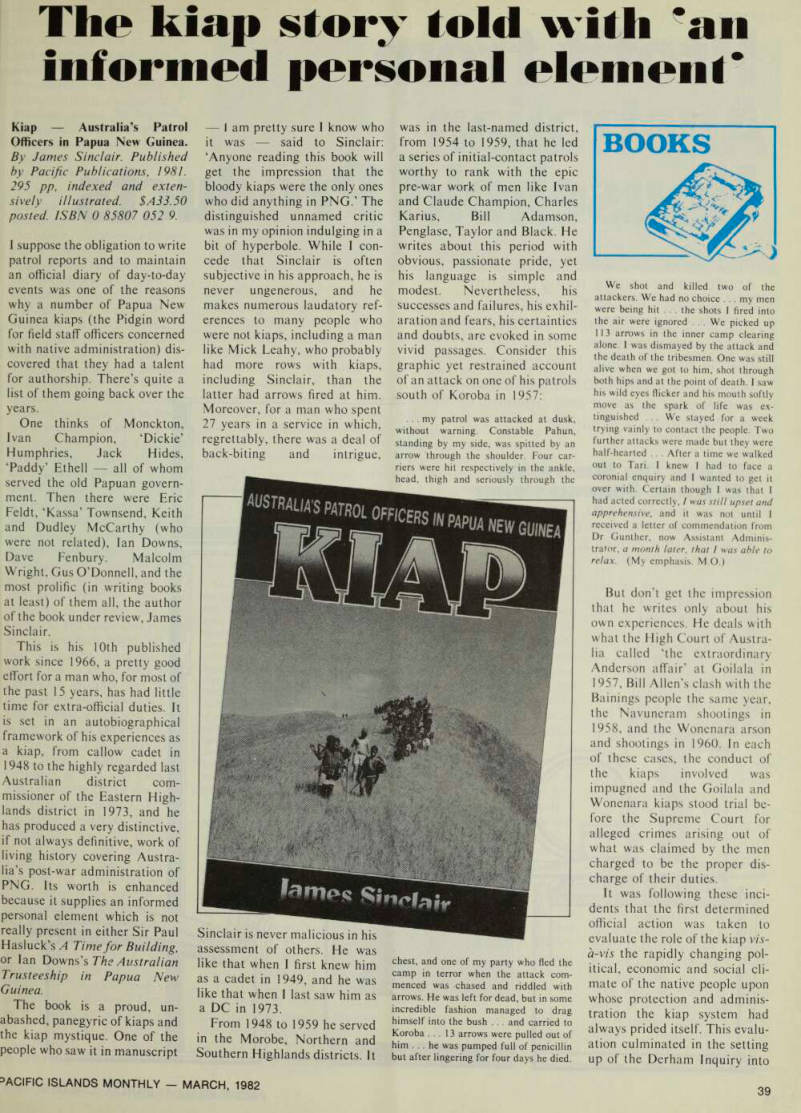
Kiap Australia’s Patrol Officers in Papua New Guinea.
By James Sinclair. Published by Pacific Publications, 1981. 295 pp, indexed and exten sively illustrated. SAS 3.50 posted. ISBN 0 85807 052 9.
I suppose the obligation to write patrol reports and to maintain an official diary of day-to-day events was one of the reasons why a number of Papua New Guinea kiaps (the Pidgin word for field staff officers concerned with native administration) dis covered that they had a talent for authorship. There’s quite a list of them going back over the years.
One thinks of Monckton, Ivan Champion, ‘Dickie’
Humphries, Jack Hides, ‘Paddy’ Ethel! all of whom served the old Papuan govern ment. Then there were Eric Feldt, ‘Kassa’ Townsend, Keith and Dudley McCarthy (who were not related), lan Downs, Dave Fenbury. Malcolm Wright, Gus O’Donnell, and the most prolific (in writing books at least) of them all, the author of the book under review, James Sinclair.
This is his 10th published work since 1966, a pretty good effort for a man who, for most of the past 15 years, has had little time for extra-official duties. It is set in an autobiographical framework of his experiences as a kiap, from callow cadet in 1948 to the highly regarded last Australian district com missioner of the Eastern High lands district in 1973, and he has produced a very distinctive, if not always definitive, work of living history covering Austra lia’s post-war administration of PNG. Its worth is enhanced because it supplies an informed personal element which is not really present in either Sir Paul Hasluck’s A Time for Building, or lan Downs’s The Australian Trusteeship in Papua New Guinea.
The book is a proud, un abashed, panegyric of kiaps and the kiap mystique. One of the people who saw it in manuscript
1 am pretty sure I know who it was said to Sinclair; ‘Anyone reading this book will get the impression that the bloody kiaps were the only ones who did anything in PNG.’ The distinguished unnamed critic was in my opinion indulging in a bit of hyperbole. While I con cede that Sinclair is often subjective in his approach, he is never ungenerous, and he makes numerous laudatory ref erences to many people who were not kiaps, including a man like Mick Leahy, who probably had more rows with kiaps, including Sinclair, than the latter had arrows fired at him.
Moreover, for a man who spent 27 years in a service in which, regrettably, there was a deal of back-biting and intrigue,
Sinclair is never malicious in his assessment of others. He was like that when I first knew him as a cadet in 1949, and he was like that when I last saw him as a DC in 1973.
From 1948 to 1959 he served in the Morobe, Northern and Southern Highlands districts. It
was in the last-named district, from 1954 to 1959, that he led a series of initial-contact patrols worthy to rank with the epic pre-war work of men like Ivan and Claude Champion, Charles Karius, Bill Adamson, Penglase, Taylor and Black. He writes about this period with obvious, passionate pride, yet his language is simple and modest. Nevertheless, his successes and failures, his exhil aration and fears, his certainties and doubts, are evoked in some vivid passages. Consider this graphic yet restrained account of an attack on one of his patrols south of Koroba in 1957: ... my patrol was attacked at dusk, without warning. Constable Pahun, standing by my side, was spitted by an arrow through the shoulder. Four car riers were hit respectively in the ankle, head, thigh and seriously through the
chest, and one of my party who fled the camp in terror when the attack com menced was chased and riddled with arrows. He was left for dead, but in some incredible fashion managed to drag himself into the bush . . . and carried to Koroba ... 13 arrows were pulled out of him ... he was pumped full of penicillin but after lingering for four days he died.
We shot and killed two of the attackers. We had no choice . . . my men were being hit . . . the shots I fired into the air were ignored . . . We picked up 113 arrows in the inner camp clearing alone. I was dismayed by the attack and the death of the tribesmen. One was still alive when we got to him, shot through both hips and at the point of death. I saw his wild eyes flicker and his mouth softly move as the spark of life was ex tinguished . . . We stayed for a week trying vainly to contact the people. Two further attacks were made but they were half-hearted . . . After a time we walked out to Tari. I knew I had to face a coronial enquiry and I wanted to get it over with. Certain though I was that I had acted correctly, I was still upset and apprehensive, and it was not until I received a letter of commendation from Dr Gunther, now Assistant Adminis trator, a month later, that I was able to relax. (My emphasis. M. 0.) But don’t get the impression that he writes only about his own experiences. He deals with what the High Court of Austra lia called ‘the extraordinary Anderson affair’ at Goilala in 1957, Bill Allen’s clash with the Bainings people the same year, the Navuneram shootings in 1958, and the Wonenara arson and shootings in 1960. In each of these cases, the conduct of the kiaps involved was impugned and the Goilala and Wonenara kiaps stood trial be fore the Supreme Court for alleged crimes arising out of what was claimed by the men charged to be the proper dis charge of their duties.
It was following these inci dents that the first determined official action was taken to evaluate the role of the kiap vis a-vis the rapidly changing pol itical, economic and social cli mate of the native people upon whose protection and adminis tration the kiap system had always prided itself. This evalu ation culminated in the setting up of the Derham Inquiry into
the Administration of Justice, and there can be no doubt, as Sinclair clearly indicates, that the adoption of Derham’s rec ommendations, as ordered by Hasluck, meant the beginning of the end of the traditional kiap pre-eminence in native adminis tration in all its many and varied facets.
This is not the place for any detailed assessment of the soundness or otherwise of Derham’s recommendations, but 1 completely agree with Sinclair when he asserts (1) that the premature withdrawal of substantial kiap police powers was a potent cause of the breakdown in law and order in many areas, particularly in the Highlands; and (2) that the direction in which the adminis tration of justice was taken in
the early 1960 s led eventually
to the virtual rejection of West ern concepts of the rule of law by many young and educated native people, and this has unfortunately persisted beyond independence From 1959 onwards, Sinclair was no longer actively person ally involved in initial-contact patrols. His account of his transformation from being a practitioner of ‘bluff, sweet talk and quiet force’ essential elements in dealing with the turbulent and suspicious people of the Southern Highlands into the poised, practised, DC at Goroka, is again given with admirable modesty and econ omy of phrase. Inevitably, in this progress which saw him a senior Assistant District Officer at Wau and Finschhafen, DO and Deputy District Com missioner at Lae and Goroka, and eventually DC of the East ern Highlands district, he en countered problems focusing around the divergent interests of the native and non-native populations of these centres, and also the differences which arose between the various gov ernment departments. When this situation was present, it did not help if there were person ality clashes between senior officers, and if the senior officers concerned had a common kiap background, problems became even harder to resolve. One
such imbroglio developed in
Lae between the redoubtable Horrie (later Sir Horace) Niall,
the DC, and his DDC, the tough and strong-minded Des Ashton. 1 like the tactful way in which Sinclair alludes to this clash of Titans. As a senior ADO he was simultaneously beholden to both of them, and, from his account, he seems to have manoeuvred between them very skilfully. No doubt his capacity for ‘sweet talk’ referred to earlier had not entirely left him.
Sinclair has a very neat turn of descriptive phraseology and I can’t resist quoting this refer ence to the late Sir Alan Mann, chief justice of PNG from 1957 to his lamented and untimely death in 1970; Mann was tall, handsome and charm ing and knowledgeable on an extraordi nary variety of subjects. He knew a lot of music, he loved orchids, flowers and shrubs, and he fancied himself as a gourmet chef ... I well remember a dinner party (at Sinclair’s house) that began at eight and ended at midnight with us still at the table, while Mann talked and talked, the food growing cold on his plate. He had an unnerving habit of gazing off gently over your head as he talked. Next morning he came to break fast informally clad in a length of flowered print material worn as a laplap and carried on the conversation at the point he had left off the night before. He was a likeable man.
As a matter of interest, I myself recall Sir Alan Mann climbing the flagpole at Bill Seale’s house in Goroka, late at night, during a small ‘get together’ to meet David Derham. I thought at the time, but I am not so sure now, that it was decidedly eccentric behav iour on the part of a chief justice, even one as physically active as Mann then was.
There is an interesting chap ter in the book dealing (a) with the trouble in Bougainville over the negotiations to purchase land for the CRA copper ven ture, and (b) with the contro
versial nature of Gough Whitlam’s meeting with the Mataungan Association in Rabaul in 1969.
Sinclair (who I think has a justifiable soft spot for his old boss, Des Ashton, then DC, Bougainville) reveals that Ashton was limited by Port Moresby to offering the Rorovana native owners of the land, no more than $3O 000 for the outright purchase of the land being sought. When this offer was summarily rejected by the Rorovanas (by and with the advice of the public solicitor, Peter Lalor, and the Marist mission) Ashton was replaced as chief negotiator by Bill Conroy, the director of agricul ture, and a very downy bird indeed. Mirabile dictu, the ‘ante’ was upped to $3OO 000, and that for a 40-year lease and not an outright purchase.
Sinclair clearly implies that Ashton was unfairly criticised because of his ‘hard driving style of negotiation’, and penal ised by being transferred later on to Manus, then widely re garded as a backwater so far as administration activity was con cerned. As I see this episode, I would also strongly believe that somewhere along the line Ashton had also crossed the path of the powerful and ruth less Tom Ellis, his director. Old ‘Laughing Boy’, as Tommy was ironically referred to by his juniors, was seldom if ever thwarted when he was discon tented with any particular officer, no matter how senior and efficient, as Ashton un
doubtedly was.
Sinclair is most critical of Whitlam for what he describes as ‘his support for an association that had beaten up elected
councillors and openly defied the law’. This interpretation of what had happened was based on information given him by his close friend, Harry West, the Rabaul DC. West had every reason to lake a poor view of Whitlam because, at a meeting with Tolai councillors, Whitlam had made a factually wrong statement which was very prop erly and promptly correc ted by West. Whitlam turned on West and savaged Tiim for daring to correct him. He later made a personal attack on West in a speech in parliament in Canberra. West, of course, had no opportunity to defend him self.
That was a cowardly thing to do, and I hold absolutely no brief whatsoever for Whitlam.
But I still don’t agree with Sinclair’s assessment of the event. I prefer lan Downs’ much more balanced and care ful analysis, not only of the immediate consequences of the visit, but of its long-term impli cations (see The Australian Trusteeship in Papua New Guinea, pp 463-467).
From my personal knowledge of Jim Sinclair, I am aware that from time to time he allows his heart to rule his head which is not a bad fault to have. When his emotions are aroused, as they were at Whitlam’s treat ment of West, his judgment is apt to become impaired, and he reacts impulsively and spontaneously. I think he is aware of this, and realises it can
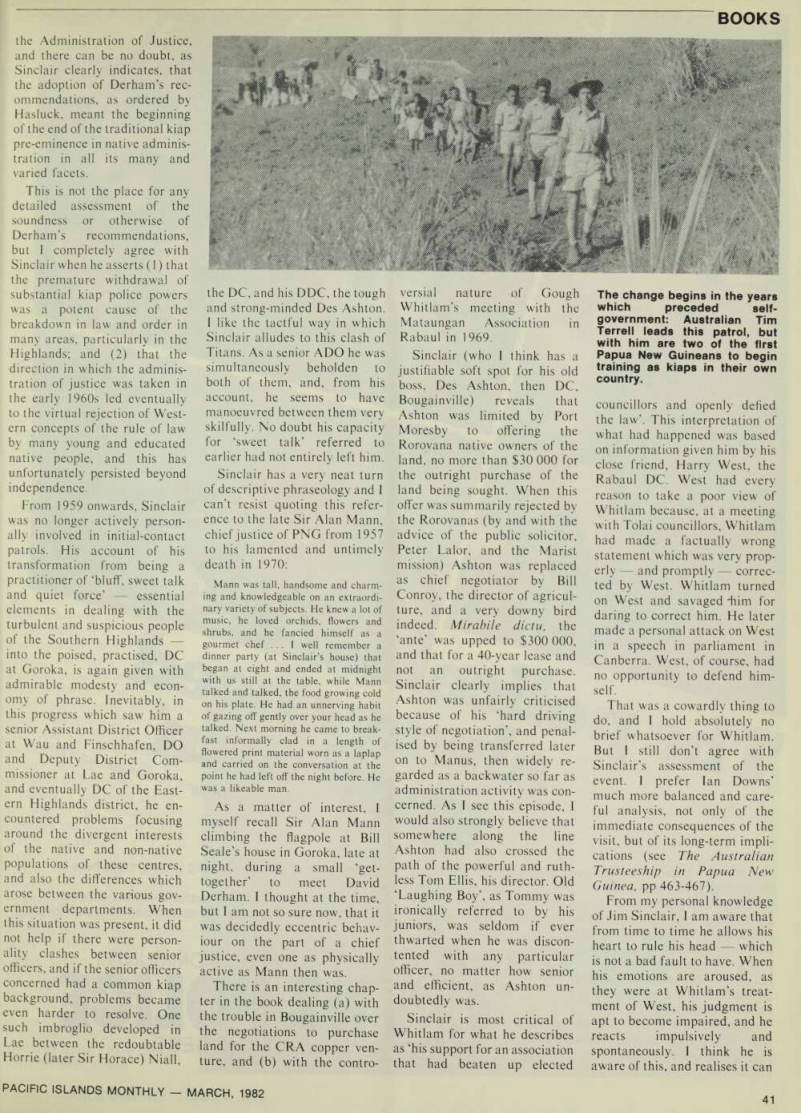
The change begins in the years which preceded self government: Australian Tim Terrell leads this patrol, but with him are two of the first Papua New Guineans to begin training as kiaps in their own country.
sometimes gel him into trouble, as he relates when writing about the letter he sent to the PNG newspaper the Post-Courier, using his official title as DDC Eastern Highlands, in con nection with the abolition of the Department of District Admin istration. As he himself admits, he might well have got into real bother had not Tom Ellis, who always looked after his own, shielded him from official wrath.
This is an important book, written with honesty and feel ing. It is the personal testament of a man who from early youth had only one career in mind to become a kiap in PNG. It wasn’t a case of ‘roses all the way’ for Jim Sinclair, particu larly in the early days of his service, when he had to cope with a number of personal and emotional problems. In the ranks of the kiaps, his repu tation is second to none. Indeed, all who had anything to do with him, in particular the many thousands of native people to whom he gave his best energies and the best years of his life, honour and respect him as a man who upheld the best tra ditions of the kiap system.
A brief word is warranted on the technical aspects of the book. Wholly set up and printed in Australia, it is handsomely and securely bound, clearly printed, and has a comprehen sive and accurate index. There are over 200 excellent black and white photographs, many of them from Sinclair’s own cam era. (He is, by the way, a photographer of international stature, particularly in the field of colour photography.) Finally, 1 commend the per son who so very imaginatively designed the book’s end-papers which incorporate a Patrol Report jacket, a 1959 memor andum from Alan Roberts (then director of native affairs) commenting on the report, fac similes of a headtax receipt issued by the same Robbie as an ADO in 1936, portion of a village census book compiled pre-war by Home Niall (also as an ADO), and a certificate issued by the Lutheran Mission to one of its native evangelists.
It is undoubtedly one of the best produced books I have seen for
years.
Max Orken.