People
pp. 30-37 · Read in the full issue
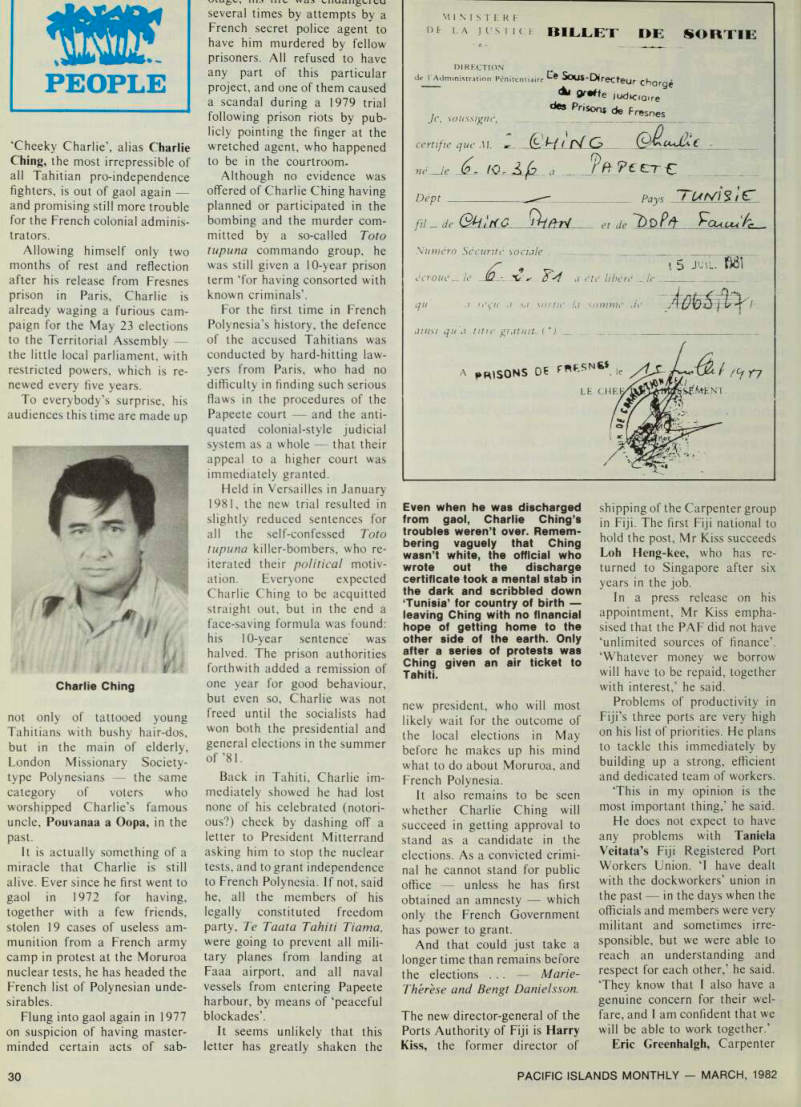
‘Cheeky Charlie’, alias Charlie Ching, the most irrepressible of all Tahitian pro-independence fighters, is out of gaol again and promising still more trouble for the French colonial adminis trators.
Allowing himself only two months of rest and reflection after his release from Fresnes prison in Paris, Charlie is already waging a furious cam paign for the May 23 elections to the Territorial Assembly the little local parliament, with restricted powers, which is re newed every five years.
To everybody’s surprise, his audiences this time are made up
not only of tattooed young Tahitians with bushy hair-dos, but in the main of elderly, London Missionary Society type Polynesians the same category of voters who worshipped Charlie’s famous uncle, Pouvanaa a Oopa, in the past.
It is actually something of a miracle that Charlie is still alive. Ever since he first went to gaol in 1972 for having, together with a few friends, stolen 19 cases of useless am munition from a French army camp in protest at the Moruroa nuclear tests, he has headed the French list of Polynesian unde sirables.
Flung into gaol again in 1977 on suspicion of having master minded certain acts of sab
mu miw viivao.ii£V^l several times by attempts by a French secret police agent to have him murdered by fellow prisoners. All refused to have any part of this particular project, and one of them caused a scandal during a 1979 trial following prison riots by pub licly pointing the finger at the wretched agent, who happened to be in the courtroom.
Although no evidence was offered of Charlie Ching having planned or participated in the bombing and the murder com mitted by a so-called Toto tupuna commando group, he was still given a 10-year prison term ‘for having consorted with known criminals’.
For the first time in French Polynesia’s history, the defence of the accused Tahitians was conducted by hard-hitting law yers from Paris, who had no difficulty in finding such serious flaws in the procedures of the Papeete court and the anti quated colonial-style judicial system as a whole that their appeal to a higher court was immediately granted.
Held in Versailles in January 1981, the new trial resulted in slightly reduced sentences for all the self-confessed Toto tupuna killer-bombers, who re iterated their political motiv ation. Everyone expected Charlie Ching to be acquitted straight out, but in the end a face-saving formula was found; his 10-year sentence was halved. The prison authorities forthwith added a remission of one year for good behaviour, but even so, Charlie was not freed until the socialists had won both the presidential and general elections in the summer of ’Bl.
Back in Tahiti, Charlie im mediately showed he had lost none of his celebrated (notori ous?) cheek by dashing off a letter to President Mitterrand asking him to stop the nuclear tests, and to grant independence to French Polynesia. If not, said he, all the members of his legally constituted freedom party, Te Taata Tahiti Tiama, were going to prevent all mili tary planes from landing at Faaa airport, and all naval vessels from entering Papeete harbour, by means of ‘peaceful blockades’.
It seems unlikely that this letter has greatly shaken the
new president, who will most likely wait for the outcome of the local elections in May before he makes up his mind what to do about Moruroa, and French Polynesia.
It also remains to be seen whether Charlie Ching will succeed in getting approval to stand as a candidate in the elections. As a convicted crimi nal he cannot stand for public office unless he has first obtained an amnesty which only the French Government has power to grant.
And that could just take a longer time than remains before the elections ... Marie- Th'erese and Bengt Danielsson.
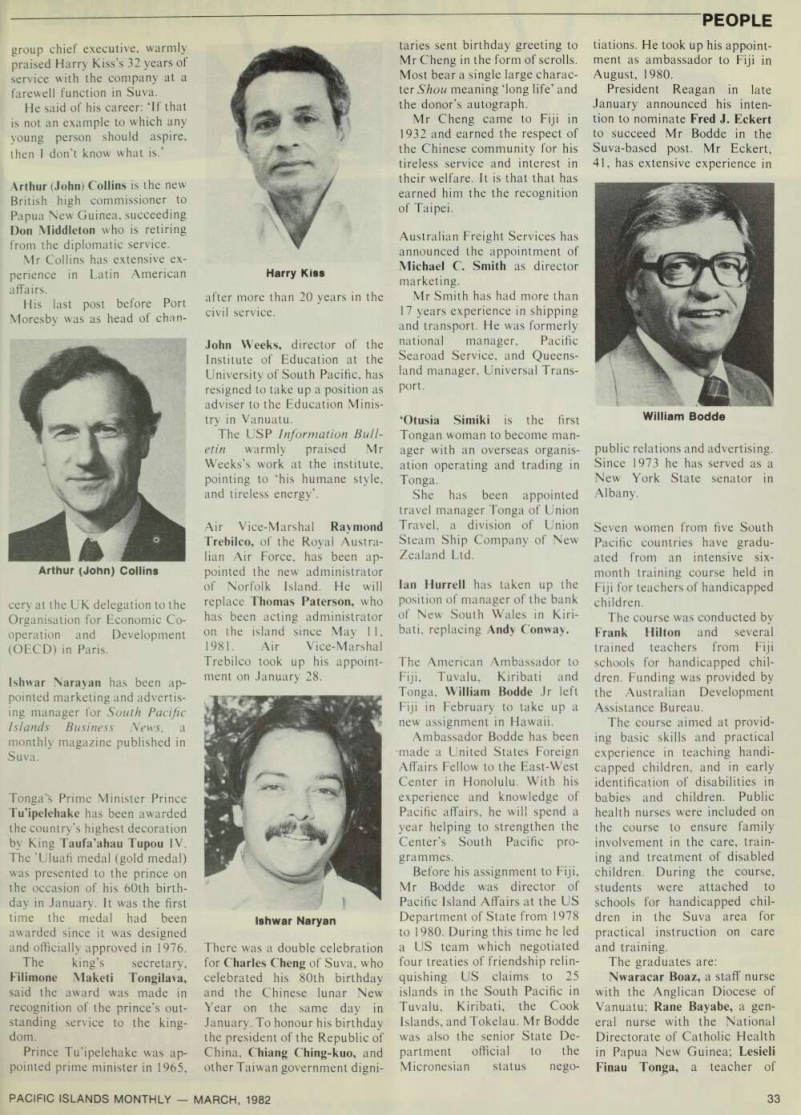
The new director-general of the Ports Authority of Fiji is Harry Kiss, the former director of
shipping of the Carpenter group in Fiji. The first Fiji national to hold the post, Mr Kiss succeeds Loh Heng-kee, who has re turned to Singapore after six years in the job.
In a press release on his appointment, Mr Kiss empha sised that the PAF did not have ‘unlimited sources of finance’. ‘Whatever money we borrow will have to be repaid, together with interest,’ he said.
Problems of productivity in Fiji’s three ports are very high on his list of priorities. He plans to tackle this immediately by building up a strong, efficient and dedicated team of workers. ‘This in my opinion is the most important thing,’ he said.
He does not expect to have any problems with Taniela Veitata’s Fiji Registered Port Workers Union. T have dealt with the dockworkers’ union in the past in the days when the officials and members were very militant and sometimes irre sponsible, but we were able to reach an understanding and respect for each other,’ he said. ‘They know that I also have a genuine concern for their wel fare, and I am confident that we will be able to work together.’
Eric Greenhalgh, Carpenter
Charlie Ching
Even when he was discharged from gaol, Charlie Ching’s troubles weren’t over. Remem bering vaguely that Ching wasn’t white, the official who wrote out the discharge certificate took a mental stab in the dark and scribbled down ‘Tunisia’ for country of birth leaving Ching with no financial hope of getting home to the other side of the earth. Only after a series of protests was Ching given an air ticket to Tahiti.
group chief executive, warmly praised Harry Kiss’s 32 years of service with the company at a farewell function in Suva.
He said of his career: ‘lf that is not an example to which any young person should aspire, then I don't know what is.’
Arthur (John) Collins is the new British high commissioner to Papua New Guinea, succeeding Don Middleton who is retiring from the diplomatic service.
Mr Collins has extensive ex perience in Latin American affairs.
His last post before Port Moresby was as head of chan-
eery at the UK delegation to the Organisation for Economic Co operation and Development (OECD) in Paris.
Ishwar Narayan has been ap pointed marketing and advertis ing manager for South Pacific Islands Business News, a monthly magazine published in Suva.
Tonga’s Prime Minister Prince Tu’ipelehake has been awarded the country’s highest decoration by King Taufa'ahau Tupou IV.
The ’Uluafi medal (gold medal) was presented to the prince on the occasion of his 60th birth day in January. It was the first time the medal had been awarded since it was designed and officially approved in 1976.
The king’s secretary, Filimone Maketi Tongilava, said the award was made in recognition of the prince’s out standing service to the king dom.
Prince Tu’ipelehake was ap pointed prime minister in 1965,
after more than 20 years in the civil service.
John Weeks, director of the Institute of Education at the University of South Pacific, has resigned to lake up a position as adviser to the Education Minis try in Vanuatu.
The USP Information Bull etin warmly praised Mr Weeks’s work at the institute, pointing to ‘his humane style, and tireless energy’.
Air Vice-Marshal Raymond Trebilco, of the Royal Austra lian Air Force, has been ap pointed the new administrator of Norfolk Island. He will replace Thomas Paterson, who has been acting administrator on the island since May 11, 1981. Air Vice-Marshal Trebilco took up his appoint ment on January 28.
There was a double celebration for Charles Cheng of Suva, who celebrated his 80th birthday and the Chinese lunar New Year on the same day in January. To honour his birthday the president of the Republic of China, Chiang Ching-kuo, and other Taiwan government digni
taries sent birthday greeting to Mr Cheng in the form of scrolls.
Most bear a single large charac ter Shou meaning ‘long life’ and the donor’s autograph.
Mr Cheng came to Fiji in 1932 and earned the respect of the Chinese community for his tireless service and interest in their welfare. It is that that has earned him the the recognition of Taipei.
Australian Freight Services has announced the appointment of Michael C. Smith as director marketing.
Mr Smith has had more than 17 years experience in shipping and transport. He was formerly national manager, Pacific Searoad Service, and Queens land manager. Universal Trans port. ‘Otusia Simiki is the first Tongan woman to become man ager with an overseas organis ation operating and trading in Tonga.
She has been appointed travel manager Tonga of Union Travel, a division of Union Steam Ship Company of New Zealand Ltd. lan Hurrell has taken up the position of manager of the bank of New South Wales in Kiri bati, replacing Andy Conway.
The American Ambassador to Fiji, Tuvalu, Kiribati and Tonga, William Bodde Jr left Fiji in February to take up a new assignment in Hawaii.
Ambassador Bodde has been made a United States Foreign Affairs Fellow to the East-West Center in Honolulu. With his experience and knowledge of Pacific affairs, he will spend a year helping to strengthen the Center’s South Pacific pro grammes.
Before his assignment to Fiji, Mr Bodde was director of Pacific Island Affairs at the US Department of State from 1978 to 1980. During this time he led a US team which negotiated four treaties of friendship relin quishing US claims to 25 islands in the South Pacific in Tuvalu, Kiribati, the Cook Islands, and Tokelau. Mr Bodde was also the senior State De partment official to the Micronesian status nego
tiations. He took up his appoint ment as ambassador to Fiji in August, 1980.
President Reagan in late January announced his inten tion to nominate Fred J. Eckert to succeed Mr Bodde in the Suva-based post. Mr Eckert, 41, has extensive experience in
public relations and advertising.
Since 1973 he has served as a New York State senator in Albany.
Seven women from five South Pacific countries have gradu ated from an intensive six month training course held in Fiji for teachers of handicapped children.
The course was conducted by Frank Hilton and several trained teachers from Fiji schools for handicapped chil dren. Funding was provided by the Australian Development Assistance Bureau.
The course aimed at provid ing basic skills and practical experience in teaching handi capped children, and in early identification of disabilities in babies and children. Public health nurses were included on the course to ensure family involvement in the care, train ing and treatment of disabled children. During the course, students were attached to schools for handicapped chil dren in the Suva area for practical instruction on care and training.
The graduates are: Nwaracar Boaz, a staff nurse with the Anglican Diocese of Vanuatu; Rane Bayabe, a gen eral nurse with the National Directorate of Catholic Health in Papua New Guinea; Lesieli Finau Tonga, a teacher of
Arthur (John) Collins
Harry Kiss
Ishwar Naryan
William Bodde
handicapped children at the OTA (Red Cross) Centre for Handicapped Children in Tonga; Sisilia Vaea, a teacher of handicapped children at the OTA (Red Cross) Centre for Handicapped Children in Tonga; Kalonikakala Makaafi, a public health nurse with the Ministry of Health in Nukualofa, Tonga; Sune Rongoronga Rusia, of Tuvalu, and Helen Mailagu Gauwane, of Solomon Islands.
"Ofa Tuionetoa, assistant sec retary in the Tongan prime minister’s office, has won a Fulbright Award for an eight month study period at Cali fornia Stale University, Chico.
He left in January to do a course in public administration.
New Zealand-trained Tongan lawyer Laki Niu resigned from the civil service post of crown prosecutor at the end of December 1981, and has set up in private practice in Nukualofa as barrister and solicitor.
His move from public to
private sector is important in the Tongan context. Previously, business firms and private cli ents have had to rely mainly on local practitioners who qualify by attending one class a week for two years and then sitting for an examination set by the chief justice, who is also the class tutor.
The alternative, for those who could afford it, was to import qualified expertise from New Zealand as and when needed.
Since the day he first put up his shingle, Mr Niu has been inunduated with more work than he can comfortably handle alone, and he is considering taking on a young local prac titioner as articled assistant. His main problem, as a ‘one-up’ in his field, is the ethical one of client conflict. ‘l’m frequently being asked to represent both sides in a legal argument,’ he says. ‘So 1 have to follow the time-honoured principle of firsl-come-first served. Obviously, we really need at least two private prac
tices with fully-qualified princi pals, and it is to be hoped that will come before long, now I’ve broken the ice.’
Meanwhile, he plans to con centrate mainly on solicitor services, leaving most of the court work to ‘my Tongan brothers in law who depend on it for their bread and butter’.
Penny Hodgkinson in Nukualofa.
Audeh Soussou arrived in Apia in January to take up his post as deputy resident representative in the United Nations Develop ment Programme office for Samoa, Cook Islands, Niue and Tokelau. Mr Soussou, who is Lebanese, has been with the UN for 21 years.
His immediate superior. Roy D. Morey, preceded him by a few months in arriving in Apia (PIM Dec ’Bl p4O).
Samoan author Albert Wendt is taking lime out from writing novels to work on a television documentary.
Its subject is the Samoan
community in New Zealand, and the way its members are adapting to life there.
Wendt says the focus will be on people in the Auckland area, particularly Ponsonby, Grey Lynn. Otara, and Mangere.
The theme we'll take is the way the traditional Samoan institutions our people brought with them have helped them survive and adapt to New Zealand life,' he says. ‘A common argument is that migrants should leave their traditional lifestyles behind them if they want to adapt properly. But our matai system, church, and close-knit families have all helped our people fit in here and develop a very strong sub-culture at the same time.’
Wendt will be frontman in the documentary, which will be produced by George Andrews of
Tvnz.
Dames & Moore, the US-based engineering and environmental consultancy firm, has appointed William M. Greenslade regional manager of its Pacific, Far East,
and Australian operations. Mr Greenslade, who will be based in the firm’s Honolulu office, is a partner of Dames & Moore and a specialist in hydrogeology and environmental engineering.
He holds an MS in hydrology and a BS in geological engineer ing from the Mackay School of Mines at the University of Nevada.
Graham McHugh, 45, has succeeded Jack White as Aus tralia’s trade commissioner to Fiji and the Pacific Islands.
Adelaide-born Mr McHugh has a background of 17 years in international trade and has served with Australian trade missions in Indonesia, Bahrain and Chile.
Mr McHugh said on taking up his appointment in January that trade and investment relations between Australia. Fiji and the South Pacific region in general were bound to be greatly stimu lated by the benefits of the recently negotiated South Pacific Area Regional Trade and Economic Co-operation Agreement (SPARTECA).
There would also be benefits from such Australian schemes for the region as government financial support for joint ven ture projects involving Austra lian and Pacific investors.
He regards the SPARTECA agreement as the prime vehicle to promote a significant in crease in the volume of Pacific Island products exported to Australia under duty-free and concessional admission arrange ments.
Mr McHugh predicted that the new investment support scheme, for which final guide lines had not yet been decided by the Australian Government, would lead to a boost of Austra lian investment in the Pacific Islands over the next five years.
Funded by the Australian De velopment Assistance Bureau, it would supply capital and expertise to joint ventures in Fiji and other countries in the region.
Three medical doctors joined Tonga’s Ministry of Health in January after graduating from the Fiji School of Medicine.
They are Dr Sione Talia’uli Afeaki, 23, of Haveluoto; Dr ’Etika ’Akau’ola, 23, of
Kanckupolu, and Dr Seini Motuliki Fakatava, 29, of Halaleva. Kolofo’ou.
They all have diplomas in surgery and medicine and have been appointed as medical officers.
Joining the ministry at the same lime is Lesieli Funaki, of Kolomotu’a, who graduated from FSM as a physiotherapist.
Lesieli has been appointed as sistant physiotherapist.
Young Benjamin Ravulolo Lomaloma wanted to be a motor mechanic but he listened to his father’s advice and ended up being a top ‘mechanic’ of hu man beings.
And after 39 years of service in Fiji’s medical field, Dr Lomaloma has retired with his last posting being that of Medi cal Superintendent of Lautoka Hospital. ‘I always wanted to be a mechanic,’ he said.
“1 saw people fiddling around with cars and whirr, off they would go. ‘But my old man wanted me to take up medicine and I did not want to disappoint him so I took it up. ‘I have never regretted that decision because being a doctor is very rewarding work.’
Firoz Shaheem in The Fiji Times.
William Sharpe-Dunn reports on a number of recent personnel changes affecting Catholic Church activities in the Pacific: The Most Reverend Peter Kurongku, 51, is the new Cath olic archbishop of Port Moresby. He succeeds Arch bishop Herman To Paivu who
died in March last year (PIM May ’Bl pB2).
Born at Tonnui in southern Bougainville, Peter was or phaned at the age of six. His early education was interrupted by the war, like that of so many others.
After deciding to study for the priesthood, among his early teachers were two Australian priests, Frs James Hannan and Frank McGuire, both from Mel bourne. The archbishop-elect did all his studies in the then Territory, and was ordained (by Bishop Leo LeMay) on December 21,1966.
In 1971, he became vicar general of Bougainville diocese.
Nominated as the first Catholic Melanesian bishop for the newly independent Solomon Islands, he was consecrated as auxiliary bishop of Honiara on March 25, 1979.
The appointment was an nounced by newly appointed Pro-Nuncio, Archbishop Francesco de Nittis, in the PNG national capital.
In Sydney, veteran missioner Fr Wally Fingleton described the new archbishop as ‘a pas toral man’, with ‘a simple lifestyle'.
The Most Reverend Michel Calvet, SM, is the new arch bishop of Noumea. At 37, he is the youngest prelate in the South Pacific.
Monsignor Calvet came to the Pacific after his ordination in 1973. He was installed as assistant bishop of Noumea on November 4, 1979.
He succeeds Monsignor Eugene Klein, MSC, who was once bishop of Bereina in Papua New Guinea.
Observers have noted that Mgr Calvet’s three administrat ive predecessors are still alive.
This is considered to be a unique feature of Christian Pacific history. Preceding Mgr Klein were Mgr Michel Darmancier, SM, (of Wallis- Futuna), and Mgr Pierre Mar tin, SM, a former prisoner in Dachau. Both men now live in retirement in France.
The Very Reverend Patrick Hurley, CSsR, 69, is the ‘sur prise’ choice as first auxiliary bishop of the Catholic diocese of Samoa and Tokelau.
Born in Wellington, New Zealand, bishop-elect Hurley was educated in his own country and in Australia, where he joined the Redemptorist Fathers (CSsR) in 1932. Or dained in March, 1938, he was missioned to the Philippines, after working in Australia. Dur ing the war he was a prisoner of the Japanese.
He led the first Redemptorist mission team to the South Pacific in the early ’7os, and lived at Safotu, Savaii. Western Samoa.
In his new position he assists Pio Cardinal Taofinu’u, SM.
Fr Hurley’s appointment at ‘7O years young’ is seen also as a special tribute to New Zea land’s overseas missionary efforts. Appropriately, the con secration ceremony in Samoa will lake place on St Patrick’s Day, March 17, the bishop elect’s patronal day.
Brother Penehe Patelihio from tiny Tokelau has made his vows as a Divine Word missionary. A former student of Chanel Col lege, Apia, Pene hopes to work in Latin America.
He is the first Polynesian to join the worldwide mission so ciety, in which more than 50 nationalities are represented.
The Society of the Divine Word (SVD), as well as missionary work, undertakes ex tensive studies in anthropology, ethnology, and linguistics.
Brother Pene will continue his studies in Melbourne this year, until his first mission appointment.
The Reverend Father Wallace Cornell, SDB, of Victoria, Aus tralia, has been appointed to head the Salesian Foundation in Western Samoa. The Salesians are an international group of priests and brothers engaged in youth work.
Fr Cornell was the leader (Provincial) in Australia for two terms, six years in all.
In Samoa, the five Salesians teach and run a parish.
Italian, Indian, Irish, Maltese and Australian Salesians make up the staffs.
The first Samoan-born aspir ants to the Salesians are ex pected to start training this year.
Graham McHugh