Australian TV in Islands, and PNG
pp. 51-53 · Read in the full issue

Trade
Winds
to get its own
Feasibility studies of the financial, technical, program ming and management require ments for a broadcast television service in Papua New Guinea are to be discussed by the PNG government in March. The gov ernment decided in principle late last year to proceed with the introduction of television, but how it will be done, how it will be paid for and what sort of material will be shown is still very much in the planning stage.
The general plan is to go ahead as soon as possible with two pilot broadcast television services, one in Port Moresby and one in Lae. Media Minister Clement Poye believes the two pilot services can be operating within two years. This will then provide a shakedown period for programming and production, a breathing space for major plan
ning, and an opportunity for viewers and community organ isations to suggest how the main project should develop.
The main project will be to establish a national television service using a communications satellite stationary above the earth. It will receive signals from a ground station and beam them down again so that they will be available throughout PNG. The PNG government has already signed a memor andum of understanding with Australia which will give it the right to lease channels in the Australian satellite AUSSAT due to go into service in 1985.
However, other satellite and transmission options are avail able to PNG, and wide investi gations and negotiations are likely before the final decisions are taken.
The government has com missioned a feasibility study,
and the first reports are ex pected to be discussed by cabi net in March. There has already been some controversy over the feasibility study for which the National Broadcasting Com mission and the Public Utilities Department are paying more than $2O 000 in fees and ex penses. The men behind the survey are an Australian public relations consultant Mr Joe Joel who earlier had an office in Port Moresby and a Swiss engineer, Mr Ueli Herren.
Mr Joel is the brother of Sir Asher Joel who operates a television service in the north ern Australian mining centre of Mount Isa and he has had his own links with television ser vices and television advertising.
Several years ago he attempted unsuccessfully to negotiate a television service for Papua New Guinea in which Austra lian Consolidated Press of Syd ney would have been one of the principals. There has been some political criticism of his role in the present series of feasibility studies on the grounds that he could represent specific inter ests. However, Mr Joel told a newspaper interviewer in Port Moresby that he was committed only to producing a workable line of approach for Papua New Guinea. His studies were purely recommendations, he said, and the decisions were for cabinet to make. Mr Joel is reporting on the programming and manage ment aspects of a television service, and Mr Herren on the technical and financial aspects.
The present line of inquiry is believed to rely heavily on the eventual availability of the AUSSAT channels, but already some technical agencies have begun lobbying for alternative systems which they say would be cheaper and which would use satellite facilities which could become available earlier.
The Australian government itself has been criticised at home for agreeing to make AUSSAT channels available to PNG. The criticism is based on suggestions that Australia itself will need all the channels.
However, the signing of the
memorandum of agreement has assured PNG of access to AUSSAT, although not until 1985. Three channels in the satellite would be available to PNG. The rentals would cost several million dollars a year, but it is politically possible that Australia would consider a sub sidy to reduce the costs.
Japan and Indonesia are two other countries which could be in a position to make satellite channels available to PNG. It is understood that the feasibility studies are considering the possibility that manufacturing countries such as Australia and Japan, and possibly Indonesia, would be prepared to offer a satellite rental subsidy if the PNG television system was willing to accept trade and
product advertising.
TV from outside
also available
While Papua New Guinea steps up planning for a television service of its own, there haas been another development which in a few months will give PNG and several other Island countries the opportunity to receive some Australian tele vision services for up to 17 hours a day.
The development is the repo
sitioning later this year of the satellite INTELSAT 4A which is already carrying the east coast and west coast trans missions of the Australian Broadcasting Commission tele vision service. This is the government-owned service which is known as Channel Two in Australian state capital cit ies. INTELSAT 4A has been beaming the programmes back to earth for some time to provide a service for the remote areas of inland Australia.
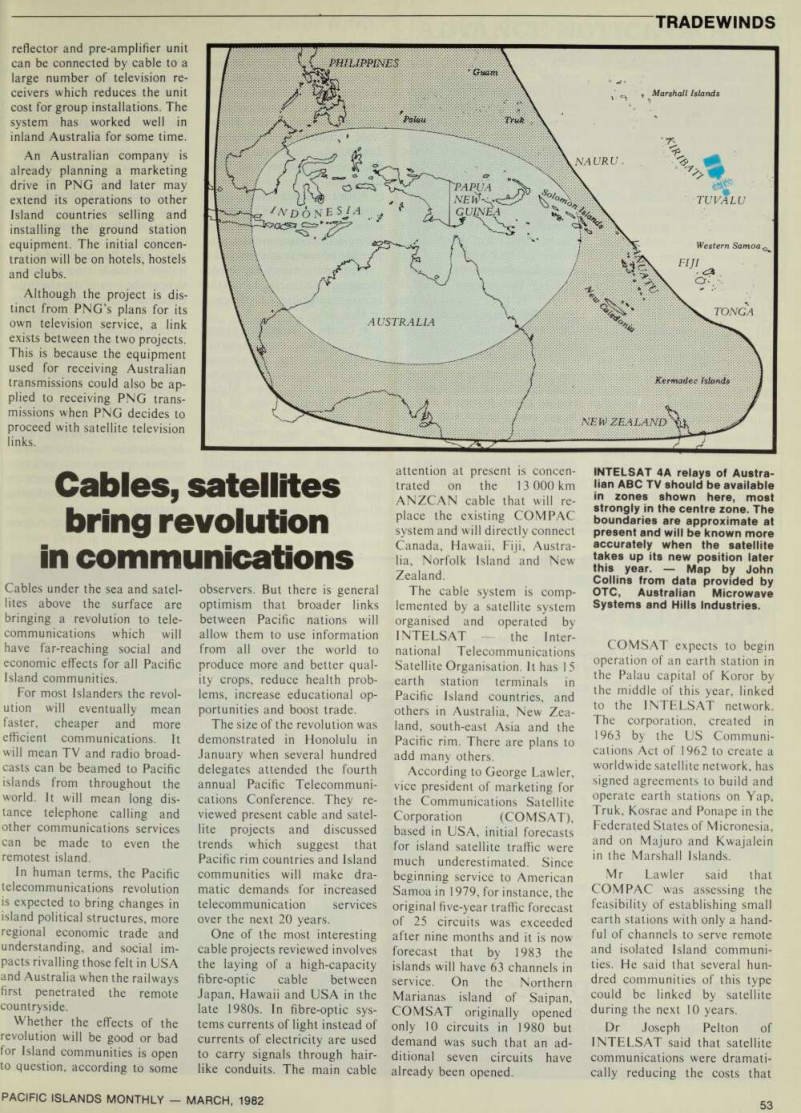
When the satellite is repo sitioned later this year its area of coverage what is known as the footprint will change.
The new area is expected to take in Papua New Guinea, Solomon Islands, Vanuatu, New Caledonia, the Kermadec Islands, Palau, part of the Federated States of Micronesia and part of Indonesia, in ad dition to Australia itself. It may also take in Nauru, although this is uncertain at present.
To receive the programmes in the footprint area it is necessary to instal what technicians call a ‘mini ground station’ in addition to a normal television receiver.
The ground station consists of a large metallic reflector and a pre-amplifier unit. The total cost is expected to be about $4OOO installed, but one
reflector and pre-amplifier unit can be connected by cable to a large number of television re ceivers which reduces the unit cost for group installations. The system has worked well in inland Australia for some time.
An Australian company is already planning a marketing drive in PNG and later may extend its operations to other Island countries selling and installing the ground station equipment. The initial concen tration will be on hotels, hostels and clubs.
Although the project is dis tinct from PNG’s plans for its own television service, a link exists between the two projects.
This is because the equipment used for receiving Australian transmissions could also be ap plied to receiving PNG trans missions when PNG decides to proceed with satellite television links.
INTELSAT 4A relays of Austra lian ABC TV should be available in zones shown here, most strongly in the centre zone. The boundaries are approximate at present and will be known more accurately when the satellite takes up its new position later
this year. - Map by John
Collins from data provided by OTC, Australian Microwave Systems and Hills Industries.