A $100 m plan
pp. 51-53 · Read in the full issue
Trade
Winds
Hawaii
A $100 m plan to rescue Waikiki
Waikiki, that stretch of sand and hotels in Honolulu that runs from Diamond Head to a yacht basin called the Ala Wai, rep resents the heart and soul of Hawaii’s economic life.
In just two and a half square kilometres is packed both the symbolic and economic centre of Hawaii’s number-one indus try tourism.
Thus it is of no little concern to local civic leaders and poli ticians when Waikiki develops a bad reputation outside the state: if Waikiki is seen else where as over-grown, over priced and unpleasant, then that dark image tarnishes the entire tourism industry. Rightly or wrongly, this is precisely what has happened to Waikiki over the past several years.
Construction has continued, little hampered, apparently, by a 1976 design district law which pul temporary limits on growth in Waikiki. Palm trees and moonlight have been replaced by air-conditioned shopping, pornography, and cheap sou venirs as key attractions.
Already, Waikiki is among Honolulu’s most densely popu lated areas. Permanent resi dents alone give it a population of about 80 persons per hectare, and that doesn’t count the 50 000 or so tourists on hand each day, along with the 30 000 workers who serve them.
Waikiki, in short, is crowded.
There is little open space left in the central portion of the famous strip, and even the gracious lawns around major hotels such as the Royal Hawaiian have been turned into shopping malls. Hawkers for vacation apartments and tours accost people on the street and even on the beach itself. Side walks are cluttered with tem porary stalls from which Indochinese immigrants and others sell inexpensive sou venirs. One end of the famous Kalakaua Avenue is fronted with pornography and sex es tablishments aimed primarily at Japanese tourists.
In some ways this brings a hint of bazaar excitment to the
area. But the sum effect is hardly what Hawaii’s tourism promoters think they should sell to the rest of the world.
Into this situation has stepped Honolulu’s newly elected mayor, Eileen Ander son, with the latest and what may be the most ambitious yet revitalisation plan for Waikiki.
Anderson’s proposal (‘Waikiki 2000' is its sales name) is bound to restart one of Hawaii’s longest-running political argu ments; should this state impose a special tax on tourists?
It is a debate which will be watched closely elsewhere in the Pacific, where the rising cost of air fares and competition from other palmy tourist areas make it critical that each visitor get maximum value for his or her dollar.
The idea of a tourist tax (most usually a tax on hotel rooms) has blown about in Hawaii’s political tradewinds for years. It has always been stopped by the combined lobby ing forces of the visitor industry and those politicians who take the industry’s concerns to heart.
But with her ‘Waikiki 2000’ proposal, Anderson puts the fight squarely on the table once more.
What Anderson proposes for Waikiki is mostly nuts and bolts civic improvements with a price tag of about SUSIOO million.
The point would be to upgrade
what Waikiki already is an urban resort area rather than attempt to make it the primitive South Seas village it is not.
The basic theme of the im provement programme is to rescue Waikiki from the traffic and crowding which now domi nates the Waikiki landscape.
Beachfront Kalakaua Avenue would be turned into a ped estrian mall in places and, overall, through-traffic would be reduced. Other streets would be widened. Bikeways and walkways would be built throughout the area. The beach itself would be widened with greater public access, and ‘mini-parks’ would be built wherever the city can pick up a spare piece of land.
Cheap bus services would be offered through Waikiki, drain age and sewers would be im proved, and a master plan for landscaping and ‘street furni ture’ would replace today’s chaotic jumble.
All of this should sound obvious for an area that wants to retain its alluring tropical destination flavour. In fact, similar improvement pro grammes have been announced in earlier times by other groups.
But. always, there is opposition.
Waikiki business interests are already screaming that they cannot live with reduced access to Kalakaua, which serves the major hotels. And no one in the
tourist industry looks kindly at an extra tax on their guests the four million or more people who visit the islands each year.
Better than three million of those stop in Waikiki.
They point out that every dollar of business done in Hawaii produces four cents of tax today, no matter if the customer is a tourist or a local resident. Tourists bear their fair share of the burden every time they pull out their wallets, they say.
Nonetheless, some additional levy on the tourist industry is essential to the Anderson plan.
One indicator: the state, which gathers in the lion’s share of the tax resources in Hawaii, has been notoriously unwilling to put extra dollars back into Waikiki.
Several years ago the state legislature put up $lO million for Waikiki improvements. But feuding between state and county government held up release of the dollars until recently. Just this past year it was considered a tremendous victory for the city when it wheedled another $6 million out of the state treasury for Waikiki.
That political resistance may be changing. Anderson came to the Honolulu mayorship from a job as budget director for the state and she still enjoys a good relationship with incumbent Governor George Ariyoshi.
Ariyoshi has always opposed a tourist tax. But he has sounded somewhat more flexible about the idea since Anderson was elected.
In one way or another.
Anderson has said, the visitor industry will have to share part of the burden for that $lOO million facelift for Waikiki. She has not said specifically what route she will propose, but it could be a hotel room tax, a head tax of some kind, or a change in the property tax laws so that hotels pick up a bigger
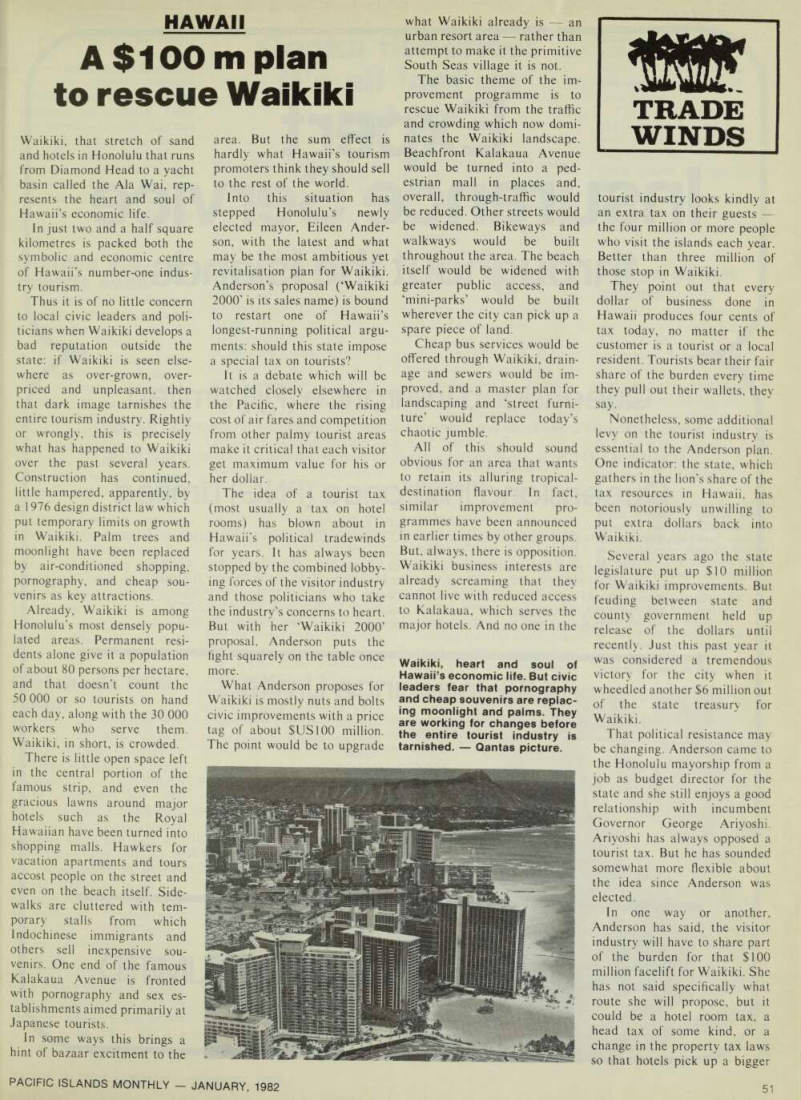
Waikiki, heart and soul of Hawaii’s economic life. But civic leaders fear that pornography and cheap souvenirs are replac ing moonlight and palms. They are working for changes before the entire tourist industry is
tarnished. - Qantas picture.
share of the overall county budget.
Such details will emerge only after the tourist industry formally agrees that Anderson’s proposals are essential. Once that hurdle is crossed, they can begin the fight over how to pay for it. The debate should offer a fine look at just what kind of experience Hawaii wants to offer its visitors through the next century. Jerry Burris in Honolulu.
Shifting N.Z.
caustic soda
A Tauranga, New Zealand, chemical company has entered a joint venture in Fiji for distributing throughout the Pacific Islands caustic soda imported from New Zealand.
The company, Chemical Cleaning Ltd, has taken a 50 percent interest in Chemical Supplies Ltd, which used to be known as Cold Storage Ltd.
Until the new arrangement was concluded, it was wholly owned by the Stinson Pearce group of Fiji.
The new company will also import and distribute sulphuric and nitric acid from New Zea land, manufacture sodium hypochlorite, and possibly go into the manufacture of dom estic bleach.
It will continue to run a coldstore business and pack Glaxo milk powder.
Fletcher’s PNG
boom
The active and increasing pres ence of the New Zealand builder Fletcher Construction in Papua New Guinea is paying dividends.
The company last year bought Morobe Constructions Ply Ltd, a long-established company which had gone into receivership. The infusion of new management, aided by buoyant conditions in the con struction industry, has turned the company’s fortunes right around. It is now once again a leading construction contractor.
Fletcher on its own secured the SNZI9.4 million contract to build PNG’s Parliament House in Port Moresby, and with its Morobe subsidiary won orders in 1981 worth more than $l5 million.