and go’
p. 53 · Read in the full issue
Cooks fisheries: It’s all ‘get up and go’
The closing months of 1981 saw a flurry of activity directed at development of the Cook Islands fishing industry.
In the last quarter of the year: • An agreement was signed with Taiwan under which up to 90 Taiwanese boats may fish within the Cooks’ 200-mile economic zone. Taiwan will pay SUS9O 000 for the privilege.
The agreement runs until October 1982, when the fee will be open for renegotiation. A similar agreement was signed with South Korea in 1980. • A Norwegian delegation was in Rarotonga for dis cussions which ended in an agreement that the Norwegians would conduct experimental fishing in Cook Islands waters for 12 months. Object of the exercise would be to find out whether Norwegian methods are effective in the Pacific.
Cook Islands News com mented: ‘lf results are good, the Cook Islands may see Norwegian fishing fleets in our waters in the near future, along side the Korean and Taiwanese fleets.’ • While these agreements concerning offshore fishing were being concluded, inshore fishing was not being neglected. (The Cooks have a fisheries develop ment strategy divided into three areas of activity: lagoon fisheries, inshore fisheries within the 12-mile territorial limit, and offshore fisheries within the 200-mile exclusive economic zone.) At a November ceremony, New Zealand Representative to the Cook Islands Lindsay Watt presented a cheque for SNZ9O 000 to Minister of
Economic Development
Vincent Ingram for fisheries development on Rakahanga and Palmerston Islands.
A sum of $35 000 was ear marked for Palmerston, an island which, in the 1976 census count had a population of 56. In the absence of any other re sources, development of
fisheries is vital to the island’s future.
The money is to be spent to buy a five-tonne freezer, a seawater ice machine, a diesel generator, and a bulk fuel storage tank.
Rakahanga (283 people, 1976 census) will benefit from a $55 000 grant to buy a 12-tonne blast freezer, a generator, and a bulk fuel storage tank.
The .Cook Islands itself is kicking in $7OOO of its own money for the Palmerston pro ject and $l5 000 for the one on Rakahanga. The money will be used to pay for buildings, water tanks, labour and freight.
Fiji’s skipjack
venture
Fiji is to invite other Pacific Island countries to join a ven ture to market skipjack tuna.
The government wants other countries to send tuna caught in their 200-mile zones to the cannery it runs at Levuka.
Prime Minister Ratu Sir Kamisese Mara revealed in November that the move arose from a cabinet decision to enlarge Fiji’s tuna fleet as a
result of the South Pacific Commission skipjack survey which indicated there was con siderable potential for skipjack tuna fishing.
The Fiji Government-owned Ika Corporation operates 12 pole-and-line boats, and has chartered two New Zealand purse seiners for experimental fishing.
Fiji expected to land about 6000 tonnes of tuna in 1981, earning about SF2O million from the effort.
Tonga deficit
grows
Tonga’s visible trade deficit for the first half of 1981 was
Sti3 124 500.
Between January and June imports totalled $l6 320 700, and exports, including re exports, were $3 196 200.
In the corresponding period for 1980, the imports bill was $l3 871900, against export earnings of $2 835 600, giving a deficit of $ll 036 300.
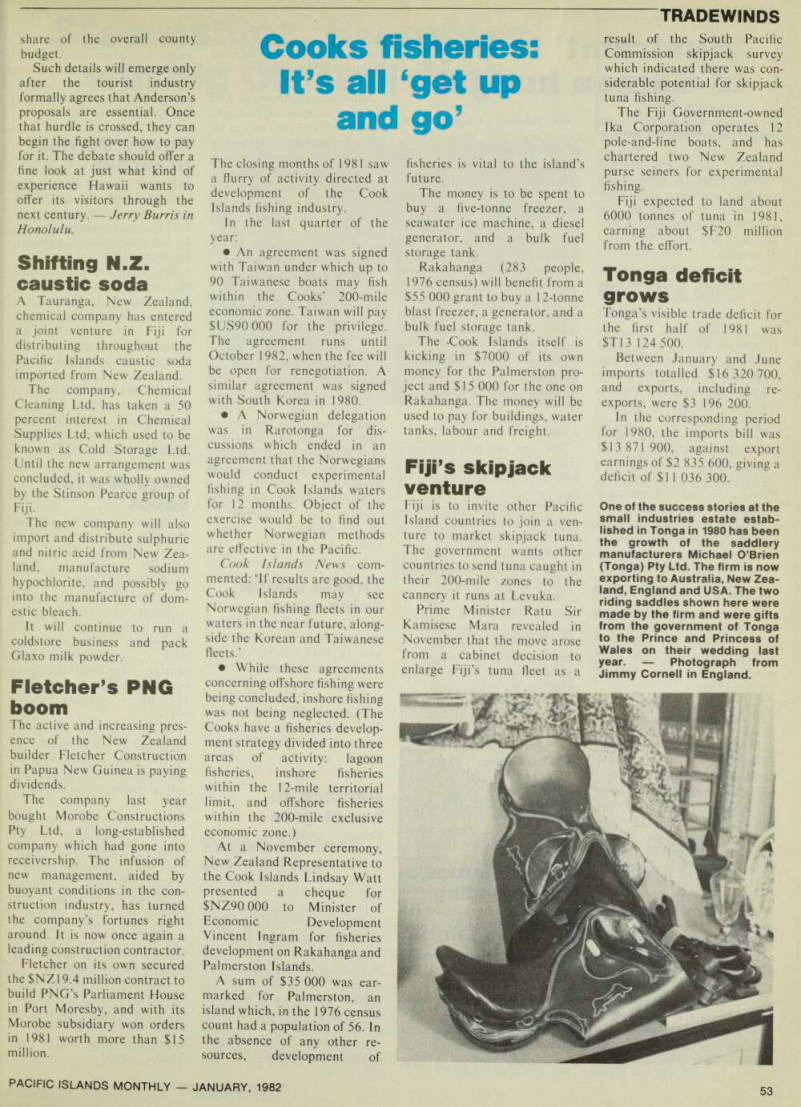
One of the success stories at the small industries estate estab lished in Tonga in 1980 has been the growth of the saddlery manufacturers Michael O’Brien (Tonga) Pty Ltd. The firm is now exporting to Australia, New Zea land, England and USA. The two riding saddles shown here were made by the firm and were gifts from the government of Tonga to the Prince and Princess of Wales on their wedding last
year. - Photograph from
Jimmy Cornell in England.