its ‘islands adjacent’
pp. 46-49 · Read in the full issue

Yesterday
150 years of Australia and its ‘islands adjacent’
The Sydney Morning Herald last year celebrated 150 years of publication. As the oldest newspaper in the Pacific, and one of the oldest in the world, the Herald s columns have reflected major developments in the Pacific Islands over a century and a half. In this article STUART INDER researches the Herald and other contemporary Australian reports and writings for an overview of what Australia’s public attitudes to the Pacific Islands have been during this period.
The report on South Pacific affairs in the first issue of the Herald, April 18, 1831, con tained most of the ingredients that were to provoke interest by Australians in the South Seas for the best part of the next 150 years.
It said: ‘SHIPWRECK. On Tuesday the 28th March ar rived here the schooner Samuel, from New Zealand, with 500 skins and 10 tons of flax; and on the day following, the Prince of Denmark, with 25 tons of flax which at the rate of from £3O to £35 a ton will form a clear Colonial export of £1,200 drawn from the industry of the natives of that island.
These vessels bring the distress ing account of the loss of the Industry, a Colonial-built vessel which was wrecked at Easy Harbour in a dreadful gale of wind on the 28th February last.
Ten men and six native women were drowned. W. Wiseman, the Master, also met a watery grave. Two men escaped and are expected in the next ship.
We refrain from stating the distressing particulars now in circulation until the arrival of the next ship. Wiseman was a remarkably active, good looking young man, son of Mr Wiseman, of the Hawkesbury, and most respectably con nected, both in the Mother Country and in the Colony. He has left a very young widow, daughter of Mr John Grono, principal owner of the Industry, and one child to lament the loss.
He arrived in the Colony a youth many years ago and has for long periods been connected with our Colonial shipping. He had for some time been in New Zealand in prosecution of the objects of his voyage, where he was well known, and had fre quently been engaged in the trade to that Island, South Shetland, South America and other places in the South Seas.’
Although the Herald wasn’t
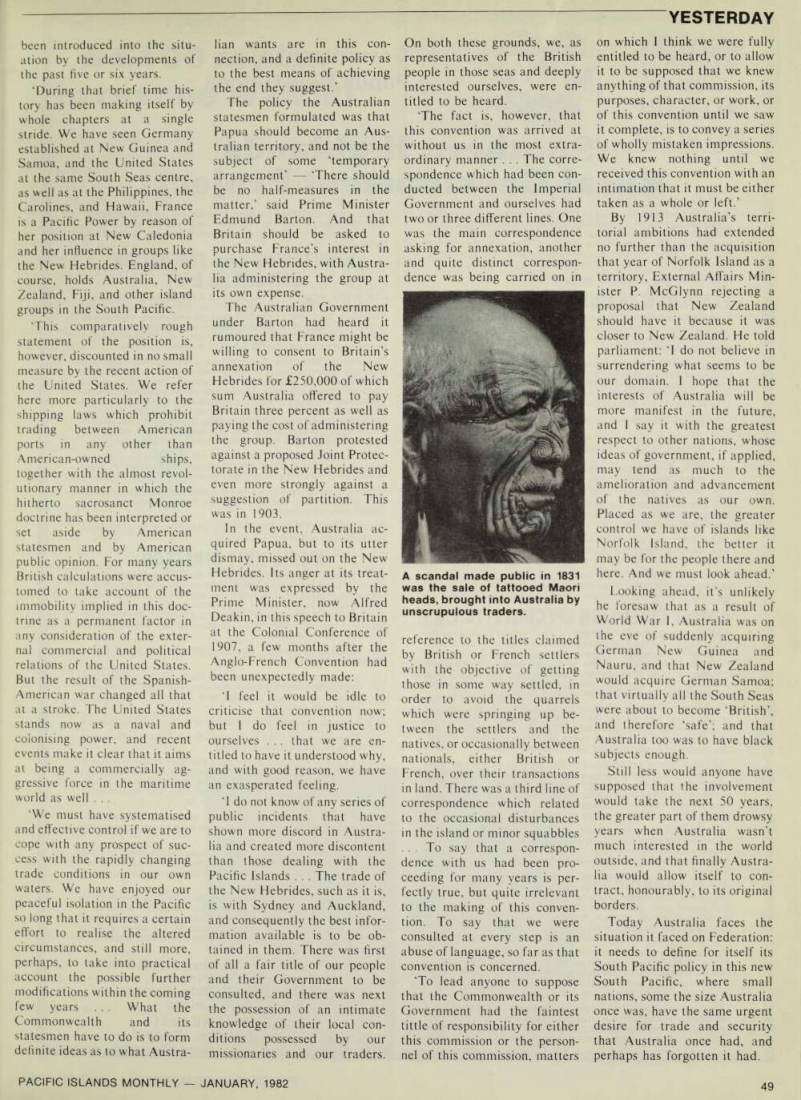
to know, the Prince of Denmark, which was also men tioned in that item, was carry ing not only 25 tons of flax but also 14 heads of New Zealand Maoris, as much a part of the ship’s trading operations as the flax.
It happened that the Rev Samuel Marsden had with him at Parramatta at the time two Maoris, one a chief, who had been brought over to support a case to Governor Darling against various ‘infamous acts of Europeans’ in New Zealand.
The other man had virtually been kidnapped by a visiting vessel and was awaiting return.
The chief had gone aboard the Prince of Denmark and had seen the heads on the cabin table, brought to Port Jackson for sale.
Marsden promptly waited
upon the governor, and, as he wrote to a fellow missionary a few days later, requested His Excellency to use every means to recover them, in order that they might be sent back to their friends. The chief knew the heads; they were his friends; and when he retired he said, “Farewell my people.”
Governor Darling issued a general order prohibiting the import of New Zealand heads into New South Wales, for
these were not the first com plaints in the colony about the developing trade in dried hu man heads, usually those of men killed in wars. But there were allegations that some traders from the colony were selecting those heads that would fetch good prices, usually those with intricate facial tat toos, while they were still on the shoulders of living men, and trading for the ‘prepared speci mens’ on their next voyage.
Wars, traders, missionaries, murders, blackbirders, ship wrecks, government reactions, were the stuff of South Seas news in the Herald and the rest of the colonial press for the rest of the century, for Australia’s concern with policy on foreign affairs was spasmodic for most of the 1800 s, and not until the last quarter of the century was
there any sustained interest in developments in the Pacific Islands.
That is not to say that the Australian colonies did not con sider it their natural right to lead in this part of the world.
When the settlement began in 1788, Governor Phillip’s com mission gave him territorial jurisdiction not only of the mainland but of ‘all the islands adjacent in the Pacific ocean within the latitudes aforesaid of 10 deg. 37 min. south and 43 deg. 36 min. south’, which wasn’t too clear and which, more than 100 years later, on the establishment of the Commonwealth, prompted some legal argument. Mean while early governors acted as though ‘adjacent islands’ in cluded Tonga and Tahiti.
It was one thing to mark out a sphere of influence, which was, presumably, what the com mission meant; it was another thing to exercise jurisdication.
The Australian colonies were never backward in voicing op position to interference in ‘their’
South Seas, but they were powerless to do much other than agitate to Whitehall as the French annexed New Caledonia, and began moving into the New Hebrides; and as the Germans, and the Americans, took a covetous interest.
Australia’s concern with the South Seas was motivated by concerns of security and trade, and considering that it had a small population which had hardly come to grips with its own massive undeveloped conti nent, its viewpoint was often irrational.
Among the more successful of its efforts in getting Britain to acquire bits and pieces of the Pacific, and thus keep other powers out, involved New Guinea. The Australian colon ies agitated for years against what they saw as German designs on the big island, but Britain considered she already had black subjects enough. She was unmoved by the actions of Yule in annexing the country in
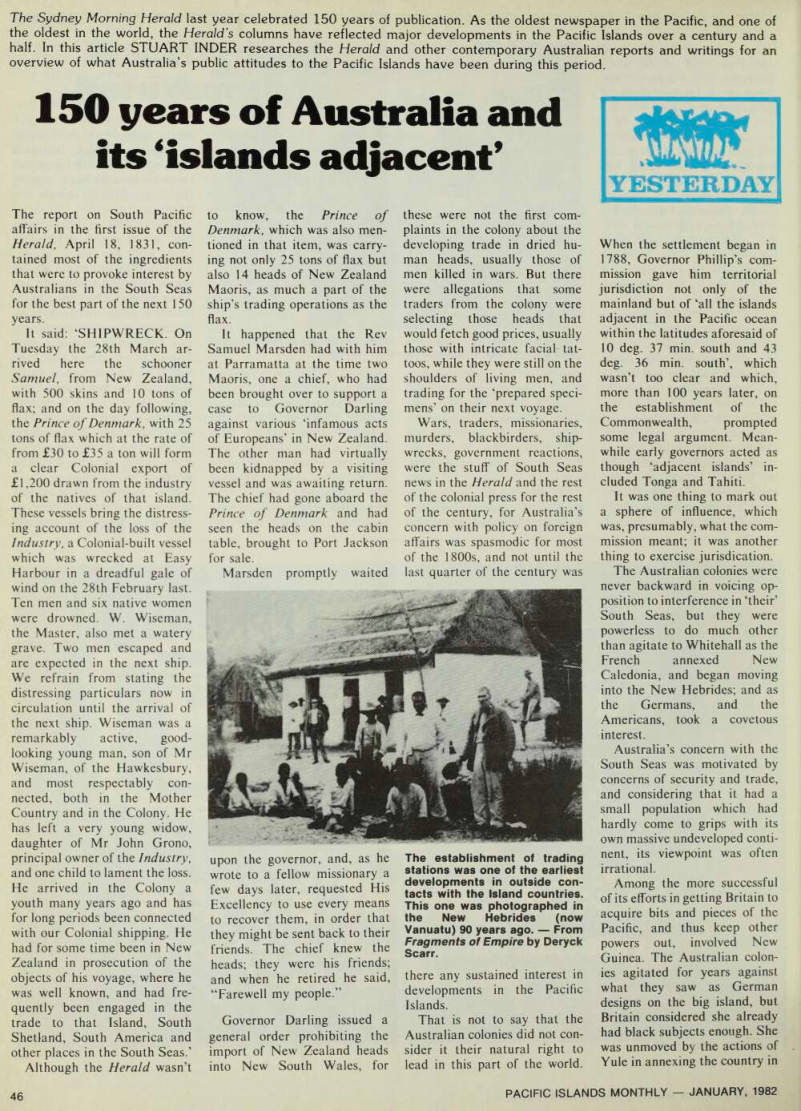
The establishment of trading stations was one of the earliest developments in outside con tacts with the Island countries.
This one was photographed in the New Hebrides (now Vanuatu) 90 years ago. - From Fragments of Empire by Deryck Scarr.
1846, Moresby in 1873, and Chester (on behalf of Queens land) in 1883, but finally sent Commodore J. E. Erskine to do the job in 1884 when there was only a small slice of it left the Germans having taken the de sirable northern half and its islands a few days before. (Even then, a week or two before Erskine arrived, Britain’s Special Commissioner, H H.
Romilly, had annexed the place yet again, having got his in structions confused).
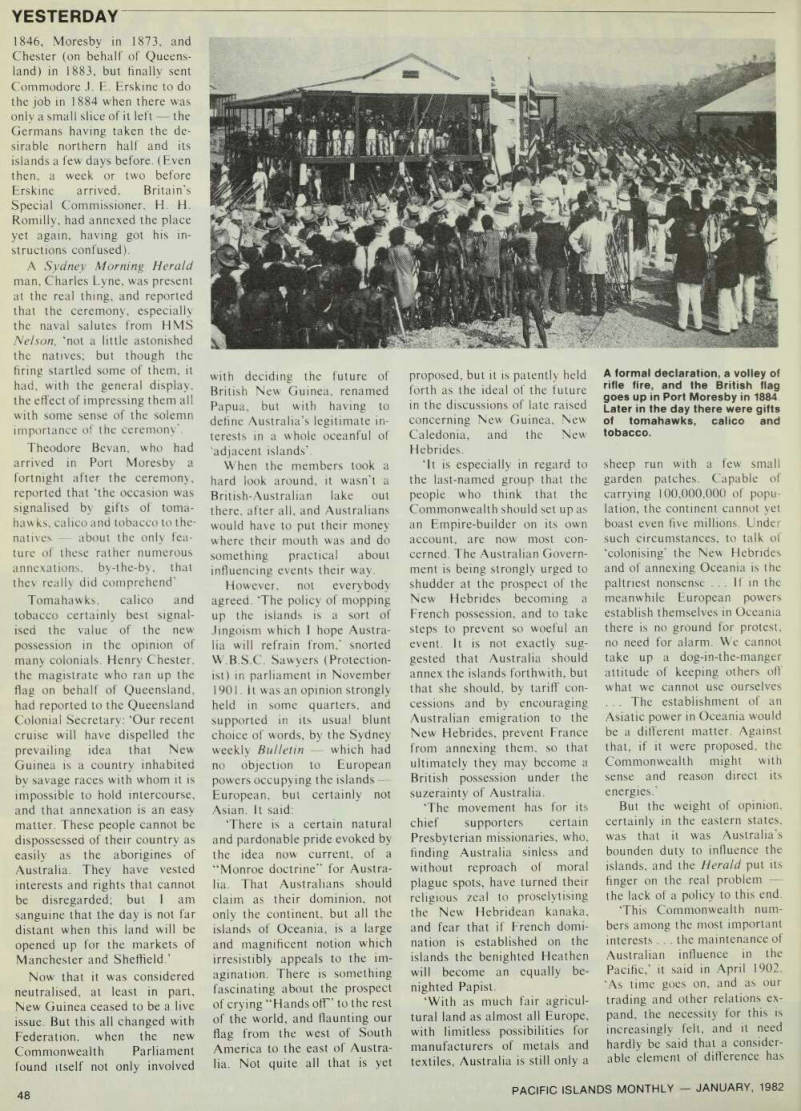
A Sydney Morning Herald man, Charles Lyne, was present at the real thing, and reported that the ceremony, especially the naval salutes from HMS Nelson, ‘not a little astonished the natives; but though the firing startled some of them, it had, with the general display, the effect of impressing them all with some sense of the solemn importance of the ceremony'.
Theodore Bevan, who had arrived in Port Moresby a fortnight after the ceremony, reported that ‘the occasion was signalised by gifts of toma hawks. calico and tobacco to the' natives about the only fea ture of these rather numerous annexations, by-lhe-by, that thev really did comprehend' Tomahawks, calico and tobacco certainly best signal ised the value of the new possession in the opinion of many colonials. Henry Chester, the magistrate who ran up the flag on behalf of Queensland, had reported to the Queensland Colonial Secretary: ‘Our recent cruise will have dispelled the prevailing idea that New Guinea is a country inhabited by savage races with whom it is impossible to hold intercourse, and that annexation is an easy matter. These people cannot be dispossessed of their country as easily as the aborigines of Australia. They have vested interests and rights that cannot be disregarded; but I am sanguine that the day is not far distant when this land will be opened up for the markets of Manchester and Sheffield.’
Now that it was considered neutralised, at least in part.
New Guinea ceased to be a live issue. But this all changed with Federation, when the new Commonwealth Parliament found itself not only involved
with deciding the future of British New Guinea, renamed Papua, but with having to define Australia’s legitimate in terests in a whole oceanful of ‘adjacent islands' When the members took a hard look around, it wasn’t a British-Auslralian lake out there, after all, and Australians would have to put their money where their mouth was and do something practical about influencing events their way.
However. not everybody agreed. ‘The policy of mopping up the islands is a sort of Jingoism which I hope Austra lia will refrain from,' snorted W.B.S.C. Sawyers (Protection ist) in parliament in November 1901. it was an opinion strongly held in some quarters, and supported in its usual blunt choice of words, by the Sydney weekly Bulletin which had no objection to European powers occupying the islands European, but certainly not Asian. It said: ‘There is a certain natural and pardonable pride evoked by the idea now current, of a “Monroe doctrine" for Austra lia. That Australians should claim as their dominion, not only the continent, but all the islands of Oceania, is a large and magnificent notion which irresistibly appeals to the im agination. There is something fascinating about the prospect of crying “Hands off" to the rest of the world, and flaunting our flag from the west of South America to the east of Austra lia. Not quite all that is yet
proposed, but it is patently held forth as the ideal of the future in the discussions of late raised concerning New Guinea. New Caledonia, and the New Hebrides. ‘lt is especially in regard to the last-named group that the people who think that the Commonwealth should set up as an Empire-builder on its own account, are now most con cerned. The Australian Govern ment is being strongly urged to shudder at the prospect of the New Hebrides becoming a French possession, and to take steps to prevent so woeful an event. It is not exactly sug gested that Australia should annex the islands forthwith, but that she should, by tariff con cessions and by encouraging Australian emigration to the New Hebrides, prevent France from annexing them, so that ultimately they may become a British possession under the suzerainty of Australia. ‘The movement has for its chief supporters certain Presbyterian missionaries, who, finding Australia sinless and without reproach of moral plague spots, have turned their religious zeal to proselytising the New Hebridean kanaka, and fear that if French domi nation is established on the islands the benighted Heathen will become an equally be nighted Papist. ‘With as much fair agricul tural land as almost all Europe, with limitless possibilities for manufacturers of metals and textiles, Australia is still only a
sheep run with a few small garden patches. Capable of carrying 100,000.000 of popu lation, the continent cannot yet boast even five millions. Under such circumstances, to talk of ‘colonising’ the New Hebrides and of annexing Oceania is the paltriest nonsense ... If in the meanwhile European powers establish themselves in Oceania there is no ground for protest, no need for alarm. We cannot take up a dog-in-the-manger attitude of keeping others oft’ what we cannot use ourselves . . . The establishment of an Asiatic power in Oceania would be a different matter. Against that, if it were proposed, the Commonwealth might with sense and reason direct its energies.’
But the weight of opinion, certainly in the eastern states, was that it was Australia's bounden duty to influence the islands, and the Herald pul its finger on the real problem the lack of a policy to this end. ‘This Commonwealth num bers among the most important interests ... the maintenance of Australian influence in the Pacific,’ it said in April 1902. ‘As lime goes on, and as our trading and other relations ex pand, the necessity for this is increasingly felt, and it need hardly be said that a consider able element of difference has
A formal declaration, a volley of rifle fire, and the British flag goes up in Port Moresby in 1884 Later in the day there were gifts of tomahawks, calico and tobacco.
been introduced into the situ ation by the developments of the past five or six years. ‘During that brief time his tory has been making itself by whole chapters at a single stride. We have seen Germany established at New Guinea and Samoa, and the United States at the same South Seas centre, as well as at the Philippines, the Carolines, and Hawaii, France is a Pacific Power by reason of her position at New Caledonia and her influence in groups like the New Hebrides. England, of course, holds Australia, New Zealand, Fiji, and other island groups in the South Pacific. ‘This comparatively rough statement of the position is, however, discounted in no small measure by the recent action of the United States. We refer here more particularly to the shipping laws which prohibit trading between American ports in any other than American-owned ships, together with the almost revol utionary manner in which the hitherto sacrosanct Monroe doctrine has been interpreted or set aside by American statesmen and by American public opinion. For many years British calculations were accus tomed to take account of the immobility implied in this doc trine as a permanent factor in any consideration of the exter nal commercial and political relations of the United States.
But the result of the Spanish- American war changed all that at a stroke. The United States stands now as a naval and colonising power, and recent events make it clear that it aims at being a commercially ag gressive force in the maritime world as well . . . ‘We must have systematised and effective control if we are to cope with any prospect of suc cess with the rapidly changing trade conditions in our own waters. We have enjoyed our peaceful isolation in the Pacific so long that it requires a certain effort to realise the altered circumstances, and still more, perhaps, to take into practical account the possible further modifications within the coming few years .. . What the Commonwealth and its statesmen have to do is to form definite ideas as to what Austra-
Man wants are in this con nection, and a definite policy as to the best means of achieving the end they suggest.’
The policy the Australian statesmen formulated was that Papua should become an Aus tralian territory, and not be the subject of some ‘temporary arrangement’ ‘There should be no half-measures in the matter,’ said Prime Minister Edmund Barton. And that Britain should be asked to purchase France’s interest in the New Hebrides, with Austra lia administering the group at its own expense.
The Australian Government under Barton had heard it rumoured that France might be willing to consent to Britain’s annexation of the New Hebrides for £250,000 of which sum Australia offered to pay Britain three percent as well as paying the cost of administering the group. Barton protested against a proposed Joint Protec torate in the New Hebrides and even more strongly against a suggestion of partition. This was in 1903.
In the event, Australia ac quired Papua, but to its utter dismay, missed out on the New Hebrides. Its anger at its treat ment was expressed by the Prime Minister, now Alfred Deakin, in this speech to Britain at the Colonial Conference of 1907, a few months after the Anglo-French Convention had been unexpectedly made: T feel it would be idle to criticise that convention now; but I do feel in justice to ourselves . . . that we are en titled to have it understood why, and with good reason, we have an exasperated feeling.
T do not know of any series of public incidents that have shown more discord in Austra lia and created more discontent than those dealing with the Pacific Islands . . . The trade of the New Hebrides, such as it is, is with Sydney and Auckland, and consequently the best infor mation available is to be ob tained in them. There was first of all a fair title of our people and their Government to be consulted, and there was next the possession of an intimate knowledge of their local con ditions possessed by our missionaries and our traders.
On both these grounds, we, as representatives of the British people in those seas and deeply interested ourselves, were en titled to be heard. ‘The fact is, however, that this convention was arrived at without us in the most extra ordinary manner . . . The corre spondence which had been con ducted between the Imperial Government and ourselves had two or three different lines. One was the main correspondence asking for annexation, another and quite distinct correspon dence was being carried on in
reference to the titles claimed by British or French settlers with the objective of getting those in some way settled, in order to avoid the quarrels which were springing up be tween the settlers and the natives, or occasionally between nationals, either British or French, over their transactions in land. There was a third line of correspondence which related to the occasional disturbances in the island or minor squabbles . . . To say that a correspon dence with us had been pro ceeding for many years is per fectly true, but quite irrelevant to the making of this conven tion. To say that we were consulted at every step is an abuse of language, so far as that convention is concerned. ‘To lead anyone to suppose that the Commonwealth or its Government had the faintest tittle of responsibility for either this commission or the person nel of this commission, matters
on which I think we were fully entitled to be heard, or to allow it to be supposed that we knew anything of that commission, its purposes, character, or work, or of this convention until we saw it complete, is to convey a series of wholly mistaken impressions.
We knew nothing until we received this convention with an intimation that it must be either taken as a whole or left.’
By 1913 Australia’s terri torial ambitions had extended no further than the acquisition that year of Norfolk Island as a territory. External Affairs Min ister P. McGlynn rejecting a proposal that New Zealand should have it because it was closer to New Zealand. He told parliament: '1 do not believe in surrendering what seems to be our domain. 1 hope that the interests of Australia will be more manifest in the future, and I say it with the greatest respect to other nations, whose ideas of government, if applied, may tend as much to the amelioration and advancement of the natives as our own.
Placed as we are, the greater control we have of islands like Norfolk Island, the better it may be for the people there and here. And we must look ahead.’
Looking ahead, it’s unlikely he foresaw that as a result of World War I, Australia was on the eve of suddenly acquiring German New Guinea and Nauru, and that New Zealand would acquire German Samoa; that virtually all the South Seas were about to become ‘British’, and therefore ‘safe’; and that Australia too was to have black subjects enough.
Still less would anyone have supposed that the involvement would take the next 50 years, the greater part of them drowsy years when Australia wasn’t much interested in the world outside, and that finally Austra lia would allow itself to con tract, honourably, to its original borders.
Today Australia faces the situation it faced on Federation; it needs to define for itself its South Pacific policy in this new South Pacific, where small nations, some the size Australia once was, have the same urgent desire for trade and security that Australia once had, and perhaps has forgotten it had.
A scandal made public in 1831 was the sale of tattooed Maori heads, brought into Australia by unscrupulous traders.