‘Blackbirding’,
pp. 44-45 · Read in the full issue
Peruvian style
Slavers in Paradise: The Peruvian Labour Trade in Polynesia, 1862-1864. By H E.
Maude. Published by Austra lian National University Press, Canberra, 1981. xxii and 244
(Pp.) Isbn O 7081 1607 8.
Price SA2S.
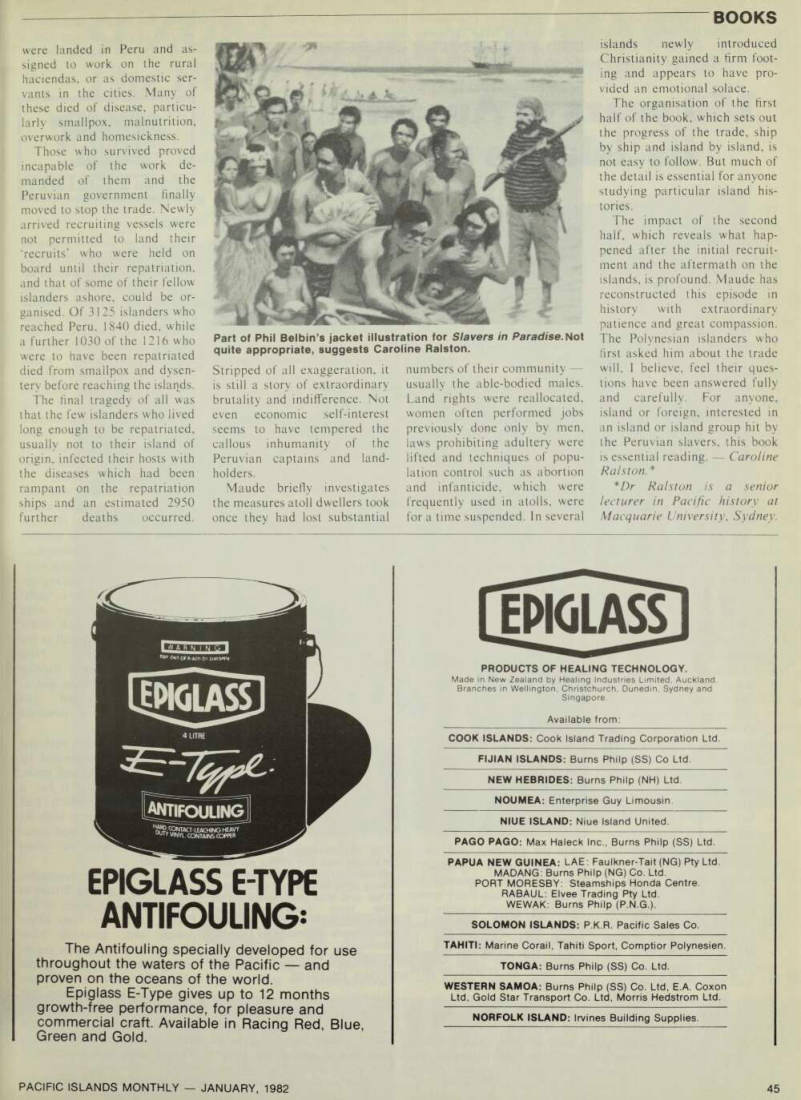
Despite the dustjacket picture and the title, Slavers in Para dise is a serious academic study and a most welcome addition to the history of many islands in Polynesia and Kiribati. The offending picture is a crude, garish representation of brown people being herded into boats by armed white villains, while the title across this background suggests little but Hollywood sensationalism.
The ‘slavers’ part of the title is not inaccurate. The Peruvian Government attempted to regu late the trade, to insist on properly interpreted contracts.
voluntarily signed, and to en sure that the islanders were adequately treated once they reached Peru. But in practice none of the regulations was adhered to. The means of ac quiring Pacific islanders and their conditions in Peru were little short of slavery.
The equation of the island world with ‘paradise’ is more questionable. In contrast to the conditions the islanders en dured on the ships and in Peru, undoubtedly home was para dise. But the stereotype of Polynesia as paradise is one most modern Polynesian histo rians shun as inaccurate and unhelpful, and Maude himself claims that some islanders went on board the slavers' vessels hoping to find food or access to food, which was, at the time of the slavers’ visit, so scarce ashore. To my mind The Peruvian Labour Trade in
Polynesia 1862-1864 would have been a more appropriate and illuminating title.
But these criticisms are not fundamental. Discard the dustjacket, ignore the title and one has a book impeccably presented, and meticulously and exhaustively researched qualities for which H.E. Maude is justifiably renowned.
Not surprisingly, over the intervening century, many as pects of the Peruvian labour trade have been exaggerated, as Maude makes clear. For example, there is no evidence to suggest that islanders were ‘re cruited’ for the guano mines on the Chincha Islands off main land Peru, and very little good evidence that any islander worked there after landing at Callao. Similarly, the claim that 200 men (more than the estimated total population of the island at the time) were taken from Atafu, a Tokelau atoll, is reduced most convinc ingly by Maude to 37. These and many other legends are carefully explored, the sources of falsification and exaggeration
documented, and the record straightened. This does not, however, mean that the story which is revealed is not gruel ling and inhumane; it is, as a brief resume of the facts will establish.
The whole tragedy, from the first islander taken to the last death on the islands due to diseases introduced by the very few islanders who were repatri ated, occurred between 1862 and 1864. Approximately 3500 islanders were rounded up, mostly from Easter Island, Niue, the Cook Islands, Tuvalu, Kiribati and the Marquesas.
Atoll dwellers were more vul nerable than high-island inhabi tants because the former had no means of retreat from the armed slavers, and their iso lation left them unprotected and unwarned by missionaries, white officials or other islanders.
Of those ‘recruited’, 345 died on the voyage to Peru dysentery being a major killer on the grossly overcrowded ships. Men, women and chil dren to the number of 2116
were landed in Peru and as signed to work on the rural haciendas, or as domestic ser vants in the cities. Many of these died of disease, particu larly smallpox, malnutrition, overwork and homesickness.
Those who survived proved incapable of the work de manded of them and the Peruvian government finally moved to stop the trade. Newly arrived recruiting vessels were not permitted to land their ‘recruits’ who were held on board until their repatriation, and that of some of their fellow islanders ashore, could be or ganised. Of 3125 islanders who reached Peru, 1840 died, while a further 1030 of the 1216 who were to have been repatriated died from smallpox and dysen tery before reaching the islands.
The final tragedy of all was that the few islanders who lived long enough to be repatriated, usually not to their island of origin, infected their hosts with the diseases which had been rampant on the repatriation ships and an estimated 2950 further deaths occurred.
Stripped of all exaggeration, it is still a story of extraordinary brutality and indifference. Not even economic self-interest seems to have tempered the callous inhumanity of the Peruvian captains and land holders.
Maude briefly investigates the measures atoll dwellers took once they had lost substantial
numbers of their community usually the able-bodied males.
Land rights were reallocated, women often performed jobs previously done only by men, laws prohibiting adultery were lifted and techniques of popu lation control such as abortion and infanticide, which were frequently used in atolls, were for a time suspended. In several
islands newly introduced Christianity gained a firm foot ing and appears to have pro vided an emotional solace.
The organisation of the first half of the book, which sets out the progress of the trade, ship by ship and island by island, is not easy to follow. But much of the detail is essential for anyone studying particular island his tories.
The impact of the second half, which reveals what hap pened after the initial recruit ment and the aftermath on the islands, is profound. Maude has reconstructed this episode in history with extraordinary patience and great compassion.
The Polynesian islanders who first asked him about the trade will, 1 believe, feel their ques tions have been answered fully and carefully. For anyone, island or foreign, interested in an island or island group hit by the Peruvian slavers, this book
is essential reading.
Caroline
Ralston.
*Dr Ralston is a senior lecturer in Pacific history at Macquarie University, Sydney.
Part of Phil Belbin’s jacket illustration for Slavers in Paradise. Not quite appropriate, suggests Caroline Ralston.