Micronesia: The ships
p. 43 · Read in the full issue
that called, 1531-1885
Foreign Ships in Micronesia: A Compendium of Ship Contacts with the Caroline and Marshall Islands, 1521-1885. By Fr Francis X. Hezel, SJ. Pub lished with the assistance of the Trust Territory Historic Pres ervation Office and the US Heritage and Recreation Ser vice. Copies may be obtained by writing to the Micronesian Seminar, Box 220, Truk, Fed erated States of Micronesia.
Professor Harry Maude and Dr Saul Riesenberg are the two Pacific scholars to whom Father Francis Hezel, SJ, has dedi cated his Foreign Ships in Micronesia: A Compendium of Ship Contacts with the
Caroline and Marshall Islands, 1521-1885 (Saipan, 1979). Fr Hezel hails the care with which both men have accumulated Pacific Islands primary source materials and the assistance they have given him with this project. Fr Hezel himself is to be commended for the thoroughness with which he
has gone about this, the first nautical reference work on the Caroline and Marshall Islands.
Foreign Ships is a listing of ships that called at each of the six districts in the Carolines and Marshalls before the founding of colonial rule in 1885. This work is as complete as any solitary researcher could make it in its list of British and American ships which came to this area in the 18th century, and its list of similar naval vessels and whaleships that called in the 19th century. In addition to these, visits by ships from European continental nations are to be found if they are mentioned in English sources, or described in the available foreign language sources. Undoubtedly, many more Spanish ships took part in the flourishing beche-de-mer trade in the western Carolines in the first half of the 19th century, but they are not listed here because no one has written about or otherwise identified them; where no one has gath ered, it is impossible to reap.
Foreign Ships sets out in 1521 with Magellan’s entry into Micronesia; the earliest visit recorded in the book is the 1522 visit of Magellan’s crew to an island in southern Palau while they were on their way home from the Philippines after
paper.
Magellan’s death. The last dis trict to be ‘discovered’ by Europeans is Kosrae (formerly Kusaie), which was not visited until 1793 by Captain Musgrave of the Sugar Cane whose name identified the island (Musgrave’s Island) until well into the 19th century.
The six districts are listed from west to east, beginning with Palau in the western Carolines, then moving east to Yap, Truk, Ponape, Kosrae and ending with the Marshalls. Two visits to unspecified Caroline islands conclude the list of ships.
Entries furnish information on ‘the name of the vessel, its captain, its hailing port, and the purpose of its voyage . . . along with occasional comments on the people or the place’.
Sources for each entry are helpfully keyed to the impress ive bibliography (pp 143-68).
The index is composed of the names of captains, ships, indi vidual islands, atolls and island groups; mention is also made there of any mutinies, ship wrecks, and descriptions of islands and Micronesians. One map accompanies the listings for each district.
Australian scholars stand to benefit most from this work as they slowly unload the cargo of documents now in Australia relating to the German colonial effort in the Marshalls and Carolines from 1885 to 1914.
Foreign Ships will be, for them, an indispensable guide to pre colonial activities in Micronesian islands north of the equator.
All readers and users of this work will find it helpful in establishing generally accurate ideas of the main commercial and missionary activities going on in the islands before 1885.
The bibliography identifies the works that should be required reading for anyone wanting to learn more about Micronesian history (including the history of Nauru and Kiribati).
Foreign Ships is bound in an attractive soft-cover edition with brown print on white
M. L. Berg.
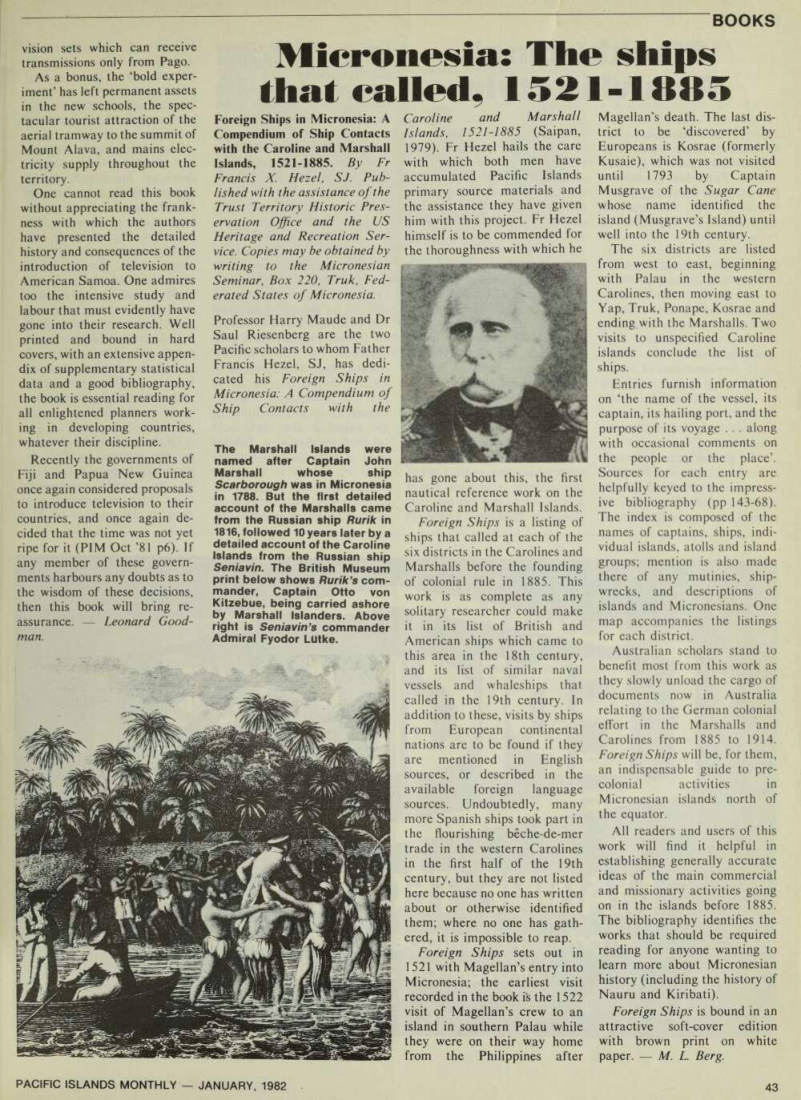
The Marshall Islands were named after Captain John Marshall whose ship Scarborough was in Micronesia in 1788. But the first detailed account of the Marshalls came from the Russian ship Rurik in 1816, followed 10 years later by a detailed account of the Caroline Islands from the Russian ship Seniavin. The British Museum print below shows Rurik’s com mander, Captain Otto von Kitzebue, being carried ashore by Marshall Islanders. Above right is Seniavin’s commander Admiral Fyodor Lutke.