Washington-based National As sociation
pp. 41-43 · Read in the full issue
sociation of Educational Broad casters (NAEB), and later for the expenditure of more than SUS 6 million on the construc tion of a six-channel television system, and the construction of 30 new special-purpose schools, ancillary buildings, and the complex equipment and ser vices essential for the establish ment and running of a com plete, comprehensive, edu cational TV system.
At the congressional hearing, a cloud no bigger than a man’s hand appeared on the horizon in the person of Senator Warren Magnuson who asked whether the scheme being proposed ‘would not lead to an irresistible demand for entertainment-type programmes’, but was re assured by Lee who said that although they might show trav elogues, or 30 minutes of an old film, or something else, he did not plan that type of service.
Once financial approval was secured, the project went ahead at great speed. There were formidable engineering prob lems, of which not the least was the construction of the trans mission mast on the 489-metres high ‘Rainmaker’, Mount Alava, where repeated attempts to construct an access road to the summit were frustrated by the rugged terrain and heavy rainfall. The task was finally accomplished only by building an aerial tramway, 1.6 kilo metres long, across Pago har bour. The provision of universal electricity supply for the oper ation of the receivers was also a
major undertaking for, al though the total land area of the territory is only a little more than 180 square kilometres, it is spread over six islands. Air conditioned studio, operational and control buildings contain ing also library, photographic, art, publication, and adminis trative accommodation were also built, as well as the new village schools especially de signed for teaching by tele vision, but preserving the tra ditional Samoan fale style and design.
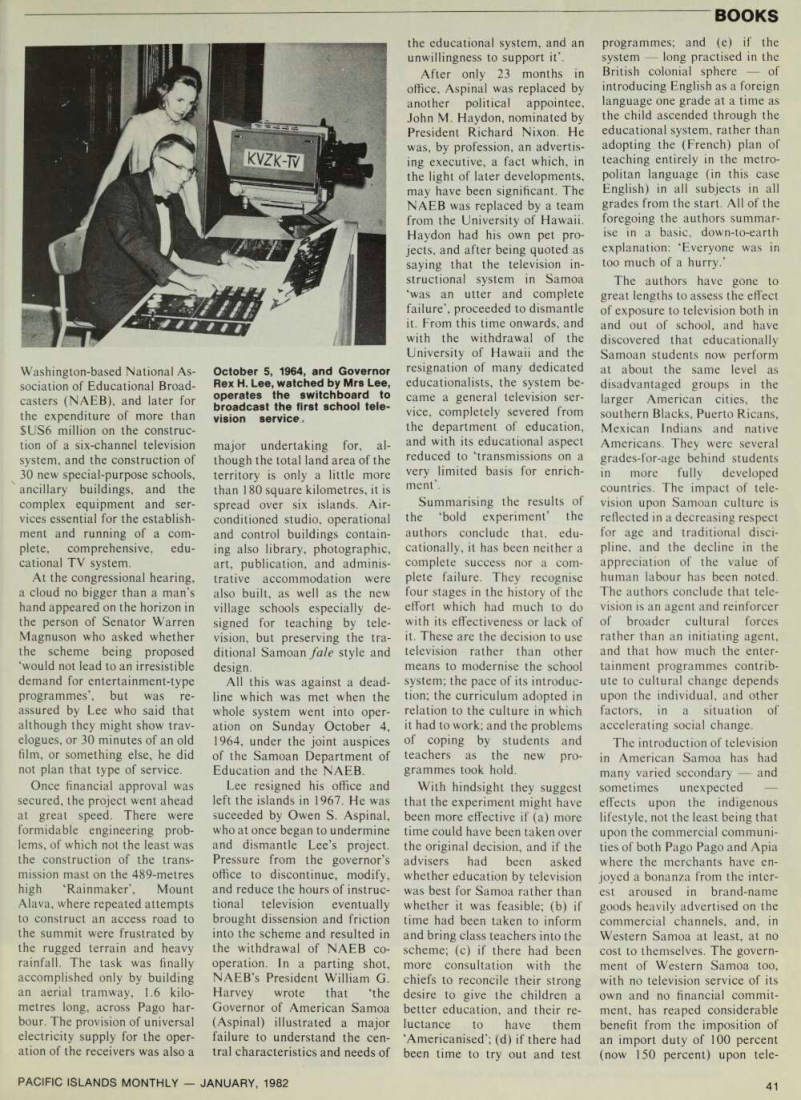
All this was against a dead line which was met when the whole system went into oper ation on Sunday October 4, 1964, under the joint auspices of the Samoan Department of Education and the NAEB.
Lee resigned his office and left the islands in 1967. He was suceeded by Owen S. Aspinal, who at once began to undermine and dismantle Lee’s project.
Pressure from the governor’s office to discontinue, modify, and reduce the hours of instruc tional television eventually brought dissension and friction into the scheme and resulted in the withdrawal of NAEB co operation. In a parting shot, NAEB’s President William G.
Harvey wrote that ‘the Governor of American Samoa (Aspinal) illustrated a major failure to understand the cen tral characteristics and needs of
the educational system, and an unwillingness to support it’.
After only 23 months in office, Aspinal was replaced by another political appointee, John M. Haydon, nominated by President Richard Nixon. He was, by profession, an advertis ing executive, a fact which, in the light of later developments, may have been significant. The NAEB was replaced by a team from the University of Hawaii.
Haydon had his own pet pro jects, and after being quoted as saying that the television in structional system in Samoa ‘was an utter and complete failure’, proceeded to dismantle it. From this time onwards, and with the withdrawal of the University of Hawaii and the resignation of many dedicated educationalists, the system be came a general television ser vice, completely severed from the department of education, and with its educational aspect reduced to ‘transmissions on a very limited basis for enrich ment'.
Summarising the results of the ‘bold experiment’ the authors conclude that, edu cationally, it has been neither a complete success nor a com plete failure. They recognise four stages in the history of the effort which had much to do with its effectiveness or lack of it. These are the decision to use television rather than other means to modernise the school system; the pace of its introduc tion; the curriculum adopted in relation to the culture in which it had to work; and the problems of coping by students and teachers as the new pro grammes took hold.
With hindsight they suggest that the experiment might have been more effective if (a) more time could have been taken over the original decision, and if the advisers had been asked whether education by television was best for Samoa rather than whether it was feasible; (b) if time had been taken to inform and bring class teachers into the scheme; (c) if there had been more consultation with the chiefs to reconcile their strong desire to give the children a better education, and their re luctance to have them ‘Americanised’; (d) if there had been time to try out and test
programmes; and (e) if the system long practised in the British colonial sphere of introducing English as a foreign language one grade at a time as the child ascended through the educational system, rather than adopting the (French) plan of teaching entirely in the metro politan language (in this case English) in all subjects in all grades from the start. All of the foregoing the authors summar ise in a basic, down-to-earth explanation; ‘Everyone was in too much of a hurry.’
The authors have gone to great lengths to assess the effect of exposure to television both in and out of school, and have discovered that educationally Samoan students now perform at about the same level as disadvantaged groups in the larger American cities, the southern Blacks, Puerto Ricans, Mexican Indians and native Americans. They were several grades-for-age behind students in more fully developed countries. The impact of tele vision upon Samoan culture is reflected in a decreasing respect for age and traditional disci pline. and the decline in the appreciation of the value of human labour has been noted.
The authors conclude that tele vision is an agent and reinforcer of broader cultural forces rather than an initiating agent, and that how much the enter tainment programmes contrib ute to cultural change depends upon the individual, and other factors, in a situation of accelerating social change.
The introduction of television in American Samoa has had many varied secondary and sometimes unexpected effects upon the indigenous lifestyle, not the least being that upon the commercial communi ties of both Pago Pago and Apia where the merchants have en joyed a bonanza from the inter est aroused in brand-name goods heavily advertised on the commercial channels, and, in Western Samoa at least, at no cost to themselves. The govern ment of Western Samoa too, with no television service of its own and no financial commit ment, has reaped considerable benefit from the imposition of an import duty of 100 percent (now 150 percent) upon tele
October 5, 1964, and Governor Rex H. Lee, watched by Mrs Lee, operates the switchboard to broadcast the first school tele vision service,
vision sets which can receive transmissions only from Pago.
As a bonus, the ‘bold exper iment’ has left permanent assets in the new schools, the spec tacular tourist attraction of the aerial tramway to the summit of Mount Alava, and mains elec tricity supply throughout the territory.
One cannot read this book without appreciating the frank ness with which the authors have presented the detailed history and consequences of the introduction of television to American Samoa. One admires too the intensive study and labour that must evidently have gone into their research. Well printed and bound in hard covers, with an extensive appen dix of supplementary statistical data and a good bibliography, the book is essential reading for all enlightened planners work ing in developing countries, whatever their discipline.
Recently the governments of Fiji and Papua New Guinea once again considered proposals to introduce television to their countries, and once again de cided that the time was not yet ripe for it (PIM Oct ’Bl p 6). If any member of these govern ments harbours any doubts as to the wisdom of these decisions, then this book will bring re assurance. Leonard Good man.