a 'bold experiment'
p. 39 · Read in the full issue
Books
Tv In American Samoa
Pluses and minuses of a 'bold experiment'
Bold Experiment: The Story of Educational Television in American Samoa. By Wilbur Schramm, Lyle M. Nelson, and Mere T. Betham. Published by Stanford University Press, California, USA, 1981. ix arid 244 pp. ISBN 0 8047 1090 2.
Price SUS 17.50.
When, in 1899, the United Kingdom, Germany, and the United States eventually re solved the long-standing dis putes over territorial rights in Samoa by recognising America’s claim to those islands east of the 171 °W meridian, and of Germany’s claim to those west of it, the Samoan group of islands was divided politically and internationally.
Those to the west became in turn a German colony, a man dated territory under New Zea land administration, and, finally, on January 1,1962, the Independent State of Western Samoa. The eastern group which somehow also acquired Swain’s Island notwithstanding that it is geographically one of the Tokelau group, and west of the 171st meridian became the base for the American Pacific fleet from 1904 until 1950, and then an ‘Unincorpor ated Territory of the United States’, a definition which, at least until 1961, appeared to be more of an exercise in semantics than any indication of its politi cal or social development from its 1899 pseudo ‘colonial’ status.
From the time of the with drawal of the US fleet in 1950 until the appointment of Rex H.
Lee in 1961, there had been six governors and four acting governors, resulting in a change of policy approximately every year. Rex H. Lee differed from his predecessors in being a career diplomat and not a political nominee, and also in that he had a mandate to make major changes, together with a strong personal determination to improve the economic and social conditions of the Samoan people. In referring to the state
of development in general and of education in particular as he found it at the time of his appointment, he said: ‘There is no time for waiting, no time for armchair patience there has been too much of that for 60 years,’ a statement which the authors of this book consider to reflect, in part, the sense of guilt felt by the US Government over not having done more to help Samoa to move into the modern world during the period of its responsibility.
Certainly there was an am bivalence in the approach to development. Many anthropol ogists and others who knew the Samoan culture well argued that that culture should not be tampered with, and that the US should not disturb further the tranquillity of the islands. On the other hand, it could be, and was, argued that the Samoans could not forever be protected
from the advancements of the modern world. Thus, with the advent of Rex H. Lee, the pull of conscience over what had not been done in the previous 60 years began to over-balance the pull of what might be.
Of the many reforms ur gently awaiting his attention, that of education had the highest priority. Lee found the school system ‘a shambles’ in terms of facilities, buildings, educational standards and re
suits, and ‘appalling even by comparison with the mainland ghettos’. All but a few of the 56 village schools were housed in Samoan fales with no equip ment or furniture whatsoever other than a blackboard. Since Samoans normally sit on the floor, no one, it seems, had thought it necessary to provide chairs or desks, even for the teachers. The only books were out of date discarded hand-me downs from the States, the contents of which had no rel evance to Samoan conditions, and with allusions and illus trations which must have been completely foreign and incom prehensible to Samoan chil dren. Not a single teacher in the elementary schools had a main land teaching certificate. Fur thermore, the few with high school diplomas scored only at the fifth grade of academic achievement, so that Lee had to
call for interpreters so that he could talk in English with teachers who were supposedly teaching a curriculum of English.
Lee was not only a man with a mission, he was also a man in a hurry. He knew what the answer was: it was complete,
universal and comprehensive education for all by television, that glamorous new medium which was being used in Europe, USA, India, Iran, Chile and other countries. Lee himself had had personal ex perience of its efficacy in that his daughter had learned to type, and he ‘conversational French’ through television courses!
Certainly Lee consulted sev eral authorities, but not as to whether educational television should be introduced he had already made that decision but as to how and how soon. In many quarters his ideas on the subject were received ‘in re spectful silence’. Some of the Samoan chiefs were far from sure what television was or what a television set looked like. But all were in favour of any scheme that would improve the edu cation of their children, and thus the opportunities of a job on the mainland. Discussion with education departmental personnel did not reveal unqualified enthusiasm for the proposal; on the contrary there were long arguments about it.
Alternatives were suggested, the main ones being an upgrad ing of the system by the mass importation of American certificated teachers, and/or the institution of ‘crash’ pro grammes to produce competent local teachers in the shortest possible time. The authors re mark that it was strange that at this time no serious consider ation was given to the possi bility of using radio as a me dium for improving educational standards, notwithstanding, as they point out, that radio would have had numerous advantages over television, and would have been far less expensive.
Eventually Lee had sufficient information and enthusiasm to present his proposal to the US Congress, where approval was quickly granted, first for a feasibility study by the
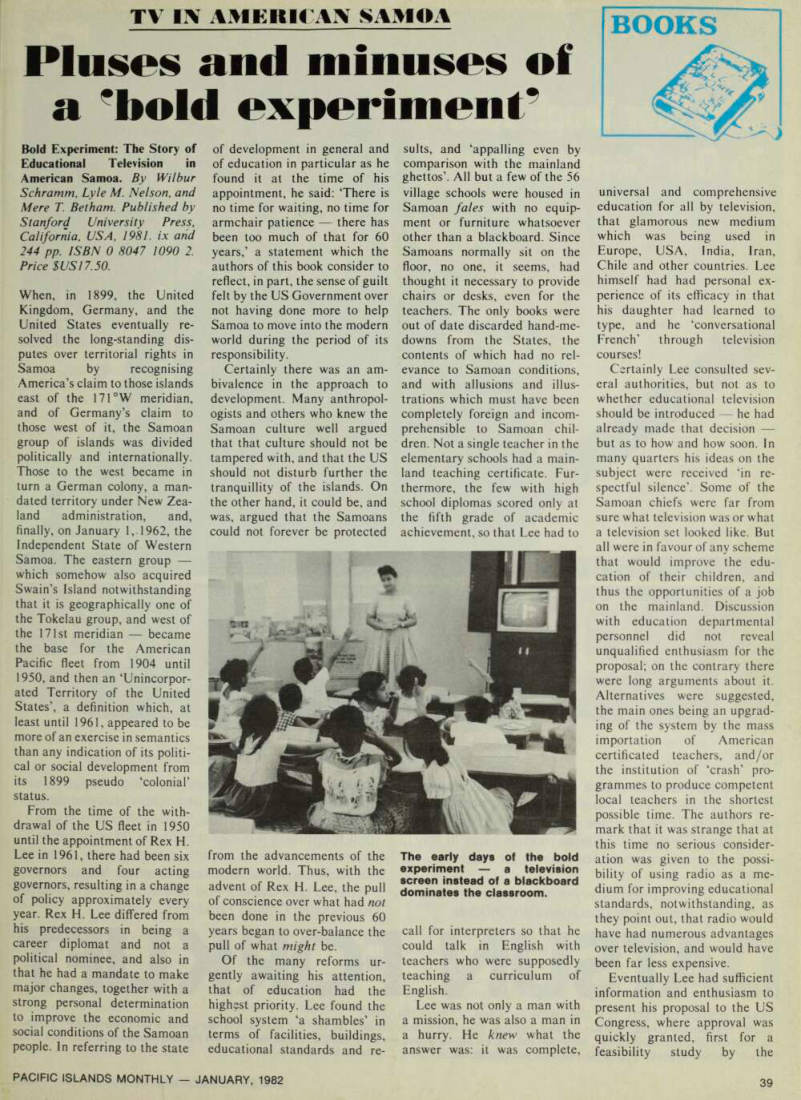
The early days of the bold
experiment - a television
screen instead of a blackboard dominates the classroom.