People
pp. 36-37 · Read in the full issue
the women they were sleeping with were in fact their wives.
The Cook Islands News re port goes on; ‘lf they were then they were fornicating and did not believe in God according to the Bible . . .’ (Careful readers will note that the vital word ‘not’ got dropped from this sentence, creating a strange impression. More, the word ‘fornicating’ did not appear as printed above; it was printed as ‘formicating’, a typographical error which led one Raro wit to suggest that this new word coinage possibly meant ‘the sensation of having ants crawl ing all over you . . .' But that’s by the way.) Mr Pitt’s Bugle article charged on; ‘lf you don't believe in God you’re a fool. Maybe that’s the problem with New Zealand, it’s governed by fools.’
Shortly before leaving Rarotonga, Mr Pitt had a cau tionary word for the Cook Islands Government. He said that the country received $6 million a year of the New Zealand taxpayers’ money, and ‘he liked to see the money spent in a worthwhile fashion’. (Sir Tom, lake note!) Saying that he took full responsibility for what he had said over the radio in his religious broadcast, Mr Pitt added perhaps unnecessarily that ‘the Assembly of God, who sponsored the programme, had no idea of what 1 was going to say .. .’
A former senior civil servant in Fiji is now in gaol in Sydney, no doubt brooding over what nasty
The Rev George Pitt was out raged that an hour-long broad cast he gave over Radio Cook Islands last November was cost ing his sponsors, the Assembly of God, SNZIBO. ‘The radio’s running at a loss because they are not giving more free lime to God especially on a Sunday when people are really thinking about God,’ he said, according to a report in Cook Islands News.
Cook Islands-born Mr Pitt he claims he was delivered in 1951 by the present Prime Minister Sir Tom Davis, in his capacity as medical practitioner moved to New Zealand when he was 15, and was back in Rarotonga on a holiday when asked to make the broadcast.
Mr Pitt’s career has been nothing if not colourful. He says he has nothing to hide about his background, and admits he was a member of ‘Highway 61’, a bikie gang in Auckland, for four years during his teens.
But when the gangs started pulling real bullets in their firearms, and one of the mem bers of his gang had his head blown off with a shotgun, he decided it was time to get out.
Cook Islands News reports: ‘He got married, joined the fire service for the next six years, was converted to Christianity, spent a year doing theological training, then received a call to the Baptist Church. ‘Now at 30 years of age he is a clean-cut Baptist minister with four children, the eldest 11.’
The paper goes on to recount the memorable tale of Mr Pitt’s part in the campaign leading up to New Zealand’s parliamen tary elections on November 28, 1981.
Writing in The Bugle, an Auckland suburban newspaper, Mr Pitt urged his readers to ask their parliamentary candidates whether they believed in God.
Among questions to be put to candidates to determine this important issue, Mr Pitt sug gested they should be asked if
consequences can result from actions that are just that little bit too greedy.
He is Leslie Angus Furness, 65, who was declared bankrupt in Sydney in August, 1974.
While still undischarged, he worked in the New South Wales Parliament, rising to the pos ition of Clerk of Bills.
In 1978, he was committed for trial on five charges under the Bankruptcy Act, allowed $lOO bail, but failed to appear for trial.
In January, 1979, Furness became director of the Business Opportunity and Management Advisory Service for the Fiji Government in Suva.
In October, 1979, he re turned to Australia to interview applicants for positions with the Fiji advisory service. He was arrested at Sydney airport on a warrant for his failure to front up in court in 1978.
Where does greed come into this melancholy tale?
At his Sydney trial last November, the court was told that Furness, while working with the Fiji Government de partment, had applied to the Australian Department of Foreign Affairs for his salary to be supplemented, as he was ‘assisting a foreign nation’.
Following this application, Foreign Affairs began inquiries into the background of this ostensibly ‘selfless’ gentleman, battling away there in the heat of Suva to ‘help’ Fiji. These inquiries soon led to the dis covery of Mr Furness’s con siderable record of helping him self and, of course, his delicate position vis-a-vis the Australian law. If he hadn’t made this effort to have the Australian Government ‘top up’ what was probably an already fairly generous salary, he’d almost certainly still be living comfortably in Suva.
As it is he has been gaoled for two-and-a-half years, on 18 charges under the Bankruptcy Act, and one under Australia’s Commonwealth Crimes Act.
The court was told that Furness owed more than $3OO 000 to creditors.
Judge Godfrey-Smith set a non-parole period for Furness of six months.
Another Australian import into Fiji who will no doubt stay longer, and be quite unlikely to get into Furness-type trouble is Clive Speed, former producer of the Australian Broadcasting Commission’s popular current affairs programme, PM.
Mr Speed announced his resignation from the ABC last November after 11 years ser vice with the commission.
He is to work as a media consultant for Fiji’s Prime Min ister Ratu Sir Kamisese Mara.
Guyette Wahea, a New Caledonian resident in Port- Vila, functions as the represen tative of the pro-independence Kanak political forces in Vanuatu. French authorities have let it be known in various ways that they wouldn’t mind in the least seeing him expelled from the country, or at least having his activities severely curtailed.
Mr Wahea is an intense man of medium build, thoroughly dedicated to the cause of Kanak independence. Born on the island of Mare in the Loyalty group, he has lived in Port-Vila for about a year. He had been a close confidant of the murdered secretary-general of the Union Caledonienne, Pierre Declercq.
This murder has exacerbated inter-racial animosities in New
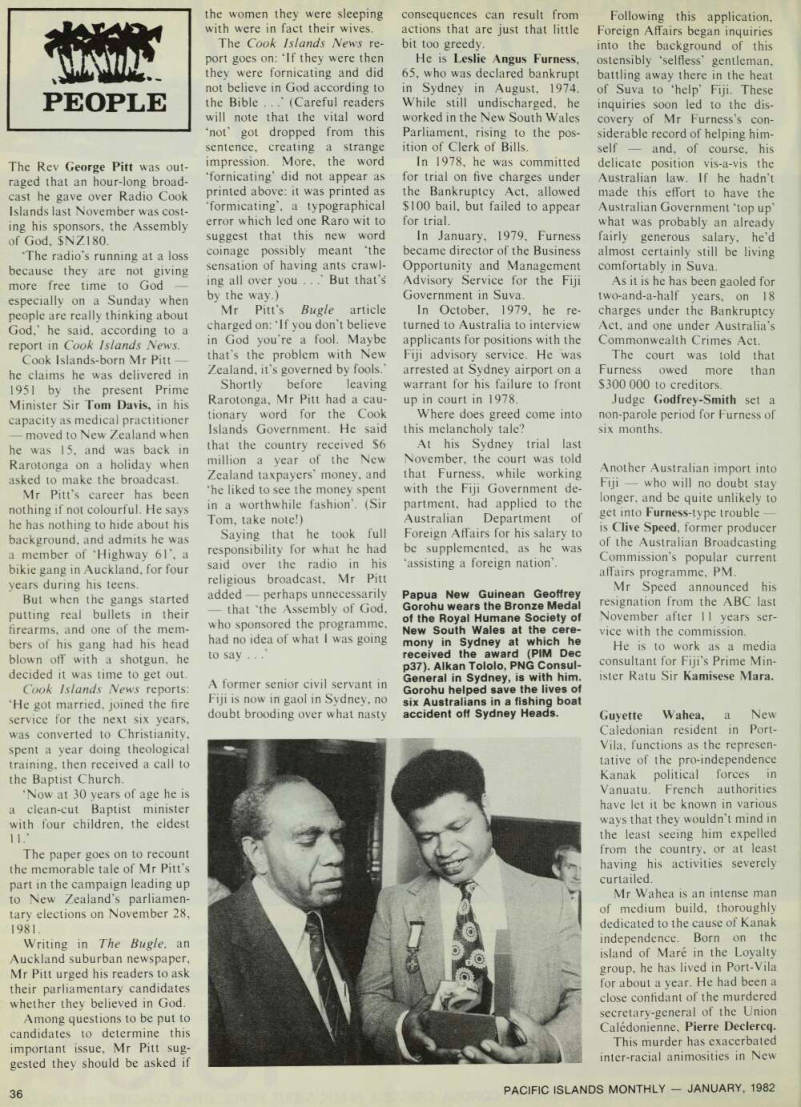
Papua New Guinean Geoffrey Gorohu wears the Bronze Medal of the Royal Humane Society of New South Wales at the cere mony in Sydney at which he received the award (PIM Dec p37). Alkan Tololo, PNG Consul- General in Sydney, is with him.
Gorohu helped save the lives of six Australians in a fishing boat accident off Sydney Heads.
Caledonia, and French sources claim that it was certainly not an event they had wished for.
The murder has made it still more difficult for the opposing groups to talk freely and reach compromise agreements.
One project dear to Guyetle Wahea’s heart is the raising of money to erect a monument to Declercq in Noumea. But it seems that most of his col leagues in the independence movement do not think the idea is feasible, and believe that the money could be pul to better use in their independence struggle.
French sources lend to write Wahea off as less than credible.
They find many of his state ments outlandish, and make much of his alleged tendency to find himself frequently on the wrong side of the law.
In Wahea’s view change in New Caledonia will not come by democratic means, as the non-Melanesian population out numbers the original inhabi tants. He hints that the Kanaks may need to resort to more forceful means if moderate approaches fail.
He denounces the collabor ation by traditional conserva tive elements of the Kanak population with the French authorities, and is particularly critical of his fellow Mare islander, Dick Ukeiwe, who is vice-president of the council of government in Noumea.
Wahea considers that the ‘French problem' in New Caledonia differs from that in French Polynesia mainly be cause of the relatively small number of French settlers in Polynesia. He says the Polynesians will eventually gain independence by democratic means, without the need to resort to violence. The task for the la mana te nunaa, the Polynesian independence party, ‘will be easier because they have kept their dignity,’ Wahea says, adding; ‘They have not suffered the post-rebellion re pressions experienced by the Kanaks in New Caledonia.’
Tony Cole.
David Barry Crabtree, 30, an Australian citizen who has lived in Fiji for 15 years, has been appointed marketing manager for the Fiji Visitors Bureau in
Australia. He succeeds Ron Michael (PIM Dec ’Bl p4O). Mr Crabtree is expected to take up his appointment in January 1982.
Mr Crabtree was educated in Fiji before he went on to higher education in Australia. He graduated with a BA degree in 1973.
He has had experience as a script writer and producer for radio programmes, as a pho tographer and editor, and in audio-visual production and presentation. He worked for a year as a cameraman-reporter for NBN3 Television in Newcastle, New South Wales. ‘The romance of the South Seas was already dying out, but those days of swimming and skylark ing in the water, feasting and dancing under the trees and, when the picnics extended into the later hours of the night, a little hand-holding while the moon sailed over the mountains, are just a glimpse of the simple fun that has now been replaced by gin, blaring radios and nights spent in honkytonks.’
That’s the ancient mariner talking in New Zealand of the days he spent in Tahiti and elsewhere in the south Pacific between the two world wars.
He looks back on those good old days and all the others he spent in the navy during World War I which ended with him commanding a ‘Q’ ship, cruising the Mediterranean in his own yacht, and charting reefs along Australia’s then little-known north-western coastline.
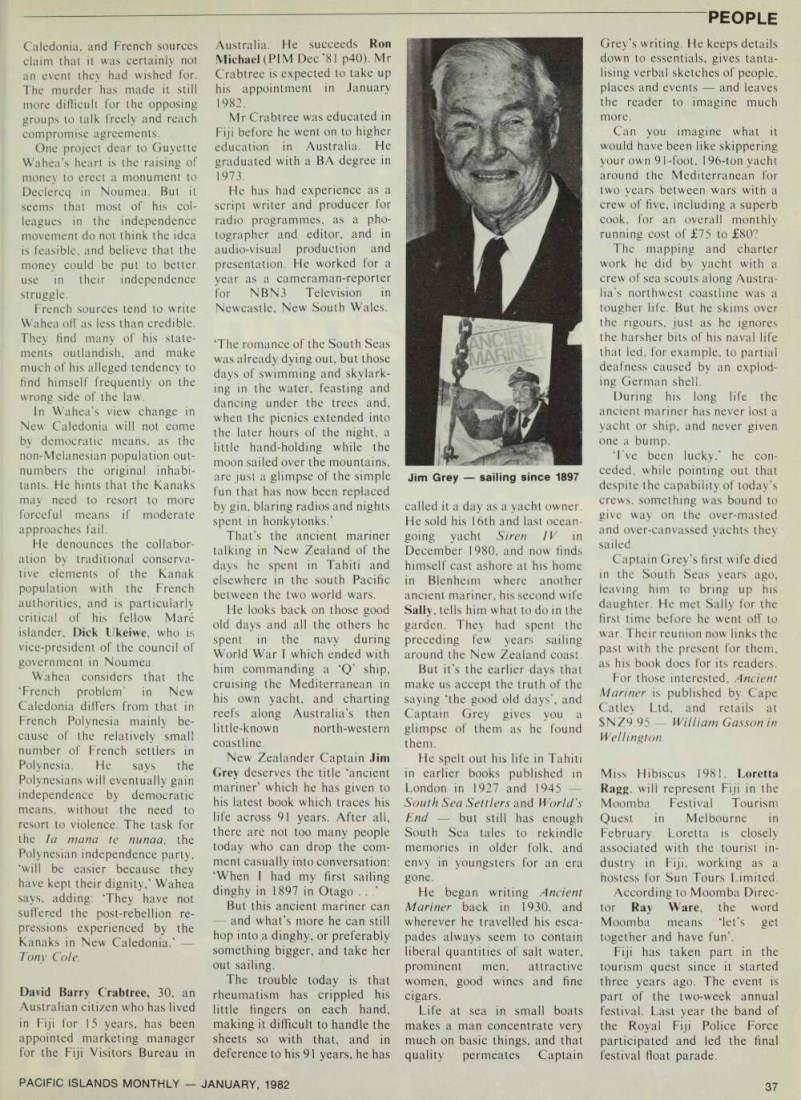
New Zealander Captain Jim Grey deserves the title ‘ancient mariner’ which he has given to his latest book which traces his life across 91 years. After all, there are not too many people today who can drop the com ment casually into conversation: ‘When I had my first sailing dinghy in 1897 in Otago . . .’
But this ancient mariner can and what’s more he can still hop into,a dinghy, or preferably something bigger, and take her out sailing.
The trouble today is that rheumatism has crippled his little fingers on each hand, making it difficult to handle the sheets so with that, and in deference to his 91 years, he has
called it a day as a yacht owner.
He sold his 16th and last ocean going yacht Siren IV in December 1980, and now finds himself cast ashore at his home in Blenheim where another ancient mariner, his second wife Sally, tells him what to do in the garden. They had spent the preceding few years sailing around the New Zealand coast.
But it’s the earlier days that make us accept the truth of the saying ‘the good old days’, and Captain Grey gives you a glimpse of them as he found them.
He spelt out his life in Tahiti in earlier books published in London in 1927 and 1945 - South Sea Settlers and World’s End but still has enough South Sea tales to rekindle memories in older folk, and envy in youngsters for an era gone.
He began writing Ancient Mariner back in 1930. and wherever he travelled his esca pades always seem to contain liberal quantities of salt water, prominent men, attractive women, good wines and fine cigars.
Life at sea in small boats makes a man concentrate very much on basic things, and that quality permeates Captain
Grey’s writing. He keeps details down to essentials, gives tanta lising verbal sketches of people, places and events and leaves the reader to imagine much more.
Can you imagine what it would have been like skippering your own 91-fool, 196-ton yacht around the Mediterranean for two years between wars with a crew of five, including a superb cook, for an overall monthly running cost of £75 to £80?
The mapping and charter work he did by yacht with a crew of sea scouts along Austra lia’s northwest coastline was a tougher life. But he skims over the rigours, just as he ignores the harsher bits of his naval life that led, for example, to partial deafness caused by an explod ing German shell.
During his long life the ancient mariner has never lost a yacht or ship, and never given one a bump.
'l've been lucky.’ he con ceded, while pointing out that despite the capability of today’s crews, something was bound to give way on the over-masted and over-canvassed yachts they sailed Captain Grey’s first wife died in the South Seas years ago, leaving him to bring up his daughter. He met Sally for the first time before he went off to war. Their reunion now links the past with the present for them, as his book does for its readers.
For those interested. Ancient Mariner is published by Cape Calley Ltd, and retails at 5NZ9.95 William Gasson in Wellington.
Miss Hibiscus 1981, Loretta Ragg. will represent Fiji in the Moomba Festival Tourism Quest in Melbourne in February. Loretta is closely associated with the tourist in dustry in Fiji, working as a hostess for Sun Tours Limited.
According to Moomba Direc tor Ray Ware, the word Moomba means ‘let’s get together and have fun’.
Fiji has taken part in the tourism quest since it started three years ago. The event is part of the two-week annual festival. Last year the band of the Royal Fiji Police Force participated and led the final festival float parade.
Jim Grey - sailing since 1897