A 30-month plan
p. 33 · Read in the full issue
from Mr Mamaloni
Solomon Islands Prime Minis ter Solomon Mamaloni, elected in August following the resig nation of Peter Kenilorea (PIM Oct ‘Bl p 33), in November issued his coalition govern ment’s Programme of Action for the 30 months before the next election.
It came in the form of a Letter to the People of Solomon Islands, and although it appears mainly to have been an initiat ive of Mr Mamaloni himself, his coalition partners the Inde pendent Group and the NADEPA were clearly in volved in its development.
Proposals include: • a study of the constitution, aimed at turning the country into a republic with a federation of provinces; • a transfer of all former Ministry of Home Affairs re sponsibilities to the provinces, leaving a Ministry of National Development at the centre; • establishment of a Melanesian Alliance with Papua New Guinea and Vanuatu; • expansion of Solomon Islands’ defence and naval forces; • a review of the govern ment’s role in Air Pacific, with eventual withdrawal of the Solomon Islands Government’s shares in that airline, and con sideration of ways of developing Solair; • conversion of the Solomon Islands monetary authority into a central bank; • a plan for a national lottery.
The Australian Department of Foreign Affairs publication, Backgrounder (Nov 25 ’81), comments: ‘Domestically, the most con troversial items are likely to be the proposed establishment of a national lottery, and continu ation of the positions of the five national Ministers for the Prov inces (created following the change in government). Most of Mr Mamaloni’s “Letter to the People” is in fact taken up with justification of these positions. ‘On the foreign policy side, Mr Mamaloni’s stated intention
to “negotiate joint defence and security arrangements with friendly Pacific nations” may strike a responsive chord with Papua New Guinea, which has recently proposed a regional peace-keeping force. Refer ences to the establishment of a Melanesian Alliance, and to the intention to withdraw from Air Pacific will, no doubt, receive attention in the region. So also will the interest expressed in sharing diplomatic offices and facilities in Australia, Vanuatu, Tuvalu and Kiribati. The only other foreign policy reference is to an intention to establish diplomatic relations with the People’s Republic of China in 1983/84.’
Vanuatu seeks
Santo compo
Vanuatu is asking Britain and France to pay compensation for loss and damage sustained dur ing the 1980 uprising on Santo.
The uprising was an attempt by rebels to seize control of Santo and to separate the island politi cally from the rest of Vanuatu.
The rebel activity began shortly before Vanuatu (which was then New Hebrides) gained independence from Britain and France, and the trouble was not ended until after independence when troops were called in from Papua New Guinea.
The Vanuatu parliament has adopted a resolution which claims that as the loss of property due to the rebellion was a direct consequence of the failure of Britain and France to maintain law and order, com pensation should not be paid by the Vanuatu Government, but wholly met by Britain and France.
No reaction has been re ceived from either the British or French Government, but the matter was to be raised during aid talks held in Paris and London in November between French and British officials and a Vanuatu Government del egation headed by Prime Minis ter Father Walter Lini. lan Mclntyre in Port-Vila.
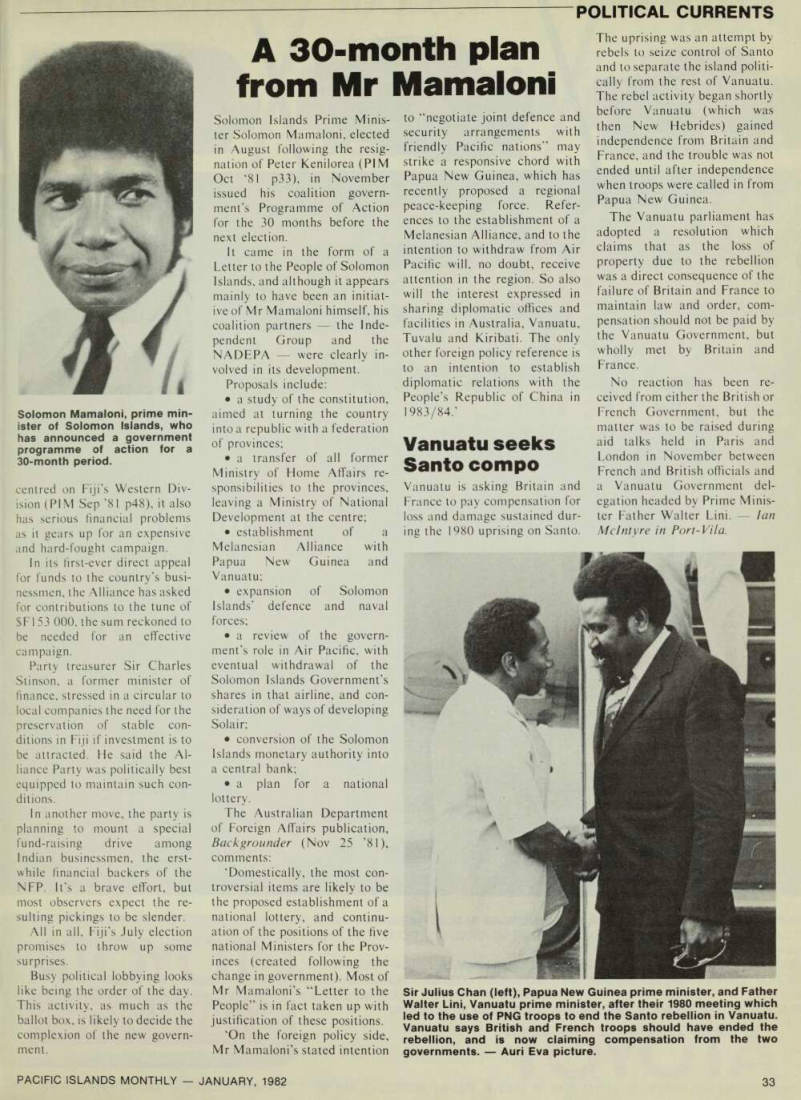
Sir Julius Chan (left), Papua New Guinea prime minister, and Father Walter Lini, Vanuatu prime minister, after their 1980 meeting which led to the use of PNG troops to end the Santo rebellion in Vanuatu.
Vanuatu says British and French troops should have ended the rebellion, and is now claiming compensation from the two
governments. - Auri Eva picture.