foreign policy
pp. 32-33 · Read in the full issue
PNG’s new-look foreign policy
In a white paper presented to Papua New Guinea’s parlia ment in November, Foreign Minister Noel Levi confirmed the abandonment of the Somare
government’s ‘universalist’
foreign policy ‘friends to all, enemies to none’ in favour of what he called a policy of ‘active and selective engage ment'.
The culmination of two years of preparatory work, the paper recommends that priority be given to relations with countries with which PNG shares significant interests. Top pri ority, the paper says, should be given to close co-operative re lations with PNG’s four direct neighbours: the Federated
States of Micronesia, Indonesia, Australia and Solomon Islands. Another pri ority would be co-operation with PNG’s other Pacific neigh bours.
The paper also stresses devel opment of closer relations with the Association of Southeast Asian Nations (ASEAN): Indonesia, the Philippines, Malaysia, Singapore, and Thailand. Mr Levi referred to PNG’s attendance as a special observer at the Manila meeting of ASEAN foreign ministers.
Also recommended for close attention are relations with PNG’s major trading partners (Western Europe and Japan), and with the United Slates,
source of a large amount of PNG’s commercial borrowing.
Examining current sources of development aid. and the possi bility of developing new sources, the paper concludes that the prospects for additional sources of aid are none 100 bright, and says that ‘priority should be given to existing trade relations’.
The report points out that the
value of Australian aid lies in the fact that it is used for current government expendi ture. Its finding is that Austra lian aid will be required for these purposes for at least another 10 years, saying: ‘Pro jections suggest that Australian aid will continue to be needed for at least another decade, even to maintain existing ser vices.’
Oz in Pacific
conference
Australia and the South Pacific is the title of a two-day confer ence in February to be co sponsored by the Centre for Continuing Education of the Australian National University, and the Australian Committee of the Foundation for the Peoples of the South Pacific.
According to organiser Brendan O’Dwyer the confer ence is intended to provide a forum for key Pacific speakers to inform Australians of their concerns and priorities. Father Walter Lini. Prime Minister of Vanuatu, will give the keynote address on February 18 at Burgmann College on the ANU campus.
Other speakers and workshop leaders will include Mere Kite of Fiji, Francis Bugotu of the Solomons. John Momis from Papua New Guinea, and Albert Wendt from Western Samoa.
The programme covers topics such as trade, aid, investment, military and strategic issues, regional organisations, edu cation, tourism, and the role of non-governmental organis ations, including churches and trade unions. Further infor mation is available from Jan Gammage, Centre for Continu ing Education, ANU. PO Box 4. Canberra 2600. Phone (062)49-4417.
Splits trouble
Fiji’s NFP
Fiji’s ruling Alliance Party is drawing comfort from splits which are appearing in the ranks of the opposition National Federation Party in the run-up to the July general election.
The mainly Indian-supported NFP displayed its divisions publicly when in the annual election for Lord Mayor of Suva three of the 11 NFP councillors on the 20-seal coun cil refused to support the en dorsed candidate of their parly, and voted for the Alliance candidate instead.
There is strife too over the selection of NFP candidates for the July election. Many of the 13 sitting NFP MPs are threat ening to rock the boat if they are not re-endorsed for their present seals.
Splits in the NFP cheated it of power after it had narrowly won the general election of May 1977; inner-parly divisions at the time were so grave it was unable to form a government.
The Alliance Party can do with comforting tidings from its main opposition camp.
Facing the hostility of the newly formed Western United Front, a Fijian-based party
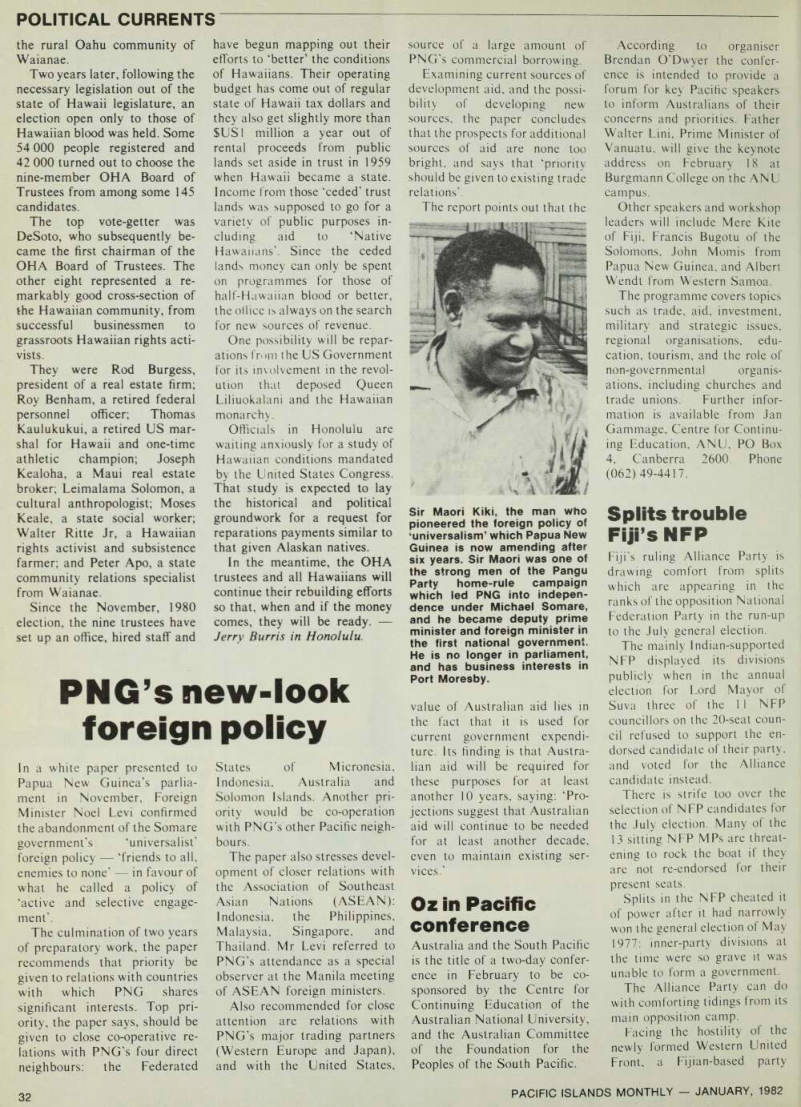
Sir Maori Kiki, the man who pioneered the foreign policy of ‘universalism’ which Papua New Guinea is now amending after six years. Sir Maori was one of the strong men of the Pangu Party home-rule campaign which led PNG into indepen dence under Michael Somare, and he became deputy prime minister and foreign minister in the first national government.
He is no longer in parliament, and has business interests in Port Moresby.
centred on Fiji’s Western Div ision (PIM Sep ’Bl p4B), it also has serious financial problems as it gears up for an expensive and hard-fought campaign.
In its first-ever direct appeal for funds to the country’s busi nessmen, the Alliance has asked for contributions to the tune of SFI 53 000. the sum reckoned to be needed for an effective campaign.
Parly treasurer Sir Charles Stinson, a former minister of finance, stressed in a circular to local companies the need for the preservation of stable con ditions in Fiji if investment is to be attracted. He said the Al liance Parly was politically best equipped to maintain such con ditions.
In another move, the party is planning to mount a special fund-raising drive among Indian businessmen, the erst while financial backers of the NFP. It’s a brave effort, but most observers expect the re sulting pickings to be slender.
All in all, Fiji's July election promises to throw up some surprises.
Busy political lobbying looks like being the order of the day.
This activity, as much as the ballot box, is likely to decide the complexion of the new govern ment.
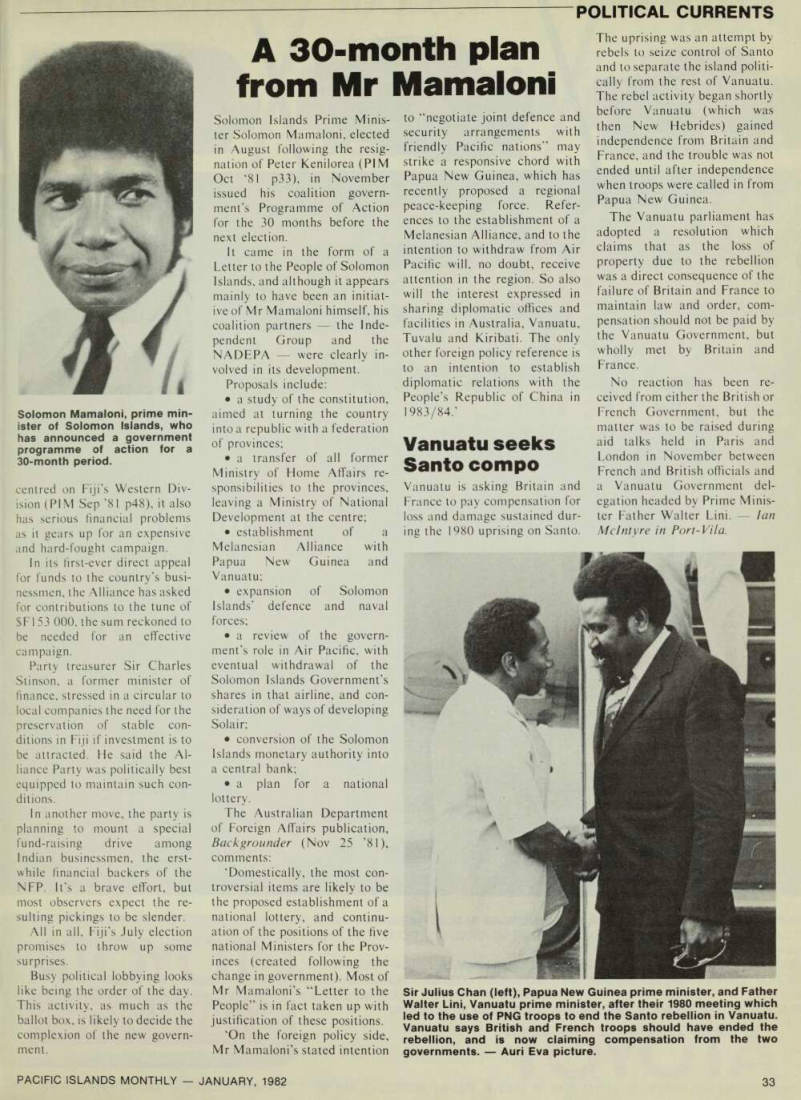
Solomon Mamaloni, prime min ister of Solomon Islands, who has announced a government programme of action for a 30-month period.