Renaissance’
pp. 31-32 · Read in the full issue
Political
Currents
A close look at the ‘Hawaiian Renaissance’
To the casual passer-by, the scene might have made little sense. On a breezy lawn outside a downtown Honolulu office building, a group of people stood on a low concrete plat form. One of their number stepped forward and began to chant in Hawaiian.
This was no Waikiki tourist show. The group wore everyday casual clothing and, individu ally, would have blended right in with those passing by on the sidewalk. The chanting was directed at a tall pleasant looking person who watched from the lawn. When it ended, that person strode forward and began a chant of his own. The language was foreign. It sounded Hawaiian, but it wasn’t.
This brief ceremony, hardly noticed by nearby office workers taking their lunch, rep resented offical greetings be tween Kare Puketapu, secretary of New Zealand’s Department of Maori Affairs, and the nine trustees of Hawaii’s newly cre ated Office of Hawaiian Affairs
(Oha).
In several ways that brief meeting symbolised a funda mental change now underway in the Hawaiian community, and it indicated a new sense of brotherhood between Hawaiians and other Pacific Island communities. The ties at this point are mostly cultural and spiritual, but businessmen in Hawaii see the web of ties eventually spun thick enough to support a growing and profitable economic relation ship between Hawaiians and the;r Pacific brothers.
If all this sounds a bit much, it should not be entirely dis counted. The trustees of OHA (as well as those who support and believe in it) see the office as a financial and spiritual wellspring for the already underway ‘Hawaiian Renaissance’. That term has come to mean pride and interest in Hawaiian culture (dance, language, history) as well as pride and interest in being Hawaiian.
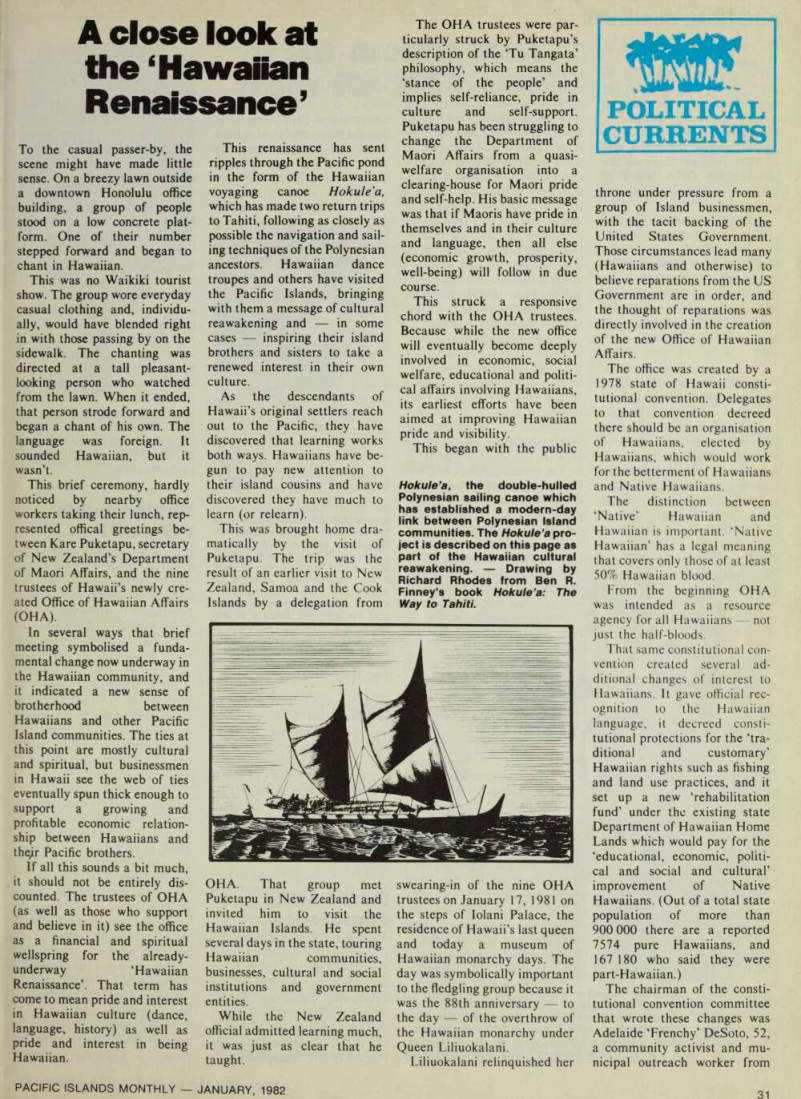
This renaissance has sent ripples through the Pacific pond in the form of the Hawaiian voyaging canoe Hokule’a, which has made two return trips to Tahiti, following as closely as possible the navigation and sail ing techniques of the Polynesian ancestors. Hawaiian dance troupes and others have visited the Pacific Islands, bringing with them a message of cultural reawakening and in some cases inspiring their island brothers and sisters to take a renewed interest in their own culture.
As the descendants of Hawaii’s original settlers reach out to the Pacific, they have discovered that learning works both ways. Hawaiians have be gun to pay new attention to their island cousins and have discovered they have much to learn (or relearn).
This was brought home dra matically by the visit of Puketapu. The trip was the result of an earlier visit to New Zealand, Samoa and the Cook Islands by a delegation from
OHA. That group met Puketapu in New Zealand and invited him to visit the Hawaiian Islands. He spent several days in the state, touring Hawaiian communities, businesses, cultural and social institutions and government entities.
While the New Zealand official admitted learning much, it was just as clear that he taught.
The OHA trustees were par ticularly struck by Puketapu’s description of the ‘Tu Tangata’ philosophy, which means the ‘stance of the people’ and implies self-reliance, pride in culture and self-support.
Puketapu has been struggling to change the Department of Maori Affairs from a quasi welfare organisation into a clearing-house for Maori pride and self-help. His basic message was that if Maoris have pride in themselves and in their culture and language, then all else (economic growth, prosperity, well-being) will follow in due course.
This struck a responsive chord with the OHA trustees.
Because while the new office will eventually become deeply involved in economic, social welfare, educational and politi cal affairs involving Hawaiians, its earliest efforts have been aimed at improving Hawaiian pride and visibility.
This began with the public
swearing-in of the nine OHA trustees on January 17, 1981 on the steps of lolani Palace, the residence of Hawaii’s last queen and today a museum of Hawaiian monarchy days. The day was symbolically important to the fledgling group because it was the 88th anniversary to the day of the overthrow of the Hawaiian monarchy under Queen Liliuokalani.
Liliuokalani relinquished her
throne under pressure from a group of Island businessmen, with the tacit backing of the United States Government.
Those circumstances lead many (Hawaiians and otherwise) to believe reparations from the US Government are in order, and the thought of reparations was directly involved in the creation of the new Office of Hawaiian Affairs.
The office was created by a 1978 state of Hawaii consti tutional convention. Delegates to that convention decreed there should be an organisation of Hawaiians, elected by Hawaiians, which would work for the betterment of Hawaiians and Native Hawaiians.
The distinction between ‘Native’ Hawaiian and Hawaiian is important. ‘Native Hawaiian’ has a legal meaning that covers only those of at least 50% Hawaiian blood.
From the beginning OHA was intended as a resource agency for all Hawaiians not just the half-bloods.
That same constitutional con vention created several ad ditional changes of interest to Hawaiians. It gave official rec ognition to the Hawaiian language, it decreed consti tutional protections for the ‘tra ditional and customary’
Hawaiian rights such as fishing and land use practices, and it set up a new ‘rehabilitation fund’ under the existing state Department of Hawaiian Home Lands which would pay for the ‘educational, economic, politi cal and social and cultural’ improvement of Native Hawaiians. (Out of a total state population of more than 900 000 there are a reported 7574 pure Hawaiians, and 167 180 who said they were part-Hawaiian.) The chairman of the consti tutional convention committee that wrote these changes was Adelaide ‘Frenchy’ DeSoto, 52, a community activist and mu nicipal outreach worker from
Hokule’a, the double-hulled Polynesian sailing canoe which has established a modern-day link between Polynesian Island communities. The Hokule’a pro ject is described on this page as part of the Hawaiian cultural reawakening. Drawing by Richard Rhodes from Ben R.
Finney’s book Hokule’a: The Way to Tahiti.
the rural Oahu community of Waianae.
Two years later, following the necessary legislation out of the state of Hawaii legislature, an election open only to those of Hawaiian blood was held. Some 54 000 people registered and 42 000 turned out to choose the nine-member OHA Board of Trustees from among some 145 candidates.
The top vote-getter was DeSoto, who subsequently be came the first chairman of the OHA Board of Trustees. The other eight represented a re markably good cross-section of the Hawaiian community, from successful businessmen to grassroots Hawaiian rights acti vists.
They were Rod Burgess, president of a real estate firm; Roy Benham, a retired federal personnel officer; Thomas Kaulukukui, a retired US mar shal for Hawaii and one-time athletic champion; Joseph Kealoha, a Maui real estate broker; Leimalama Solomon, a cultural anthropologist; Moses Keale, a state social worker; Walter Ritte Jr, a Hawaiian rights activist and subsistence farmer; and Peter Apo, a state community relations specialist from Waianae.
Since the November, 1980 election, the nine trustees have set up an office, hired staff and
have begun mapping out their efforts to ‘better’ the conditions of Hawaiians. Their operating budget has come out of regular state of Hawaii tax dollars and they also get slightly more than SUSI million a year out of rental proceeds from public lands set aside in trust in 1959 when Hawaii became a state.
Income from those ‘ceded’ trust lands was supposed to go for a variety of public purposes in cluding aid to ‘Native Hawaiians’. Since the ceded lands money can only be spent on programmes for those of half-Hawaiian blood or better, the office is always on the search for new sources of revenue.
One possibility will be repar ations from the US Government for its involvement in the revol ution that deposed Queen Liliuokalani and the Hawaiian monarchy.
Officials in Honolulu are waiting anxiously for a study of Hawaiian conditions mandated by the United States Congress.
That study is expected to lay the historical and political groundwork for a request for reparations payments similar to that given Alaskan natives.
In the meantime, the OHA trustees and all Hawaiians will continue their rebuilding efforts so that, when and if the money comes, they will be ready.
Jerry Burris in Honolulu.