Tahitian watering holes; notori
pp. 27-29 · Read in the full issue
ous honky-tonks like Quinn’s Hut downtown, and the barn like Lafayette out Arue way.
The Lafayette, as some readers may remember, opened late after Quinn’s closed.
Inebriated merrymakers charged out there from Papeete by all means possible car, motorscooter, bicycle, taxi, and aboard Le Truck loaded with bar-hopping party girls.
Legendary Suzy No Pants and her happy-go-lucky companions (known as ‘Queen’s Girls’ by one and all) sang and enter tained all the way from town at midnight, and all the way back through the countryside at dawn.
In modern times, nightclubs like the New Orleans catered to a more affluent class of clientele than Quinn’s and Lafayette used to. Makes you wonder whatever happened to all the free spirits who patronised Tahiti’s disreputable dives in the ‘good old days’ before jet air travel and Mutiny On The Bounty movies.
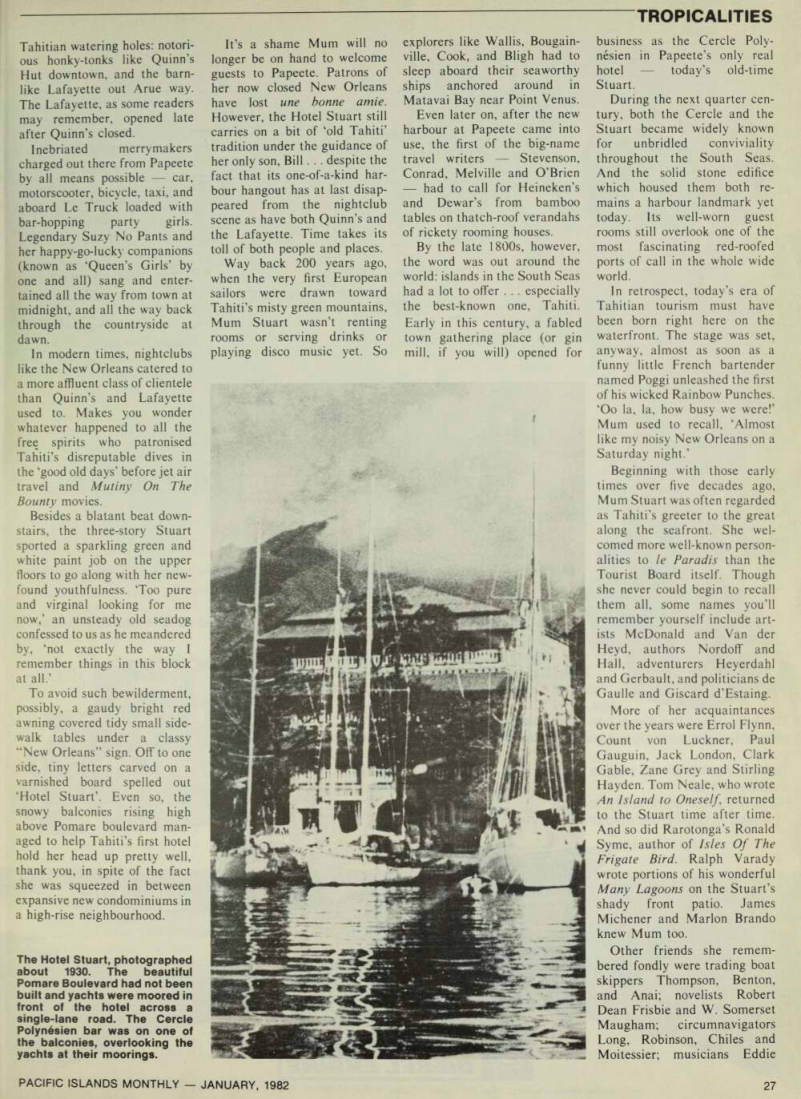
Besides a blatant beat down stairs, the three-story Stuart sported a sparkling green and white paint job on the upper floors to go along with her new found youthfulness. ‘Too pure and virginal looking for me now,’ an unsteady old seadog confessed to us as he meandered by, ‘not exactly the way I remember things in this block at all.’
To avoid such bewilderment, possibly, a gaudy bright red awning covered tidy small side walk tables under a classy “New Orleans” sign. Off to one side, tiny letters carved on a varnished board spelled out ‘Hotel Stuart’. Even so, the snowy balconies rising high above Pomare boulevard man aged to help Tahiti’s first hotel hold her head up pretty well, thank you, in spite of the fact she was squeezed in between expansive new condominiums in a high-rise neighbourhood.
It’s a shame Mum will no longer be on hand to welcome guests to Papeete. Patrons of her now closed New Orleans have lost une bonne amie.
However, the Hotel Stuart still carries on a bit of ‘old Tahiti’ tradition under the guidance of her only son. Bill. . . despite the fact that its one-of-a-kind har bour hangout has at last disap peared from the nightclub scene as have both Quinn’s and the Lafayette. Time takes its toll of both people and places.
Way back 200 years ago, when the very first European sailors were drawn toward Tahiti’s misty green mountains, Mum Stuart wasn’t renting rooms or serving drinks or playing disco music yet. So
explorers like Wallis, Bougain ville, Cook, and Bligh had to sleep aboard their seaworthy ships anchored around in Matavai Bay near Point Venus.
Even later on, after the new harbour at Papeete came into use, the first of the big-name travel writers Stevenson, Conrad, Melville and O’Brien had to call for Heineken’s and Dewar’s from bamboo tables on thatch-roof verandahs of rickety rooming houses.
By the late 1800 s, however, the word was out around the world: islands in the South Seas had a lot to offer ... especially the best-known one, Tahiti.
Early in this century, a fabled town gathering place (or gin mill, if you will) opened for
business as the Cercle Poly nesien in Papeete’s only real hotel today’s old-time Stuart.
During the next quarter cen tury, both the Cercle and the Stuart became widely known for unbridled conviviality throughout the South Seas.
And the solid stone edifice which housed them both re mains a harbour landmark yet today. Its well-worn guest rooms still overlook one of the most fascinating red-roofed ports of call in the whole wide world.
In retrospect, today’s era of Tahitian tourism must have been born right here on the waterfront. The stage was set, anyway, almost as soon as a funny little French bartender named Poggi unleashed the first of his wicked Rainbow Punches. ‘Oo la, la, how busy we were!’
Mum used to recall, ‘Almost like my noisy New Orleans on a Saturday night.’
Beginning with those early times over five decades ago.
Mum Stuart was often regarded as Tahiti’s greeter to the great along the seafront. She wel comed more well-known person alities to le Paradis than the Tourist Board itself. Though she never could begin to recall them all, some names you’ll remember yourself include art ists McDonald and Van der Heyd, authors Nordoff and Hall, adventurers Heyerdahl and Gerbault, and politicians de Gaulle and Giscard d’Estaing.
More of her acquaintances over the years were Errol Flynn, Count von Luckner, Paul Gauguin, Jack London, Clark Gable, Zane Grey and Stirling Hayden. Tom Neale, who wrote An Island to Oneself, returned to the Stuart time after time.
And so did Rarotonga’s Ronald Syme, author of Isles Of The Frigate Bird. Ralph Varady wrote portions of his wonderful Many Lagoons on the Stuart’s shady front patio. James Michener and Marlon Brando knew Mum too.
Other friends she remem bered fondly were trading boat skippers Thompson, Benton, and Anai; novelists Robert Dean Frisbie and W. Somerset Maugham; circumnavigators Long, Robinson, Chiles and Moitessier; musicians Eddie
The Hotel Stuart, photographed about 1930. The beautiful Pomare Boulevard had not been built and yachts were moored in front of the hotel across a single-lane road. The Cercle Polynèsien bar was on one of the balconies, overlooking the yachts at their moorings.
Lund. Bill Slone, and Bouzou Frogier; and those fugitives from the California freeways Kelley, Carlisle and McCallum who now run Bali Hai resorts on white sand beaches under outer-island palm trees.
Old Tahiti hands will remind you that today’s Stuart is a last jink between the sleepy-lagoon past and the jet-age present.
Further, they suggest that ad venturous travellers requir ing neither resort amenities nor world class accommodation might even now enjoy sampling a bit of ‘island atmosphere of yesteryear' by slaying in one of its spartan, no-frills, cold-water rooms beside the seafront.
After arriving at Faaa air port. simple ride Le Truck (Tahiti’s owner-operated public transportation system) into Papeete for a modest 50 francs.
To locate the Stuart, watch for tall masts on sailboats along the quay. Pull the bell cord so the driver can let you off kerbside under a shady flamboyant tree.
Traffic on the busy boulevard will be unbelievable, not at all what you expected to find in South Sea islands. Vespas, Renaults, Hondas, VWs, Dat suns, and Fiats whiz by in a frenzy. Only bicycles and ped estrians, whose days appear to be numbered, give any relief from the furious spitting and sputtering of so many small engines.
Step under the sidewalk awn ing for safety and climb a creaky stairway beside what once was the New Orleans' streetfront bar. Hopefully, Bill Stuart will have a vacant room with a harbour view . . . maybe the very same one from which Henri Matisse painted sunsets in 1930. Or perhaps another where Edgar Leeleg slept off his sprees in the 1940 s after selling one of his masterpieces on velvet. Or possibly even Gable’s old quarters, used while he was playing Fletcher Christian on film so many years ago.
Finally settled high above cars and confusion, slowly un wind. Contemplate the most colourful nautical crossroads in the South Pacific. Lose your jet lag as Polynesian paralysis gradually takes over. Begin to put together bits and pieces of all your reading about Oceania.
Below are French warships,
Danish freighters, Korean tuna clippers, Yankee yachtsmen, Chinese junks, and Tahitian outrigger canoes. Looming up near the centre of town huge cruise ships are docked. Sight seers and shoppers from Eng land, Russia, Holland, Norway, the States and almost any where else one can name spill into the streets.
Moored close by is the pictur esque, locally owned fishing fleet. And remember, here’s the area where catering trucks run by local people serve excep tional ‘meals on wheels’ at reasonable prices every even ing.
From your own balcony, watch rusty copra schooners sail for storied, far-flung outly ing specks of civilisation islands and atolls known as the Marquesas, the Tuamotus, the Gambiers, the Australs. A few paying passengers travel on board weeks or months at a lime for less than $lO a day.
Twice a week antique cargo passenger boats chug out of Papeete to the much closer Society islands of Huahine, Raiatea and Borabora. Low roundtrip fares are bargain priced for five unbelievable days and nights aboard the Taporo or the Temehani.
At 9 o’clock every morning, both a small freighter and a speedy launch carry visitors 20 km across the Sea of The Moon into Cook’s Bay on Moorea. No wonder Moorea is so often referred to as Bali Hai. It has to be the most spectacularly beautiful ‘high island' any where in the world.
In recent years most visitors to Tahiti have arrived in tour groups using new resort hotels located 5 to 8 km outside the capital city of Papeete. Some are soon airborne again, flying to outlying islands before seeing very much of Tahiti itself. As a matter of fact, many miss the ‘downtown’ harbour area en tirely.
So it’s still worthwhile to consider staying in the centre of Papeete where most island ac tivity originates. You’re near good restaurants, chic shop ping, lively bars, transport aboard Le Truck from the central market place, and vin tage character freightboats for romantic island hopping.
Whichever way you choose to see Tahiti for yourself whether luxuriating in the countryside or mingling with city folks please find time for at least a quick glance at the celebrated Hotel Stuart. Stop in to see where Mum's past tri umphs like her nightclub New Orleans, her busy Bar Vaiora, and her fabled Cercle Poly nesien used to attract les bons vivants for so many years.
Though quiet nowadays, compared with its boisterous reputation of the past, Tahiti's oldest hotel is still thought of as a legend in its own lime by many of the 55 000 residents of Papeete.
And nobody in all the Society Islands can forget amiable Mum Stuart herself, for she played a prominent role in the history of true Tahitian hos pitality for over 50 years.
Oldtimers will always remem ber her friendly smile and kind word as she welcomed wan derers from the world over to her part of Paradise in the South Pacific.
Date change for
Fiji meeting
The 1982 Fiji Tourism Conven tion Planning Committee has announced a change in dates for this year’s convention, Fiji’s 21st, to be held in Suva*.
The June 4-6 date first set by the committee has been changed to June 24-26.
Planning committee mem bers have since discovered that a Pacific Area Travel Associ
ation (PATA) travel trade meeting is to be held in Honolulu from June 2-4 leading up to a PATA South Pacific Travel Mart scheduled for Mel bourne the week beginning June 5.
As these dates would have clashed with the Fiji conven tion, it was decided to move it to later in the month. Many del egates to the PATA meetings would probably be travel people who would also wish to attend Fiji’s convention.
Having the convention later in the month would also mean allowing time for the 1982 South Pacific Bowling Carnival, as well as the 1982 Auckland to Suva Yacht Race (also sched uled for June) to be completed.
Planning committee chair man Geoff Newton (Travelodge Fiji), says a record number of delegates, more than 400, are expected.
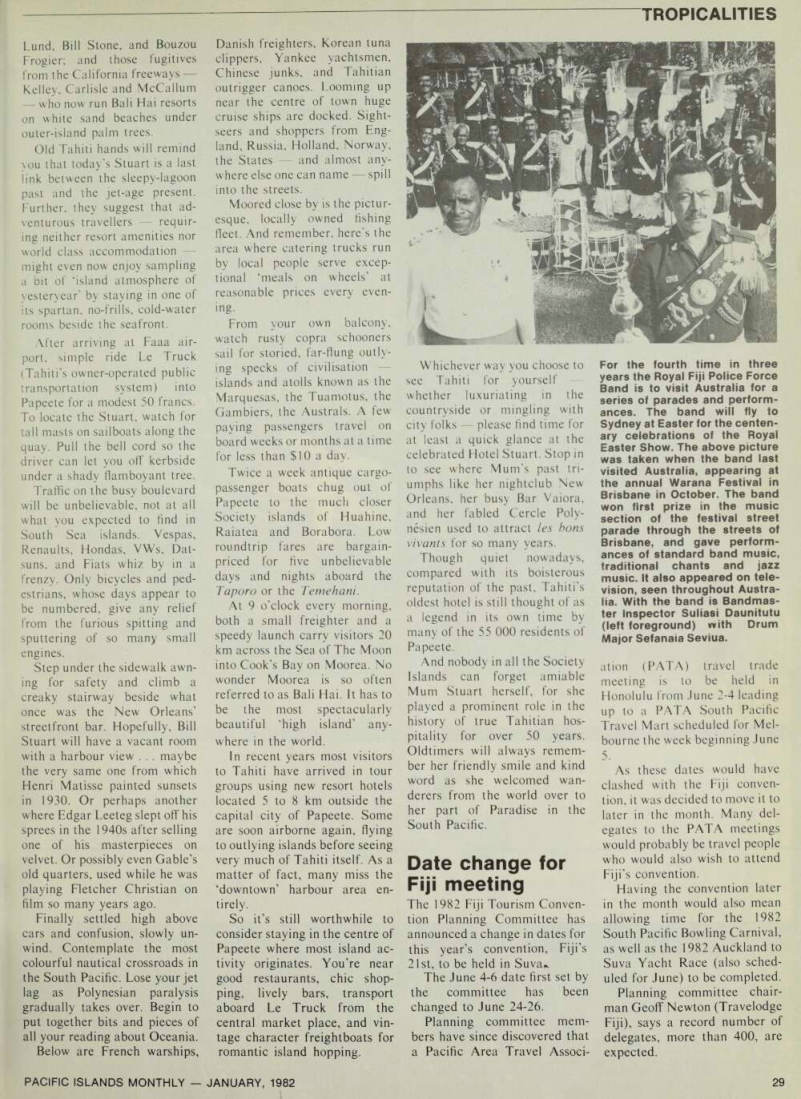
For the fourth time in three years the Royal Fiji Police Force Band is to visit Australia for a series of parades and perform ances. The band will fly to Sydney at Easter for the centen ary celebrations of the Royal Easter Show. The above picture was taken when the band last visited Australia, appearing at the annual Warana Festival in Brisbane in October. The band won first prize in the music section of the festival street parade through the streets of Brisbane, and gave perform ances of standard band music, traditional chants and jazz music. It also appeared on tele vision, seen throughout Austra lia. With the band is Bandmas ter Inspector Suliasi Daunitutu (left foreground) with Drum Major Sefanaia Seviua.