Reviving an
p. 23 · Read in the full issue
Tropicalities
Reviving an old art for $35 000
could meet loteve’s wishes.
Tavana, a man very much interested in the cultures and traditions of Polynesia, started to’ask more questions.
Later it was revealed that any information needed on the Marquesas could be obtained from Germany, as the Germans had carried out the most thorough research on the Marquesas Island many years ago. So Tavana wrote to con tacts in West Germany where complete pictures of a Marquesan tattoo were found.
Copies were made and sent to Tavana.
The next stage was a tricky one. Who could study those pictures and fulfil loteve’s de sire? There was no one in French Polynesia who could do it in the traditional way.
Tavana, after visiting Manua and finding no one there willing to do the tattooing, approached Asi Eikeni, a very good friend.
Asi was thrilled with the idea of a Marquesan tattoo done by a Samoan tufuga. Though it took two years in the past for a Marquesan man to complete his tattoo, Asi and Tavana believed a Samoan tufuga could com plete the Marquesan tattoo in about one to one and a half months. Their confidence in Samoan tufuga was later confirmed when loteve’s tattoo was completed in only six weeks.
Asi contacted his neighbour, Taumuafono Leatigaga Sio, (Joe Belford) and he rec ommended his cousin, Lesa Li’o, of Siumu, who has tat tooed over 200 Samoans, in cluding a few women. Tavana and loteve moved to Western Samoa for the big event. Lesa Li’o studied the photographs and drawings for four weeks then took his mallet, dye and the other tools of his trade and started tattooing loteve, begin ning from the chest and shoulders. He worked from eight to one o’clock, Monday to Friday, until the whole tattoo was completed just before mid day on Tuesday.
Matagialalua Tavana is very grateful to the Samoans, es pecially Asi Eikeni, for making it possible for loteve to have his tattoo done in Western Samoa.
When Tavana was asked if the Marquesans would not feel offended, he said: ‘Why should they? We are all Polynesians
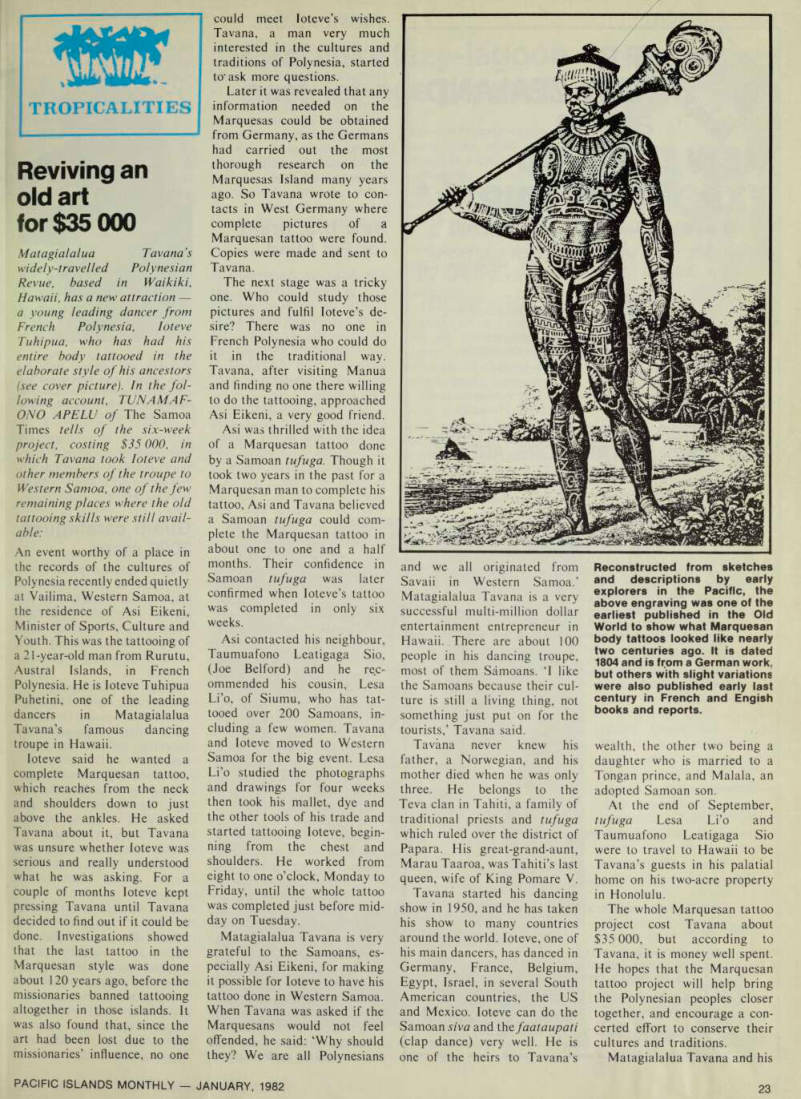
Matagialalua Tavana’s widely-travelled Polynesian Revue, based in Waikiki, Hawaii, has a new attraction a young leading dancer from French Polynesia, loteve Tuhipua, who has had his entire body tattooed in the elaborate style of his ancestors (see cover picture). In the fol lowing account, TUNAMAF ONO APELU of The Samoa Times tells of the six-week project, costing $35 000, in which Tavana took loteve and other members of the troupe to Western Samoa, one of the few remaining places where the old tattooing skills were still avail able: An event worthy of a place in the records of the cultures of Polynesia recently ended quietly at Vailima, Western Samoa, at the residence of Asi Eikeni, Minister of Sports, Culture and Youth. This was the tattooing of a 21-year-old man from Rurutu, Austral Islands, in French Polynesia. He is loteve Tuhipua Puhetini, one of the leading dancers in Matagialalua Tavana’s famous dancing troupe in Hawaii. loteve said he wanted a complete Marquesan tattoo, which reaches from the neck and shoulders down to just above the ankles. He asked Tavana about it, but Tavana was unsure whether loteve was serious and really understood what he was asking. For a couple of months loteve kept pressing Tavana until Tavana decided to find out if it could be done. Investigations showed that the last tattoo in the Marquesan style was done about 120 years ago, before the missionaries banned tattooing altogether in those islands. It was also found that, since the art had been lost due to the missionaries’ influence, no one
and we all originated from Savaii in Western Samoa.’
Matagialalua Tavana is a very successful multi-million dollar entertainment entrepreneur in Hawaii. There are about 100 people in his dancing troupe, most of them Samoans. T like the Samoans because their cul ture is still a living thing, not something just put on for the tourists,’ Tavana said.
Tavana never knew his father, a Norwegian, and his mother died when he was only three. He belongs to the Teva clan in Tahiti, a family of traditional priests and tufuga which ruled over the district of Papara. His great-grand-aunt, Marau Taaroa, was Tahiti’s last queen, wife of King Pomare V.
Tavana started his dancing show in 1950, and he has taken his show to many countries around the world. loteve, one of his main dancers, has danced in Germany, France, Belgium, Egypt, Israel, in several South American countries, the US and Mexico. loteve can do the Samoan siva and the faataupati (clap dance) very well. He is one of the heirs to Tavana’s
wealth, the other two being a daughter who is married to a Tongan prince, and Malala, an adopted Samoan son.
At the end of September, tufuga Lesa Li’o and Taumuafono Leatigaga Sio were to travel to Hawaii to be Tavana’s guests in his palatial home on his two-acre property in Honolulu.
The whole Marquesan tattoo project cost Tavana about $35 000, but according to Tavana, it is money well spent.
He hopes that the Marquesan tattoo project will help bring the Polynesian peoples closer together, and encourage a con certed effort to conserve their cultures and traditions.
Matagialalua Tavana and his
Reconstructed from sketches and descriptions by early explorers in the Pacific, the above engraving was one of the earliest published in the Old World to show what Marquesan body tattoos looked like nearly two centuries ago. It is dated 1804 and is from a German work, but others with slight variations were also published early last century in French and Engish books and reports.