own bomb
pp. 20-21 · Read in the full issue
Moruroa men throw their own bomb
In the wake of the visit to French Polynesia last August of France’s new Defence Minister Charles Hernu, the Centre d’Experimenlation du Pacifique (CEP) for the first time officially admitted that there were indeed some nasty pollution problems at Moruroa something that had always been denied in the past (PIM Oct ’Bl p 22).
Even after two serious accidents had occurred on the atoll in July 1979 two technicians were burnt to death, and a great chunk of the outer wall of the atoll fell out, causing an enormous tidal wave tight-lipped CEP spokesmen were maintaining that these were 'isolated’ events, in no way related to the nuclear testing programme (PIM May 'BO p2B).
The writers of this chronicle have lime and again pointed out that the French bombs exploded at Moruroa are in no way different from the American bombs that we know for a fact have polluted Bikini, Enewetak, and many other adjacent atolls in Micronesia. Such a simplistic view was of course anathema to the succession of colonial governors of French Polynesia appointed by the governments of General de Gaulle, Pompidou and Giscard d’Estaing. For expressing it we were like all other dissenters treated almost like traitors, and regularly harassed.
Contrary to the hopes of the peoples and nations of the South Pacific, the election victories of Francois Mitterrand and the French Socialist Parly have not put an end to the nuclear tests at Moruroa. But at the end of October, a number of French civilian workers on Moruroa showed themselves to be sufficiently emboldened by the change of government to throw a bomb of their own.
They bitterly complained to their trade union, the Confederation Fransaise Democratique du Travail (CFDT), that their work was putting their lives at risk. The union promptly drew up a report based on their revelations, and distributed the horrifying document widely among its members.
What follows is a translation of the summary of the CFDT report which has been published in the French newspaper.
Liberation. Under the headline ‘Atomic Gangrene at Moruroa’, the summary says: For the past 10 years the northern part of Moruroa Atoll has been extensively contaminated by the deliberate release of plutonium. This was done as a sort of security exercise to train personnel in procedures to be followed in the event of an aircraft accident. The most tangible effect was the spilling out on the atoll, and beyond it into the ocean, of several kilograms of plutonium. To prevent the plutonium from being blown by wind off the surface of the atoll it was ‘fixed’ with tar. The idea was that eventually everything, tar as well as plutonium, would be removed. This, however, has not been done.
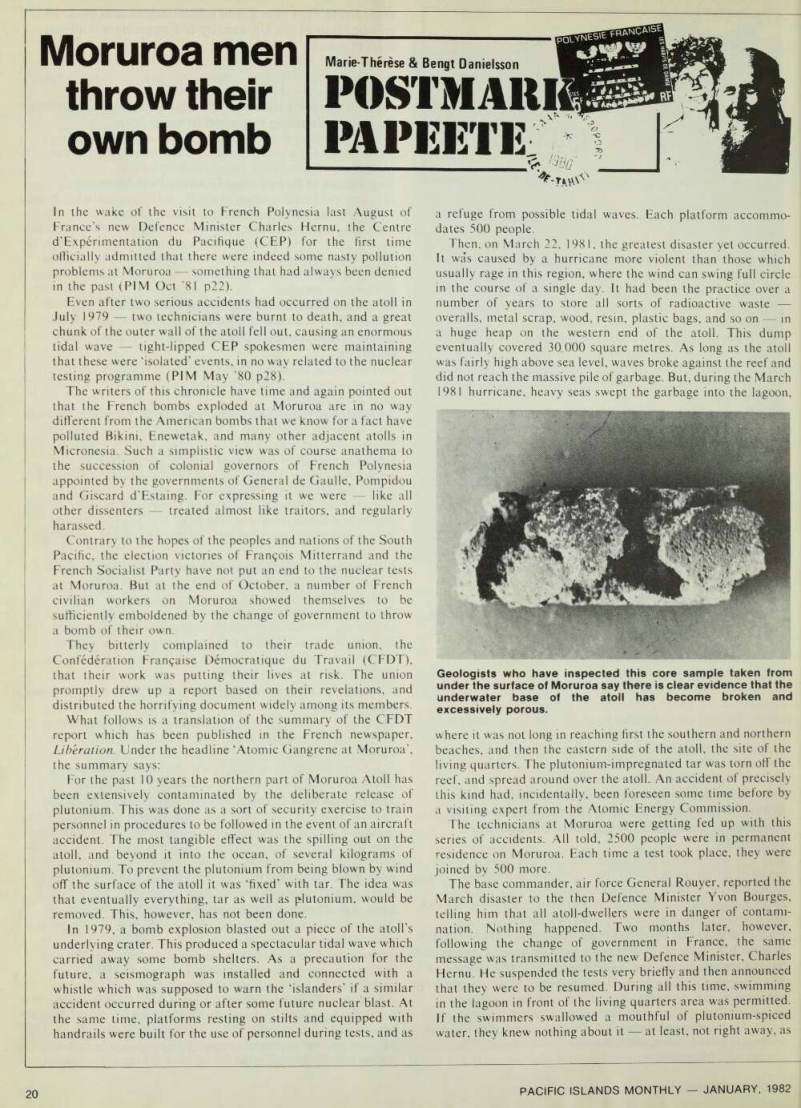
In 1979, a bomb explosion blasted out a piece of the atoll’s underlying crater. This produced a spectacular tidal wave which carried away some bomb shelters. As a precaution for the future, a seismograph was installed and connected with a whistle which was supposed to warn the ‘islanders’ if a similar accident occurred during or after some future nuclear blast. At the same time, platforms resting on stilts and equipped with handrails were built for the use of personnel during tests, and as
a refuge from possible tidal waves. Each platform accommo dates 500 people.
Then, on March 22, 1981, the greatest disaster yet occurred.
It was caused by a hurricane more violent than those which usually rage in this region, where the wind can swing full circle in the course of a single day. It had been the practice over a number of years to store all sorts of radioactive waste overalls, metal scrap, wood, resin, plastic bags, and so on in a huge heap on the western end of the atoll. This dump eventually covered 30 000 square metres. As long as the atoll was fairly high above sea level, waves broke against the reef and did not reach the massive pile of garbage. But, during the March 1981 hurricane, heavy seas swept the garbage into the lagoon.
where it was not long in reaching first the southern and northern beaches, and then the eastern side of the atoll, the site of the living quarters. The plutonium-impregnated tar was torn off the reef, and spread around over the atoll. An accident of precisely this kind had, incidentally, been foreseen some time before by a visiting expert from the Atomic Energy Commission.
The technicians at Moruroa were getting fed up with this series of accidents. All told, 2500 people were in permanent residence on Moruroa. Each time a test took place, they were joined by 500 more.
The base commander, air force General Rouyer, reported the March disaster to the then Defence Minister Yvon Bourges, telling him that all atoll-dwellers were in danger of contami nation. Nothing happened. Two months later, however, following the change of government in France, the same message was transmitted to the new Defence Minister, Charles Hernu. He suspended the tests very briefly and then announced that they were to be resumed. During all this time, swimming in the lagoon in front of the living quarters area was permitted.
If the swimmers swallowed a mouthful of plutonium-spiced water, they knew nothing about it at least, not right away, as
Geologists who have inspected this core sample taken from under the surface of Moruroa say there is clear evidence that the underwater base of the atoll has become broken and excessively porous.
no health checks were being made outside the zones officially declared off-limits. At any rale, swimming was considered good for morale . . .
At the beginning of July, a 10-man delegation of civilian emplovees at Moruroa sought and were granted an interview with Charles Hernu in Paris. The minister declared that he was unaware of this grave problem and he was. of course, later told that the Russians, or perhaps some West Indians, were pulling strings behind the scenes in the hope of bringing French nuclear testing to a hall. The minister then decided to visit Moruroa, stepping ashore there on August 4. A few days earlier, an effort had been made to remove the traces of the scars left by the March 22 hurricane. But, as luck would have it, another storm hit the atoll on the eve of the ministerial visit, revealing once again the full extent of the pollution. As required by protocol, a dinner was held for the minister during his visit. In the course of a speech at the dinner, the local CFDT leader harangued Mr Hernu on the matter of living conditions. In the course of his remarks he used the familiar form of address tu (instead of the formal vous ), no doubt on the grounds that he and the minister were Socialist Party comrades. The minister turned crimson and told the insolent fellow to shut up.
At the end of his stay Hernu decided 1) to clean up the atoll, a job the military brass undertook to accomplish in three months; and 2) to reorganise the security system. General Rouyer and Jean-Marie Lavie, the civilian director of the protection service, kept their jobs. But two engineers one military, one civilian and 10 minor officials, were posted elsewhere. They were promptly replaced by learned specialists who may have profound theoretical knowledge, but probably not the necessary practical experience for their tasks. For example.
Polynesia’s wet sands cannot be decontaminated in the same way as the dry sands of the Sahara. On September 22, civilian technicians threatened strike action if this switch in personnel was gone ahead with. But the test directors replied that they were powerless, as the transfers also had a political character, and were in any case covered by military secrecy.
Despite the promise made by the highly-placed military men
to clean up the atoll quickly, it was twice as contaminated on October 31 as on July 31 The fact is that the clean-up couldn't be done even in five or 10 years. Plutonium, which has a half life of 24 400 years, has impregnated the coral ring, and is constantly seeping into the ocean.
Moreover, the amount of accumulated nuclear waste is so vast that it will take 200 000 concrete containers, each 1.5 metres in height and diameter, and holding 200 litres, to dispose of it. The method envisaged is to drop these containers into 2000-metre-deep shafts sunk in the ground. Unfortunately, no concrete containers can be made on the spot, all the sand on Moruroa being contaminated. A number of metal drums containing nuclear waste are actually floating in the lagoon.
Most of the waste, however, has simply been pul into vinyl bags, four or five times the size of household dustbin bags Paradoxically , the most horrifying aspect of this long tale of criminal neglect and callousness is the sudden decision to clean up the atoll ‘in three months'.
On the Micronesian atoll of Enewetak the Americans have recently spent SUSIOO million over two years in a desperate attempt to dispose of the accumulated nuclear waste. They have thrown it into an old bomb crater as deep as the Grand Canyon on the coral ring, and sealed it with a giant concrete lid. The dump is off-limits to the islanders for the next 25 000 years. So how could the French bombers solve their nuclear waste problem on Moruroa in three months, without any concrete at all'iThe one way would be to push the whole garbage dump into the ocean. But the immersed material would contaminate all marine life, and light waste contained in the plastic bags would float off to other islands. The fact that all Pacific nations are firmly opposed to any form of nuclear waste dumping in the ocean perhaps explains better than anything else why there has so far been more of a cover-up than a clean-up operation on
Moruroa.
Marie-Thérèse and Bengt Danielsson.
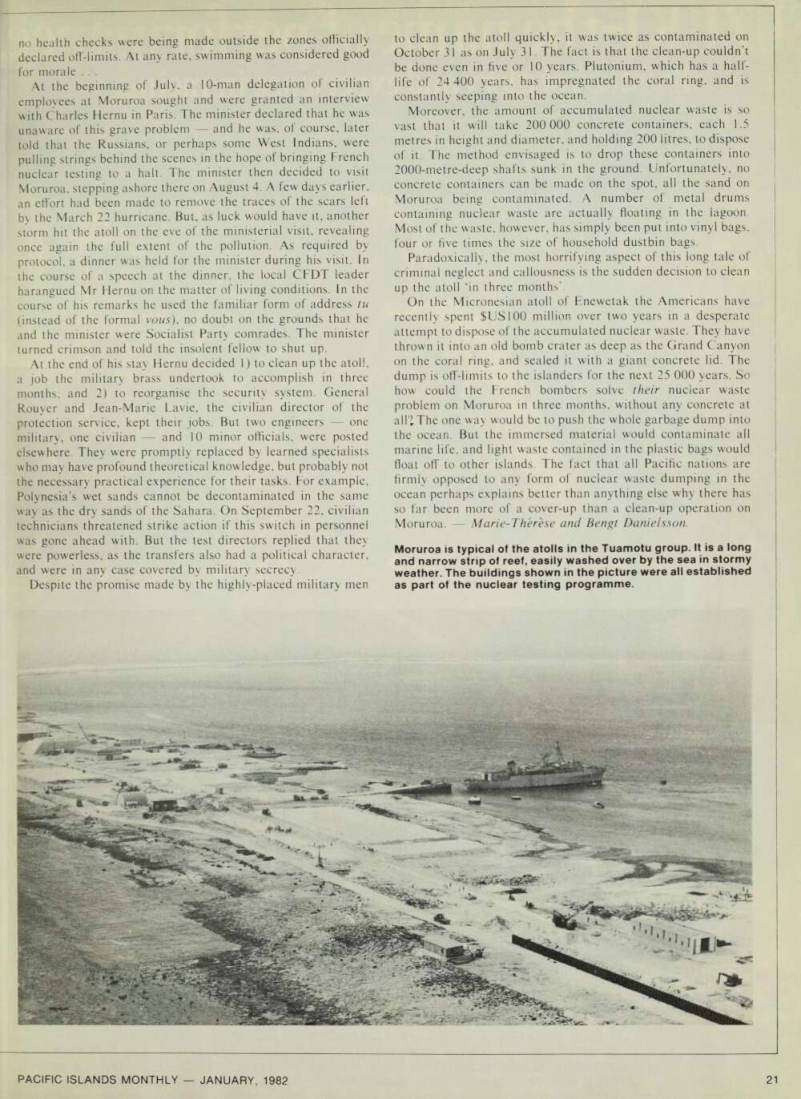
Moruroa is typical of the atolls in the Tuamotu group. It is a long and narrow strip of reef, easily washed over by the sea in stormy weather. The buildings shown in the picture were all established as part of the nuclear testing programme.