Guam catalogues
pp. 24-25 · Read in the full issue
parly presented to Western Samoa’s Head of State. His Highness Malietoa Tanumafili 11, a Tahitian sua at Vailima. an expression of their appreciation for the love and care shown to them by so many Samoans during their slay. ‘Without the help of the Samoans. 1 would not be where I am today,’ Tavana said.
New U.S. grant
for Fiji blind
The American Ambassador to Fiji, William Bodde Jr, has praised the work of the Fiji Blind Society and Helen Keller International (a private US organisation) and announced an additional grant of $142 000 to assist in continuation of their joint project. ‘During the past year, many Fiji citizens have contributed both time and money towards helping their fellow beings, who have been deprived wholly or partially of sight,’ said Am bassador Bodde. ‘lt is this sort of private endeavour which best expresses the Fiji character of service towards one’s fellow man.' Helen Keller International is an internationally known hu manitarian organisation which provides specialised training for blind persons in many countries of the world. It joined forces with the Fiji Blind Society a year ago in order to assist and expand services to the blind in Fiji.
The original aid grant was for $167 000 which was used to develop the programme in the last 12 months. The period stimulated interest not only within Fiji but from other international donors. ‘lt is a pleasure to note,’ said Ambassador Bodde, ‘that we have been joined in support of this very worthwhile project by the Christoffel-Blindenmission, the Royal Commonwealth So ciety for the Blind, the Canadian International Devel opment Agency and the Canadian National Institute for the Blind, among others. ‘But the most important con tributions in both time and money are those which have been made by the people of Fiji themselves who have provided free services to the activity, as
well as funds to purchase such items as motor scooters to allow the Fiji Blind Society trainers to travel through rural villages working with the adult blind.'
Guam catalogues
3000 maps
Three thousand maps have been catalogued at the University of Guam’s Micronesian Area Re search Center (MARC), completing a project that began in July 1980, according to a report in the weekly, Marianas Variety.
Until the cataloguing pro gramme was started, MARC’s collection of Spanish Document Maps, and its general map collection, had not been organ ised.
Undertaking the task of pro cessing the maps and classify ing them under a modified Library of Congress System, was Rebecca A. Wilson. Ms Wilson had done similar work with the 125 000-item map col lection at the University of Oregon.
Five hundred and thirty-six of MARC's maps are in the Spanish Document Collection.
These are primarily photo graphic copies of originals which are in Spanish archives.
The bulk of the collection con tains in all 2221 Pacific-area maps, These include maps of the Caroline, Marshall, Mariana and Gilbert Islands,
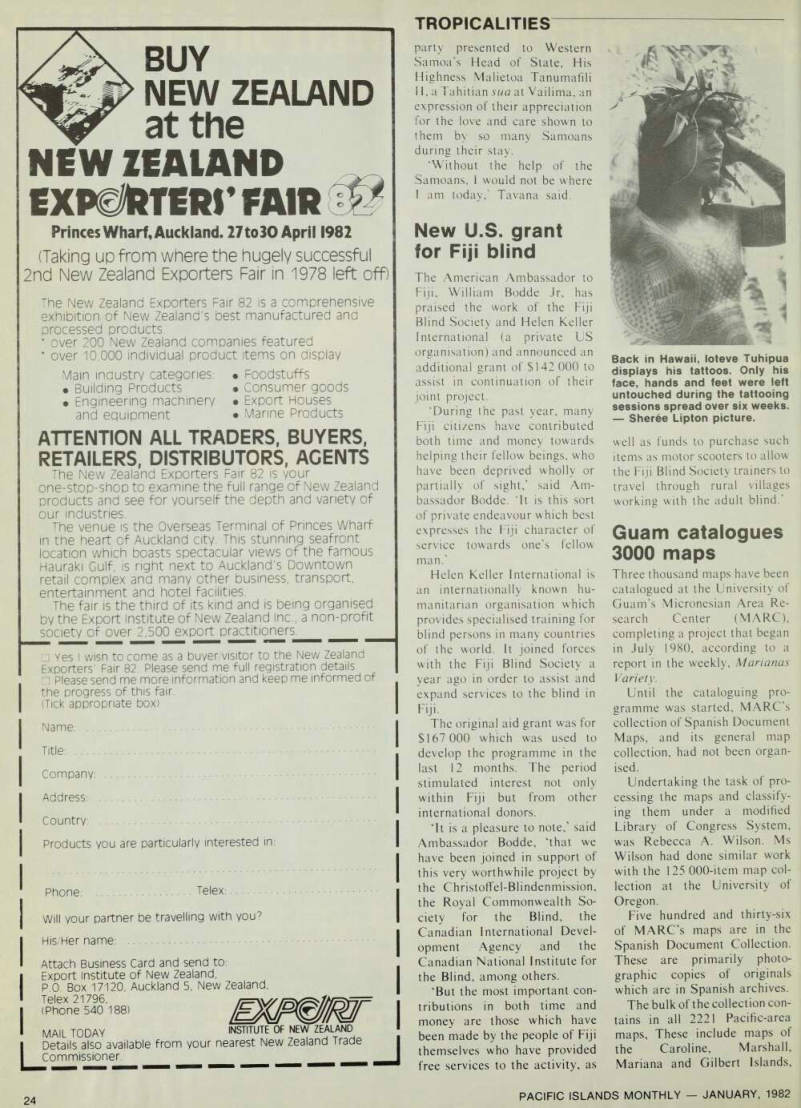
Back in Hawaii, loteve Tuhipua displays his tattoos. Only his face, hands and feet were left untouched during the tattooing sessions spread over six weeks. - Sheree Lipton picture.
and a number of maps of Japan.
The large collection of Guam maps includes special subjects such as aerial views, geological, nautical and archaeological maps.
The collection includes some rare, quite old, hand-drawn maps that are thought to be ‘originals’. One particularly in teresting specimen depicts Umatac Bay in 1819 and forts, guns, the church.
Governor’s House and other structures.
PNG’s Abelam
people studied
A permanent exhibition of the history and culture of the Abelam people from the West Sepik Province of Papua New Guinea is being mounted at a cost of SA4OO 000 in a gallery at the Australian Museum in Sydney.
Two senior tribesmen from the village of Apangai in the Prince Alexander mountain range on the northern coastal slopes of Papua New Guinea were in Sydney for two months supervising the creation of part of a village in the gallery.
They were Nera Jambruku and Nerikowi Konbapa, the Abelam artists who helped cre ate the elaborate wood carvings and paintings for use in the spirit house which the museum commissioned from their vil lage.
American anlhroplogist. Dr Diane Losche, who trained under the world-renowed anthropologist, the late Margaret Mead, joined the Australian Museum two years ago to organise the walk through gallery exhibition. She spent 15 months living with the Abelam people on her first visit to Papua New Guinea in 1976 to carry out research for her PhD from Columbia Univer sity, New York.
Dr Losche has been giving classes in Pidgin to the museum staff working on the preparation of the exhibition due to open next March.
The exhibition will include a spirit house, yam display house, sleeping and cooking houses and display cases and photo graphs woven around the archi tectural features. Australian Information Service.