Pacific 2000: Another look at the future
pp. 11-12 · Read in the full issue
future of Rim and Islands
Dr DAVID R. W. JONES* in the article below takes issue with certain ideas expressed by Professor RON CROCOMBE in an article in PIM of April 1981. Dr Jones sees the main tendency in the South Pacific over the next couple of decades as one of increased diversity, rather than greater unity, between the states in the region.
Professor Crocombe’s elaborate geopolitical essay on the Pacific basin (PIM April p 11) suffers from a number of conceptual and analytical weaknesses.
Possibly a response might serve to open a dialogue which, how ever far short it may fall of a South Pacific ‘think tank’, as proposed by Professor Crocombe, may be of some value to those in the region who must necessarily think in geo political terms.
It is a common failing of political geographers, in or out of uniform, to conceive of nation states as pieces in a vast game of chess. Indeed, a com parative map of chess-playing densities would point up some astute minds lucked away in the Philippines and Indonesia, some deadly intellects in the forgot ten Latin American fringe of the Pacific, and some mighty brains pushing their pieces in Vladivostok. I have yet to experience the Korean version of the game. The South Pacific can hardly expect to win at chess, and must bear the awful certitude of being regarded as ranks of pawns. Some are slightly fatter than others, but all face the inevitability of being sacrificed in somebody else’s game.
Fortunately, most political geographers are wrong. Nation states are not chess pieces with specified roles, set objectives and fixed configurations, but are subject to occasional and sometimes cataclysmic change.
It is in recognising this, and in studying the process of change, that political geographers differ most markedly from geopoli ticians. Each of the ‘great powers’ circling the Pacific, or
making their presence felt, are subject to political change; Japan, China, the USSR, the USA and the European Econ omic Community. So too are the currently less powerful circum-Pacific countries of Chile, Peru, Ecuador, Colombia, Mexico, the Central American republics, Australia, New Zealand, Indonesia, the Philippines, Vietnam and Korea. No prognosis of pres sures and events over a 10-or -20-year period is complete with out a thorough analysis of potential changes in each of these component parts. A ‘Pacific 2000’ think-tank mem ber requires a greater breadth of background knowledge than most of us possess.
Within the small nation stales of the South Pacific, change is also taking place and may well accelerate during the next decade or two. For example, the mid-1981 strike of public servants in Western Samoa is hardly likely to make zero impact on the socio political structure of that country, just as the reverber ations of Jimmy Stevens’ antics in Vanuatu have not yet ceased to shape attitudes in that country. A central plank in Professor Crocombe’s geopoliti cal manifesto, for such it at limes appears to be, is that the South Pacific nation states should stand united in the face of diverse pressures from the Pacific rim and beyond. To do this, however, is to minimise each small state’s liberty to make internal changes in what ever direction. Differential rates of change in each state imply, surely, some widening in the already apparent rifts between the South Pacific countries, differing philosophies, differing levels of acceptance of aid from specified donor countries, differing international transport requirements and so on.
For example, we cannot ex pect, say, a socialist Kiribati to
receive proportionate aid flows from the USA and Australia, given the present political stance of those countries. Nor could we expect an obscurantist quasi-mystical government to receive much encouragement and assistance from the Soviet Union. The circum-Pacific powers do have exportable preferences with regard to the political complexion of states whom they wish to aid and abet, and will continue to hold to these preferences in spile of a possible post-Reagan re-
surgence of multi-lateral aid programming.
It is perhaps in this light that we should see Soviet aid, in cluding military assistance, to Afghanistan and Vietnam, rather than in the perspective of Sir Halford Mackinder and other long-dead geopoliticians, i.e., that of global moves in a vast strategical chess game.
After all, the USSR does not aid Pakistan (at present) or, for that matter, Turkey.
The status quo in South Pacific countries is supported principally by aid flows from Australia, NZ, the UK and the USA, with EEC price supports and Japanese long-term raw material extraction contracts.
They have internal economic structures largely dominated by
a handful of banks and com panies based in these same countries. It is inconceivable, in the light of recent Jamaican experience, that a nationalis ation of the banks and selected major companies in one or other South Pacific nation state would not be accompanied by concerted attempts at destabilisation from outside.
We need only recall the over throw of Ali Soilih’s Left leaning government in the Comoro Islands by a group of French mercenaries, the con
slant threat of a mercenary spearheaded coup in the Seychelles, and frequent land ings of armed men in Grenada to realise that small island states are not immune from the most drastic forms of outside intervention.
In that Professor Crocombe’s thesis apparently leans heavily on a concept of South Pacific unity, it inevitably implies the
*Dr David R. W. Jones teaches political geography at the Uni versity of Calgary in Western Canada, and until recently was reader in geography at the University of the South Pacific, Suva.
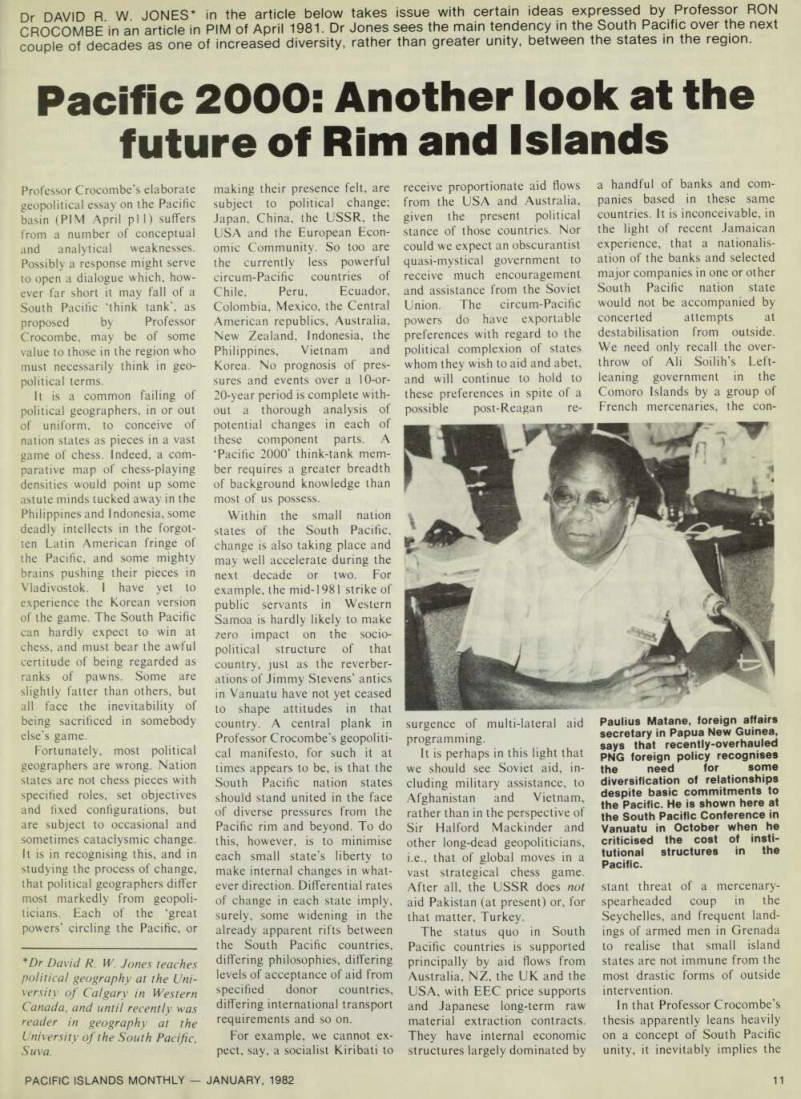
Paulius Matane, foreign affairs secretary in Papua New Guinea, says that recently-overhauled
PNG foreign policy recognises
the need for some diversification of relationships despite basic commitments to the Pacific. He is shown here at the South Pacific Conference in Vanuatu in October when he criticised the cost of insti tutional structures in the Pacific.
maintenance of the status quo in the South Pacific. This pros pect may be of diminishing allure to the inhabitants and, in its effect, can be compared to the policy of indirect rule in Northern Nigeria, Malaya and elsewhere in the defunct British Empire.
There is no sound reason to believe that small island states must, of necessity, be clients of larger powers, even though
‘. . . If one were to conclude with an admonition to people in the South Pacific, it would be to suggest periodic examination of the bank accounts of leading military, politico/administrative and other figures, in their countries, and the development of links with rather more circum-Pacific intelligence organisations than is presently the case
many in fact are. It would not be easy to assign the Maldives, the Cape Verde Islands, Seychelles or Malta to any particular camp. Tonga, Tuvalu and even Tokelau are perfectly capable of developing and maintaining a real indepen dence, free of external leverage and without recourse to regional groupings. Indeed, the sheer multiplicity of interested large and medium powers in the Pacific permits some adroit manoeuvring in the pursuit of genuine independence.
We may accept, however, Professor Crocombe’s assertion that some members of the educated elite in the South Pacific may succumb to the blandishments of interested foreign powers and may, in deed, reach positions high enough to temporarily take their countries into the orbit of large circum-Pacific powers.
The discovery of West German and US agents even among cabinet ministers in Guinea subsequent to the abortive Portuguese-backed invasion at tempt of 1970, should make this point clear. Traitors are not hard to find and recruit in any country. Nor will any assertion of Pacific culture or the Pacific Way do more than camouflage sell-outs to foreign powers. We may recall that Leopold Senghor’s ‘negritude’ did little more, in the event, than mask a blatantly pro-French neo colonial regime.
In terms of a 20-year prog nosis of developments in the Pacific basin we may fairly confidently predict a steady diversification of trade patterns.
facilitated by the appearance of relatively low-cost Soviet, Chinese and perhaps Indian merchant vessels. Alternative markets for exports and sources of imports will, at least, reduce the leverage that Australia, NZ, Britain the USA, Japan and the EEC now have in the South Pacific, making it poss ible for some countries to usher in significant structural changes in their economies. If the post
1974 economic recession con tinues to deepen, the likelihood of radical change in some South Pacific nation states must inevi tably increase, and with such changes will come a realign ment of external political link ages. A US-Australian axis in the South Pacific will be hard pul to maintain the status quo in each errant nation state.
This is particularly true as the Third World continues to shake itself free of residual colonial and neo-colonial ties.
After all, it only requires a significant change of direction in, say, five or six major Third World countries for the spirit of Bandung to return revivified.
Should Brazil, Zaire, Saudi Arabia. Pakistan and Indonesia
radically alter their inter national political stance, countries such as the Cook Islands may find it more profitable to assert their inde pendence and Third World character than to remain in the backyard of a rapidly declining New Zealand. The Group of 77 and the militant Third World in general is likely, in the next decade, to provide solid diplo matic support to even the smallest South Pacific country.
It is also apparent that no circum-Pacific power is likely to repeat the demographic exper iments of the colonial period.
We need not fear the implan tation of thousands of Italian settlers, American settlers, Somali labourers or Afghan shopkeepers. Except where it might suit the ambitions of some parochial political hopeful to whip up racialism within the Pacific, we may expect each South Pacific country to gradu ally absorb all of their citizens into a single polity. In this respect only Fiji remains fragile. Intrusion in the South
Pacific is likely to be military, economic and political.
Military intrusion may effectively be countered, and I believe will be, by greater Soviet naval capabilities; wit ness the about-face performed by a US fleet, steaming towards Bangladesh in its birth pangs, when it found itself shadowed by a Soviet naval force. Econ omic intrusion is likely to be the most intense, with a whole gamut of international trade techniques, ranging from export quotas to boycotts, coming into play. I would personally see the establishment of an aggressive School of International Trade as likely to be more profitable than a geopolitical ‘think tank’ in the South Pacific. External economic interests in the form of investments, banks and mer chant houses are vulnerable, given the crucial fact of sover eignty in the South Pacific, and being so are less likely to interfere excessively in the pol itical process.
In the political sense we may confidently anticipate, and here 1 agree with Professor Cro combe, a small but significant percentage of the South Pacific’s military, trade union and administrative elites selling themselves to circum-Pacific in telligence services. As a result, we are likely to see the emerg ence of several regimes, poss ibly as grotesque in nature as the late Central African Empire or Haiti, whose real function will be little more than to preserve the economic status quo.
If one were to conclude with an admonition to people in the South Pacific, it would be to suggest periodic examination of the bank accounts of leading
military, politico/admin
istrative and other figures, and the development of links with rather more circum-Pacific in telligence organisations than is presently the case. Overall, my own prognosis would be that external interference in the South Pacific will be quite largely generated by the very process of change and conserva tive reaction within the region itself, each seeking allies and links outside. Least of all can I foresee any broad alliance of South Pacific nations fending off unsolicited interference from the wider world peering covetously over the Pacific rim.
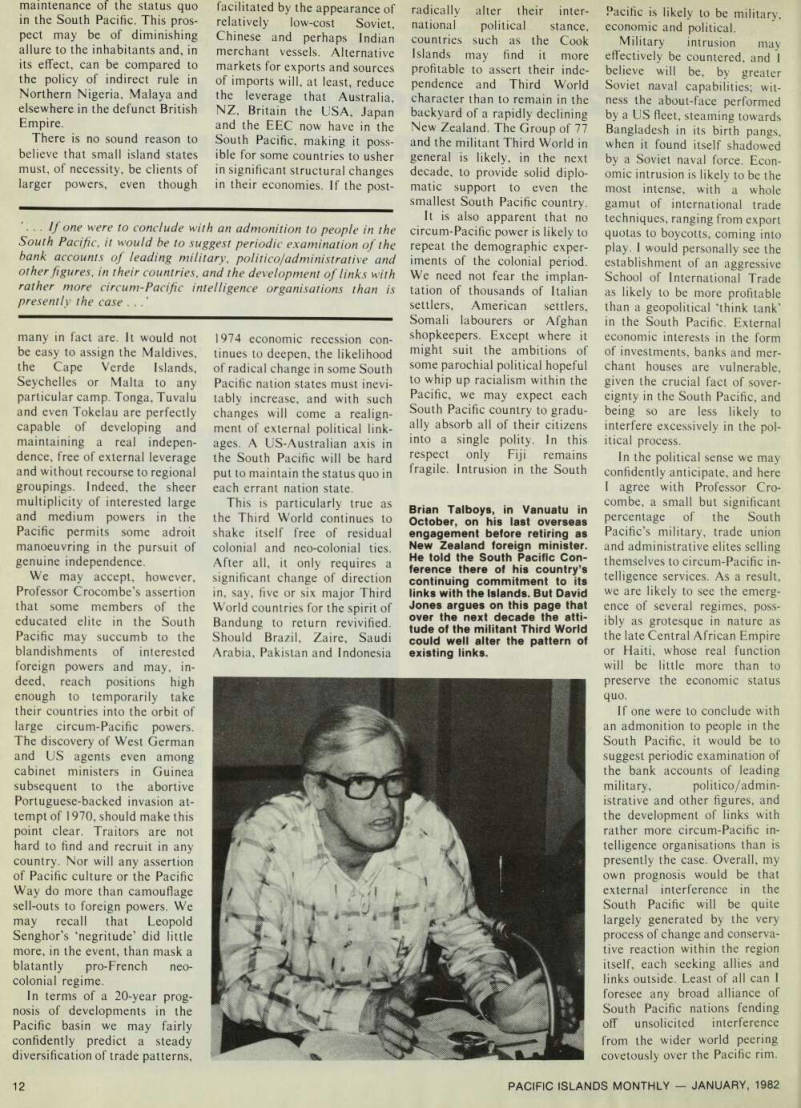
Brian Talboys, in Vanuatu in October, on his last overseas engagement before retiring as New Zealand foreign minister.
He told the South Pacific Con ference there of his country’s continuing commitment to its links with the Islands. But David Jones argues on this page that over the next decade the atti tude of the militant Third World could well alter the pattern of existing links.