of yachties?
pp. 8-10 · Read in the full issue
Letters
What value in news of yachties?
Fair crack of the whip. You’re beginning to overdo the Yachtie gossip column.
Current issue (October 1981) has no fewer than seven of its 82 pages devoted to the comings and goings of this leisure class, quite apart from that harrowing letter from Alvah G. Simon re the poor people of Nauru being deprived of the pleasure of his company.
Surely your coverage is out of all proportion to their numbers or value to the Pacific Way.
It’s all very interesting. I’m sure, to themselves and possibly other yachties, but pretty damned boring for the rest of us.
PIM has always reported on the wanderings of yachtsmen, and fair enough, but don’t let’s go overboard on the matter.
It seems to be expected by most Yankee sailors that, hav ing drifted across the Pacific to these climes, we should all stand up and cheer.
Hell, Thor Whatsisname proved years back that if one sat on a lump of wood over there, and stuck to it, one would inevitably finish up over here.
What about stopping this nonsense before they take you
over completely.
Frank Lewis
Rabaul Papua New Guinea Would any other reader care to comment? Editor.
Christine Bourne
has a fan Congratulations to Christine Bourne of Tahiti (PIM Oct p3l). She appears to be one of the few remaining individuals in the region with courage enough to tackle the truth and congratulations to PIM editors.
who appear to run the only remaining unbiased regional publication.
Perhaps it is time for the advocates of ‘decolonisation’ and ‘freedom’ to clean up their own socio-economic-industrial mess before embarking on purely materialistic adventures in their neighbours’ gardens stirring a bit of Kanaka revol ution in the process.
Daily earbashings about Namibia and Poland will not eliminate the memory of the cowardice shown over Cambodia, Timor and Irian Jaya. Nor will they eliminate the problems of land rights for the Australian Aborigines.
Let us hope the Kanaka movements have the logic and realism to see the greedy am bitions of those who may already be calculating the profits that could come their way from nickel, and via Steam ships and BP supermarkets.
Vitaliz Paingame
Cairns Qld Australia In defence of Kiwi cops In reply to your corespondent Bruce Turner’s letter (PIM Sep 1981 plO), I wish to comment on his allegations of brutal tactics and strongarm methods used by the New Zealand police during the South African Springbok lour of 1981.
I wish to point out to Mr Turner that at no time did the police throw rocks, sticks, or acid in tennis balls at the demonstrators, as the demon strators threw at the police. At no time did the police call members of the public who were Maoris and Islanders ‘black bastards’. This was done by demonstrators to members of the police force.
If he has read the New Zealand newspapers he would have seen that the public as a whole were more than pleased with the way in which the police handled themselves during this controversial lour, and have shown this in a practical man ner by donating over SNZI2O 000 for holiday homes for members of the police force.
As far as I am aware the advertisement placed in PIM is there for recruiting purposes.
As one who served as district police recruiting officer in
Wellington for almost two years, 1 am able to state that the percentage of Maoris and Islanders in the New Zealand police force far exceeds their percentage of the population as a whole.
As a Maori myself and as a Senior NCO in the New Zea land police, having been in the service for over 24 years, I believe I know what 1 am talking about.
I would like to point out that our police force is one of the few in the world who are not armed while on duty, and as far as we are concerned we would like to keep it this way. I feel that this shows the respect that the general public have for our police service.
Before becoming district re cruiting officer in Wellington, I was a member of the Welling ton Section of the Task Force’, which we called The Team Policing Unit'. This unit com prised two sections of five with three NCOs. 1 was one of the NCOs. The unit comprised 13 men. On that team there were two Samoans, three Maoris, and one Fijian, with the remainder
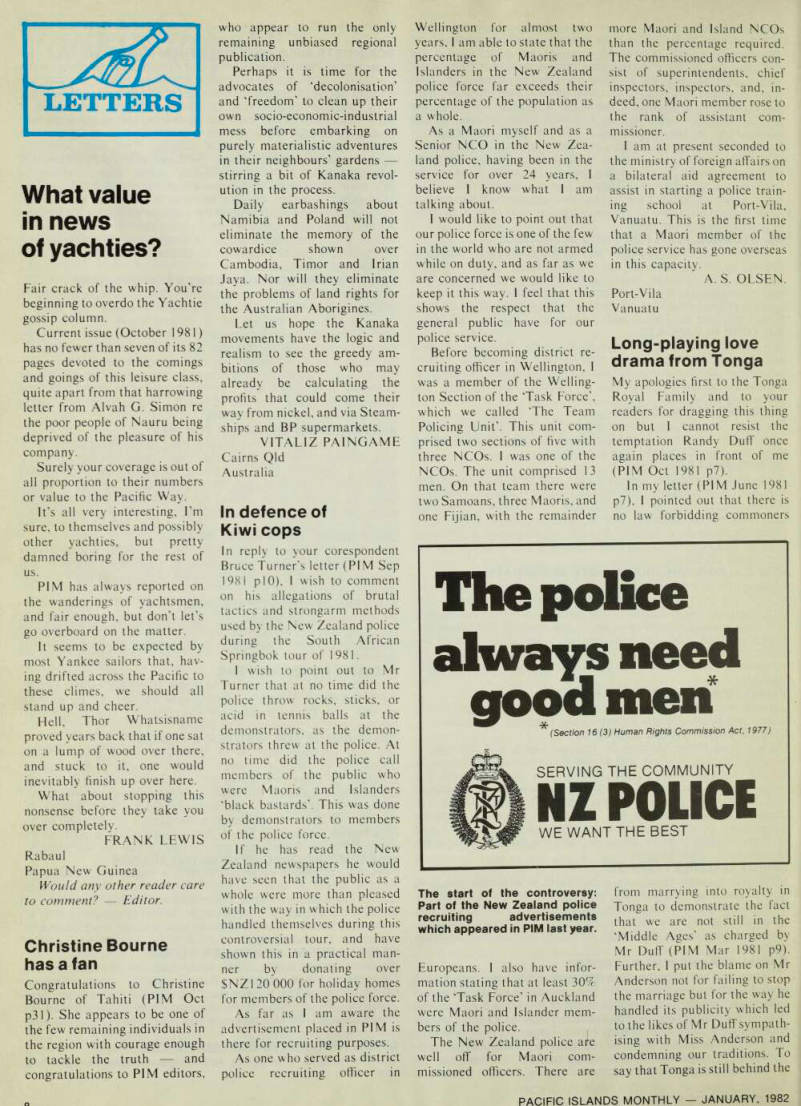
The start of the controversy: Part of the New Zealand police recruiting advertisements which appeared in PIM last year.
Europeans. I also have infor mation stating that at least 30% of the Task Force’ in Auckland were Maori and Islander mem bers of the police.
The New Zealand police are well off for Maori com missioned officers. There are
more Maori and Island NCOs than the percentage required.
The commissioned officers con sist of superintendents, chief inspectors, inspectors, and, in deed, one Maori member rose to the rank of assistant com missioner.
I am at present seconded to the ministry of foreign affairs on a bilateral aid agreement to assist in starting a police train ing school at Port-Vila, Vanuatu. This is the first time that a Maori member of the police service has gone overseas in this capacity.
A S. Olsen.
Port-Vila Vanuatu
Long-playing love
drama from Tonga My apologies first to the Tonga Royal Family and to your readers for dragging this thing on but I cannot resist the temptation Randy Duff once again places in front of me (PIM Oct 1981 p 7).
In my letter (PIM June 1981 p 7), I pointed out that there is no law forbidding commoners
from marrying into royalty in Tonga to demonstrate the fact that we are not still in the ‘Middle Ages’ as charged by Mr Duff (PIM Mar 1981 p 9).
Further, 1 put the blame on Mr Anderson not for failing to stop the marriage but for the way he handled its publicity which led to the likes of Mr Duff sympath ising with Miss Anderson and condemning our traditions. To say that Tonga is still behind the
times is hardly a compliment at all. Also there is a big difference between failing to notice a friendship in Tonga, and en couraging and organising a wedding in Hawaii, not to mention the carefully worded and nicely-framed stories given to the press.
To be acceptable means ‘worth accepting'. That’s why in England in the 19305, Mrs Wallis Simpson, despite her vast wealth and impressive con nections. did not sit on the throne. And lately. Miss Davina Sheffield of England would have walked Prince Charles to the altar if not for her former live-in lover blowing the lid on their affair.
Sure Miss Anderson has a background and 1 did not contradict that. But perhaps I should have been more frank and to the point. Being a step daughter in her later life to a Tongan noble, and also eventu ally having a wealthy showman in Hawaii declared her father, simply fails to impress us Tongans at all.
Mr Duff also pointed out that Miss Anderson is at great ease in the company of our royal family. I sure am glad to inform him that this privilege is definitely not exclusive to Miss Anderson.
And on Mr Duffs proposal that ‘this lovely girl should be welcomed into the royal family' I am sure they would rather welcome an untainted beauty, not necessarily with a high birth-status, but most definitely without an embarrassing past, to protect both our traditional values and the reputation of our Royal members.
Lastly, please note that 1 am definitely a ‘Miss’ not a ‘Mr’.
(Miss) Pauline
Manutu’Ufanga
’Unga
Sydney NSW Australia
Anti-Oz bug bites
in French Pacific An anti-Australian bug seems to be biting quite a few mem bers of the elite in the French Pacific territories, and it is leading them into some embar rassing situations.
French Polynesia’s Senator Daniel Millaud, led by the bug
into barking up the wrong tree in charging that Polynesians were treated in a discriminatory fashion by Australian immi gration authorities (PIM Dec ’Bl p 6), is not the only one to suffer.
The Papeete newspaper La Depeche de Tahiti recently went wild with excitement about a World Council of Churches report which made strong criti cisms of aspects of the Austra lian Government’s treatment of Australian Aborigines.
The headline on its article on the subject proclaimed that the Australian Government had had ‘its nose rubbed in its racism’, and the article praised the WCC report as the work of ‘defenders of this oppressed people’.
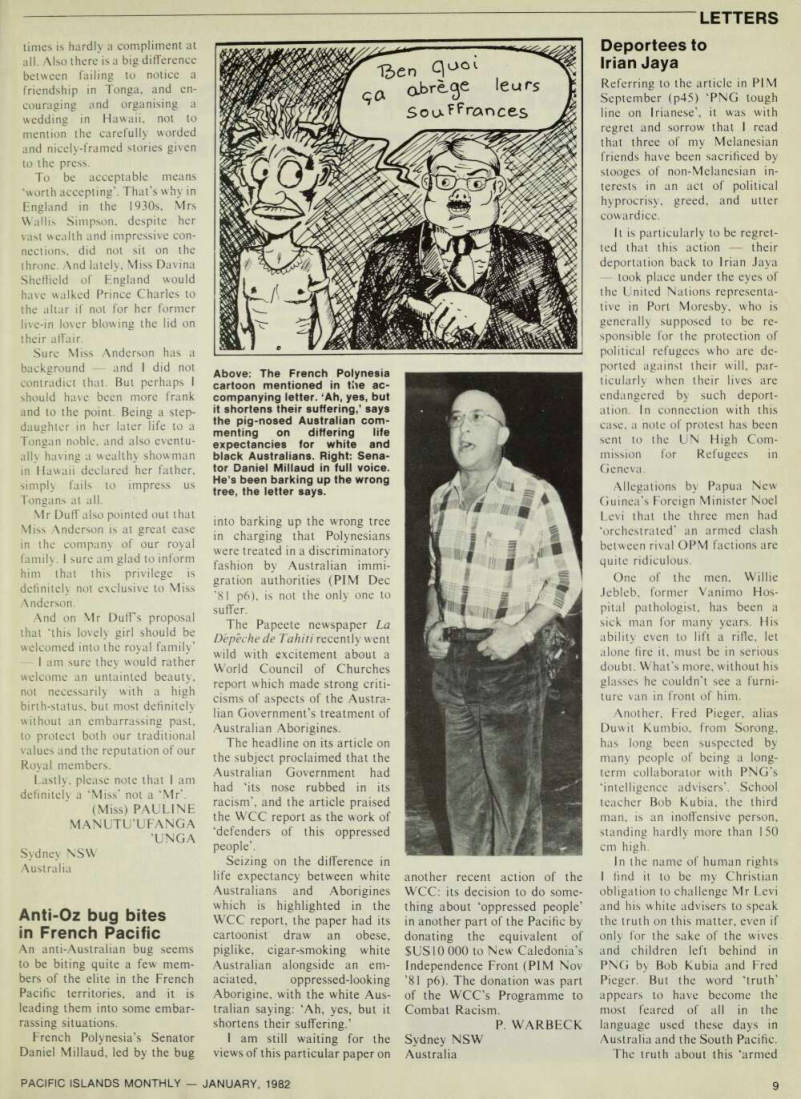
Seizing on the difference in life expectancy between white Australians and Aborigines which is highlighted in the WCC report, the paper had its cartoonist draw an obese, piglike, cigar-smoking white Australian alongside an em aciated, oppressed-looking Aborigine, with the white Aus tralian saying: ‘Ah, yes, but it shortens their suffering.’
I am still waiting for the views of this particular paper on
another recent action of the WCC: its decision to do some thing about ‘oppressed people’ in another part of the Pacific by donating the equivalent of SUSIO 000 to New Caledonia’s Independence Front (PIM Nov ’Bl p 6). The donation was part of the WCC’s Programme to Combat Racism.
P. Warbeck
Sydney NSW Australia
Deportees to
Irian Jaya
Referring to the article in PIM September (p 45) ‘PNG tough line on Irianese’, it was with regret and sorrow that 1 read that three of my Melanesian friends have been sacrificed by stooges of non-Melanesian in terests in an act of political hyprocrisy, greed, and utter cowardice.
It is particularly to be regret ted that this action their deportation back to Irian Jaya took place under the eyes of the United Nations representa tive in Port Moresby, who is generally supposed to be re sponsible for the protection of political refugees who are de ported against their will, par ticularly when their lives are endangered by such deport ation. In connection with this case, a note of protest has been sent to the UN High Com mission for Refugees in Geneva.
Allegations by Papua New Guinea's Foreign Minister Noel Levi that the three men had ‘orchestrated' an armed clash between rival OPM factions are quite ridiculous.
One of the men, Willie Jeblcb, former Vanimo Hos pital pathologist, has been a sick man for many years. His ability even to lift a rifle, let alone fire it, must be in serious doubt. What’s more, without his glasses he couldn’t see a furni ture van in front of him.
Another, Fred Picger, alias Duwit Kumbio, from Sorong, has long been suspected by many people of being a long term collaborator with PNG’s ‘intelligence advisers’. School teacher Bob Kubia, the third man, is an inoffensive person, standing hardly more than 150 cm high.
In the name of human rights I find it to be my Christian obligation to challenge Mr Levi and his white advisers to speak the truth on this matter, even if only for the sake of the wives and children left behind in PNG by Bob Kubia and Fred Pieger. But the word ‘truth’ appears to have become the most feared of all in the language used these days in Australia and the South Pacific.
The truth about this ‘armed
Above: The French Polynesia cartoon mentioned in the ac companying letter. ‘Ah, yes, but it shortens their suffering,’ says the pig-nosed Australian com menting on differing life expectancies for white and black Australians. Right: Sena tor Daniel Millaud in full voice.
He’s been barking up the wrong tree, the letter says.
clash’ and the historical facts are as follows: the OPM Righlwing leader, E. O. Bemey, crossed the border and attacked ‘General’ Rumkorem's commu nist faction in the Wulung gardens near Vanimo, where he has been in permanent resi dence (with the PNG auth orities turning a blind eye) since 1976. In the process, Bemey took prisoner another notorious collaborator and traitor to his own people, the Luluai from Scoliao village, OPM ‘Major’
Jordan Pieger This man and Fred Pieger betrayed their own brother-in-law and tambu, Jacob Hendrick Prai, to Austra lian kiaps and so-called intelli gence and security advisers to the PNG Government, also in Vanimo.
Neither of the Piegers is much loss, it is true. But the big question remains: how is it possible for ‘General’ Seth Rumkorem and his OPM Left wing faction to remain for so many years unnoticed with all his men in the immediate neigh bourhood of the Vanimo PNG Defence Force barracks, and the Vanimo ‘security’ and advis ory staff? I further would like to ask Mr Levi and Mr Ted Diro the following questions; Is it not a fact that ever since the communist OPM ‘General’ look up residence in the Wulung gardens, he has been a constant
visitor to the PNG Defence Force canteen, occasionally in the company of the commander of the PNG Defence Force?
And is it not a fact that certain foreign ‘advisers’ keep a con stant liaison with the commu nist ‘General’ in either Wulung or the Vanimo Hospital?
Who are Mr Levi and the PNG Government trying to fool with their anti-communist and anti-socialist propaganda cam
paign? Maybe they’re fooling
Australia, but certainly not Mr Busiri Surjowinoto or Admiral Sudomo.
Manfred Eiserman
Cairns Qld Australia Appeal from a voisin For the last eight months 1 have been preparing a weekly broad cast for FR3 Radio Tahiti entitied ‘Nos Voisins du Pacifique’ (‘Our Pacific Neigh bours’). This broadcast informs the people of French Polynesia about what is happening in the Pacific area, and is the only one of its kind.
The broadcast, which lasts 20-25 minutes, is divided into a magazine section and a news section.
The magazine section might present details on a particular country in the Pacific, an inter view with a person prominent in regional affairs (a head of state, prime minister, or such), details of one of the Pacific regional organisations (SPC, SPEC, Fo rum, for example), deal with certain Pacific customs, or ana lyse some recent events.
The news part includes news on political, economic, indus trial, scientific, and artistic
events, as well as sports and outstanding recent events in public affairs.
The purpose of this broadcast is to make people interested in their part of the world. Unfortu nately, I find it quite difficult to gather adequate information (although I read PIM every month) and documents, since I have no allowance to support me in this work.
I would very much appreci ate it if some PIM readers were kind enough to send me as much documentation as they can on their country news papers, magazines, anything that conveys information from on the spot about what is happening in the country con cerned. I very much want to present a realistic picture so I want all the information 1 can get: economic statistics, consti tution, history, plans for devel opment, agricultural resources, fishing, forests and so on and on.
I do hope some of your readers will be willing to help me.
Michel Charleux
‘Nos Voisins du Pacifique’
BP 3935 Papeete Tahiti French Polynesia Fiji and the Sinai force Nakavandra’s emotional letter (PIM Oct ’Bl p 7) deploring Fiji's participation in the pro posed Sinai peace-keeping force suffers from several errors and misconceptions which should not pass uncorrccled.
Firstly, Fiji and the US are not the only participants in the Sinai force. Countries that have indicated their support for or their willingness to participate in the force are Uruguay, Colombia, Italy, France, Britain, Netherlands, Australia and New Zealand.
Secondly, all peace-keeping forces can be described as being ‘controversial’ as they are in variably creatures of political controversy. There is no such creature as an ‘unconlroversiaF peace-keeping force and if there has been one created can your magazine or Nakavandra please enlighten its readers with an example?
Thirdly, for Nakavandra to
claim that the government of Fiji is under . . the delusion that the whole world appreci ates and admires the sacrifice of Fiji military manhood in Lebanon’ is not only a grossly unfair statement for anyone to make but is an insult to the memory of Fijian soldiers who have fallen in Lebanon. We in Fiji do not expect the sympathies of the whole world.
We are quite content with the expressed appreciation and ad miration shown to our soldiers by the Lebanese people them selves, the displaced Palestinians and the Israelis.
Moreover the sacrificing of Fijian military manhood is not a new experience to Fijians. We have made similar and greater sacrifices before in France and Italy (World War 1), the Solomons and Bougainville (World War II), Malaya (1952 to 1956), Lebanon (since 1978), Zimbabwc-Rhodcsia (1980) and to commence in 1982, the Sinai peninsula. Mention must also be made of the hundreds of Fijians who have served and are still continuing to serve the British army with distinction.
Fourthly, Fiji did not contrib ute troops to Vanuatu because as far as Fiji was concerned, the nature of the Santo dispute was essentially civil and not military and therefore military force was not required. It would appear that Britain and France agreed with this assessment judging by the passivity of British and French troops in Vanuatu at the lime. The use of troops to settle the comic-opera situation that existed in Santo at the time was an unnecessary overkill.
In conclusion I would like to point out that a commonly held principle in Fiji is that if a person does not pay tax to the government of a country then that person has no right to criticise the policies of that government. If we accept this principle as being a fair one, then Sir Julius Chan had no right to criticise the Fiji Gov ernment policy not to commit Fijian soldiers to Vanuatu, and likewise Nakavandra has no right to criticise Fiji Govern ment policy to commit troops to the Sinai force.
N.W. Lalokalo
Suva, Fiji
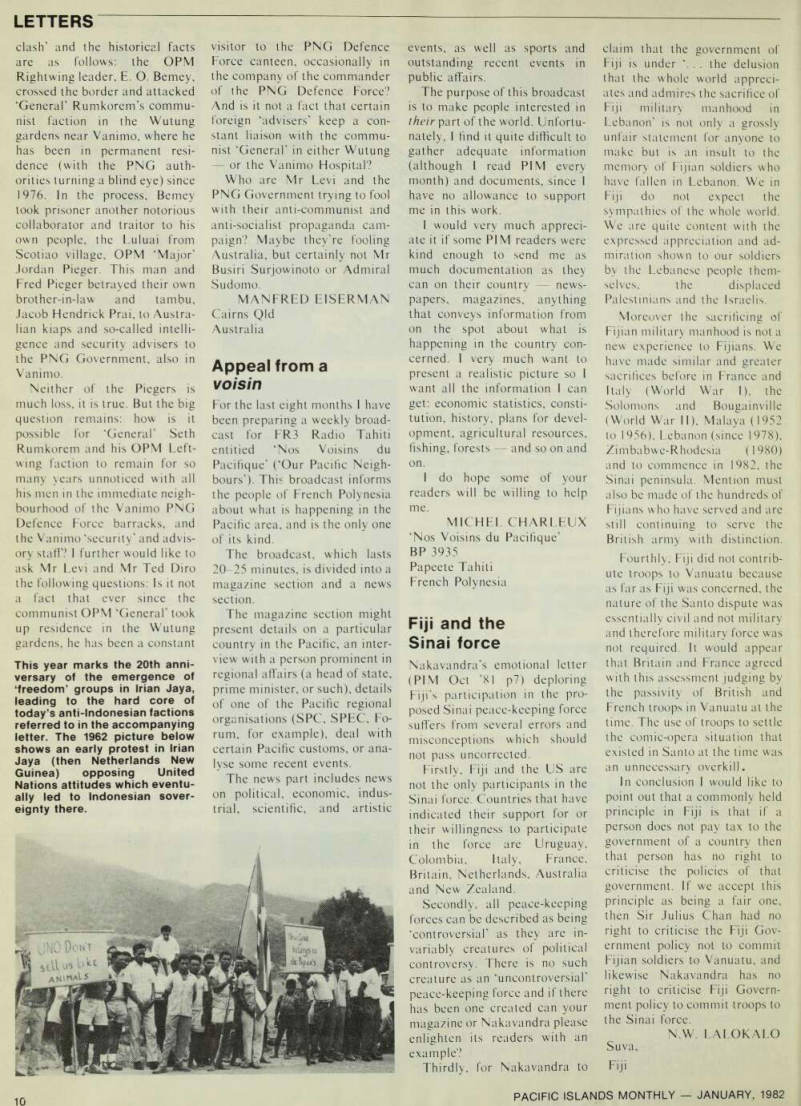
This year marks the 20th anni versary of the emergence of ‘freedom' groups in Irian Jaya, leading to the hard core of today's anti-Indonesian factions referred to in the accompanying letter. The 1962 picture below shows an early protest in Irian Jaya (then Netherlands New Guinea) opposing United Nations attitudes which eventu ally led to Indonesian sover eignty there.