Caledonia in September ’82?
pp. 13-18 · Read in the full issue


On the way up: A UDI for New Caledonia in September ’82?
Australian journalist CHRIS RAY was in New Caledonia for several weeks late last year. During his visit he discussed with representatives of New Caledonia’s oldest political party, the Union Caledonienne, the results of the UC s talks in Paris with President Mitterrand last October, and also met representatives of other political groups.
French President Mitterrand’s remarks during his October talks in Paris with representa tives of the pro-independence party Union Caledonienne centred on the future of the New Caledonian-born whites, the Caldoches, according to Francois Burck, a UC Terri torial Assembly member.
Speaking at UC head quarters in Noumea a run down suburban villa patrolled by a ferocious dog Mr Burck said that the president was keenly aware that the Caldoches were ‘worried as to what their future would be under Kanak and socialist inde pendence’. ‘After our talks,’ said Mr Burck, The president under stands that our demands for Kanak independence are not racist, as some would have him believe. That is a step forward for us. ‘No party seeking indepen dence has ever spoken of mak ing anyone pack their bags and leave.’
Mr Burck told me that the UC was sufficiently pleased with the talks to consider delay ing by six months or a year the plan of the Independence Front - in which the UC is the largest party to make a unilateral declaration of inde pendence on September 24 this year the 129th anniversary of French colonisation of New Caledonia. But our interview took place shortly before the November 11-15 congress of the UC on the island of Lifou in the Loyalty group of islands off New Caledonia’s east coast.
And to judge from post congress remarks by another UC leader, Jean-Marie Tjibaou, on Noumea television, this plan was not adopted: Mr Tjibaou quite firmly predicted that inde pendence would be declared as planned on September 24, 1982.
Apart from Mr Burck’s re marks, and the generally ap
proving comments made on the talks by the UC delegation leader Roch Pidjot, (PIM Dec ’Bl p 5), few details of what transpired have been made pub lic.
In its comments, the Noumea daily Les Nouvelles Caledon iennes. assured its predomi nantly white readership that Mitterrand had given ‘no pre cise undertakings’ to the UC team.
The paper said the president had ‘indicated to his guests that he was going to think aloud before them, and he submitted to them in turn each of the possible scenarios for the terri tory and asked them to react to them, without stating his view’.
But it added that the four members of the UC delegation ‘noted above all that Mitterrand did not deny the right of the Kanak people to independence, and therefore did not renege on his previous undertakings on this point’.
But no amount of good news
from Paris is likely to defuse growing agitation by tribal Kanaks seeking to recover tra ditional lands now owned by French colons.
Mr Burck said Kanak tribes would go ahead with plans to occupy a number of farms and plantations owned by whites.
He said the owner of one property (400 hectares of cattle pasture) at Poya, near the central-western coast, was in formed of and ‘gave his consent’ to the planned occupation. But neighbouring white farmers had since been pressuring him to resist.
Although the Kanaks in tended the occupations to be peaceful, Burck said he did not rule out the possibility that some colons would react violently. ‘lf this does happen we are confident the French Socialist government will not hesitate to use riot police or even troops against any white vigilante movement,’ he said.
Burck claimed the number of firearms in white hands in New Caledonia was put at 140 000 by the three senior police officers sent from Paris to inves tigate the murder of UC secretary-general and indepen dence activist Pierre Declercq last September.
Burck argued: ‘lt is better for the tribes to take possession of the land in their own way. A Kanak does not feel at home if he is not installed by the clan that owns the land. It is hoped that these occupations will force the colons to listen to the Kanaks’ demands, instead of running to the police or the high commissioner. A dialogue must start now.’
Indications that the planned
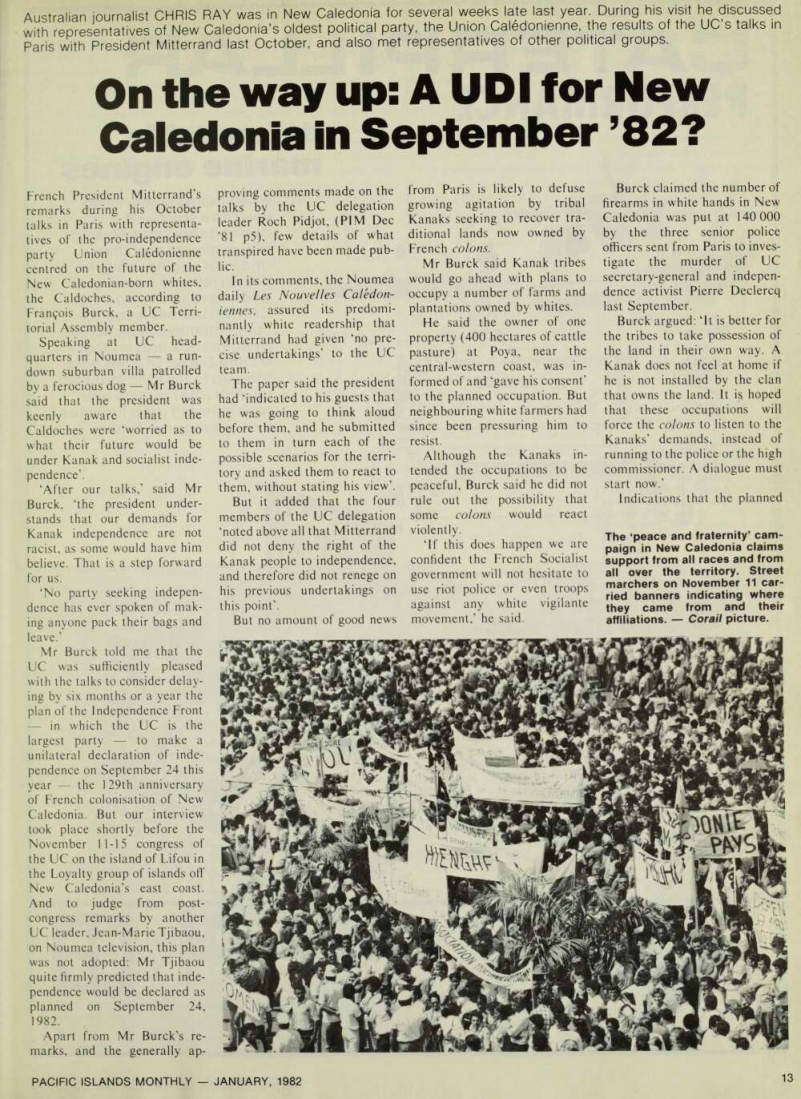
The ‘peace and fraternity’ cam paign in New Caledonia claims support from all races and from all over the territory. Street marchers on November 11 car ried banners indicating where they came from and their
affiliations. - Corail picture.
New Caledonia Politics
actions had got underway were contained in a November 22 Australian press report which said; ‘An unarmed group of more than 200 Melanesians yesterday tried to take over a 270-hectare estate in New Caledonia without violence.
The estate was heavily guarded so the group, led by pro independence activists, broke up after heated discussions among its leaders.’
Burck said that the first attempts at peaceful occu pations of land would be fol lowed by other tribes in different parts of the territory, though he was reluctant to state exactly when and where.
The movement to regain tra ditional land lost to Europeans in some cases more than a century ago is strongest in the northwest. Though each tribe has its own objective, their activities are co-ordinated.
They are supported by the Independence Front which holds 14 of the 36 Territorial Assembly seats, and by the more radical Kanak Liberation Party, Palika, which usually distances itself from the co alition.
Until now the tribes have generally been content to make contact with French colons occupying alienated land and make formal requests for its return. Since 1979 the French administration has been pre pared to purchase land from the colons and return it to the Kanaks, and last August the new French Secretary of State for Overseas Departments and Territories, Henri Emmanuelli, promised to speed the process.
But land reform appears not to have satisfied the Kanaks. ‘Only about 6000 hectares has gone back to Kanaks and most of it is poor soil,’ Burck com plained.
Kanaks are worried also that a reform which delivers pieces of once-tribal land to individ uals or sub-groups of a tribe could further disrupt the communal way of life. Thus they view the land reform as yet another threat to the concept of group ownership and a social structure already eroded by colonisation.
The inadequacy of the land reform and related policies so far pursued by the Socialist government was acknowledged
by Mr Emmanuelli in a state ment made following the November 7 rioting in Noumea (PIM Dec 'Bl p 5). He said: ‘We must make a political response to the Melanesian problem. ‘lt is not only economic and social reforms that will bring a solution to this problem.' His statement coincided with a special meeting called by President Mitterrand to discuss the New Caledonian crisis.
Writing in the Australian weekly The National Times, journalist Robert Milliken com mented; ‘Australian Govern ment officials see Emmanuelli’s statement as the first hard sign that the French are willing to consider decolonisation of their troublesome Pacific territory.' After more than a century of colonisation Kanaks make up less than half the population of New Caledonia. The January 1980 census put their members at 60 500, and Burck estimates that only 7000 are employed outside of subsistence farming on the reserves one reason why land is so important to them.
The census counted 49 700 Europeans in the territory, with
17 600 Polynesians and I I 800 Asians.
In the French presidential election last May, 65.5 percent of votes cast in New Caledonia went to Giscard d’Estaing, and since Mitterrand's Socialist Party had ’reaffirmed its desire to support and guarantee the Kanak people’s right to freely decide their future,’ the ballot was seen by whiles at least as a sort of referendum on indepen dence.
The Kanak independence parlies dispute this view, argu ing that only Kanaks have the right to determine whether New Caledonia becomes indepen dent or stays with France. At the least they would insist that the right to vole in any refer endum on the subject be limited by a qualifying period of resi dence.
At present, any French citi zen can vole in New Caledonia
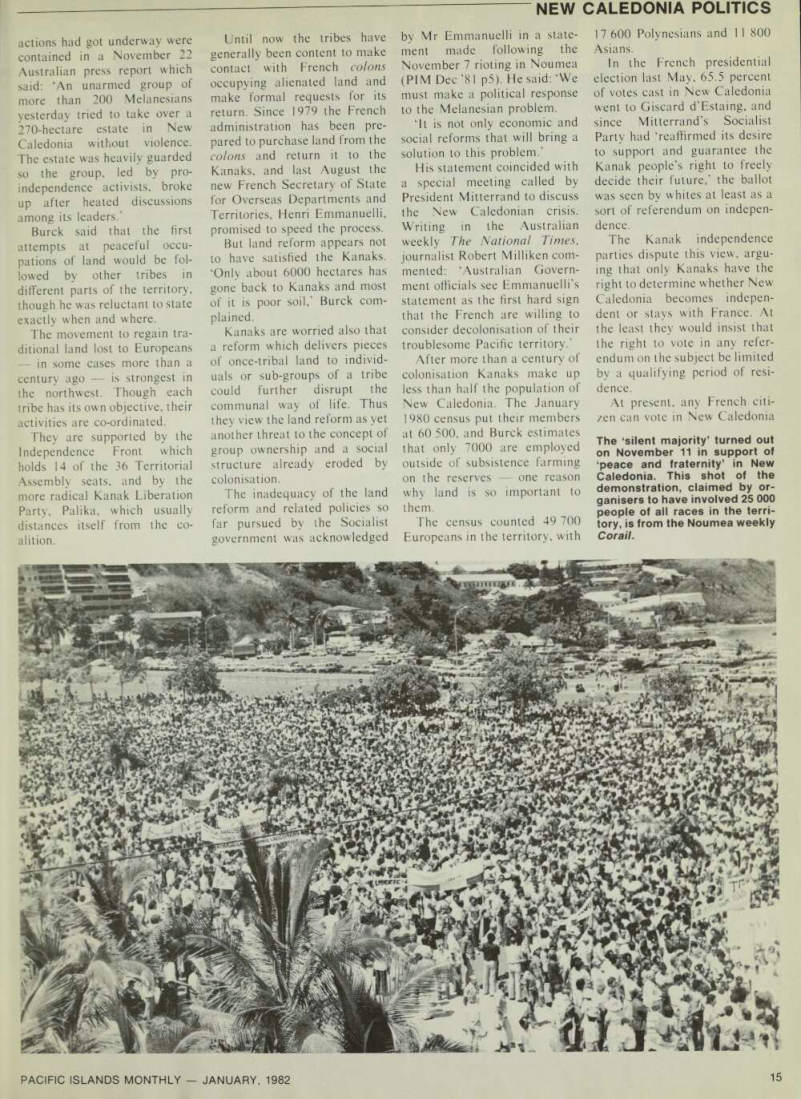
The ‘silent majority’ turned out on November 11 in support of peace and fraternity’ in New Caledonia. This shot of the demonstration, claimed by or ganisers to have involved 25 000 people of all races in the terri tory, is from the Noumea weekly Corail.
after three months' residence.
Asks Burck: ‘Who has the right to demand independence other than those who have been colonised? Who is entitled to land rights, other than those whose land has been stolen?’
The independence parties want legal title to all land to revert to the clans, to the ‘custom owners’. White farmers who accept Kanak indepen dence would be able to nego tiate leases if the clans wanted them to stay on (as is happening in newly independent, neigh bouring Vanuatu).
But such reassurances seem to be having little effect on the whites. The drive for Kanak independence has divided even those whites on the left of politics who are generally sym pathetic to Kanak aims.
Last October the Socialist Party of New Caledonia, kin to its namesake in France, split down the middle over the inde pendence question at a rowdy annual congress in Noumea (PIM Dec 'Bl p 5).
Delegates rejected by 219 votes to 181 a move to commit the party to ‘prepare for inde pendence’, and the losing fac tion announced its intention to form a new party.
A leader of the defeated group. Paris-trained economist Max Chivot, claimed his op ponents had ‘stacked’ the con gress by hurriedly enrolling new members, mainly people from the French island of Wallis who emigrated to New Caledonia seeking work in the nickel mines and refinery, and worry that
they would be expelled after independence. He said only a quarter of congress delegates were Kanaks.
Chivot’s convict ancestors settled in the north of New Caledonia in 1878, the year of the great Kanak revolt. At university in Paris Chivot was a classmate of Nidioshe Naisseline who leads the organ isation known as Liberation Kanake Socialiste (LKS), a member of the Independence Front.
Chivot worries that the forces of Kanak independence ‘tell us we are immigrants. We recog nise the Kanaks were the first inhabitants and that their land was stolen from them. But they must recognise too that people like myself are a part of the country'. ‘As for the Europeans, they must decide right now whether they are New Caledonian or French. If like me they choose the former they must side with the Kanaks and work for a peaceful transition to a multi racial independent state,’ he says.
Chivot complains that Kanak demands for land make no distinction between small farm ers and big landholders.
Chivot himself owns 100 hec tares of pasture ‘capable of supporting perhaps 50 cows'.
The neighbouring property of 30 000 hectares is owned by Jacques Lafleur, one of New Caledonia’s two deputies to the French parliament. ‘My land is not important to me,' he says, ‘but there are many settlers who rely on such relatively small parcels of land for their income. They won't give them up without a struggle.’
If the fiercely anti independence Noumea weekly Corail is to be believed, that struggle is already on in earnest.
Its issue of November 21 last, as well as carrying a full four pages of pictures of the big November 11 Noumea demon stration of the territory's ‘silent majority’ for ‘Caledonian Fra ternity,’ contained a savage editorial under the heading ‘The Criminal Adventure of the Union Caledonienne'.
The editorial depicts a ‘counter-power’ already estab lished in New Caledonia by the
UC following its Lifou con gress.
Referring to Jean-Marie Tjibaou’s TV appearance in which he proclaimed ‘the inde pendence of the regions' of New Caledonia, Corail wrote; ‘So, since November 14, each region (there are six or eight of them) is adrift in the euphoria of pre independence. Independence it self will be officially proclaimed on September 24 next. ‘Each region, according to Mr Tjibaou, has taken charge of its economic activities, and is to decide its future at the township level . . . ‘ln his Republik of Kanala, Mr Machoro lays down the law and nobody can say him nay.
The few remaining colons are “invited” to compulsory meet ings of the Land Reform Com mission. The “invitation” is signed by Karembeu, vice president of the Republik, who also happens to be the town's mayor. ‘Watch it. The situation has entered a dangerous skid. The Union Caledonienne is in the process of systematically divid
ing up New Caledonia. Al Canala today, in other places tomorrow. On Saturday there will be more occupations of land. Don’t let the authorities say they know nothing about it.
They have been warned.’
The French journalist Alain Rollat, writing in The Guardian Weekly, has described Canala as ‘the centre of the indepen dence movement that has mo bilised the Kanaks over recent years’.
He explains: ‘The Melan esian community of over 2000 in Canala is particularly politi cised because most local workers, who are almost all employed by the mining com pany, Societe Le Nickel, 30 kilometres to the north of Kouaoua, have long been trained in political militancy by their trade union . . .’
The emblem which has been adopted by the oldest political party in New Caledonia, the Union Caledonienne, the largest party in the increasingly active Independence Front.
Landholder Jacques Lafleur, prominent in New Caledonia land politics and now one of the territory’s two deputies to the French parliament. Sections of the Socialist Party in New Caledonia say the non-Kanak landholders must decide im mediately whether they are New Caledonian or French.