Merger for Fiji’s
p. 61 · Read in the full issue
shipbuilding Big Two?
Ships
Fiji’s two leading shipbuilding and engineering firms are inves tigating the possibilities of a merger.
The directors of Bish Ltd, and Carpenters Industrial, re vealed preliminary details in a joint statement released in Suva in October. Bish Ltd is jointly owned by Burns Philp and the UK-based Inchcape company.
The directors’ joint statement said that a strong shipbuilding, marine and general engineering industry could, in co-operation with the Fiji Government, form a vital part of the economy.
Tt could provide a powerful base for helping to improve social, economic and financial prosperity in Fiji,’ they said. ‘Over recent years there has been insufficient work available to enable both businesses to remain viable.’
The directors’ statement said it was hoped that the merger would lead to increased efficiency, which in turn would create a climate for expansion.
Fiji could become an important international ship repair and shipbuilding centre, they said.
Bish and Carpenters Indus trial Division have separate marine and general engineering complexes at Walu Bay in Suva.
Also concerned in the merger would be Burns Philp’s Wrought Iron and Steel Co Ltd of Suva, and a small engineer ing shop belonging to Carpenters in Lautoka.
Severe falls in recent profits from the Pacific operations of both Burns Philp and W. R.
Carpenter appear to have spurred the merger idea.
In the year to June 30, 1981, Burns Philp and Carpenter re ported large falls in profit from their Pacific activities down 69% and 53% respectively.
As part of the preparations for the merger, the two com panies will have talks with the Fiji Government over its ship building programme, which is now in an active phase.
The government-sponsored fishing company, Ika Corpor ation, recently placed orders
worth SF2 million with Fiji shipyards for five 22 m, 125-tonne tuna boats, the biggest order yet placed with local shipyards.
Keel of the first ship was laid at the government shipyard in November, with completion ex pected in four months.
The first ship will be used over a trial period of three months, and its performance will determine plans for the other four, which are to be built as a joint venture by the government and commercial shipyards.
Long live
Onma 111
Onma , an inter-island trading vessel well-known in Vanuatu waters, struck a reef off Bushmans Bay on the island of Malakula in September, and, salvage attempts having failed, broke up after a few weeks.
The 26 m, 71-tonne vessel was carrying 60 passengers, all
of whom were successfully taken off. She also had a near full cargo of beer, soft drinks and roofing iron, all bound for the Santo market.
Reece Discombe, appointed as marine surveyor by the insurers, QBE, reported, after an on-the-spot inspection, that all cargo had been lost to water damage.
Onma was owned by Issachar Dennis and Co, who were reportedly paid VT9 million (about SA9O 000) by QBE fol lowing her loss.
Company director Holling son Issachar told the Port-Vila weekly Voice of Vanuatu that the money would go towards buying a new ship, which had already been chosen. It was the Fiji-based Coral Princess , a wooden vessel which at 27 m is slightly larger than the Onma.
For her new role in Vanuatu, the vessel will be renamed Onma 11. She was expected to be in ser.vice by the end of November.
Seagoing bank
school
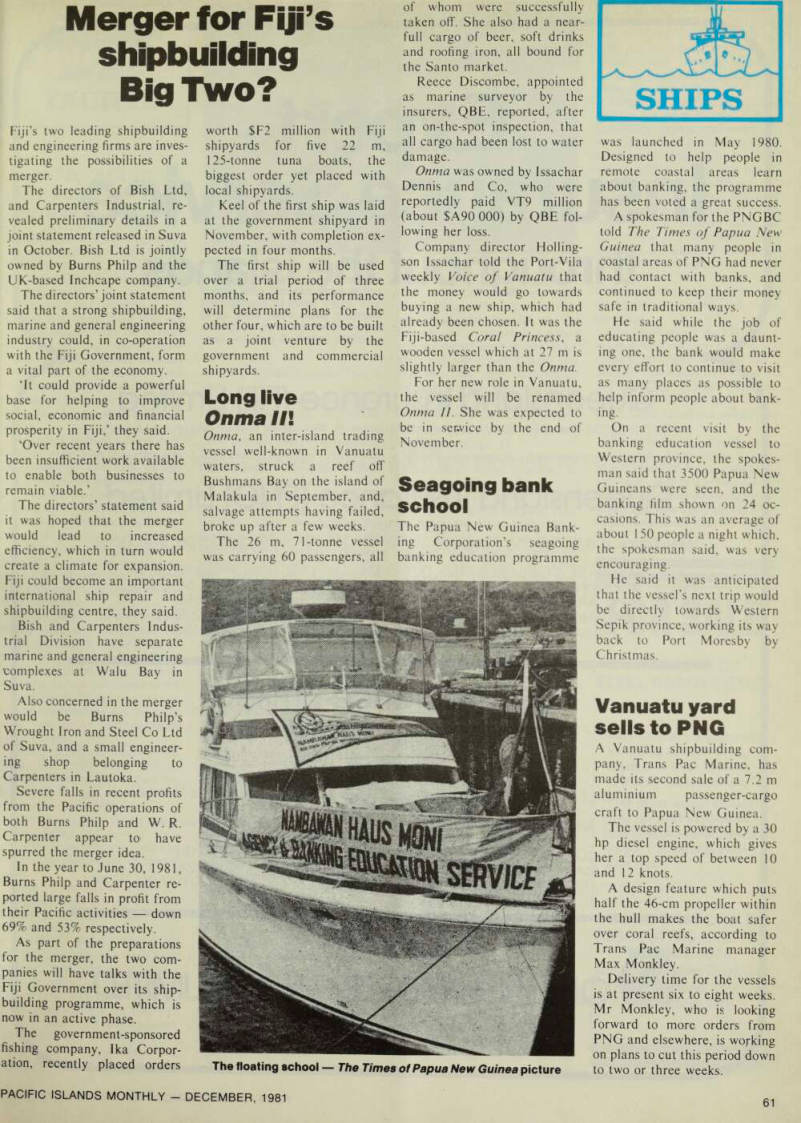
The Papua New Guinea Bank ing Corporation’s seagoing banking education programme
was launched in May 1980.
Designed to help people in remote coastal areas learn about banking, the programme has been voted a great success.
A spokesman for the PNGBC told The Times of Papua New Guinea that many people in coastal areas of PNG had never had contact with banks, and continued to keep their money safe in traditional ways.
He said while the job of educating people was a daunt ing one, the bank would make every effort to continue to visit as many places as possible to help inform people about bank ing.
On a recent visit by the banking education vessel to Western province, the spokes man said that 3500 Papua New Guineans were seen, and the banking film shown on 24 oc casions. This was an average of about 150 people a night which, the spokesman said, was very encouraging.
He said it was anticipated that the vessel’s next trip would be directly towards Western Sepik province, working its way back to Port Moresby by Christmas.
Vanuatu yard
sells to PNG
A Vanuatu shipbuilding com pany, Trans Pac Marine, has made its second sale of a 7.2 m aluminium passenger-cargo craft to Papua New Guinea.
The vessel is powered by a 30 hp diesel engine, which gives her a top speed of between 10 and 12 knots.
A design feature which puts half the 46-cm propeller within the hull makes the boat safer over coral reefs, according to Trans Pac Marine manager Max Monkley.
Delivery time for the vessels is at present six to eight weeks.
Mr Monkley, who is looking forward to more orders from PNG and elsewhere, is working on plans to cut this period down to two or three weeks.
The floating school - The Times of Papua New Guinea picture