trade with Chile
pp. 58-59 · Read in the full issue
Poll issue in N.Z. union ban on trade with Chile
Trade
Winds
New Zealand’s trade with Chile or the lack of it emerged as a hot issue in the run-up to the country’s November 28 general election.
With a deficit of SNZB43 million in its overseas exchange transactions for the year ending in September, and foreign exchange reserves down to $5OO million, the country is in desper ate straits for new and expand ing markets for its food, paper and manufactured exports.
But in this respect the national trade union body, the Federation of Labour, was prov ing a kingsize fly in the oint ment: its ban on all trade with Chile stymied a trading re lationship which New Zealand authorities reckoned could be bringing $l5O million annually into the country. The FOL was refusing to budge on the ban in spite of the fact that a good number of other countries, in cluding some communist countries, are trading actively with Chile.
Stubborn adherence to the ban has placed FOL President Jim Knox at odds even with his traditional allies in the Oppo sition Labour Party, which had promised electors that the ban would be lifted before mid-1982 if Labour were elected. Not so, said Mr Knox, adding that he would continue to oppose the ‘fascist Pinochet regime’ until it restores the rights of Chilean trade unions, and frees political prisoners from its gaols. For good measure he took a sideswipe at politicans who ‘make statements about FOL policy without consulting it first’. He said: ‘As MPs they should have more brains than to come out with statements like this.’
Summing up, New Zealand journalist lan Templeton wrote in the Sydney magazine The Bulletin on November 24: ‘lf the trade ban has hurt New Zealand more than it has Chile, the issue that disturbs many New Zealanders is that foreign policy is being decided in this instance not in parliament but in the trades hall. The ban also
underlines the monopoly power of the union movement. Both these anxieties extend across the spectrum of voting opinion and some political observers believe they are the real “sleepers” of the election cam paign. ‘The Prime Minister, Robert Muldoon, has sought to exploit them by questioning the re lationship between the Labour Party and the FOL, which, he says, is falling into the hands of the extreme Left. “You’ve got Ken Douglas (secretary of the FOL and a leading figure of the Moscow-aligned Socialist Unity Party) down there, making the ammunition for poor old Jim Knox to fire,” he told one election meeting.’
While the Chile trade issue was moving centre-stage in New Zealand politics, lower-key efforts have been under way in Australia to end the eight-year, union-imposed freeze on trade with that country. A shipping company planned to launch a Sydney-Valparaiso service in November, but at press time it was still unclear whether their efforts would be successful (see Pacific Report).
Australia’s Deputy Prime Minister Doug Anthony, in a recent speech in parliament, warmly praised the initiative.
His fulsome lauding of the Chilean Government’s econ omic successes, and of the confidence it was now inspiring in foreign investors, even brought a smile to the normally austere face of Australian Prime Minister Malcolm Fraser.
PNG: Fiddling
with grants
Papua New Guinea’s Chief Ombudsman Ignatius Kilage did some plain speaking in November when he charged that some senior politicians and public servants in PNG think government grant programmes are for their personal benefit.
In his annual report for the Ombudsman Commission, he revealed that he had used his
power to stop cheques being issued under one government scheme. He had done so be cause the commission’s investi gations had revealed that in two instances the grants were for the purchase of Land Rovers for MPs. A third involved a grant to help the MPs’ business company purchase assets of another company.
Mr Kilage recommended, as part of the way out of the problem, higher pay for MPs and senior public servants, say ing: ‘The situation in PNG is that only expatriates get real wages. Nationals get a grossly disproportionate amount .. .
We wish also to point out that our leaders become susceptible to temptation when there is no parity between their income and the standard of living expected of them.’
The chief ombudsman also had a word or two about the business activities of PNG’s provincial governments. Said he: ‘ln some provinces the people who run the govern ment’s business arms are using them for their own selfish ends.’
In the same week that saw publication of his report, the West Sepik provincial govern ment’s business arm, Wesdeco, went into oblivion, owing more than SAI.3 million. Observers of the PNG scene say it’s unlikely to be the last.
Bumper citrus
crop in Cooks
The Cook Islands’ total citrus harvest in 1981 was 2671 tonnes, up almost 100% on the 1980 harvest of 1436 tonnes.
Rarotonga had the biggest harvest, taking in 2485 tonnes, of which 126 tonnes were ex ported as fresh fruit, with the rest being processed by Kia Orana Foods Factory.
Total fruit received from the Outer Islands was 186 tonnes, down 56 tonnes as compared with last year. The decrease was attributed to shipping prob lems, domestic consumption, and a severe drought during the early cropping season.
Karlil Valji, Kia Orana man ager, said his company and the government, through price sup port, had this year paid citrus farmers a total of $354 340 for their products. The actual value of processed fruit juice for the year had been $B2O 000.
Vanuatu’s
buttons
Vanuatu has become the first developing country to produce mother-of-pearl buttons from trochus shells, which abound in its coastal waters, for export to fashion markets in the West.
The French sportswear manu facturer, Lacoste, is expected to buy more than two million of the buttons. The Times of Papua New Guinea.
Air Pacific’s
737-200 Air Pacific took delivery of a new Boeing 737-200 jet on October 31, 1981 in another major step into the world of modern jet aviation.
The company, then known as Fiji Airways, was established in 1951 with an eight-seater Rapide. Three years later i Drovers began taking over. As the domestic airline grew Doves and Herons were added, \ Then came DHC-2 Beaver am- ( phibious aircraft for the outly ing islands.
DC3s appeared in 1965 on aj ‘wet lease’ arrangement, and the first Hawker Siddeley 748 ■ was purchased in 1967. Thus Fiji Airways became a regional airline, and to denote its re-1 gional character, the name Fiji!
Airways was changed to Air Pacific in 1971.
As the demands for regional] services grew Air Pacific pur-1 chased its first BACI-11 in] 1972. By 1978 Air Pacific had in its fleet three BACI-lls and] four Bandeirantes.
The airline is now operating] flights to Tahiti, Solomon!
Islands, New Caledonia, Vanuatu, Tonga, Kiribati, and 1 Western and American Samoa. ] It also has regular services tol Australia and New Zealand.
With the addition of the new I Boeing 737-200 Air Pacific has I the capability and flexibility to I provide more services, and more 1 freight and passenger capacity, I than ever before.
New resort
for Naisali
Construction of a multi-million dollar island resort, the biggest hotel complex in Fiji, will begin in February, 1982. The develop ment, which aims at trans forming Naisali Island, 16 kilo metres from Nadi international airport, into a lush tropical resort, is expected to be com pleted by July 1983.
Over SF3 million is expected to be invested in developing the resort which when completed will contain 375 suites and 105 villas. Other facilities will in clude an all-weather bowling green, squash and racket-ball courts, six tennis courts with lighting, and a volleyball court.
A golf course will be developed later.
Sonaisali Island Ltd, a local company formed by a
Californian parternship,
Naisali Island Development, has been granted a 99-year lease by the Fijian landowners ander the guidance of the Native Lands Trust Board.
Architectural plans have been irawn up by Frank Holtom of ocally based firm Larsen rJoltom and Maybir.
Completion of this island esort will bring total room capacity of the Fiji tourist nduslry to over the 5000 mark.
N.Z. ewes
For Fiji
fhe Fijian Government has >oughl 50 Wiltshire sheep from 'Jew Zealand in the hope of >oosting sheep meat pro luction. The ewes will be mated vith Barbados Blackbellies, one •f the few species of sheep that ireed successfully in the ropics.
Efforts to raise flocks from onventional breeds have failed •ecause there is insufficient hange in the climate between ummer and autumn to trigger wes to ovulation. However, flackbellies are poor meat pro ucers and the Fijian Govern icnt hopes the infusion of the Wiltshire strain will produce lore meat.
The ewes, which come from he only flock of the breed in Jew Zealand, were to be flown ) Fiji in November.
Vi I ham Gasson in Wellington.
Tight situation
looms for PNG
Papua New Guinea’s financial foundations are sound but its unemployment problem is serious and getting worse and the country is chronically short of skilled workers and tradesmen. These were some of the major comments which emerged from a recent confer ence on post-independence economic development. The conference, held in Port Moresby, was described as an ‘ideas workshop’, and drew con tributions from government, the public service, private enter prise, the workforce and re search organisations. The talks were sponsored by the Institute for Applied Social and Econ omic Research.
The strong message which emerged from the talks was that PNG faces a tough financial road despite its proven re sources and despite the outward success of its attempts to de velop financial self-reliance.
The executive director of the PNG Employers Federation, Mr M. Wells, told the confer ence that the shortage of skilled workers was so great that a big spiral of wage demands and wage increases was looming.
The National Planning and Development Minister, Mr Kwarara, told the conference that by 1986 an estimated 1.4 million people would be unable to obtain work if present trends continued. Some representa tives at the talks claimed there was a contradiction between the
predictions given by Mr Wells and by Mr Kwarara. It was argued however that a serious situation of general unemploy ment could exist side by side with a shortage of highly-skilled tradesmen.
The conference was opened by the Prime Minister, Sir Julius Chan, who said that PNG had entered independence as ‘a very vulnerable com munity in economic terms’.
Since then, however, there had been a number of achievements which had stabilised the econ omy. These included fixing gov ernment expenditure at a level which could be sustained, nego tiating two five-year aid agree ments with Australia, stabilis ing minimum wage levels on a three-year basis, extending stabilisation schemes for agri cultural and mineral. products, and pursuing a rational and successful currency policy.
The PNG budget for 1982 was tabled in the National Parliament on November 3 and it reflected the tightening econ omy. The total expenditure is estimated at K 751.3 million, which is an increase of about 10% over the previous year, but in real terms because of inflation it reflects a static situation. The budget papers disclosed that PNG overspent K 18.6 on its estimate for last year.
New measures to raise rev enue increase the price of tele phone calls, petroleum fuels, beer, cigarettes, jewellery, cam eras and motor vehicles.
In an incentive for export industries the government has exempted export growth profits from company tax. The govern ment has attempted to increase security in the plantation indus try by allowing the transfer of leases between non-citizens and by re-issuing leases which existed before independence.
The Finance Minister, Mr Kaputin, said this move was not meant as a free and unrestricted guarantee of security to non citizen planters, but was de signed to stabilise the position of non-citizens who were pre pared to stay and work in the interests of national develop ment. A number of redevelop ment conditions will be applied to the ongoing leases.
Loss reported
by Fiji mine
Emperor Mines Ltd of Fiji went from a profit to a loss situation in the financial year to June 30, and is not paying a dividend.
The company’s profit in 1979-80 was $1.52 million, and the loss for 1980-81 was $2.67 million.
Gold prices for the year averaged below the budgeted figure, but a major factor in the loss was put down to a high level of development work connected with future operations.
The directors reported that the degree of development work was expected to significantly raise gold production during the current year, and thus lift the company’s operations.
The mine’s yield for the year under review was 802 855 grams of gold and 194 752 grams of silver. This compared with the previous year’s yield of 857 104 grams of gold and 187 882 grams of silver. Taken in relation to market prices this gave a 10 percent fall in the value of production.
In a subsequent report, issued in November, the mine direc tors said there was already evidence that the development expenditure was proving its worth. Gold and silver extrac tions had both increased significantly in the latest quar terly figures, the report said.
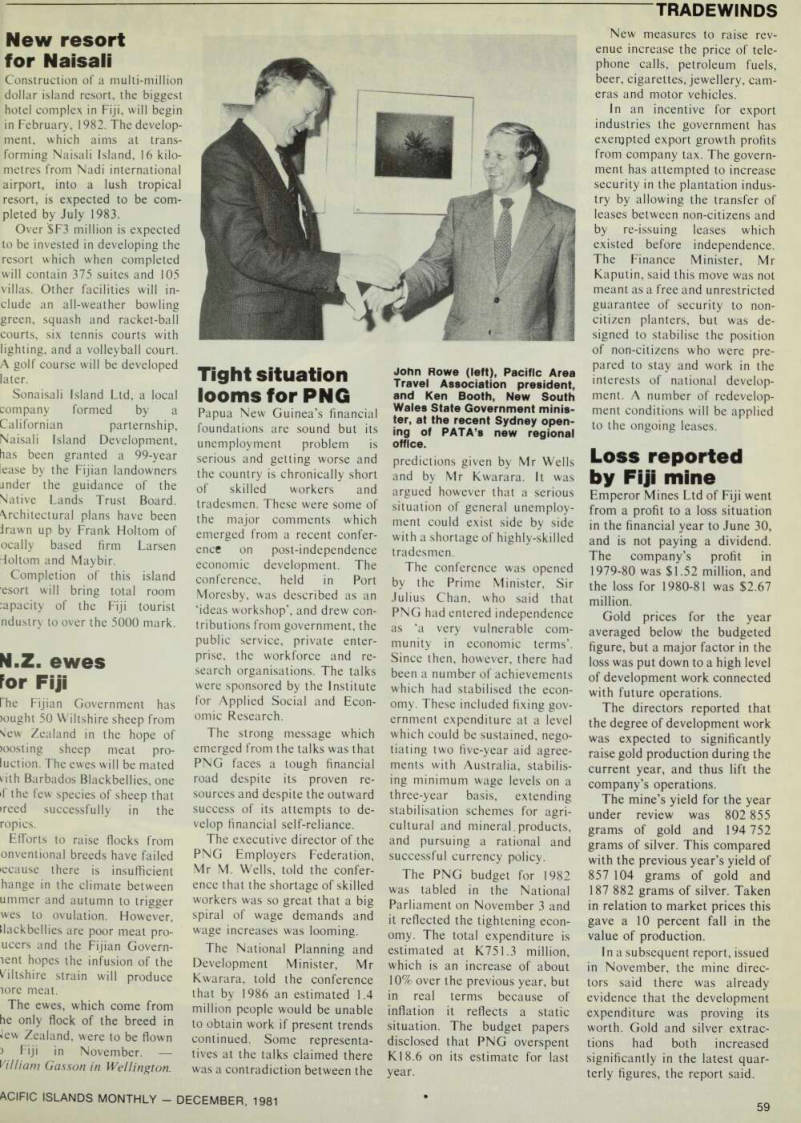
John Rowe (left), Pacific Area Travel Association president, and Ken Booth, New South Wales State Government minis ter, at the recent Sydney open ing of PATA’s new regional office.