learning for tourism planners
pp. 51-55 · Read in the full issue
Isle of Pines, a charming seat of learning for tourism planners
Travel
PIM Associate Editor MALCOLM SALMON concludes his two-part series on a week-long visit to New Caledonia in September during which he visited with his family several day-trip tourist destinations available from Noumea, and studied the prospects and problems facing the territory’s ambitious tourism development plan. The first article appeared last month (PIM Nov p 53).
Just before I went to New Caledonia in September I re ceived a letter from a friend in Paris enclosing a copy of a magazine article he’d written on this French territory which he, by coincidence, had himself just visited. In his article he described the sand on the beaches of New Caledonia’s Isle of Pines as having ‘the texture of flour’.
He wasn’t exaggerating.
Walking barefoot on the beaches of that island is sheer sensuous delight. The quality of the sand is understandably a major talking point with tourist industry people in Noumea when they discuss the Isle of Pines.
But there’s much more than some remarkable sand to the story of this island. A 30-minute flight to the south of Noumea, the Isle of Pines is roughly 45 km around. It is home to eight Melanesian tribes, numbering in all about 3000 people. They are known as Kunie, which is also the local name for the island.
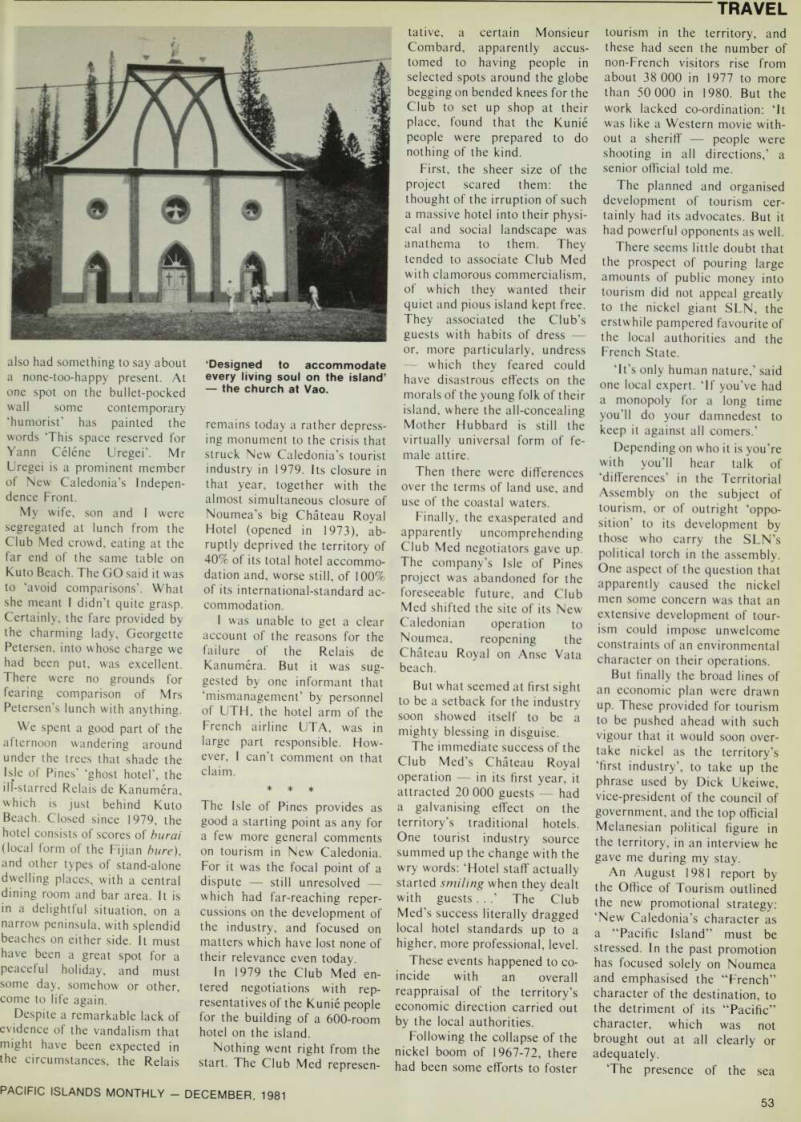
On a bus tour before lunch on our day there, together with a group day-tripping from the Club Mediterranee in Noumea, we visited the island’s ‘capital’ of Vao. This liny, pleasant settlement is dominated by a Roman Catholic church which
was designed, it is said, to accommodate every living soul on the island. Gazing into its cavernous interior, one could easily believe it.
The Isle of Pines seems to be very much a Roman Catholic fiefdom, much more so than many other areas in New Caledonia. It is somehow not surprising that the vote for the pro-independence parties is relatively lower there than in the territory’s other all- Melanesian constituencies.
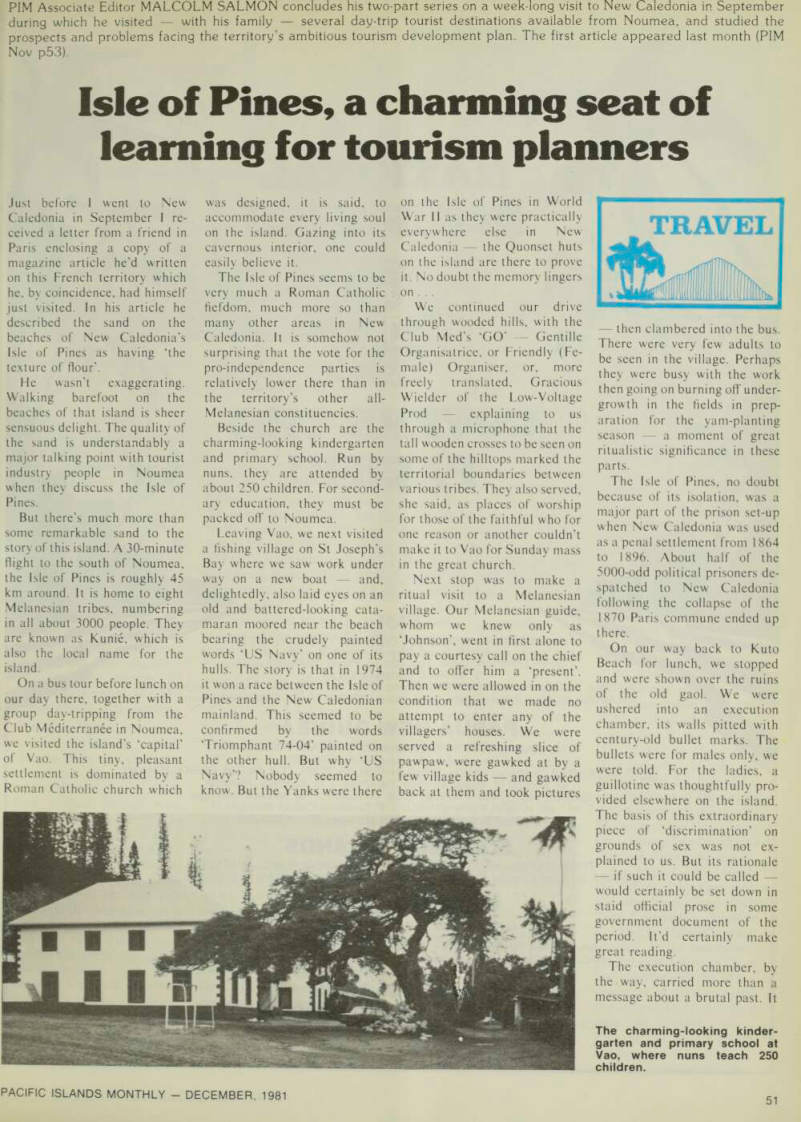
Beside the church are the charming-looking kindergarten and primary school. Run by nuns, they are attended by about 250 children. For second ary education, they must be packed off to Noumea.
Leaving Vao, we next visited a fishing village on St Joseph’s Bay where we saw work under way on a new boat and, delightedly, also laid eyes on an old and battered-looking cata maran moored near the beach bearing the crudely painted words ‘US Navy’ on one of its hulls. The story is that in 1974 it won a race between the Isle of Pines and the New Caledonian mainland. This seemed to be confirmed by the words ‘Triomphant 74-04’ painted on the other hull. But why ‘US Navy’? Nobody seemed to know. But the Yanks were there
on the Isle of Pines in World War II as they were practically everywhere else in New Caledonia the Quonset huts on the island are there to prove it. No doubt the memory lingers on . . .
We continued our drive through wooded hills, with the Club Med’s ‘GO’ Gentille Organisatrice, or Friendly (Fe male) Organiser, or, more freely translated. Gracious Wielder of the Low-Voltage Prod explaining to us through a microphone that the tall wooden crosses to be seen on some of the hilltops marked the territorial boundaries between various tribes. They also served, she said, as places of worship for those of the faithful who for one reason or another couldn’t make it to Vao for Sunday mass in the great church.
Next stop was to make a ritual visit to a Melanesian village. Our Melanesian guide, whom we knew only as ‘Johnson’, went in first alone to pay a courtesy call on the chief and to offer him a ‘present’.
Then we were allowed in on the condition that we made no attempt to enter any of the villagers’ houses. We were served a refreshing slice of pawpaw, were gawked at by a few village kids and gawked back at them and took pictures
then clambered into the bus.
There were very few adults to be seen in the village. Perhaps they were busy with the work then going on burning off under growth in the fields in prep aration for the yam-planting season a moment of great ritualistic significance in these parts.
The Isle of Pines, no doubt because of its isolation, was a major part of the prison set-up when New Caledonia was used as a penal settlement from 1864 to 1896. About half of the 5000-odd political prisoners de spatched to New Caledonia following the collapse of the 1870 Paris commune ended up there.
On our way back to Kuto Beach for lunch, we stopped and were shown over the ruins of the old gaol. We were ushered into an execution chamber, its walls pitted with century-old bullet marks. The bullets were for males only, we were told. For the ladies, a guillotine was thoughtfully pro vided elsewhere on the island.
The basis of this extraordinary piece of ‘discrimination’ on grounds of sex was not ex plained to us. But its rationale if such it could be called would certainly be set down in staid official prose in some government document of the period. It’d certainly make great reading.
The execution chamber, by the way, carried more than a message about a brutal past. It
The charming-looking kinder garten and primary school at Vao, where nuns teach 250 children.
also had something to say about a none-too-happy present. At one spot on the bullet-pocked wall some contemporary ‘humorist’ has painted the words ‘This space reserved for Yann Celene Uregei’. Mr Uregei is a prominent member of New Caledonia’s Indepen dence Front.
My wife, son and I were segregated at lunch from the Club Med crowd, eating at the far end of the same table on Kuto Beach. The GO said it was to ‘avoid comparisons’. What she meant I didn’t quite grasp.
Certainly, the fare provided by the charming lady, Georgette Petersen, into whose charge we had been put, was excellent.
There were no grounds for fearing comparison of Mrs Petersen’s lunch with anything.
We spent a good part of the afternoon wandering around under the trees that shade the Isje of Pines’ ‘ghost hotel’, the ill-starred Relais de Kanumera, which is just behind Kuto Beach. Closed since 1979, the hotel consists of scores of burai (local form of the Fijian bare), and other types of stand-alone dwelling places, with a central dining room and bar area. It is in a delightful situation, on a narrow peninsula, with splendid beaches on either side. It must have been a great spot for a peaceful holiday, and must some day, somehow or other, come to life again.
Despite a remarkable lack of evidence of the vandalism that might have been expected in the circumstances, the Relais
remains today a rather depress ing monument to the crisis that struck New Caledonia’s tourist industry in 1979. Its closure in that year, together with the almost simultaneous closure of Noumea’s big Chateau Royal Hotel (opened in 1973), ab ruptly deprived the territory of 40% of its total hotel accommo dation and, worse still, of 100% of its international-standard ac commodation.
I was unable to get a clear account of the reasons for the failure of the Relais de Kanumera. But it was sug gested by one informant that ‘mismanagement’ by personnel of UTH, the hotel arm of the French airline UTA, was in large part responsible. How ever, I can’t comment on that claim.
The Isle of Pines provides as good a starting point as any for a few more general comments on tourism in New Caledonia.
For it was the focal point of a dispute still unresolved which had far-reaching reper cussions on the development of the industry, and focused on matters which have lost none of their relevance even today.
In 1979 the Club Med en tered negotiations with rep resentatives of the Kunie people for the building of a 600-room hotel on the island.
Nothing went right from the start. The Club Med represen
tative, a certain Monsieur Combard, apparently accus tomed to having people in selected spots around the globe begging on bended knees for the Club to set up shop at their place, found that the Kunie people were prepared to do nothing of the kind.
First, the sheer size of the project scared them: the thought of the irruption of such a massive hotel into their physi cal and social landscape was anathema to them. They tended to associate Club Med with clamorous commercialism, of which they wanted their quiet and pious island kept free.
They associated the Club’s guests with habits of dress or, more particularly, undress - which they feared could have disastrous effects on the morals of the young folk of their island, where the all-concealing Mother Hubbard is still the virtually universal form of fe male attire.
Then there were differences over the terms of land use, and use of the coastal waters.
Finally, the exasperated and apparently uncomprehending Club Med negotiators gave up.
The company’s Isle of Pines project was abandoned for the foreseeable future, and Club Med shifted the site of its New Caledonian operation to Noumea, reopening the Chateau Royal on Anse Vata beach.
But what seemed at first sight to be a setback for the industry soon showed itself to be a mighty blessing in disguise.
The immediate success of the Club Med’s Chateau Royal operation in its first year, it attracted 20 000 guests had a galvanising effect on the territory’s traditional hotels.
One tourist industry source summed up the change with the wry words: ‘Hotel staff actually started smiling when they dealt with guests.. .’ The Club Med’s success literally dragged local hotel standards up to a higher, more professional, level.
These events happened to co incide with an overall reappraisal of the territory’s economic direction carried out by the local authorities.
Following the collapse of the nickel boom of 1967-72, there had been some efforts to foster
tourism in the territory, and these had seen the number of non-French visitors rise from about 38 000 in 1977 to more than 50 000 in 1980. But the work lacked co-ordination: ‘lt was like a Western movie with out a sheriff people were shooting in all directions,’ a senior official told me.
The planned and organised development of tourism cer tainly had its advocates. But it had powerful opponents as well.
There seems little doubt that the prospect of pouring large amounts of public money into tourism did not appeal greatly to the nickel giant SLN, the erstwhile pampered favourite of the local authorities and the French State. ‘lt’s only human nature,’ said one local expert. ‘lf you’ve had a monopoly for a long time you’ll do your damnedest to keep it against all comers.’
Depending on who it is you’re with you’ll hear talk of ‘differences’ in the Territorial Assembly on the subject of tourism, or of outright ‘oppo sition’ to its development by those who carry the SLN’s political torch in the assembly.
One aspect of the question that apparently caused the nickel men some concern was that an extensive development of tour ism could impose unwelcome constraints of an environmental character on their operations.
But finally the broad lines of an economic plan were drawn up. These provided for tourism to be pushed ahead with such vigour that it would soon over take nickel as the territory’s ‘first industry’, to take up the phrase used by Dick Ukeiwe, vice-president of the council of government, and the top official Melanesian political figure in the territory, in an interview he gave me during my stay.
An August 1981 report by the Office of Tourism outlined the new promotional strategy: ‘New Caledonia’s character as a “Pacific Island” must be stressed. In the past promotion has focused solely on Noumea and emphasised the “French” character of the destination, to the detriment of its “Pacific” character, which was not brought out at all clearly or
adequately.
‘The presence of the sea
‘Designed to accommodate every living soul on the island’ -the church at Vao.
naturally defines New Caledonia. What is required, therefore, is that promotional themes and slogans should be reversed so that New Caledonia becomes “A wonderful Pacific Island with the bonus of a French atmosphere”. ‘To this seaside holiday con cept we must add the promise of discovery of the various natural environments to be found in the territory. The importance of building hotel accommodation, whether in Noumea, in the interior, or in the islands, can thus be clearly seen. This work must be given very high pri ority . ..’
As can be seen, a key part of the plan is the strong develop ment of tourist facilities in the New Caledonian interior, and the offshore islands princi pally the main islands of the Loyalty group off the east coast, Lifou, Ouvea and Mare. ‘Noumea alone is not an adequate Pacific destination,’ said Stanley Camerlynck, the member of the council of gov ernment responsible for tour ism. He told me: ‘What we see as an ideal week’s holiday in the territory would be three days in Noumea, and four either in the interior or the islands.’
This new thrust of New Caledonian tourist policy inevi tably poses the problem of developing the meagre existing 'acilities outside Noumea md that in turn necessarily mtails doing so in a Melanesian mvironment.
Mr Camerlynck, as a veteran )f the epic Battle of the Isle of J ines, is keenly aware of the )roblems. ‘There can be no atisfactory tourist develop nent without trust on both ides. Tourists will go to a given pot for a few days. To meet heir needs we will have to move n and do things, build things, in laces where the local /lelanesian people spend their ntire lives. What we do, what 'e build, simply has to be cceptable to them.’
Mr Camerlynck said the gov rnment was preparing a code f investment designed to in olve Melanesians as joint ntrepreneurs with the govern lent in tourist accommodation rojects. ‘We hope that nancial rewards, and the re ilting benefits to the local
communities will gradually make tourism and, of course, tourists acceptable and even welcome. ‘What we do just has to be acceptable to the local com munity. That must be our first and golden rule.’
Mr Camerlynck and two rep resentatives of the Kunie from the Isle of Pines visited Fiji last year to study ways in which these problems have been tackled in the context of that country’s much more developed tourist trade. Mr Camerlynck says the trip was well worth while and that he and his Kunie companions had learned much that could be of value in the New Caledonian situation.
1 returned to Australia on September 9. Ten days later Pierre Declercq, secretary general of the pro-independence party Union Caledonienne, was assassinated in Noumea.
I met Mr Camerlynck again in Sydney early in October. He had come for the opening in that city of the new South Pacific regional office of the Pacific Area Travel Association and also to talk to the Downs family, residents of Sydney who, in the disturbances follow ing Declercq’s murder, had been held hostage by rebellious Melanesians at Canala while they were holidaying on New Caledonia’s east coast. Mr Camerlynck was to offer them recompense in the form of a
further week’s holiday in the territory at the expense of the New Caledonian authorities.
His offer was accepted.
He told me: ‘lf our tourist trade is to grow at all, we simply must be able to offer visitors a safe destination. My party, the Federation pour une Nouvelle Societe Caledonienne (FNSC), is working hard for the political changes required to achieve this end.’(The FNSC is more or less the Centre party in New Caledonian politics. It operates as part of the majority in the Territorial Assembly, but differs on many matters from its coalition partners to the Right of it. While stopping short of advocating independence, it seeks a much broader autonomy for New Caledonia, favours more rights for the Melanesian community, and supports the introduction of income tax. It has seven members in the as sembly and two (one of them Stanley Camerlynck) members of the council of government. It also sends New Caledonia’s only senator, Lionel Cherrier, to represent the terri tory in the French Senate in Paris.) New Caledonia certainly has a lot going for it in terms of tourism. What my wife, son and I saw in Noumea (its marvel lous aquarium alone would almost justify a visit), on Turtle Island, Amedee Island, and the Isle of Pines, is proof enough of that. We did not visit the east coast so did not see its tropical forests and waterfalls. But that highly seasoned and revered
Australian observer, David McNicoll, from the Sydney magazine The Bulletin , who preceded us by a few weeks in New Caledonia, has assured his readers that the east coast is ‘sheer magic’. Then there are the islands, especially the Loy alty Islands, which have great appeal, especially for those keen to learn more about tra ditional Melanesian society.
The new tourism develop ment strategy seems very soundly based. The main ques tion is: can it be applied in such a way in the various Melanesian environments as to help the kind of political change towards greater self-rule which is the over-arching condition for the success of the tourist plan or for any other plan that may be undertaken in today’s New Caledonia? Then there is a further question; will the new French Government view the territory’s tourism development ambitions with as favourable an eye as the old? Certain com ments by the new man in charge of the problems of ‘overseas France’, Henri Emmanuelli, about the ‘bloated tertiary sec tor’ of New Caledonia’s econ omy must give rise to some doubt on this score.
But if hard work is any criterion, the devoted team who are working to develop New
Caledonia’s tourism Mr Camerlynck himself. Director of the Office of Tourism Michael Doppler, the talented young Melanesian Emile Wabete (who served us on our visit as guide, philosopher and friend), the tourist office’s ac tive Sydney representative Jacques Saint, and a good number of others certainly deserve to succeed.
The ruined gaol which held political prisoners from France.
Emile Wabete