Yachts
pp. 63-67 · Read in the full issue
Joan D. Pease Re
ports from Pago Pago,
American Samoa:
• SANDCASTLE. The Pago Pago cruising community was sad to hear of the destruction of this 9.4 m trimaran on the island of Savaii in Western Samoa.
The vessel was owned by David Albinus who spent more than six years building it. When the tri went up on the reef, Dave and his crew Linda Horn were sailing between Savaii and Upolu Islands in the Apolima Strait heading to Tonga, and eventually New Zealand, where they planned to spend the hurricane season.
According to Dave it was a dark moonless night with little wind and poor visibility. The light on the island of Apolima was not function ing. When the wind got up, Dave dropped the mainsail and was on the foredeck dropping the genoa when he saw the reef. ‘I wake up at night reliving that moment,’ he said. At the time of impact, the tide was low. ‘ln a high tide we wouldn’t have gone on the reef,’ Dave said.
Feeling the hull could be saved if it were taken off the reef before too much pounding, he made a call on the ham radio and talked with hams in Solomon Islands, New Zealand, Australia and the west coast of the United States. By the time the tug arrived the following day the hulls were still afloat, but damaged
beyond repair.
With the help of local people Dave and Linda were able to remove all their belongings from the boat and salvage most of the
removable equipment.
‘They let us stay at the police station during the salvage oper ition. We moved the ship’s stove in md ate from our supply of canned »oods.’
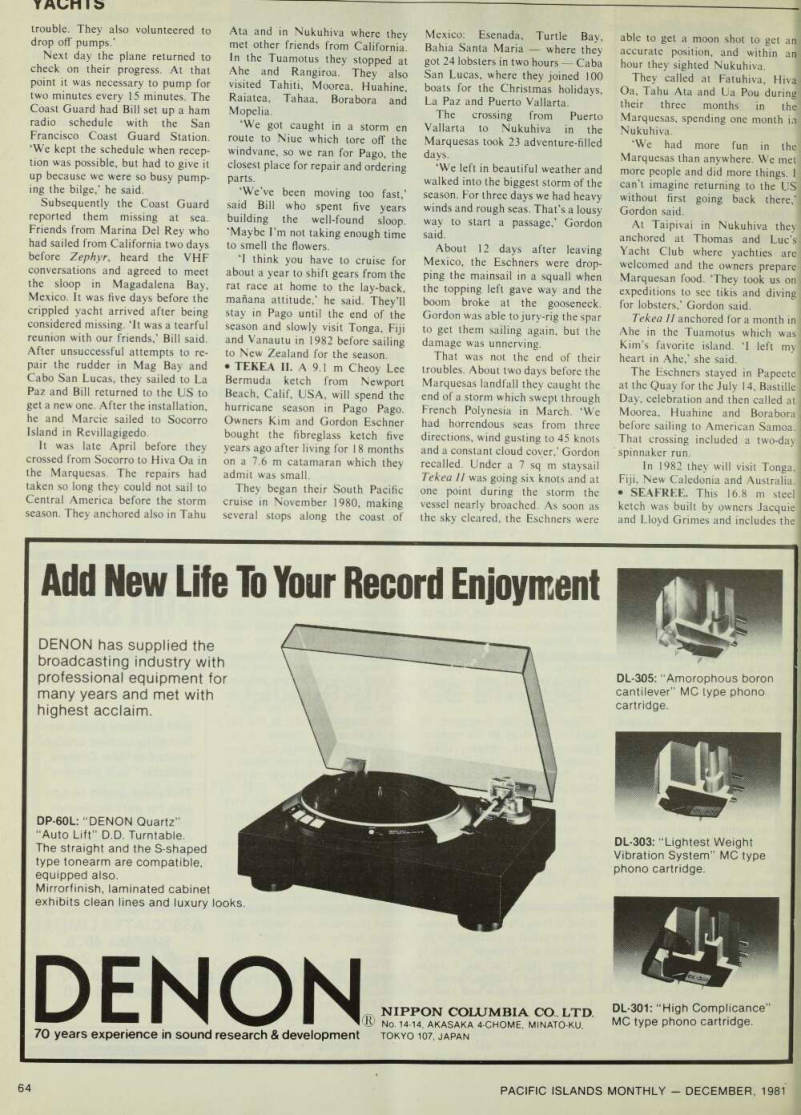
Since he was able to remove all he rigging, sails and most of the ;quipment, Dave may yet build mother trimaran. ► CANAAN ROSE. When this 10.9 m sloop arrived in Pago Pago larbour, three beautiful blondes vere standing on the foredeck ;miling and waving to yachties. fhese girls, who win the hearts of
weryone they meet, are four-year
)ld Michele and six-year-old twins lennifer and Amy who have been ailing with their parents Martha
and Mike Carter for more than a year.
The family moved aboard the vessel in Alameda, California, USA, after its purchase in April, 1980, and left from San Francisco Bay that November with the Carters’ nephew Steve also aboard.
Their trip took them down the coast of California with stops in Santa Barbara, Santa Cruz Island, Catalina, Long Beach, Cabrillo Beach and San Diego. They went about 160 km offshore for the leg to Cabo San Lucas, Mexico, an eight day trip which included a Christmas Day celebration. ‘The girls put out food for Santa near the Christmas tree,’ Martha explained. ‘And next morning there were presents waiting for them.’ On the same day they saw their first porpoises of the trip. ‘They put on a beautiful show and were so close to the boat we could almost touch them,’ she said.
From Cabo the sloop went to Sayulita, a village 40 km north of Puerto Vallarta, where Mike’s parents live for six months of the year. They also anchored at Yelapa, Zihautanejo, Las Hadas, Manza nillo and the Yacht Club at Acapulco. There the girls, who were all born in March, had a joint birthday party complete with a traditional Mexican pinata, a brightly decorated box filled with gifts. Theirs was in the shape of a rose.
From Mexico Canaan Rose sailed to Hiva Oa in the Marquesas and then called at anchorage in the Tuamotus and Societies. While in Borabora they received a radio request from a yacht on Mopelia to bring tobacco, papers and rice for the residents on the island. ‘When we arrived Calami, the chief, came roaring across the field in a new Kawasaki,’ Martha said.
The time they spent on the small
atoll was one of the highlights of their trip. There are only nine people living on Mopelia, and they were kind and friendly to the Carters and a couple in another cruising yacht travelling with them.
Mike cut copra with Calami one day and they went spearfishing together. ‘The day we left they gave each of us a beautiful handmade head-dress with beautiful feathers, and I had tears in my eyes,’ said Martha.
Before arriving in American Samoa, the sloop stopped in Aitutaki and Vavau in Tonga. ‘This trip has been a good geography lesson for the girls. They can trace the entire cruise on a globe,’ Martha said. For Equator Day the family had a celebration where Mike served as King Neptune. A circular cake was decorated to represent the world showing zero degrees latitude and the hemispheres. Michele was named ‘Miss Equator’ and the twins were Northern Hemisphere and
Southern Hemisphere.
You spend a lot more time with children when you’re on a passage, and it gives them much more time to be with Daddy,’ Martha said.
She commented that at this age the children are content to go anywhere. ‘They really don’t care because they have each other. It might be more difficult with an only child,’ she said. ‘lt’s nice when families with children can buddy-boat because it gives the parents a break and children can learn to get along with others,’ she said.
The Carters do not keep a lot of toys aboard for the children. In stead they stress reading and writ ing. Each girl has a log in which she draws pictures of their experiences.
As a family they enjoy shell
collecting.
While in Pago Pago the twins are enrolled in school, their first formal education. • ZEPHYR, An 11.6 m fibreglass sloop. Zephyr is owned by Bill and Marcie Jones who have completed a year of cruising and will stay in Pago Pago for the season. When
they left Marina Del Rey, Calif, USA, in January, the Joneses plan ned to sail off the Mexican coast, enter at Cabo San Lucas and slowly cruise south through Central America. An accident at sea spoiled those plans.
About 320 km off the coast of Mexico and about 160 km south of Guadalupe Island, the vessel hit something which fractured a lower bearing on the rudder. As it was no longer fully attached, the rudder ripped a hole in the hull below the waterline and the vessel began to take water. The rudder had to be cast off and steering was ac complished with the wind vane.
Although Bill was able to stop the heavy inflow of water, it was still necessary for the Joneses and friends who were sailing with them to regularly bail water and pump the bilges. ‘My friend got on the VHP radio to see if there were any boats in the vicinity. An English freighter and a Swedish vessel answered the call,’
Bill said. ‘The Swedish ship then contacted the US Coast Guard, who sent a plane to aid the owners and crew. ‘We picked them up on the radio and turned on the strobe light to attract attention because visibility was poor,’ Bill said. ‘They asked pertinent questions about the extent of damage, how many people were aboard and if we were in serious
Michele, Amy and Jennifer Carter with Canaan Rose in the background at Pago Pago. The three girls have been cruising with their parents for the past year.-Joan D. Pease picture.
trouble. They also volunteered to drop off pumps.’
Next day the plane returned to check on their progress. At that point it was necessary to pump for two minutes every 15 minutes. The Coast Guard had Bill set up a ham radio schedule with the San Francisco Coast Guard Station. ‘We kept the schedule when reception was possible, but had to give it up because we were so busy pumping the bilge, he said.
Subsequently the Coast Guard reported them missing at sea.
Friends from Marina Del Rey who had sailed from California two days before Zephyr , heard the VHF conversations and agreed to meet the sloop in Magadalena Bay, Mexico. It was five days before the crippled yacht arrived after being considered missing. ‘lt was a tearful reunion with our friends,’ Bill said.
After unsuccessful attempts to repair the rudder in Mag Bay and Cabo San Lucas, they sailed to La Paz and Bill returned to the US to get a new one. After the installation, he and Marcie sailed to Socorro Island in Revillagigedo.
It was late April before they crossed from Socorro to Hiva Oa in the Marquesas. The repairs had taken so long they could not sail to Central America before the storm season. They anchored also in Tahu
Ata and in Nukuhiva where they met other friends from California.
In the Tuamotus they stopped at Ahe and Rangiroa. They also visited Tahiti, Moorea, Huahine Raiatea, Tahaa, Borabora and
Mopelia.
‘We got caught in a storm en route to Niue which tore off the windvane, so we ran for Pago, the closest place for repair and ordering parts. ‘We’ve been moving too fast,’ said Bill who spent five years
building the well-found sloop.
‘Maybe I’m not taking enough time to smell the flowers, T think you have to cruise for about a year to shift gears from the rat race at home to the lay-back, manana attitude,’ he said. They’ll stay in Pago until the end of the season and slowly visit Tonga, Fiji and Vanautu in 1982 before sailing to New Zealand for the season, • TEKEA 11. A 9.1 m Cheoy Lee Bermuda ketch from Newport Beach, Calif, USA, will spend the hurricane season in Pago Pago, Owners Kim and Gordon Eschner bought the fibreglass ketch five years ago after living for 18 months on a 7.6 m catamaran which they admit was small, They began their South Pacific cruise in November 1980, making several stops along the coast of
Mexico: Esenada, Turtle Bay, Bahia Santa Maria where they got 24 lobsters in two hours Caba San Lucas, where they joined 100 boats for the Christmas holidays, La Paz and Puerto Vallarta.
The crossing from Puerto Vallarta to Nukuhiva in the Marquesas took 23 adventure-filled days. ‘We left in beautiful weather and walked into the biggest storm of the season. For three days we had heavy winds and rough seas. That’s a lousy way to start a passage,’ Gordon said.
About 12 days after leaving Mexico, the Eschners were drop ping the mainsail in a squall when the topping left gave way and the boom broke at the gooseneck.
Gordon was able to jury-rig the spar to get them sailing again, but the damage was unnerving.
That was not the end of their troubles. About two days before the Marquesas landfall they caught the end of a storm which swept through French Polynesia in March. ‘We had horrendous seas from three directions, wind gusting to 45 knots and a constant cloud coyer,’ Gordon recalled. Under a 7 sq m staysail Tekea II was going six knots and at one point during the storm the vessel nearly broached. As soon as the sky cleared, the Eschners were
able to get a moon shot to get an accurate position, and within an hour they sighted Nukuhiva.
They called at Fatuhiva, Hiva Oa, Tahu Ata and Ua Pou during their three months in the Marquesas, spending one month in Nukuhiva. ‘We had more fun in the Marquesas than anywhere. We met more people and did more things. I can’t imagine returning to the US without first going back there,’
Gordon said.
At Taipivai in Nukuhiva they anchored at Thomas and Luc’s Yacht Club where yachties are welcomed and the owners prepare Marquesan food. ‘They took us on expeditions to see tikis and diving for lobsters,’ Gordon said.
Tekea II anchored for a month in Ahe in the Tuamotus which was Kim’s favorite island. ‘I left my heart in Ahe,’ she said.
The Eschners stayed in Papeete at the Quay for the July 14, Bastille Day, celebration and then called at Moorea, Huahine and Borabora before sailing to American Samoa.
That crossing included a two-day spinnaker run.
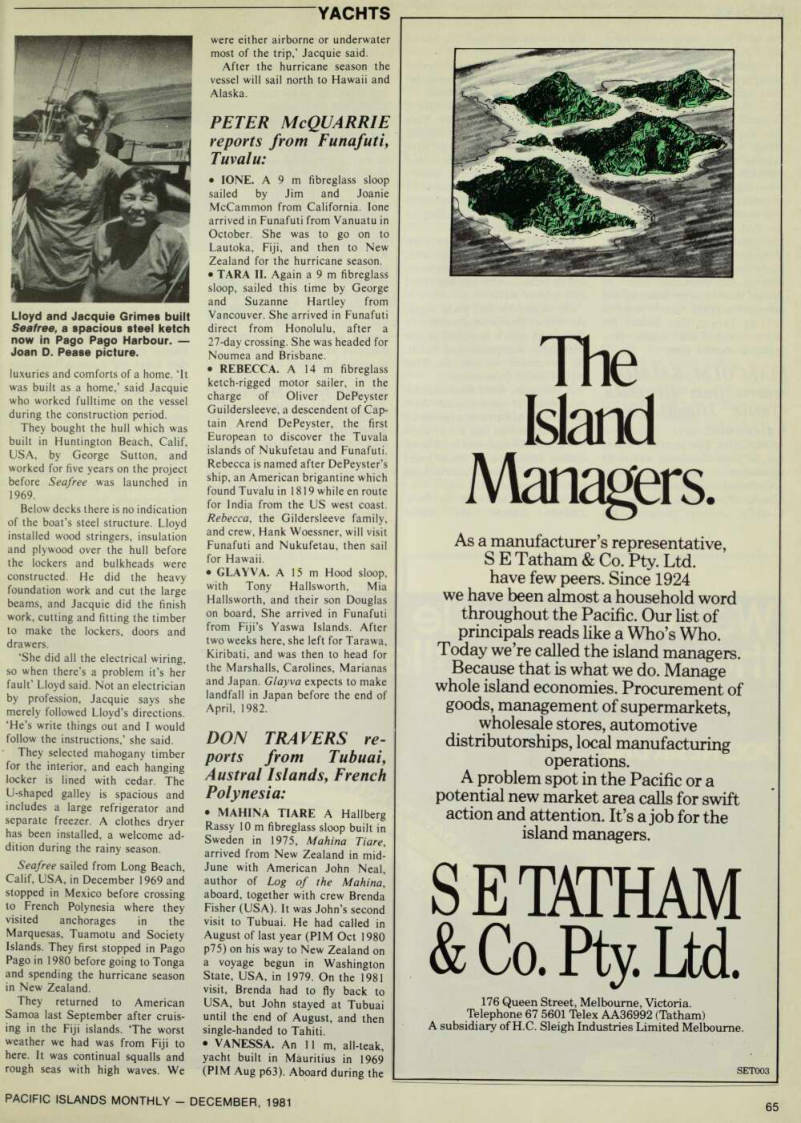
In 1982 they will visit Tonga, Fiji, New Caledonia and Australia. • SEAFREE. This 16.8 m steel ketch was built by owners Jacquie and Lloyd Grimes and includes the
luxuries and comforts of a home. ‘lt was built as a home,’ said Jacquie who worked fulltime on the vessel during the construction period.
They bought the hull which was built in Huntington Beach, Calif, USA, by George Sutton, and worked for five years on the project before Seafree was launched in 1969.
Below decks there is no indication of the boat’s steel structure. Lloyd installed wood stringers, insulation and plywood over the hull before the lockers and bulkheads were constructed. He did the heavy foundation work and cut the large beams, and Jacquie did the finish work, cutting and fitting the timber to make the lockers, doors and drawers. ‘She did all the electrical wiring, so when there’s a problem it’s her fault’ Lloyd said. Not an electrician by profession, Jacquie says she merely followed Lloyd’s directions. ‘He’s write things out and I would follow the instructions,’ she said.
They selected mahogany timber for the interior, and each hanging locker is lined with cedar. The U-shaped galley is spacious and includes a large refrigerator and separate freezer. A clothes dryer has been installed, a welcome ad dition during the rainy season.
Seafree sailed from Long Beach, Calif, USA, in December 1969 and stopped in Mexico before crossing to French Polynesia where they visited anchorages in the Marquesas, Tuamotu and Society Islands. They first stopped in Pago Pago in 1980 before going to Tonga and spending the hurricane season in New Zealand.
They returned to American Samoa last September after cruis ing in the Fiji islands. ‘The worst weather we had was from Fiji to here. It was continual squalls and rough seas with high waves. We
were either airborne or underwater most of the trip,’ Jacquie said.
After the hurricane season the vessel will sail north to Hawaii and Alaska.
Peter Mcquarrie
reports from Funafuti ,
Tuvalu:
• lONE. A 9 m fibreglass sloop sailed by Jim and Joanie McCammon from California. lone arrived in Funafuti from Vanuatu in October. She was to go on to Lautoka, Fiji, and then to New Zealand for the hurricane season. • TARA 11. Again a 9 m fibreglass sloop, sailed this time by George and Suzanne Hartley from Vancouver. She arrived in Funafuti direct from Honolulu, after a 27-day crossing. She was headed for Noumea and Brisbane. • REBECCA. A 14 m fibreglass ketch-rigged motor sailer, in the charge of Oliver DePeyster Guildersleeve, a descendent of Cap tain Arend DePeyster, the first European to discover the Tuvala islands of Nukufetau and Funafuti.
Rebecca is named after DePeyster’s ship, an American brigantine which found Tuvalu in 1819 while en route for India from the US west coast.
Rebecca , the Gildersleeve family, and crew. Hank Woessner, will visit Funafuti and Nukufetau, then sail for Hawaii. • GLAYVA. A 15 m Hood sloop, with Tony Hallsworth, Mia Hallsworth, and their son Douglas on board, She arrived in Funafuti from Fiji’s Yaswa Islands. After two weeks here, she left for Tarawa, Kiribati, and was then to head for the Marshalls, Carolines, Marianas and Japan. Glayva expects to make landfall in Japan before the end of April, 1982.
Don Travers Re
ports from Tubuai,
Austral Islands , French
Polynesia:
• MAHINA TIARE A Hallberg Rassy 10 m fibreglass sloop built in Sweden in 1975, Mahina Tiare, arrived from New Zealand in mid- June with American John Neal, author of Log of the Mahina , aboard, together with crew Brenda Fisher (USA). It was John’s second visit to Tubuai. He had called in August of last year (PIM Oct 1980 p 75) on his way to New Zealand on a voyage begun in Washington State, USA, in 1979. On the 1981 visit, Brenda had to fly back to USA, but John stayed at Tubuai until the end of August, and then single-handed to Tahiti. • VANESSA. An 11 m, all-teak, yacht built in Mauritius in 1969 (PIM Aug p 63). Aboard during the
Lloyd and Jacquie Grimes built Seafree, a spacious steel ketch now in Pago Pago Harbour.- Joan D. Pease picture.
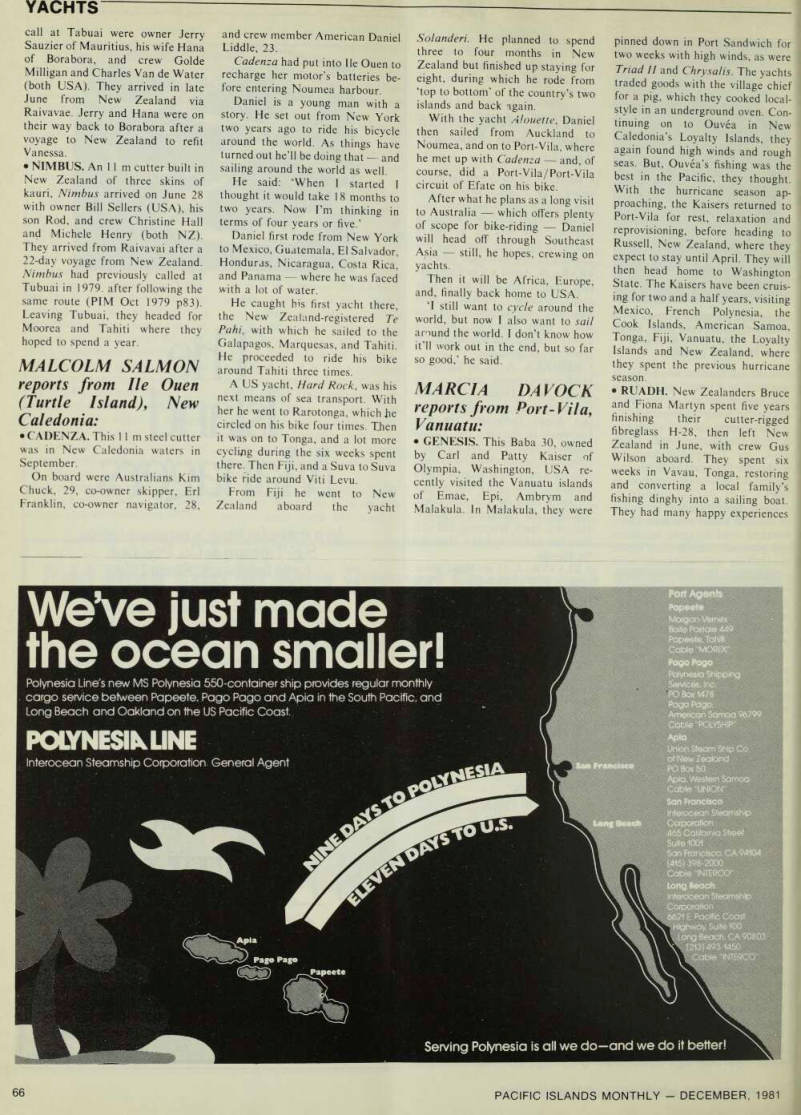
call at Tabuai were owner Jerry Sauzier of Mauritius, his wife Hana of Borabora, and crew Golde Milligan and Charles Van de Water (both USA). They arrived in late June from New Zealand via Raivavae. Jerry and Hana were on their way back to Borabora after a voyage to New Zealand to refit Vanessa. • NIMBUS. An 11 m cutter built in New Zealand of three skins of kauri, Nimbus arrived on June 28 with owner Bill Sellers (USA), his son Rod, and crew Christine Hall and Michele Henry (both NZ).
They arrived from Raivavai after a 22-day voyage from New Zealand.
Nimbus had previously called at Tubuai in 1979. after following the same route (PIM Oct 1979 pB3).
Leaving Tubuai, they headed for Moorea and Tahiti where they hoped to spend a year.
Malcolm Salmon
reports from lie Ouen
(Turtle Island) y New
Caledonia:
• CADENZA. This 11 m steel cutter was in New Caledonia waters in
September.
On board were Australians Kim Chuck, 29, co-owner skipper, Erl Franklin, co-owner navigator, 28,
and crew member American Daniel Liddle, 23.
Cadenza had put into He Ouen to recharge her motor’s batteries be fore entering Noumea harbour.
Daniel is a young man with a story. He set out from New York two years ago to ride his bicycle around the world. As things have turned out he’ll be doing that and sailing around the world as well.
He said: ‘When I started I thought it would take 18 months to two years. Now I’m thinking in terms of four years or five.’
Daniel first rode from New York to Mexico, Guatemala, El Salvador, Honduras, Nicaragua, Costa Rica, and Panama where he was faced with a lot of water.
He caught his first yacht there, the New Zealand-registered Te Pahi, with which he sailed to the
Galapagos, Marquesas, and Tahiti.
He proceeded to ride his bike around Tahiti three times.
A US yacht. Hard Rock , was his next means of sea transport. With her he went to Rarotonga, which he circled on his bike four times. Then it was on to Tonga, and a lot more cycling during the six weeks spent there. Then Fiji, and a Suva to Suva bike ride around Viti Levu.
From Fiji he went to New Zealand aboard the yacht
Solanderi. He planned to spend three to four months in New Zealand but finished up staying for eight, during which he rode from ‘top to bottom’ of the country’s two islands and back again.
With the yacht Alouette , Daniel then sailed from Auckland to Noumea, and on to Port-Vila, where he met up with Cadenza and, of course, did a Port-Vila/Port-Vila circuit of Efate on his bike.
After what he plans as a long visit to Australia which offers plenty of scope for bike-riding Daniel will head off through Southeast Asia still, he hopes, crewing on yachts.
Then it will be Africa, Europe, and, finally back home to USA. ‘I still want to cycle around the world, but now I also want to sail around the world. I don’t know how it’ll work out in the end, but so far so good,’ he said.
Marcia Davock
reports from Port-Vila ,
Vanuatu:
• GENESIS. This Baba 30, owned by Carl and Patty Kaiser of
Olympia, Washington, USA re
cently visited the Vanuatu islands of Emae, Epi, Ambrym and Malakula. In Malakula, they were
pinned down in Port Sandwich for two weeks with high winds, as were Triad II and Chrysalis. The yachts traded goods with the village chief for a pig, which they cooked local style in an underground oven. Con tinuing on to Ouvea in New Caledonia’s Loyalty Islands, they again found high winds and rough seas. But, Ouvea’s fishing was the best in the Pacific, they thought.
With the hurricane season ap proaching, the Kaisers returned to Port-Vila for rest, relaxation and
reprovisioning, before heading to
Russell, New Zealand, where they expect to stay until April. They will then head home to Washington State. The Kaisers have been cruis ing for two and a half years, visiting Mexico, French Polynesia, the Cook Islands, American Samoa, Tonga, Fiji, Vanuatu, the Loyalty Islands and New Zealand, where they spent the previous hurricane season. • RUADH. New Zealanders Bruce and Fiona Martyn spent five years finishing their cutter-rigged fibreglass FI-28, then left New Zealand in June, with crew Gus Wilson aboard. They spent six weeks in Vavau, Tonga, restoring and converting a local family’s
fishing dinghy into a sailing boat.
They had many happy experiences
with this family on the small island of Pangai Motu. They then cruised for two months in Fiji, spending most of their time in sunny Nadi waters. From Port-Vila, the Martyns will head for Southport, Australia, where they plan to work and install a new motor and a self steering unit. • ENSALLA. This 16 m cutter rigged Tradewinds 48, a Monk design, is in Port-Vila. Owners Maurice and Lucy Baldwin, whose homebase is San Francisco, Cali fornia, will leave shortly for New Caledonia and New Zealand, where they will spend the hurricane season.
The Baldwins left California two and a half years ago for Mexico, Costa Rica, the Panama Canal, San Bias Islands, Venezuela and Colombia (they particularly loved Cartagena). They visited Caribbean islands as far north as Puerto Rico, originally intending to sail to Europe. Then, however, they changed their minds and returned through the canal to the Pacific, visiting the Marquesas, Tuamotus and Society Islands; American and Western Samoa; Tonga, Fiji and Vanuatu. They are undecided about future plans following New Zea land. • BRIGHT WING. Dean Whitaker and Wanda Rensel are in Port-Vila aboard their 10 m engineless Brown Searunner trimaran, whose home port is New Orleans, Louisiana.
Since departing California seven years ago, Bright Wing had zig zagged across the Pacific, stopping ‘almost everywhere’, Dean said.
They especially enjoyed Fanning
Island, but Fiji offers their pre ferred cruising grounds. A previous trip in 1953 to the South Pacific aboard 15 m Laurent Giles ketch took Dean to Hawaii, French Polynesia, New Hebrides (now Vanuatu), Solomons, New Guinea and Australia. Then, in 1965, he circumnavigated Africa, starting
and finishing the trip in Nigeria,
aboard his 10 m Golden Hind. Dean is a former deep sea diver on oil rigs; he is also a crop duster pilot and stunt pilot in movies. Future plans may include Australia, Fiji,
Singapore or Papua New Guinea . . . we’re not in a rush to make decisions,’ said Dean. • WANDERLURE. Art Hammond reports that he is ‘alive and well in Vanuatu’ aboard his 10 m schooner, whose homeport is Long Beach, California. Art, who worked for the Panama Canal from 1970 to 1975, has been cruising the Pacific ever since. His most recent cruising has included New Zealand, Fiji, Vanuatu, Solomons, Australia and New Caledonia. He has spent three previous hurricane seasons in New Zealand, and plans to head for the Bay of Islands in December. • MOONDOG. Jo and Joanne Hudson, from Big Sur, California, arrived in Port-Vila, planning to remain for the hurricane season. Jo co-designed the unique 14 m trimaran with Jim Brown, and it’s a one-of-a-kind boat, panelled inside with Big Sur redwood. The boat took three years to build, then went on a ‘shakedown’ cruise to Tahiti, arriving back in California in 1976.
This year, the Hudsons departed in June for Hawaii, then stopped at Fanning Island and Fiji en route for Vanuatu. Jo, who cruised the New Hebrides 16 years ago, still finds them the most comfortable and charming cruising waters, with much more variety (volcanoes, blend of cultures, exotic local cus toms) than other areas. ‘lt’s like being on a frontier,’ Joanne said. Jo is a cartoonist and writer who contributes to numerous publica tions.
Other boats in Port-Vila include Tethys, Barones and Shearwater.
PA UL RYSA VYreports
from Rarotonga , Cook
Islands:
• HARMONY. An 11 m Fantasia sloop was one of the few late callers to Rarotonga in October. On board the four-year-old yacht were Frank Boucek and his wife Susan. The couple began their voyage from San
Diego in November 1979, and cruised down the California coast to Baja, and then spent 14 months in the Sea of Cortez. As keen scuba divers, the couple were enthralled by the abundance of marine life in this area, and this strongly influenced their decision to remain in Mexico longer than planned.
The couple then continued their journey to the Marquesas, the Tuamotus and the Societies where they remained for several months.
Frank and Susan were so im pressed with Mopelia in the Societies that they persuaded friends aboard Aura, another cruis ing yacht, to join them there.
Unfortunately, as Aura approached Mopelia, the watch fell asleep and the yacht was smashed on the reef.
A month of salvage work ensued, but, according to Frank, they were only able to recover about $6OOO worth of equipment. The cost of Aura was around $300,000. The delay in Mopelia accounts for Harmony’s late arrival in Rarotonga. She will berth in New Zealand for the hurricane season, and then sail back to San Diego via Fiji, the Societies, Tonga, Samoa and Hawaii. • JOSHUA. A five-year-old Cava lier 32 sloop was also berthed in Avatiu Harbour in early October.
The vessel is owned by Kiwi couple Ross and Jo Blackman, and their sole crew member is Chris Brombie.
Joshua is travelling in the opposite direction to most yachts now in the South Pacific.
She began her journey from her home port of Auckland in late September, and Rarotonga is the first port of call. After two weeks here, Joshua departed for the Societies, the Tuamotus, the Marquesas, and Hawaii, where it will remain for the hurricane season.
The Blackmans have owned the sloop for only six months, and this is their first ocean cruise in their own boat. Ross, a sailmaker by pro fession, has done some ocean racing, and has always longed to sail his own vessel.
The trip so far has been good, though Murphy’s Law, ‘everything that can go wrong will go wrong’, has come into play.
Ross feels that after four months, the couple will have adjusted prop erly to the cruising life, and all the mechanical appliancies on the yacht will have long since broken down and been repaired. Then, he hopes, it will be really smooth sailing. The couple anticipate re turning to Auckland around July 1982.
On board Nimbus at Tubuai were (from left) Bill Sellers, Christine Hall, Michelle Henry and Rod Sellers (report p66)- Don Travers picture.