People
pp. 37-41 · Read in the full issue
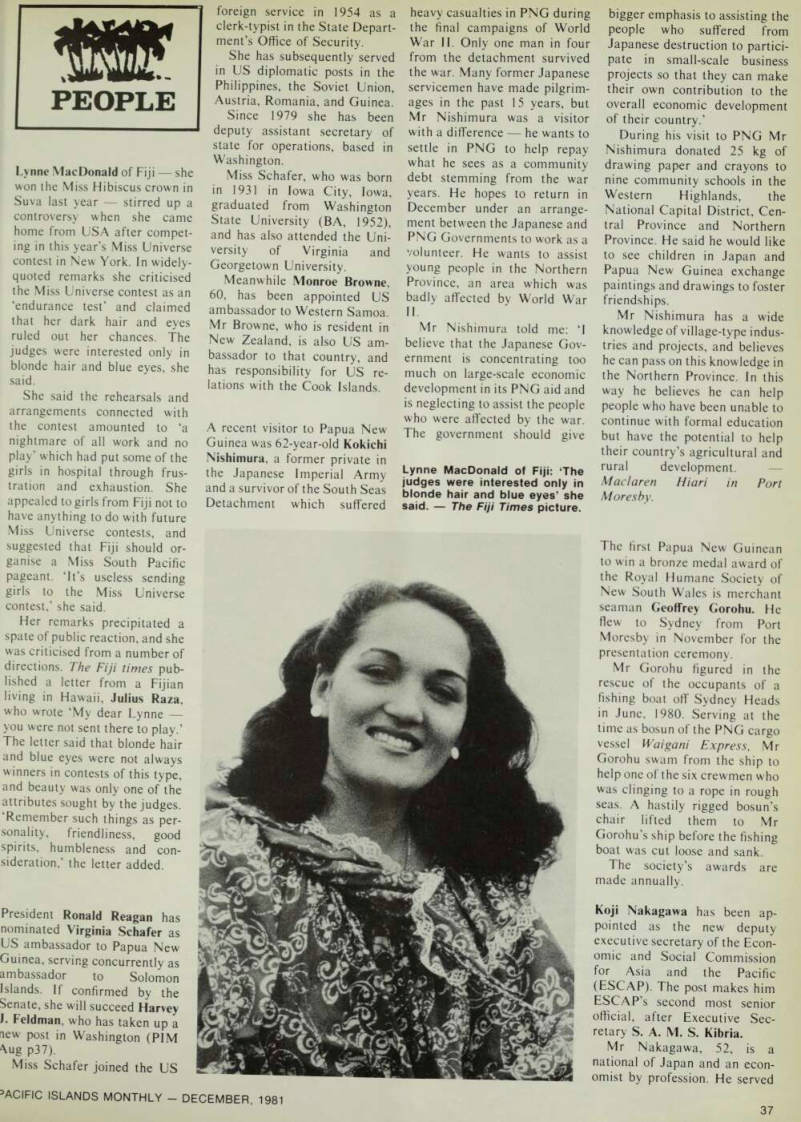
Lynne MacDonald of Fiji she won the Miss Hibiscus crown in Suva last year stirred up a controversy when she came home from USA after compet ing in this year’s Miss Universe contest in New York. In widely quoted remarks she criticised the Miss Universe contest as an ‘endurance test’ and claimed that her dark hair and eyes ruled out her chances. The judges were interested only in blonde hair and blue eyes, she said.
She said the rehearsals and arrangements connected with the contest amounted to ‘a nightmare of all work and no play’ which had put some of the girls in hospital through frus tration and exhaustion. She appealed to girls from Fiji not to have anything to do with future Miss Universe contests, and suggested that Fiji should or ganise a Miss South Pacific pageant. ‘lt’s useless sending girls to the Miss Universe contest,’ she said.
Her remarks precipitated a spate of public reaction, and she was criticised from a number of directions. The Fiji times pub lished a letter from a Fijian living in Hawaii, Julius Raza, who wrote ‘My dear Lynne you were not sent there to play.’
The letter said that blonde hair and blue eyes were not always winners in contests of this type, and beauty was only one of the attributes sought by the judges. ‘Remember such things as per sonality, friendliness, good spirits, humbleness and con sideration,’ the letter added.
President Ronald Reagan has nominated Virginia Schafer as US ambassador to Papua New Guinea, serving concurrently as ambassador to Solomon Islands. If confirmed by the Senate, she will succeed Harvey J. Feldman, who has taken up a lew post in Washington (PIM p37).
Miss Schafer joined the US
foreign service in 1954 as a clerk-typist in the State Depart ment’s Office of Security.
She has subsequently served in US diplomatic posts in the Philippines, the Soviet Union, Austria, Romania, and Guinea.
Since 1979 she has been deputy assistant secretary of state for operations, based in Washington.
Miss Schafer, who was born in 1931 in lowa City, lowa, graduated from Washington State University (BA, 1952), and has also attended the Uni versity of Virginia and Georgetown University.
Meanwhile Monroe Browne. 60, has been appointed US ambassador to Western Samoa.
Mr Browne, who is resident in New Zealand, is also U T S am bassador to that country, and has responsibility for US re lations with the Cook Islands.
A recent visitor to Papua New Guinea was 62-year-old Kokichi Nishimura, a former private in the Japanese Imperial Army and a survivor of the South Seas Detachment which suffered
heavy casualties in PNG during the final campaigns of World War 11. Only one man in four from the detachment survived the war. Many former Japanese servicemen have made pilgrim ages in the past 15 years, but Mr Nishimura was a visitor with a difference he wants to settle in PNG to help repay what he sees as a community debt stemming from the war years. He hopes to return in December under an arrange ment between the Japanese and PNG Governments to work as a volunteer. He wants to assist young people in the Northern Province, an area which was badly affected by World War 11.
Mr Nishimura told me; ‘I believe that the Japanese Gov ernment is concentrating too much on large-scale economic development in its PNG aid and is neglecting to assist the people who were affected by the war.
The government should give
bigger emphasis to assisting the people who suffered from Japanese destruction to partici pate in small-scale business projects so that they can make their own contribution to the overall economic development of their country.’
During his visit to PNG Mr Nishimura donated 25 kg of drawing paper and crayons to nine community schools in the Western Highlands, the National Capital District, Cen tral Province and Northern Province. He said he would like to see children in Japan and Papua New Guinea exchange paintings and drawings to foster friendships.
Mr Nishimura has a wide knowledge of village-type indus tries and projects, and believes he can pass on this knowledge in the Northern Province. In this way he believes he can help people who have been unable to continue with formal education but have the potential to help their country’s agricultural and rural development.
Maclaren Hiari in Port Moresby.
The first Papua New Guinean to win a bronze medal award of the Royal Humane Society of New South Wales is merchant seaman Geoffrey Gorohu. He flew to Sydney from Port Moresby in November for the presentation ceremony.
Mr Gorohu figured in the rescue of the occupants of a fishing boat off Sydney Heads in June, 1980. Serving at the time as bosun of the PNG cargo vessel Waigani Express. Mr Gorohu swam from the ship to help one of the six crewmen who was clinging to a rope in rough seas. A hastily rigged bosun’s chair lifted them to Mr Gorohu’s ship before the fishing boat was cut loose and sank.
The society’s awards are made annually.
Koji Nakagawa has been ap pointed as the new deputy executive secretary of the Econ omic and Social Commission for Asia and the Pacific (ESCAP). The post makes him ESCAP’s second most senior official, after Executive Sec retary S. A. M. S. Kibria.
Mr Nakagawa, 52, is a national of Japan and an econ omist by profession. He served
Lynne MacDonald of Fiji: ‘The judges were interested only in blonde hair and blue eyes' she said.- The Fiji Times picture.
almost 10 years with the Asian Development Bank, and in 1980 joined ESCAP as a consultant in the division of industry, human settlements and tech nology. He became chief of the division in June, 1981.
The cultural value of the tatau, or Samoan tattoo, is the theme of a book researched in Samoa by cultural anthropologist Noel McGrevy, of the University of Hawaii.
New Zealand-born Mr McGrevy found that the only places where the art of tattooing was still alive were Western Samoa, and in the Samoan communities in New Zealand, on the US mainland, and Hawaii.
The theme of his book is the unifying force of the tatau. especially among the Samoan people, whether they live in Samoa or overseas. The book has taken almost 11 years to research and has cost about $25 000. It will be published in 1982 or 1983.
Grants for the project were raised by the New Zealand Queen Elizabeth Arts Council and business groups in New Zealand which employ large numbers of Samoans. The author hopes his work will increase understanding of Samoan culture in those countries with large Samoan populations.
The book will be translated into Samoan by Tuiletufuga Enele. Profits from the Samoan version will go towards the establishment of a fund for similar work, and for the pro posed Samoan National Cul tural Centre.
Well-known British composer and musicologist David Fanshawe is back in the Pacific on the second leg of a marathon music collection journey.
In 1978 he visited the Cook Islands, Tonga, Fiji, Solomon Islands, Kiribati, Western Samoa and Tahiti. He has presented the traditional music and songs collected on that journey to the University of the South Pacific, Suva, as the basis of the university’s Archives of Pacific Music.
This time round he is to visit the Marianas, Carolines, Marshall, Tuvalu, Vanuatu, Tokelau, Tuamotus, Mar quesas, Australs, New Zea land, Hawaii and Fiji. He will also pay return visits to a number of the countries he was in on his first journey.
Mr Fanshawe has made a similar collection of the tra ditional songs, chants and music
of Africa and from it produced his widely acclaimed mass, African Sanctus.
The USP is considering invit ing Mr Fanshawe, at a later stage, to spend a period as composer in residence at the university so that he can (in the words of the USP Bulletin) ‘develop a major work to pre serve and present authentic traditional Pacific music to the world’.
The new resident representative of the United Nations Develop ment Programme in Western Samoa is Roy D. Morey, an experienced US civil servant and diplomat.
Mr Morey came to Apia after spending three years as deputy regional representative for the UNDP in Bangkok, Thailand.
He was welcomed at a recep tion in the Tusitala Hotel hosted by Western Samoa’s Acting Secretary to Government Vito Lui.
Peter Peipul is Papua New Guinea’s new ambassador to Belgium and the Holy Sea. He will serve concurrently as PNG representative to the European Economic Community whose headquarters are in the Belgian capital, Brussels.
Mr Peipul, 33, served with the Australian Embassy in Washington before PNG’s inde pendence in 1975. He under went foreign service training in Australia and the United States. In 1977 he became charge d’affaires of the PNG Embassy in Washington.
Immediately before his new appointment, Mr Peipul was a commissioner of the PNG Pub lic Services Commission in charge of industrial relations, employment conditions and overseas recruitment.
He holds a master’s degree in international public policy. He has also completed a political science course at the University of PNG.
Pandit Sharma is the new gen eral manager of the Tradewinds Hotel, Suva. Previously, he had been general manager of Tanoa Hotel, Nadi.
The Pacific Area Travel Associ ation (PATA) has appointed Timothy L. Devine as its new
director finance and adminis tration.
Mr Devine, 38, is based at the association’s head office in San Francisco, but has respons ibility for finance and adminis tration functions for PATA’s regional offices in Manila and Sydney, and for its representa tive offices in London, Frankfurt and Paris.
A graduate of Notre Dame University, with an MBA from Eastern Michigan University, Mr Devine has a 16-year back ground in accounting and financial management, includ ing periods with such com panies as Ford, the Sperry Corporation, Volkswagen of America, and Greyhound Food Management.
President leremia Tabai of Kiri bati climbs 10 metres up a coconut tree twice a day to get coconut milk, his and his fam ily’s favourite ‘soft drink’. ‘We drink it rather than lemonade and strawberry juice from the store because they cost money and anyway I don’t like them,’ he told Sydney Morning Her ald reporter Greg Turnbull while in Australia for the Commonwealth Heads of Gov
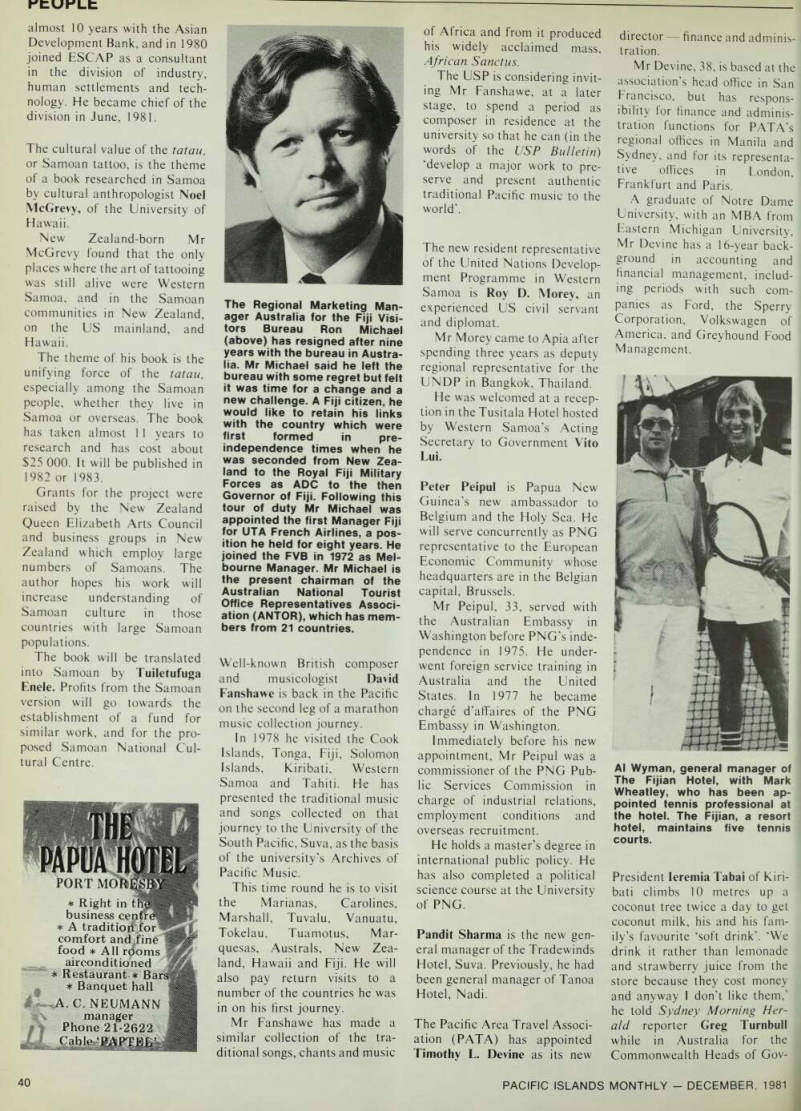
The Regional Marketing Man
ager Australia for the Fiji Visi tors Bureau Ron Michael (above) has resigned after nine years with the bureau in Austra lia. Mr Michael said he left the bureau with some regret but felt it was time for a change and a new challenge. A Fiji citizen, he would like to retain his links with the country which were first formed in pre independence times when he was seconded from New Zea land to the Royal Fiji Military Forces as ADC to the then Governor of Fiji. Following this tour of duty Mr Michael was appointed the first Manager Fiji for UTA French Airlines, a pos ition he held for eight years. He joined the FVB in 1972 as Mel bourne Manager. Mr Michael is the present chairman of the Australian National Tourist Office Representatives Associ ation (ANTOR), which has mem bers from 21 countries.
Al Wyman, general manager of The Fijian Hotel, with Mark Wheatley, who has been ap pointed tennis professional at the hotel. The Fijian, a resort hotel, maintains five tennis courts.
ernment Meeting last October.
President Tabai also had another reason for this activity, according to Turnbull, who wrote: The president climbs trees because one day he may have to do it for a living. He faces a presidential election next February and if he loses . . . well, there are no parliamen tary pensions in Kiribati.' Speaking of his chances of re election, President Tabai told Turnbull; ‘lf you say you are confident you will be re-elected in Kiribati, you are throwing away votes. ‘I will not over-campaign, in fact I may not campaign at all.
It is more important to be known personally, for people to think you have commonsense ‘I am retaining the way of a normal villager so it will not be a shock if I lose my job. I do not fear returning to the outer islands.’
The 31-year-old president does not like to play sport because he is conscious of his youth and does not want to give the impression that he is cava lier about his job, Turnbull wrote. ‘I try to judge the view of the people about how they expect me to behave. They do not want me to be playing all the time,’ he said.
Commenting on the ‘North- South Dialogue’ which loomed large at the CHOGM meeting.
President Tabai said: ‘We are at the mercy of the developed countries, but we feel our needs are largely ignored . . . ‘We put a lot of hope on the development of our fisheries resources. But, for instance, we need a wharf that would cost $3 million, and it is beyond our capacity. ‘Wharves are not made of dialogues . ..’
For American Dr Frederic Sutter, filming a shark being caught in traditional Samoan style was the highlight of a recent three-month assignment in Western Samoa.
According to a report in The Samoa Times, he was there to make films and displays for US and other educational establish ments on the people, places and customs of Samoa.
But one thing eluded him until quite late in his stay: he
had been unable to get film of a shark being caught in the tra ditional manner.
Then one day he was in a boat with two fishermen a few kilo metres off the island of Siumu when they sighted a shark. The fishermen began rattling loose pieces of coconut the sound of which attracted the shark it is believed the noise resembles that made by a wounded fish.
The shark was lured closer to the boat with bonito and mutton bait dangled on the end of a coconut-fibre string. ‘lt was rather like teasing a bull at a bullfight,’ said Dr Sutter. When the shark was alongside, fisherman Faaaso slipped a noose of especially strong coconut fibre over its head, making sure at the same time it was placed well down its body. Then he pulled the noose tight and lifted the thrashing shark out of the water. His mate rammed the stick down its throat and struck it over the head 10 times, killing it.
Dr Sutter said the technique was highly ingenious, consider ing that only coconut fibre was used to make the catch. New fishing techniques have by now made this method practically obsolete. But he was greatly pleased that he’d been able to record it on film.
He said: ‘Showing American teenagers a picture of a kava ceremony probably won’t inter est them very much. But show them a shark caught this way and they’ll really sit up and say
“wow”, and they will have a new respect for Samoans.’
Gary B. Wong, former consul at the Australian high commission in Vanuatu, has returned to Canberra after a two-year post ing. During his service in Vanuatu, he experienced the upgrading of the Australian diplomatic mission from a con sulate (under William Fisher) to a high commission (under Michael Ovington) when Vanuatu became independent in 1980.
Gary Wong was very actively involved looking after the affairs of Australian citizens caught on both sides of the prison fence during the Santo rebellion of May-August 1980.
His antics on the cricket pitch will be greatly missed by his friends.
Replacing him in Port-Vila is Robert E. Secombe, whose most recent postings were in Jakarta and Cairo. lan Mclntyre in Port-Vila.
Vance C. Pace is the newly appointed US International Communication Agency (USICA) public affairs officer in Fiji. He replaces Don Crider who has returned to the USA.
Born in Utah, Mr Pace has had extensive diplomatic ex perience in Latin America, and
speaks Spanish as a second language.
A graduate of the Fiji School of Medicine, Dr Balram Iyer, has become the first local graduate to become a member of the Royal Australian and New Zea land College of Psychiatrists.
Dr Iyer is consultant psychiatrist and medical super intendent at St Giles Hospital, Suva, and is also the first local graduate to hold this position.
In 1976 he was awarded a New Zealand Government scholarship to study psychiatry at Otago University, where he completed his post-graduate course in psychological medi cine in 1979.
Yoda Nysta has been confirmed for a new three-year term as Public Service Commissioner of the Marshall Islands.
Confirmation came in a vote of 13-10 in the Nitijela (parlia ment).
A Cook Islander, Paul Koteke, 24, was chosen as a member of the New Zealand All Blacks Rugby Union team which re cently toured France and Romania. He was the first Cook Islands player ever to win selec tion in the team.
Joe Mulders (PIM People Apr p 35) has returned to Australia to live after almost 20 years spent in New Hebrides/ Vanuatu.
Arriving in Port-Vila in 1962, Mr Mulders was first involved with the travel company Coral Tour, and then in 1964 became manager of the Vate Hotel. He also worked for New Hebrides Airways, which later merged with Air Melanesiae. He was president of the first National Arts Festival of the New Hebrides held in 1979. He was also president of the Vanuatu Tourism Association, and of the board of Kawenu College.
For many years he was re sponsible for the Port-Vila Agri cultural Show.
His wife Katherine directed the Burns Philp Travel com pany, and was for 16 years the representative in Port-Vila of the Fiji airline. Air Pacific.
She had also represented the New Hebrides at the South Pacific Games.
Vance C. Pace of the US Inter
national Communication Agency,
now public affairs officer with the US Embassy in Fiji.