Rarotonga’s
pp. 31-36 · Read in the full issue

Tropicalities
Rarotonga’s white (line) Christmas
Poiri, author of a letter to the editor in Cook Islands News , 6 recalls wondrous events on Rarotonga at Christmas 1980 and wonders whether there will be a repetition at Christmas 1981. Text of Poiri’s letter follows: Dear Sir, What a wonderful month December 1980 was.
Never before had we seen such activity and co-operation.
You must remember?
The Survey Department, the Police Department, the Public Works Department, the New Zealand Ministry of Works Department, Traffic Control Officers, Honourable Ministers, First Class Citizens, right down to Iti Tangata and Peasants all watched with fascination as a White Traffic Line was painted from the ‘Tree of Knowledge’, eastward and westward.
The effort lasted nearly all the way to the Tamure and right through Arorengi Village be fore the boiler lost steam pres sure and the last perspiring policeman said; ‘Halt, that’s enough before Christmas’. The
Honourable Minister-in-Charge
said: ‘Wait, it looks good. Now we have started we will finish the job. Traffic road studs enough for the town area are already ordered from New Zea land. Soon a great meeting will take place where the Prime Minister Himself will paint a Golden Line where the two gangs of painters finally meet up.’
The roads in town were swept clean. Flowers were growing where flowers never grew be fore. The whole town looked cleaner and tidier than even the oldest inhabitant could remem ber. What a month it was to be sure.
Then the Christmas Party followed, and eventually every
one went back to bed. As the New Year’s resolution they said: Tomorrow we will keep this wonderful line painted.' Traffic accidents dropped for the month. A wonderful road courtesy blossomed forth, the midnight revellers who drove homewards had a white line to guide them. People who lived round the back of the island said: ‘Soon we too will have a white line to follow homewards on dark nights.’
So . . . can we hope to see such a wonderful revival again for Christmas 1981?
What are our problems?
Poiri.
PIM hopes to be in a position to report on whether Poiri’s hopes were disappointed or not.
But that must wait until after Christmas.
Ten years ago
on Santo...
As the ‘big island’ of Espiritu Santo slowly recovers from the traumas of last year’s at tempted secession, and the pro cess of its integration into the unified nation of Vanuatu goes ahead, PETER COLE recalls earlier times when life on Santo was nothing if not slow and quiet.
I first landed on Santo in June 1970, ferried from Noumea aboard a shaky old DC3.
The airstrip was an old US bomber field, and at a casual glance looked very much in original condition. The terminal for want of a better word was a two-sided tin shack con taining two school desks. Be hind one sat a French gendarme, and behind the other an English policeman. Behind each inspector was a local ‘police boy’ in French and English uniforms respectively.
This was my first introduc tion to the jointly administered condominium.
I had come to Santo to Join an Australian salvage outfit en gaged in bringing up non ferrous metals from sunken World War II wrecks of which there were many scattered around the Pacific.
Two in particular were off Santo: the USS Tucker , a destroyer blown in two and lying in 18 mof water off Malo Island a few kilometres off Santo, and the 33 000-tonne US troopship, the USS President
Coolidge , lying at a steep angle at depths varying from 21 m to 73 m just north of Luganville, the ‘capital’ and only town on Santo.
The salvage company had two ships: the Pacific Seal , an 18-m workboat which had just left for New Guinea, and the Onewa , a 22-m former New Zealand coaster. The crew of the Pacific Seal had been work ing on the Coolidge for several months before I arrived and they had removed the ship’s propellers.
As the wreck lay on its port side, the starboard prop was quite accessible, but it was at a depth of about 55 m. An enormous spanner was made up to fit the boss, and in successive ‘bounce’ dives the boss was unscrewed. The prop was then secured to the hull by cables and a small charge of dynamite blew the prop off the shaft and left it hanging ready to be winched up.
The port prop was a different matter as it was concealed under the keel and 9 to 12 m deeper. Attempts to use the spanner were laborious and slow, so a quicker method was devised. A case of dynamite was strung around the back of the prop and the whole lot was blown off the shaft. The ex plosion loosened a few hull plates and some fuel oil escaped this prevented us from using explosives on the Coolidge from then on.
Our first job after setting up
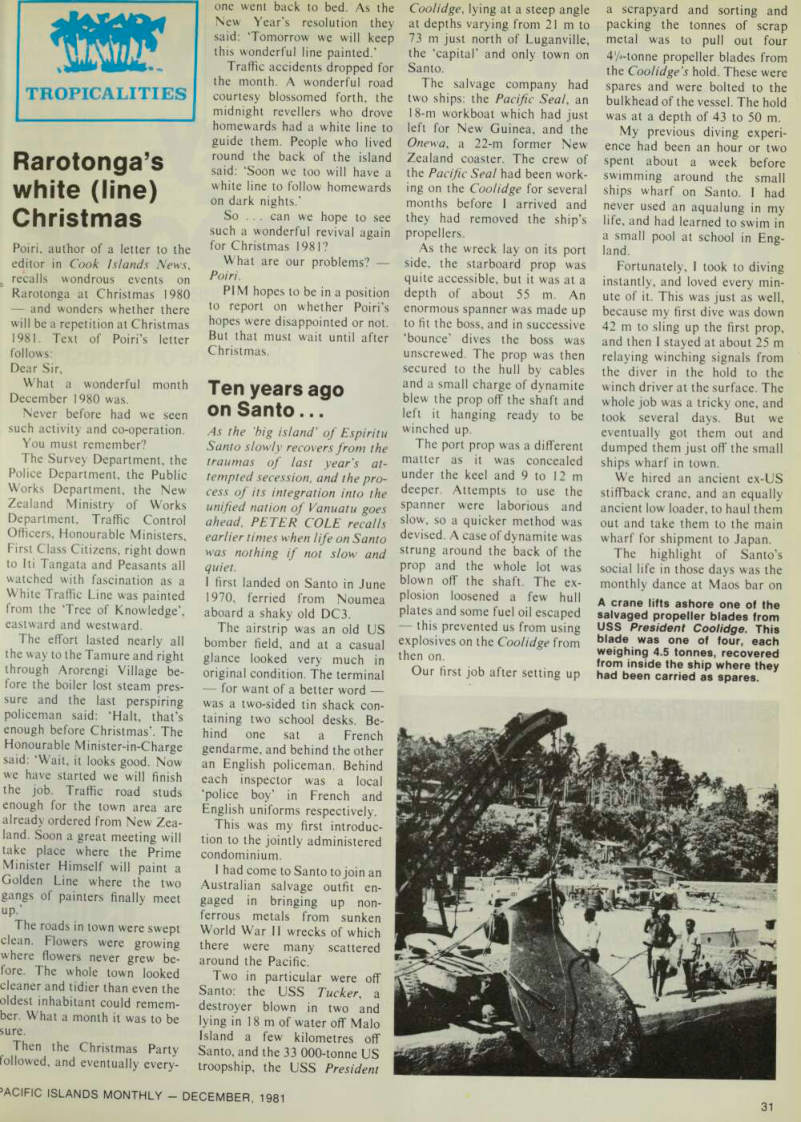
a scrapyard and sorting and packing the tonnes of scrap metal was to pull out four 4‘/4-tonne propeller blades from the Coolidge’s hold. These were spares and were bolted to the bulkhead of the vessel. The hold was at a depth of 43 to 50 m.
My previous diving experi ence had been an hour or two spent about a week before swimming around the small ships wharf on Santo. I had never used an aqualung in my life, and had learned to swim in a small pool at school in Eng land.
Fortunately, I took to diving instantly, and loved every min ute of it. This was just as well, because my first dive was down 42 m to sling up the first prop, and then I stayed at about 25 m relaying winching signals from the diver in the hold to the winch driver at the surface. The whole job was a tricky one, and took several days. But we eventually got them out and dumped them just off the small ships wharf in town.
We hired an ancient ex-US stiffback crane, and an equally ancient low loader, to haul them out and take them to the main wharf for shipment to Japan.
The highlight of Santo’s social life in those days was the monthly dance at Maos bar on
A crane lifts ashore one of the salvaged propeller blades from USS President Coolidge. This blade was one of four, each weighing 4.5 tonnes, recovered from inside the ship where they had been carried as spares.
the arrival of the Polynesie , a small, neat freighter that plied the Australia-New Caledonia- New Hebrides run. A noisy rock group belted out the latest songs, the French girls danced (with each other), and the men drank. Drinking was the major activity on Santo, and it didn’t take long to become an active member of this informal club.
There were two hotels on the main road: Maos run by a Tahitian, and The Corsican, run by an expatriate Australian. A third bar, Goodyns Bar, off the main road, was run by a Belgian Gaullist who preferred to swear in English because it had more swearwords than French.
The town was full of ‘charac ters’, mostly English, French
Vanikoro in the eastern Solomons. It was a two-day trip from Santo, and we usually spent three to four weeks work ing there.
In July 1971, returning from the fifth trip, the Onewa struck heavy weather and, fully loaded with a cargo of scrap metal, sprang a leak and began taking water. After 15 hours of pump ing, she eventually sank about 25 kilometres off Vanikoro. We took to the liferaft and then the aluminium workboat in which we motored to Vanikoro, towing the liferaft! We were picked up from Vanikoro four days later
and Australian expatriates who had lived and worked on the island for most of their lives, some for more than 30 years.
After salvaging the props off ;he Coolidge , we did several imall jobs which included some lives on Million Dollar Point.
Phis was the spot where the \mericans dumped millions of lollars worth of equipment and 'chicles at the end of the war. fhere were cranes, trucks, eeps, forklifts, and all sorts of quipment that had been bull iozed into the water. It made a cry interesting and rather urreal dive.
Our next big job was salvag es cartridges on the island of
by the Konanda, a local trading ship, and were taken back to Santo, none the worse for our experience but considerably poorer.
We were back in Santo again in April 1972 for a serious attempt to salvage the cargo and possibly the engine room of the President Coolidge.
Life on the island was un changed. A nightclub had been added to the local attractions in Luganville, the Hog Harbour Hotel had a bit of weekend life, and the French and English were still bickering. An earth quake had dropped the small ships wharf below low water mark and demolished the build
ing of CFNH, the French trad ing company (it was only two US Quonset huts side by side).
Back on the Coolidge we opened up No 1 hold and pulled out thousands of live 105 mm shells which had to be defused aboard the workboat. Other cargo in the hold consisted of dozens of spare wheels and tyres. We sold the tyres locally as there were still quite a few trucks around which the ‘as new’, water-preserved tyres fitted. One ambitious driver bolted a complete 30-year-old steel wheel and tyre on his truck. The wheel collapsed with the first load he carried, al though the tyre was OK.
Cases and cases of Springfield bolt-action rifles came to light. We winched a case on board and examined the contents. Every single one had suffered corrosion, although some looked all right.
Numbers 2 and 3 holds had already been opened by the Americans: they had removed two complete plates from the hull. In No 2 hold there were dozens of trucks, jeeps, halftrack vehicles, boxes of spares, kitchen equipment, enormous aluminium pressure cookers, and all sorts of general ‘campaign’ equipment.
No 3 hold contained thou sands of cases of small arms ammunition and hundreds of 105 mm and 75 mm shells. We salvaged as many of these as we could and then rigged up an air lift dredge to suck up the small shells.
These were ‘deloused’ ashore in a home-made furnace of 44-gallon drums and sheet metal. We fed compressed air and diesel fuel into the furnace and burned great piles of shells at a time. The brass cases were separated from the projectiles and packed into 44-gallon drums for shipment to Austra lia.
On July 14, 1972, I had an accident on the boat which put me out of action for a couple of months. I returned to Santo for several months, but the price of scrap had fallen, operating costs had doubled, and our lack of sophisticated modern equip ment led us to fold up the operation and take the boat to Port-Vila to lay it up.
That was the last I saw of
Santo a peaceful, quiet, and, more often than not, unheard of, backwater somewhere in the Pacific. Even after all that has happened, I wonder if it has changed all that much?
Crime: Learning
the hard way
PIM has received a remarkable letter from an inmate of Niue’s prison. Unfortunately it has had to be reduced in length for publication (the original covered nine foolscap pages).
But the essentials of what the writer, Shonby Your’s Truly Ikimouga, had to say appear in the following shortened ver sion: I, Shonby Your’s Truly Ikimouga, send my greetings to all my family and friends on the island of Niue and to those who have helped me, as I stay in gaol, the home for those who need repentance. I am writing to disclose my experiences and to explain why I am in gaol, a black sheep among my people.
Although I was born on Niue, at the age of two I was adopted by my birth mother’s brother and taken to Rarotonga in the Cook Islands where I was brought up and educated.
While I was at school, I began to write essays concern ing topics like crime, detectives, investigations and police work.
In 1971 I attended Tereora College and took a home study course on investigations for private investigators with an institute in the United States, which was provided for me by an elder of the Church of
Latter-day Saints.
During that time my mind was very strong and very inter ested about why people were turning so often to crime, what kind of people were they, and what happened to such people.
I left school and got a job as a shipping clerk for the Electric Power Supply in 1975, still studying to be a private investi gator. However, while doing assignments in forgery, bur glary and theft, I was thinking to myself: what is the use of completing the theory without practical experience? If a per son wishes to be a mechanic he studies the parts of engines, and then puts his knowledge into practice. Therefore, to solve a
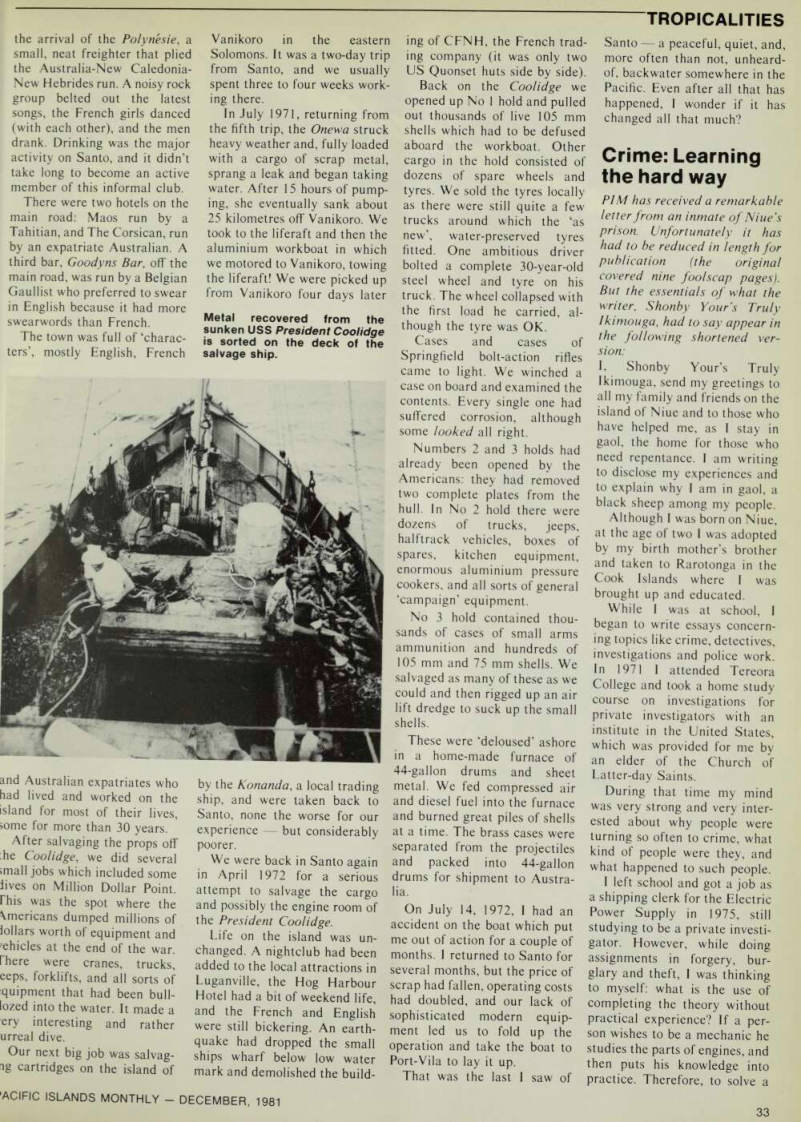
Metal recovered from the sunken USS President Coolidge is sorted on the deck of the salvage ship.
crime, one must be involved in crime, and so I decided to sacrifice myself to find out what drives people to commit crimes and to experience myself what happens to such people.
The first time I put the theories I had studied into practice was when I forged $150.00 on a cheque book. I donated the money to the church, and I was found out, and was sentenced to one year on probation. My parents hit me and I was teased by people and I was without friends. 1 got married and returned to Niue. In 1980 I completed the theory in my studies and passed all 12 courses, gaining a badge, an identification card and a diploma as a qualified pro fessional investigator. Although the institute in the United States provided the theory, the practical part was my own idea, and I felt that 1 needed to experience it further. 1 became employed with Burns Philp (SS) Co Ltd as an invoice customs clerk. My job was to clear cargoes from cus toms and I was told to make payments for all goods entered on import entries. I did not wish to handle cash as it is the job of the cashiers, but they told me to still do what I am told to do. As my wages of $33.75 a week could not provide for me and my family, I used some of the cash intended for payments of import duties for myself. I told the manager what I had done, and he reported me to the police.
When I went to court, I had no legal aid, and although I explained to the judge my reasons for commiting the crime, he said policemen do courses but they don’t get involved in criminal offences, and he sentenced me to three years in prison. My appeal against the sentence failed, even though I had a wife and two daughters to support, and although I offered to repay Burns Philp out of my wages, they refused.
So I am writing from prison to share my experiences and what I have found out about being a criminal.
Firstly, people often steal Decause they do not have mough money to buy the things hey need. Forgery is a crime
usually committed by teenagers, mainly males who want easy money for pleasure, Burglary starts because youths want what the rich persons have, and is usually committed by those from poor families, Second, although in this world today everyone has done something bad, if you are from a highly respected family and you commit a crime, everything possible is done to get you out of prison, but a person from a poor family is not recognised and is left to his fate. People with important jobs or relatives of the judge get away without being convicted, or are not sent to gaol, which is not fair to others.
Third, when a person has been sent to prison and later released, he should be treated like a human being. Fie has worked for so many months or years in prison and when he comes out he is utterly clean, he has paid back what he did and should be given a chance, Here in prison, we have no blankets, no sort of entertain ment facilities, no library and it is very dirty. I feel very sorry for my family and all the families
of the other people in prison with me. For those families, whose sons and fathers are in prison, cannot support them selves.
I wish to start an appeal fund, to be called the Prison Inmates Family Benefit Fund. It is time we help these families. I don’t mind about me but I am worried for the others. I have accomplished my mission and have done what no man dare try to do, to qualify as a private investigator and to experience crimes as well, although it is not nice in prison. But I appeal to you to support the fund. And also, please feel free to write to me and tell me what you think about what I have done. Is it right? Is it wrong? It is for you all to answer.
Finally, you parents are the teachers of your children. Give them what they need and love them the Christian way. That way you will never depart from your children and your children
will never depart from you to go to prison. Also, never under estimate yourself because you never know what will happen to you, so be alert for temptations and do not do dishonest things.
God bless you all.
Shonby Your’s Truly Ikimouga, PO Box 13, Alofi South, Niue Island.
Top windsurfers
for Fiji in June
More than 400 of the world’s best windsurfers will be pitting muscles and skills against each other at Fiji’s Beachcomber Island Resort next June at the First World Professional
Windsurf Championships.
Competitors from Europe, Japan, USA, Canada, Austra lia, New Zealand and Fiji itself, are expected to take part in the four rated events slalom, freestyle, long-distance endur ance and pentathlon.
Racing will take place in the waters surrounding Beach comber and Treasure Islands, 15 km off Lautoka, and will last from June 20-July 4. Canadian Pacific Airlines are sponsoring the competition, which offers $3O 000 (Canadian) to be won.
A travel package, including 14 nights’ accommodation, and all meals, plus some special evening functions, has been prepared for the event. In addition to its two islands resort facilities the Islands in the Sun company will anchor its mini liner Matthews Flinders off the islands for use as a hotel-ship.
Fund to honour
John Knight
The great interest and involve ment in the South Pacific by Australian Senator John Knight, who died in March (PIM Apr p 9), is to be perpetu ated with a special fund estab lished in his memory.
Details of the fund were given in Suva by Mr Roger Shipton, a member of the Aus tralian Parliament and chair man of the Parliamentary Joint Committee on Foreign Affairs and Defence.
Mr Shipton was visiting Fiji as a special emissary of the Australian Government for ad vance talks with the Prime
Windsurfing is rapidly becom ing a big sport in a number of Pacific harbours, and the first world championships will be in Fiji next year.-Alize picture in Corail, New Caledonia.
Minister of Fiji, Ratu Sir Kamisese Mara, about the Commonwealth Heads of Gov ernment Meeting in Melbourne in September-October.
Mr Shipton said that under the fund it was proposed that South Pacific islanders would visit Australia to expand their professional and educational ex perience and to increase under standing between the countries.
Where possible, it would favour handicapped people, or those involved in their care.
The fund would be adminis tered by the Australian National University, where earlier in his career John Knight held a public service fellowship. The university would have an advisory and selection committee including Members of Parliament and Senator Knight’s family, to choose the fellows.
Senator Knight, who died from a heart attack aged 37, was an officer of the Australian Department of Foreign Affairs before entering parliament and served in India, Fiji and Saudi Arabia.
During his parliamentary ca reer he was a member of the Senate Standing Committee on Foreign Affairs and Defence which reported on Australia and the South Pacific. Aus tralian Information Service.
Bounty for sale,
at $5,175 million
Bounty fever swept Auckland last October, with tens of thou sands of sightseers clambering over the replica of the famous 18th-century sailing ship during her first visit to the city.
Graeme Kennedy reports in the New Zealand paper 8 O’clock: Schoolchildren and office workers lined up with housewives and businessmen for almost an hour at times for their chance to go aboard the majestic vessel at Princes Wharf . . .
More than 50 000 people crowded the wharf on the Sunday to relive if only for an hour or so the long-gone days of the tall ships.
The 30 m replica the star of the 1981 Travel Show has had a controversial career since Mrs Thea Muldoon launched
her at the Whangarei engineer ing yards in December, 1978.
Bounty was built for $2.5 million for the Dino De Laurentiis Corp., which had asked top producer David Lean to make two films about the 1789 mutiny The Law breaker and The Long Arm.
De Laurentiis, however, scrapped plans for the movies in 1979 and Lean was unable to find other backers.
The Bounty became a tourist attraction in Whangarei’s town basin but was closed to the public for several months in late 1979 when she was arrested and a writ nailed to her mast.
Her builders alleged that the De Laurentiis company had failed to make final payment.
The dispute settled, Bounty resumed her role as a tourist attraction; then De Laurentiis announced that the great ship was for sale for $5,175 million.
Since then, several schemes have been put forward as a means of keeping the Bounty in New Zealand waters and, in September 1981, it was sug gested she sail to the UK to commemorate the centenary of the first shipment of frozen meat from New Zealand to London.
Meanwhile, a Bounty Society has been formed to try to raise the millions needed to buy the ship.
Whatever her fate, it will be a long time before Aucklanders forget the memories of another age the Bounty brought to the city.
‘Freedom route’
for Oz crime
It appears that Lord Howe and Norfolk Islands are playing an unwitting role in the criminal world by forming an important part of an escape route for fugitives from the law in Aus tralia.
It has been discovered that criminals can by-pass the rigor ous security checks at Austra lia’s international airports by slipping out of the country via Port Macquarie on the New South Wales north coast. They then island-hop by air to Lord Howe, Norfolk Island and on to New Zealand.
During the entire trip, the
only official check is made on the tiny island of Lord Howe which has a population of 250 people, no police force, and a radio telephone to the mainland which only works a few hours each day. The Lord Howe check is made to ensure that each passenger has a valid passport, and as forged pass ports and identification papers are readily available through the Australian underworld net work for between $2OOO and $20,000 depending on how ‘big’ the criminal in question is, this is not an insurmountable hurdle.
On reaching New Zealand the traveller is safe unless arbitrarily singled out for atten tion, as there is normally no provision for New Zealand police and immigration officials to have a copy of the Australian ‘wanted’ list.
The problem lies in the fact that both Lord Howe and Norfolk Islands are considered part of Australia, and flights to them are classified as internal and therefore do not have to undergo the stringent security checks required for inter national travel. The route is also believed to be used for smug gling narcotics into Australia from Asia via New Zealand and Fiji.
Australian police are aware of the existence of the route, and attempts to tighten up security between New Zealand and Australia were made from July 1 this year with the introduction of passports for travel between the two countries (pre-anounced in PIM Jun p 6).
At time of writing, they ' appear to be doing little more than scratching their heads as to what more can be done to close off this embarrassing ‘freedom route’ for wanted criminals.
Ancient pottery
find in Fiji
Fragments of clay figurines 3000 years older than anything like them found in Fiji before have been unearthed at Naigani Island between Viti Levu and Ovalau.
The only other known Fijian pottery figures date from the 19th century, according to
Fergus Clunie, director of the Fiji Museum. He rates the Naigani find as ‘an archaeol ogical discovery of the most primary significance’.
The fragments include a skull-like human face, part of a dog-like or pig-like animal, and part of an unknown animal.
Mr Clunie said they were 3000 to 3500 years old and were related to what is known as Capita pottery, a product of what are believed to have been the first people to settle in Fiji in about 1500 BC. They turned up during drain digging for a resort on the island being built by Naigani Resorts Ltd.
The company’s managing di rector, Charles Williams, and works manager, John Moore, immediately realised the value of the find and halted work until the museum could carry out an excavation, Mr Clunie said.
Led by a New Zealand auth ority on Capita pottery, Simon Best, a team from the museum worked through August and early September and recovered several hundred kilograms of material.
Mr Best was reluctant to give a firm verdict until a detailed examination of the pottery had been made, but it looked as if Naigani was one of the earliest occupied sites in the Fiji group, Mr Clunie said. The site seemed also to have been used for the manufacture of stone adzes and shell bracelets.
Some chips of black obsidian or volcanic glass could have been imported from New Britain, off the northeast New Guinea coast.
This will be remarkable evi dence for the crossing of the broad sea gap between Fiji and Melanesia, if this proves to be true, and could suggest some sort of direct or indirect contact between the Capita pottery using people of Fiji and northwest Melanesia over 3000 years ago.’
The site seemed to have lain undisturbed since it had been abandoned, a rather unusual situation for so old a site in a country which had been for so long heavily populated, Mr Clunie said.
The 3000-year-old pottery figures will go on display in the museum after detailed study.
From The Fiji Times