Fiji sugar study
pp. 43-44 · Read in the full issue
Old CSR records help Fiji sugar study
Books
Brown or White? A History of the Fiji Sugar Industry, 1873-1973. By Michael Moynagh. Published by the Australian National Univer sity, 1981. ANU Pacific Re search Monograph No 5. Series Editor E.K.Fisk. xiii and 306 pp. 5A11.40 posted. ISBN 0 908160 87 9.
Michael Moynagh (PhD in Pacific history from Australian National University) had a scholarship from ANU, 1975-78. During that period he researched this monograph from many sources. It contains 14 pages of bibliography and 34 pages of notes listing authorities, etc, supporting statements in the 258 pages of text. Regrettably, there is no index, a fact which will limit the usefulness of the work.
Among his principal sources were the extensive ‘private official’ letters and records that passed between senior execu tives of CSR Ltd in Sydney and Fiji. No scholar has previously had access to those records.
Thus, it may be said almost truly that ‘Dr Moynagh pro vides the first comprehensive history of Fiji’s sugar industry’ (pv). Yet it is not complete in that it does not deal, except cursorily, with the industrial relations between the Fiji sugar millers and the mill-workers.
Dr Moynagh says that CSR has not sought to influence the
conclusions he has drawn. Nor has CSR commented publicly upon his book in any way. It would seem that CSR has allowed the contents of its private correspondence to be displayed to the public through Moynagh, adopting the attitude that the public might study the factual data presented and draw its own conclusions, which might or might not be those of Dr Moynagh. Dr Moynagh writes that ‘the company (was) most enlightened in its attitude to scholarly research' and thanks CSR officers for being ‘always courteous and helpful’ (pxi).
In Chapter 1. Dr Moynagh gives a quick economic picture of the Fiji sugar industry, divid ing its history into three phases: (1) The European planter phase lasting from 1870 to 1916 during which CSR acquired its dominant position in the indus try, having mills at Nausori, Rarawai, Labasa and Lautoka (Penang was purchased in 1926). Labour for the industry was imported from India by arrangement between the gov ernments of the United King dom, India and Fiji, a project that India terminated in 1920.
Conditions in Fiji suited the Indians relatively few took advantage of the free passage back to India after 10 years in Fiji. (2) 1916-1940: Cessation of immigration from India re
sulted in a shortage of labour in mill and field. In 1920 the mill workers in southeast Viti Levu struck work; in 1921 there was a strike by Indian cane-growers in western Viti Levu. To overcome the shortage of field labour the very successful small-farm sys tem was introduced by CSR more on this later. (3) 1940-73: A period of intermittent conflict between the cane-growers and CSR.
There were serious strikes in 1943 and 1960. The momentous dispute of 1969 which did not result in an actual strike led to CSR’s decision to withdraw from the industry.
Chapter 2 deals more fully with the bursting of the cotton boom in the late 1870 s. It tells also of the Fiji Government’s (particularly J. B. Thurston’s) successful encouragement of CSR to invest Australian money in the infant sugar indus try which had been operating in a small way, off and on, since around 1862.
Chapter 3 treats in detail the plantation system of cane growing, 1880-1914, while Chapter 4 deals with the Indian settlement on sugar lands up to about 1912. ‘Crisis and Change, 1912-1923’ is the heading of Chapter 5. Immigrant Indian
labour had come to an end a great shortage of labour offer ing for employment existed.
Early government and CSR efforts to persuade Indians to grow cane failed.
The industry was salvaged by CSR’s establishment of the small-farm system, 1924-39.
The story is told in Chapter 6.
Dr Moynagh, however, seems to have seen the scheme as a CSR device of labour control and reduction of production costs, although on p 240 he writes ‘the introduction of the small-farm system has been regarded as one of CSR’s major achieve ments’. Professor Shephard, in 1944, was far more enthusiastic in his commendation: ‘The de cision of the Colonial Sugar Refining company to convert its estates into small-holdings was an exceptionally bold one, and the company deserves great credit for the skill and energy with which the transformation was effected. The success achieved by the company in rapidly training thousands of Indian labourers to become cane-farmers on their own ac count is an achievement of outstanding merit. The cane farmers are similarly entitled to praise for the manner in which they adapted themselves to changing circumstances and the ability with which they shouldered their new responsi bilities.’
The omission in Dr Moynagh’s monograph of such an estimable opinion as Prof Shephard’s has made me won der to what extent, if any, Dr Moynagh has been influenced by current local opinion in Fiji.
Chapters 7 and 8 deal with the confrontations between the cane-growers and CSR in the 1940 s and 19505.
The outcome of the former disagreements was the Shephard Inquiry (1944), and of the latter, the Trustram Eve Commission of 1961. Both re ports aimed to reconcile cane growers to the continuing pres
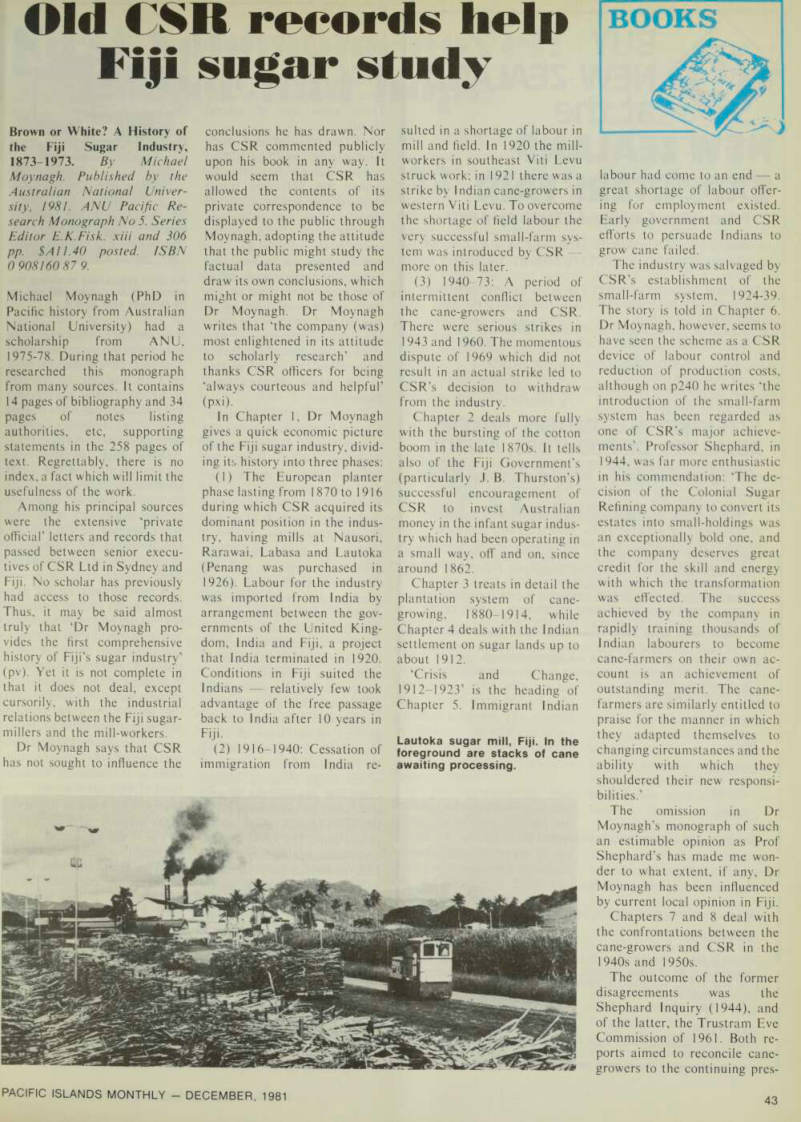
Lautoka sugar mill, Fiji. In the foreground are stacks of cane awaiting processing.
ence of CSR in Fiji. The withdrawal of CSR is the sub ject of Chapter 9.
During the 1960 s the Indians were in financial difficulties.
These arose out of several factors; (1) The basis of the small farm system was that 10-12 acres would provide a living for a man, his wife and young children, the family doing all the work of cultivation, harvest ing, etc, and of reaping the rewards therefrom. But the families grew up, married and had issue of their own, all of whom wanted to live on the farm and be sustained by its insufficient profit. On p6O Moynagh tells that about one third of the labour living on the farms (sons, etc) were surplus to the needs of the farms’ husbandry. (2) Farmers refused to under take the hard work: they bought tractors for which there was but part-time work, employed labour to clean drains, to har vest the cane, etc. As Dr Moynagh says, the farmer came to consider himself as a pro prietor and manager. (3) They were burdened with debt, borrowing to maintain their new standard of living.
Average debt was about two thirds of gross annual income (p 228). There was the huge mutti k'dam (earth money), the premium that had to be paid in acquiring a non-CSR farm.
Accordingly, the demands as presented by the growers’ unions were great because the growers’ needs were of those dimensions. The prestigious the Rt Hon Lord Denning, Master of the Rolls, England, adjudi cated and awarded the farmers with what he considered to be justice in respect of the matter before him. The CSR subsidi ary, South Pacific Sugar Mills Ltd, the then owner of the mills, determined ‘it is not feasible for a commercial milling enterprise to engage in the Denning Con tract on a long-term basis’; it accepted the award but gave two years notice that ‘the own ership of the mills must change’. (Also, says Moynagh, CSR was dismayed at the errors in the Denning Report and at his criticisms of the company.) Since no private investor was willing to buy SPSM, and if the
sugar industry in Fiji were to be continued, the government had to acquire SPSM together with the CSR land not the property of SPSM (which government had refused to buy when offered a few years previously). Govern ment took over on April 1, 1973.
Dr Moynagh tells the story of the formation of the Fiji Sugar Corporation (almost wholly government-owned), notes the striking similarities in its style of management to that of CSR, and describes the unexpected sharp rise in sugar prices in the 19705.
A new formula for the pay ment for cane became operative in 1980. Dr Moynagh notes that ‘some wonder if FSC’s share of proceeds will leave it with sufficient margin to maintain desired capital expenditure’ (p 243). He observes also that the conflict between growers and millers, and between labour and millers, ‘limits the potential contribution the industry can make to the economic develop ment of Fiji’ (p 244).
I spent my working life in the sugar industry, 37'/* years of it in Fiji. 1 do not accept all Dr Moynagh’s conclusions; I think some of them are those of an academician, not those of a businessman. I think also the text contains some errors.
Nevertheless, for those inter ested in Fiji and its sugar industry, 1 think the monograph can be classed as the best available on the subject. I suggest that such people should read it and make their own judgment. LM. Sherwood * *Mr Sherwood is a retired CSR industrial chemist.
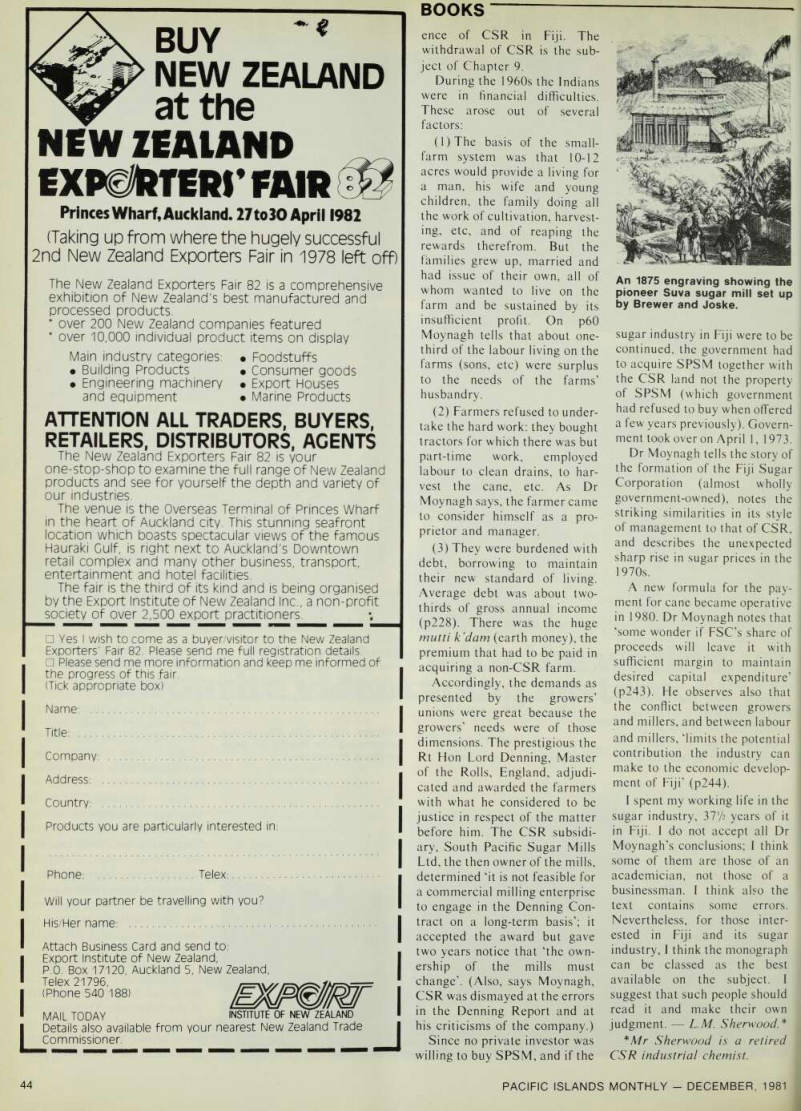
An 1875 engraving showing the pioneer Suva sugar mill set up by Brewer and Joske.