People
pp. 40-44 · Read in the full issue


slap in the face for them’. Mr Corner said he had also marched because of the national interests involved. It had been damaging to New Zealand, he said, for the Rugby Union to invite the Springboks and for the government to permit the visit.
Mr Corner was New Zea land’s ambassador and perma nent representative to the UN for five years until 1967 and headed the New Zealand De partment of Foreign Affairs until his retirement last year.
He was appointed administrator of Tokelau a year ago.
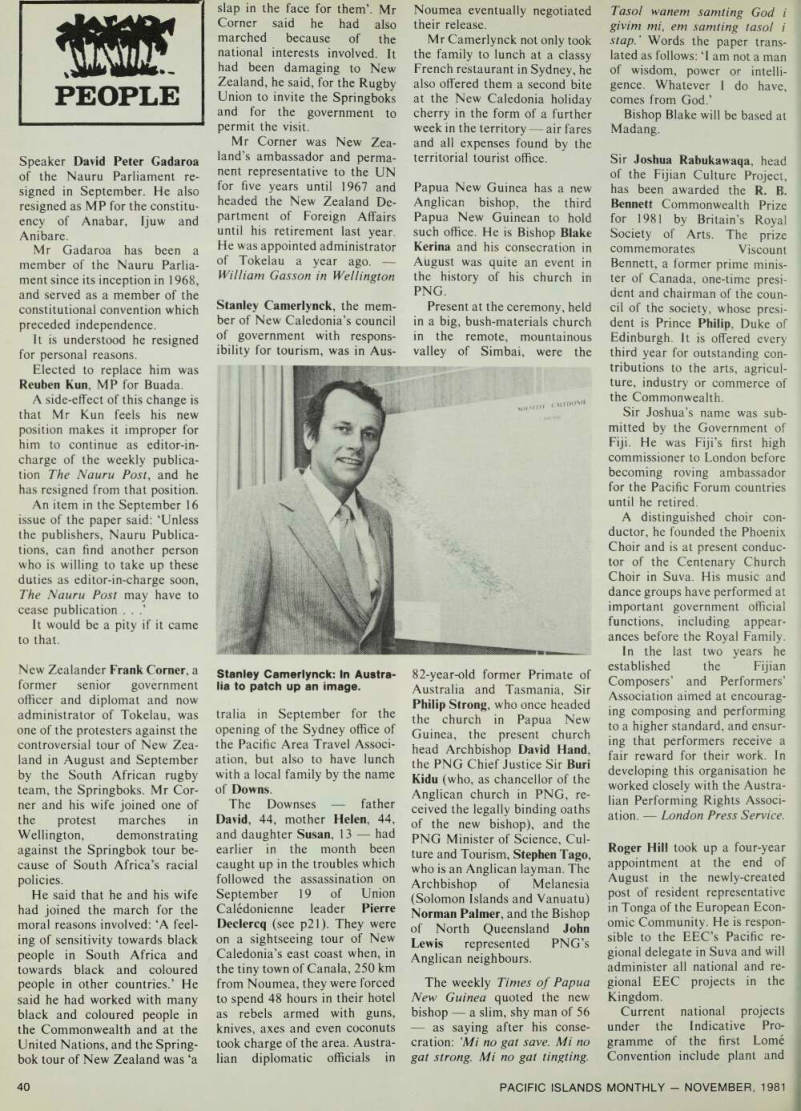
William Gasson in Wellington Stanley Camerlynck, the mem ber of New Caledonia’s council of government with respons ibility for tourism, was in Aus-
Speaker David Peter Gadaroa of the Nauru Parliament re signed in September. He also resigned as MP for the constitu ency of Anabar, Ijuw and Anibare.
Mr Gadaroa has been a member of the Nauru Parlia ment since its inception in 1968, and served as a member of the constitutional convention which preceded independence.
It is understood he resigned for personal reasons.
Elected to replace him was Reuben Kun, MP for Buada.
A side-effect of this change is that Mr Kun feels his new position makes it improper for him to continue as editor-in charge of the weekly publica tion The Nauru Post , and he has resigned from that position.
An item in the September 16 issue of the paper said; ‘Unless the publishers, Nauru Publica tions, can find another person who is willing to take up these duties as editor-in-charge soon.
The Nauru Post may have to cease publication . . .’
It would be a pity if it came to that.
New Zealander Frank Corner, a former senior government officer and diplomat and now administrator of Tokelau, was one of the protesters against the controversial tour of New Zea land in August and September by the South African rugby team, the Springboks. Mr Cor ner and his wife joined one of the protest marches in Wellington, demonstrating against the Springbok tour be cause of South Africa’s racial policies.
He said that he and his wife had joined the march for the moral reasons involved: ‘A feel ing of sensitivity towards black people in South Africa and towards black and coloured people in other countries.’ He said he had worked with many black and coloured people in the Commonwealth and at the United Nations, and the Spring bok tour of New Zealand was ‘a
tralia in September for the opening of the Sydney office of the Pacific Area Travel Associ ation, but also to have lunch with a local family by the name of Downs.
The Downses father David, 44, mother Helen, 44, and daughter Susan, 13 had earlier in the month been caught up in the troubles which followed the assassination on September 19 of Union Caledonienne leader Pierre Declercq (see p2l). They were on a sightseeing tour of New Caledonia’s east coast when, in the tiny town of Canala, 250 km from Noumea, they were forced to spend 48 hours in their hotel as rebels armed with guns, knives, axes and even coconuts took charge of the area. Austra lian diplomatic officials in
Noumea eventually negotiated their release.
Mr Camerlynck not only took the family to lunch at a classy French restaurant in Sydney, he also offered them a second bite at the New Caledonia holiday cherry in the form of a further week in the territory air fares and all expenses found by the territorial tourist office.
Papua New Guinea has a new Anglican bishop, the third Papua New Guinean to hold such office. He is Bishop Blake Kerina and his consecration in August was quite an event in the history of his church in
Png.
Present at the ceremony, held in a big, bush-materials church in the remote, mountainous valley of Simbai, were the
82-year-old former Primate of Australia and Tasmania, Sir Philip Strong, who once headed the church in Papua New Guinea, the present church head Archbishop David Hand, the PNG Chief Justice Sir Buri Kidu (who, as chancellor of the Anglican church in PNG, re ceived the legally binding oaths of the new bishop), and the PNG Minister of Science, Cul ture and Tourism, Stephen Tago, who is an Anglican layman. The Archbishop of Melanesia (Solomon Islands and Vanuatu) Norman Palmer, and the Bishop of North Queensland John Lewis represented PNG’s Anglican neighbours.
The weekly Times of Papua New Guinea quoted the new bishop a slim, shy man of 56 as saying after his conse cration: ‘Mi no gat save. Mi no gat strong. Mi no gat tingting.
Tasol wanem samting God i givim mi, em samting tasol i stap.’ Words the paper trans lated as follows: T am not a man of wisdom, power or intelli gence. Whatever 1 do have, comes from God.’
Bishop Blake will be based at Madang.
Sir Joshua Rabukawaqa, head of the Fijian Culture Project, has been awarded the R. B.
Bennett Commonwealth Prize for 1981 by Britain’s Royal Society of Arts. The prize commemorates Viscount Bennett, a former prime minis ter of Canada, one-time presi dent and chairman of the coun cil of the society, whose presi dent is Prince Philip, Duke of Edinburgh. It is offered every third year for outstanding con tributions to the arts, agricul ture, industry or commerce of the Commonwealth.
Sir Joshua’s name was sub mitted by the Government of Fiji. He was Fiji’s first high commissioner to London before becoming roving ambassador for the Pacific Forum countries until he retired.
A distinguished choir con ductor, he founded the Phoenix Choir and is at present conduc tor of the Centenary Church Choir in Suva. His music and dance groups have performed at important government official functions, including appear ances before the Royal Family.
In the last two years he established the Fijian Composers’ and Performers’
Association aimed at encourag ing composing and performing to a higher standard, and ensur ing that performers receive a fair reward for their work. In developing this organisation he worked closely with the Austra lian Performing Rights Associ
ation.
London Press Service.
Roger Hil! took up a four-year appointment at the end of August in the newly-created post of resident representative in Tonga of the European Econ omic Community. He is respon sible to the EEC’s Pacific re gional delegate in Suva and will administer all national and re gional EEC projects in the Kingdom.
Current national projects under the Indicative Pro gramme of the first Lome Convention include plant and
Stanley Camerlynck: In Austra lia to patch up an image.
equipment for major public works programmes such as the upgrading of the airport road, fisheries and port facilities, a line of credit to the Tonga Development Bank, training courses, and trade promotion, to a total value of ECUS 169 000 (ST2 801 000).
Also funded under Lome I are three Tongan-based re gional projects - the new Gate way Telephone Exchange to become part of the regional telecommunications network, the provision of equipment to upgrade Fuaamotu Airport, and construction of the University of the South Pacific’s regionally-oriented Rural De velopment Centre on the out skirts of Nukualofa. These projects have a combined value of ECU 1 827 000 (STI 615 000).
Mr Hill will also be respon sible for administering further Tonga-based projects as ap proved under Lome 11.
Before coming to Tonga, he worked for four years in Kenya and Mauritius as a project co ordinator under the EEC tech nical assistance programme. He is a graduate geographer and town planner with a strong administrative background.
Penny Hodgkinson in Nukualofa.
Kllisitina M. Fiefia, a senior executive officer in Tonga’s Ministry of Labour, Commerce and Industries, is undertaking a five-year course in business ad ministration at the National Chengchi University, Republic of China (Taiwan). The first year of her studies, which are sponsored by the ROC, will be devoted to study of the Chinese language.
Chairman Frank J. Manaut of Bank of Hawaii has an nounced the appointment of Anthony J. Killingback as Man ager, Overseas Bank of Tonga.
Bank of Hawaii owns 20% of the Tongan bank.
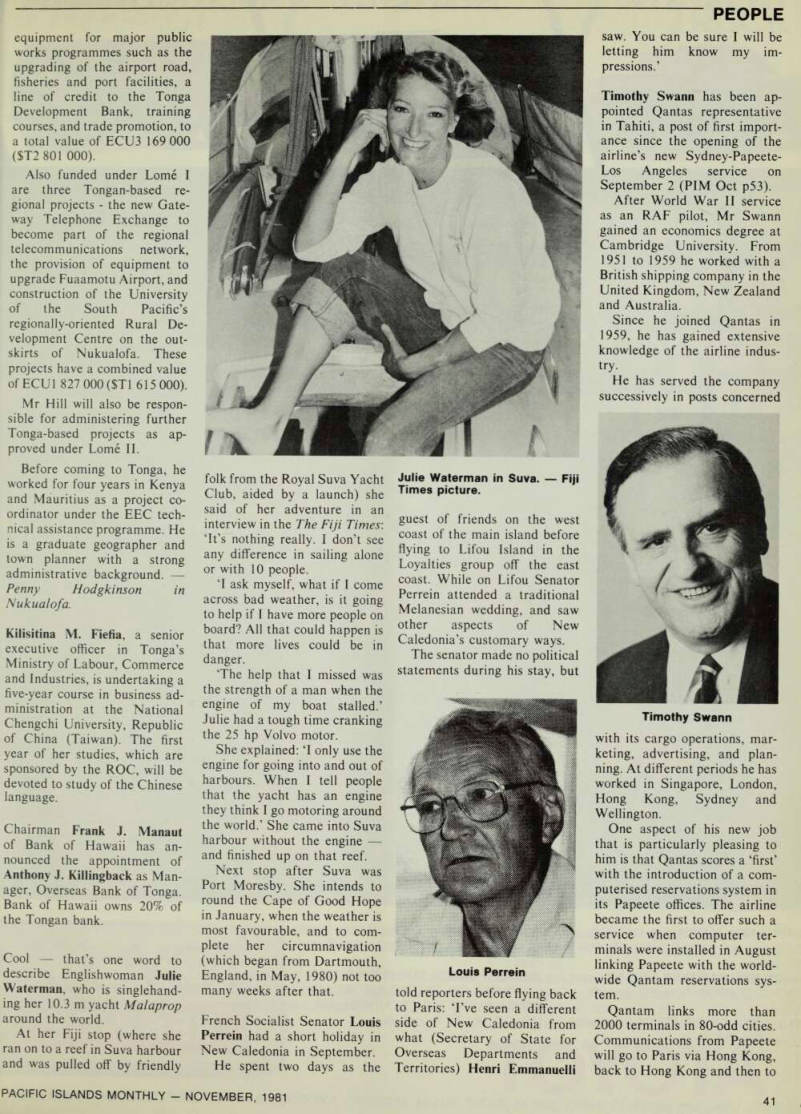
Cool that’s one word to describe Englishwoman Julie Waterman, who is singlehand ing her 10.3 m yacht Malaprop around the world.
At her Fiji stop (where she ran on to a reef in Suva harbour and was pulled off by friendly
folk from the Royal Suva Yacht Club, aided by a launch) she said of her adventure in an interview in the The Fiji Times: ‘lt’s nothing really. I don’t see any difference in sailing alone or with 10 people.
T ask myself, what if I come across bad weather, is it going to help if I have more people on board? All that could happen is that more lives could be in danger. ‘The help that I missed was the strength of a man when the engine of my boat stalled.’
Julie had a tough time cranking the 25 hp Volvo motor.
She explained; T only use the engine for going into and out of harbours. When I tell people that the yacht has an engine they think I go motoring around the world.’ She came into Suva harbour without the engine and finished up on that reef.
Next stop after Suva was Port Moresby. She intends to round the Cape of Good Hope in January, when the weather is most favourable, and to com plete her circumnavigation (which began from Dartmouth, England, in May, 1980) not too many weeks after that.
French Socialist Senator Louis Perrein had a short holiday in New Caledonia in September.
He spent two days as the
guest of friends on the west coast of the main island before flying to Lifou Island in the Loyalties group off the east coast. While on Lifou Senator Perrein attended a traditional Melanesian wedding, and saw other aspects of New Caledonia’s customary ways.
The senator made no political statements during his stay, but
told reporters before flying back to Paris: ‘l’ve seen a different side of New Caledonia from what (Secretary of State for Overseas Departments and Territories) Henri Emmanuelli
People
saw. You can be sure I will be letting him know my im pressions.’
Timothy Swann has been ap pointed Qantas representative in Tahiti, a post of first import ance since the opening of the airline’s new Sydney-Papeete- Los Angeles service on September 2 (PIM Oct p 53).
After World War II service as an RAF pilot, Mr Swann gained an economics degree at Cambridge University. From 1951 to 1959 he worked with a British shipping company in the United Kingdom, New Zealand and Australia.
Since he joined Qantas in 1959, he has gained extensive knowledge of the airline indus try.
He has served the company successively in posts concerned
with its cargo operations, mar keting, advertising, and plan ning. At different periods he has worked in Singapore, London, Hong Kong, Sydney and Wellington.
One aspect of his new job that is particularly pleasing to him is that Qantas scores a ‘first’ with the introduction of a com puterised reservations system in its Papeete offices. The airline became the first to offer such a service when computer ter minals were installed in August linking Papeete with the world wide Qantam reservations sys tem.
Qantam links more than 2000 terminals in 80-odd cities.
Communications from Papeete will go to Paris via Hong Kong, back to Hong Kong and then to
Julie Waterman in Suva. - Fiji Times picture.
Louis Perrein
Timothy Swann
Sydney where the IBM 3032 computers the heart of the system are installed. Despite the distances, responses to messages take only a few seconds. A more direct com munications route is expected to be in use before the end of the year.
New general manager of the Nauru Phosphate Corporation is R. H. Floyd. He replaces B. L.
Blundell, who now holds the post of marketing manager in the corporation’s Melbourne office.
Mr Floyd was born and educated in New Zealand. He holds an honours degree in mining engineering from Otago University. He spent 15 years working with Mount Isa Mines in Queensland, Australia, be fore becoming project manager at the Western Mining Corpor ation’s Windarra mine in West ern Australia.
Before going to Nauru he was in business on his own account in New Zealand.
The Fiji Broadcasting Com mission had their own man in London to cover the royal wedding, but rather than send a reporter from Suva, they asked Isimeli Cerelala to hop across the Channel from Paris where he had finished a term at the university.
An FBC man hailing from Labasa, on Vanua Levu, Isimeli had the fortune to be singled out for a French Government scholarship to teach Fijian to the students at the faculty of linguistics, Port Dauphine Uni versity.
The first Fijian student ever to receive such a scholarship, Isimeli left Suva in December 1980, finishing his stint in Paris at the end of June. The faculty of linguistics, which is part of the prestigious Sorbonne Uni versity, is involved in the study of various Pacific languages.
One of Isimeli’s colleagues was a Maori from New Zealand.
Besides teaching the French students Fijian, Isimeli ended up with a good knowledge of French himself. He was forced to acquire it quickly, as English wasn’t as widely spoken in Paris as he had expected.
FBC’s offer to report on the preparations for the royal wed ding and the wedding itself gave Isimeli the opportunity also to visit London. During the month spent here he managed to see a little of England and also sev eral times visited Bush House, the London base of the BBC external service. There he met an old friend, Heather Waters,
head of BBC’s gramophone library, who had spent 18 months in Suva from September 1977 to March 1979. Ms Waters had been seconded from the BBC and sent to Fiji through the Commonwealth Fund for Tech nical Cooperation to introduce new systems of classifying re cords and tapes in the FBC sound library.
Isimeli found a rather glum atmosphere in Bush House which is yet again threatened by government cuts. One of the programmes threatened is Hello Tomorrow, which is well known to Pacific audiences, as it is regularly broadcast by re gional stations who receive the tapes from the BBC.
Isimeli hopes that his time in Paris will not be wasted and that he will be able to make use of his knowledge of French by covering Pacific events where both French and English are
necessary.
Jimmy Cornell in
London.
They were very far from con ventional farewell remarks made by French Polynesia’s Gaullist deputy Gaston Flosse when he referred at a press conference to the departure of High Commissioner Paul Cousseran for his new posting as prefect in Southern Corsica (PIM Aug p 49).
For four years representa
lives of Flosse’s Tahoeraa Huiraatira party have boy cotted all social occasions at the high commissioner’s residence, having contact with him only for purposes of official work.
Mr Flosse closed his press conference with the words; ‘I heartily applaud the departure of Mr Cousseran because he deserted his role as representa tive of the State and arbiter. He became the United Front’s man and didn’t even win their gratitude for the fact! He did this solely to promote his own advancement and damaged the interests of the Territory in the process. Now his advancement is behind him, because Corsica is no sinecure and Corsicans are not Polynesians. This is by no means a promotion far from it and it seems that the Corsicans are ready and waiting for him. They won’t be hanging any lei round his neck over there!’
Carl Lukech Harris has been appointed Nauruan Welfare Officer in New Zealand.
Mr Harris, a teacher with 17 years service with Nauru’s Edu cation Department, taught at the Nauru Secondary School and transferred later to the Aiwo Primary School.
Keith Bustraan, 25, of Elmira, New York, has been appointed budget officer for the Congress of the Federated States of Micronesia.
Mr Bustraan holds a BA degree in international affairs from Lafayette College, Pennsylvania, and an MA from George Washington University, Washington, DC, where he studied public administration.
As budget officer, he will be responsible for providing staff support to the committee of ways and means, as well as to the whole congress.
He is engaged to Marcia Livingston of New Jersey, who is studying to be an emergency nurse and paramedic, and who is also captain of a rescue squad for the fire department in Falls Church, Virginia.
Mr Bustraan says he finds the people of Ponape very pleasant to work with, and that he is looking forward eagerly to working with the Congress of the FSM.
Ambika Prasad, 31, (above) for mer acting head of the Fiji Institute of Technology’s school of electrical engineering, has been appointed electronic superintendent of the newly formed Technical Services De partment of Bish Ltd. The new operation will carry out the repair and maintenance of highly sophisticated electronic machines including control and electro-medical equipment, radio and radar systems, and instrumentation. It is hoped that it will help not only Fiji but other island countries who have pre viously had to send their equip ment to Australia, New Zealand or the USA for these highly technical repairs.
Heather Waters with guest Isimeli Cerela outside the BBC’s Bush House in London.