Elected, erected,
p. 37 · Read in the full issue
Western Samoa Mp
ejected
Judge rules 1982 before member can stand again
A section of the Western Samoa Electoral Act concerning the sexual relationships of members of parliament was used in Apia in September to dismiss a politician from parliament. The Supreme Court found that Leota Leuluaialii Ituau Ale had, since his election to parlia ment, fathered a child to a woman who was not his wife.
Section 10 of the Electoral Act forbids members of parliament to have sexual relationships except with their marriage part ners, and the court proceedings against Leota arose from an application by the Speaker of the Legislative Assembly, Tuuu Faletoese.
The Chief Justice, Mr Justice R. J. B. St John, upheld the application and issued an order disqualifying Leota from con tinuing to hold his seat in parliament. The order remains effective until the time at which Leota’s parliamentary term would normally have ended.
This means he will be free to stand for parliament again at next year’s general election.
The chief justice also criti
cised the nature of the evidence which Leota gave to the court and accused Leota of having behaved despicably to the young woman involved in the
relationship.
Leota opposed the appli cation on the grounds that the conditions in question for re taining membership of parlia ment were discriminatory, and were therefore in conflict with Article 15 of the Western Samoa national constitution which forbids discriminatory legislation against citizens.
The chief justice ruled that no conflict was involved. He found on the evidence that Leota had for four years con ducted a sexual relationship with a young woman who was not his wife, and that the relationship had extended into the time when Leota was a member of parliament. The woman had given birth to a child in July this year, but earlier Leota had unsuc cessfully attempted to procure an abortion and had sent the woman to New Zealand in an attempt to conceal the birth.
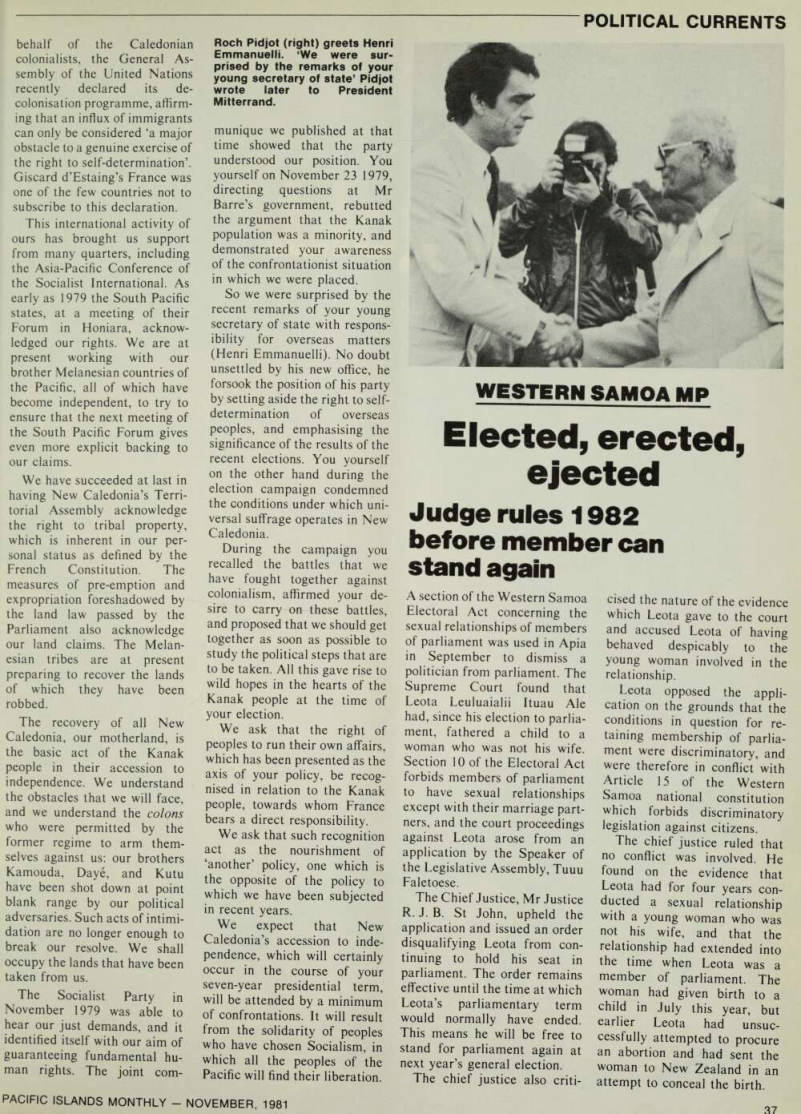
Roch Pidjot (right) greets Henri Emmanuelli. ‘We were sur prised by the remarks of your young secretary of state’ Pidjot wrote later to President Mitterrand.