Tuvalu’s turn for
pp. 33-37 · Read in the full issue

a change of PM
Political
Currents
Following the late-August upset in Solomon Islands when for mer Prime Minister Peter Kenilorea had to give up his job to Solomon Mamaloni (PIM Oct p 33), it was Tuvalu’s turn in September to see the country’s top political post change hands.
Prime Minister Toaripi Lauti was defeated five votes to seven in a parliamentary vote for the prime ministership by Dr Tomasi Puapua. Mr Lauti had been chief minister in the self government period from October 1975, and became prime minister when indepen dence came to Tuvalu on October 1, 1978. He had been in the job ever since.
The September 17 vote fol lowed the first general elections since independence for Tuvalu’s 12-seat parliament. Held on September 8, the elections re sulted in all but four of the sitting members retaining their seats. Two government MPs, including the former minister for social services, lost their seats, as did two opposition MPs.
Prime Minister Dr Tomasi Puapua, who is in his 40s, worked with the Medical De partment in the old Gilbert and Ellice Islands Colony, but re tired to take up a political career when Tuvalu (formerly the Ellice Islands) separated from the Gilberts (now Kiri bati). He is widely seen as a talented administrator and poli tician. He is described as a moderate, and appears unlikely to make any substantial foreign policy changes.
A close observer of the Tuvalu scene writes: ‘The main issue in the election for prime minister appears to have been the close identification of Mr Lauti with a decision to invest government funds with an American financier, Sidney Gross. Both Dr Puapua and (former opposition leader) Henry Faati Naisali led criti cism over the fate of this investment, which has resulted in some fiery exchanges in parliament in its recent sessions. The fact that interest on the investment had begun to
be paid was not, apparently, sufficient to save the prime ministership for Mr Lauti.’
The new five-member cabinet is as follows: Prime Minister, Minister for Civil Service Ad ministration and Local Govern ment, and Minister for Foreign Affairs: Dr Tomasi Puapua; Deputy Prime Minister and Minister for Finance; Henry Faati Naisali; Minister for Works and Communications: Solomona Metia Tealofi; Minis ter for Social Services: Falaile Pilitati; Minister for Commerce and Natural Resources: Lale Seluka.
While there is a general feeling on Funafuti that it was time for a change, and that the new prime minister and cabinet are better qualified than the old, the new government could face problems over the absence from cabinet of members from two of the largest islands, including Funafuti, the seat of govern ment. Both of the islands con cerned elect two members to the parliament.
New cabinet in
Solomon Islands
The appointment of a separate minister for foreign affairs is part of a general restructuring of cabinet which has been undertaken in Solomon Islands following the change of govern ment there. Previously the prime minister held respons ibility for foreign affairs.
The government changed early in September following the defeat in parliament of Peter Kenilorea, who had been prime minister since indepen dence, and the election of Solomon Mamaloni to replace him (PIM Oct p 33).
Mr Mamaloni’s restructured cabinet has now been sworn in.
It consists of six members of his Peoples Alliance Party, one member of the National Demo cratic Party and three indepen dents. The man who has been given the foreign affairs port folio is one of the independents, Ezekiel Alebua from East Honiara electorate. He will also be responsible for international
trade, following the pattern established in Papua New Guinea, Solomon Islands’ near est neighbour. The cabinet also includes a new portfolio for home affairs and national devel opment which Mr Mamaloni announced was of particular importance in his scheme of national management. He has given the portfolio to his deputy, Kamilio Teke. The portfolio draws its responsi bilities from functions which were spread over a number of ministries during the Kenilorea period of government. The functions include development co-ordination over a wide range of economic affairs, the depart ment of agriculture, industry, commerce, manufacture, cattle project development, copra marketing regulation and co operatives.
In addition to the cabinet, Mr Mamaloni has established five ministers for provincial affairs.
Each minister in this group will be responsible for a single province as part of a promised policy of devolving greater powers to the provinces.
The newly sworn in cabinet is: Prime minister, Solomon Mamaloni (Alliance); home affairs, national development and deputy prime minister, Kamilio Teke (Alliance); finance, Bartholomew Ulufa’alu (National Demo cratic leader in parliament); police and justice, Paul
Keyaumi (Alliance); land, en ergy and natural resources, Peter Salaka (Alliance); health and medical services, George Suri (independent); foreign affairs and international trade, Ezekiel Alebua (independent); education and training, Michael Evo (independent); transport, communications and government utilities, John Ngina (Alliance); employment, youth and social development, George Talasasa (Alliance).
The additional ministers re sponsible for provincial affairs are: Western Province, Geoffrey Beti (independent); Guadalcanal, Waeta Ben (inde pendent); Malaita, Adrian Bata (National Democratic); Central Islands and Isabel, Richard Harper (Alliance); Makula and Temotu, Ataban Tropa (Al liance).
Mr Mamaloni announced after he was sworn in that his government’s policies would fol low the long-established key principles of the Alliance Party manifesto which is the party’s foundation platform. The three key principles are decentralis ation, distribution and local participation. The manifesto also calls for the appointment of a president as head of state instead of the present system in which a governor-general rep resents the sovereign head of the Commonwealth of Nations as nominal head of state. Con stitutionally the parliament of Solomon Islands would have to vote in such a change by a majority of at least two thirds of its membership, but Mr Mamaloni has not announced any plan to put the issue to parliament.
Chan sacks a
minister
Roy Evara, leader of the United Party in the Papua New Guinea parliament and a constant source of political controversy in recent months, was sacked
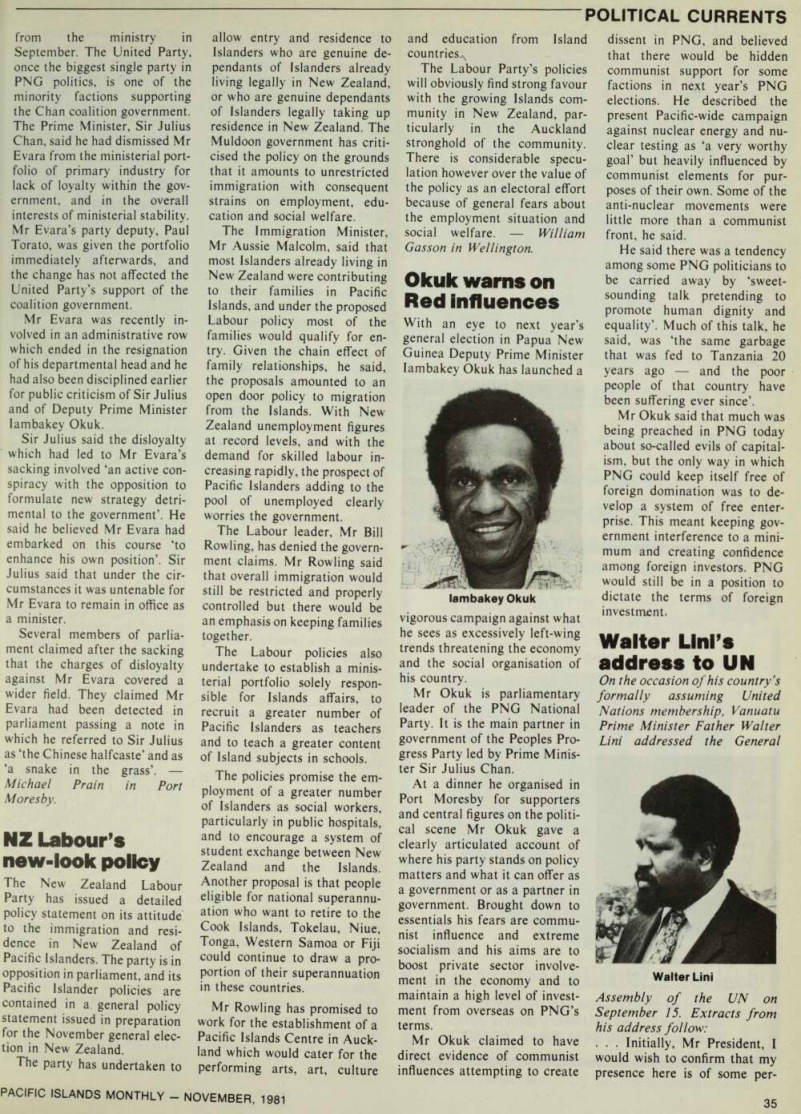
Bartholomew Ulufa’alu, former opposition leader, announced himself as one of the men running for prime minister in Solomon Islands during the re cent change in government. But he withdrew from the vote in parliament and the new prime minister, Solomon Mamaloni, has given him the police and justice portfolio.
from the ministry in September. The United Party, once the biggest single party in PNG politics, is one of the minority factions supporting the Chan coalition government.
The Prime Minister, Sir Julius Chan, said he had dismissed Mr Evara from the ministerial port folio of primary industry for lack of loyalty within the gov ernment, and in the overall interests of ministerial stability.
Mr Evara’s party deputy, Paul Torato, was given the portfolio immediately afterwards, and the change has not affected the United Party’s support of the coalition government.
Mr Evara was recently in volved in an administrative row which ended in the resignation of his departmental head and he had also been disciplined earlier for public criticism of Sir Julius and of Deputy Prime Minister lambakey Okuk.
Sir Julius said the disloyalty which had led to Mr Evara’s sacking involved ‘an active con spiracy with the opposition to formulate new strategy detri mental to the government’. He said he believed Mr Evara had embarked on this course ‘to enhance his own position’. Sir Julius said that under the cir cumstances it was untenable for Mr Evara to remain in office as a minister.
Several members of parlia ment claimed after the sacking that the charges of disloyalty against Mr Evara covered a wider field. They claimed Mr Evara had been detected in parliament passing a note in which he referred to Sir Julius as ‘the Chinese halfcaste’ and as ‘a snake in the grass’.
Michael Prain in Port Moresby.
NZ Labour’s
new-look policy
The New Zealand Labour Party has issued a detailed policy statement on its attitude to the immigration and resi dence in New Zealand of Pacific Islanders. The party is in opposition in parliament, and its Pacific Islander policies are contained in a general policy statement issued in preparation for the November general elec tion in New Zealand.
The party has undertaken to
allow entry and residence to Islanders who are genuine de pendants of Islanders already living legally in New Zealand, or who are genuine dependants of Islanders legally taking up residence in New Zealand. The Muldoon government has criti cised the policy on the grounds that it amounts to unrestricted immigration with consequent strains on employment, edu cation and social welfare.
The Immigration Minister, Mr Aussie Malcolm, said that most Islanders already living in New Zealand were contributing to their families in Pacific Islands, and under the proposed Labour policy most of the families would qualify for en try, Given the chain effect of family relationships, he said, the proposals amounted to an open door policy to migration from the Islands. With New Zealand unemployment figures at record levels, and with the demand for skilled labour in creasing rapidly, the prospect of Pacific Islanders adding to the pool of unemployed clearly worries the government.
The Labour leader, Mr Bill Rowling, has denied the govern ment claims. Mr Rowling said that overall immigration would still be restricted and properly controlled but there would be an emphasis on keeping families together.
The Labour policies also undertake to establish a minis terial portfolio solely respon sible for Islands affairs, to recruit a greater number of Pacific Islanders as teachers and to teach a greater content of Island subjects in schools.
The policies promise the em ployment of a greater number of Islanders as social workers, particularly in public hospitals, and to encourage a system of student exchange between New Zealand and the Islands.
Another proposal is that people eligible for national superannu ation who want to retire to the Cook Islands, Tokelau, Niue, Tonga, Western Samoa or Fiji could continue to draw a pro portion of their superannuation in these countries.
Mr Rowling has promised to work for the establishment of a Pacific Islands Centre in Auck land which would cater for the performing arts, art, culture
and education from Island countries. N The Labour Party’s policies will obviously find strong favour with the growing Islands com munity in New Zealand, par ticularly in the Auckland stronghold of the community.
There is considerable specu lation however over the value of the policy as an electoral effort because of general fears about the employment situation and social welfare. William Gasson in Wellington.
Okuk warns on
Red influences
With an eye to next year’s general election in Papua New Guinea Deputy Prime Minister lambakey Okuk has launched a
vigorous campaign against what he sees as excessively left-wing trends threatening the economy and the social organisation of his country.
Mr Okuk is parliamentary leader of the PNG National Party. It is the main partner in government of the Peoples Pro gress Party led by Prime Minis ter Sir Julius Chan.
At a dinner he organised in Port Moresby for supporters and central figures on the politi cal scene Mr Okuk gave a clearly articulated account of where his party stands on policy matters and what it can offer as a government or as a partner in government. Brought down to essentials his fears are commu nist influence and extreme socialism and his aims are to boost private sector involve ment in the economy and to maintain a high level of invest ment from overseas on PNG’s terms.
Mr Okuk claimed to have direct evidence of communist influences attempting to create
dissent in PNG, and believed that there would be hidden communist support for some factions in next year’s PNG elections. He described the present Pacific-wide campaign against nuclear energy and nu clear testing as ‘a very worthy goal’ but heavily influenced by communist elements for pur poses of their own. Some of the anti-nuclear movements were little more than a communist front, he said.
He said there was a tendency among some PNG politicians to be carried away by ‘sweet sounding talk pretending to promote human dignity and equality’. Much of this talk, he said, was ‘the same garbage that was fed to Tanzania 20 years ago and the poor people of that country have been suffering ever since’.
Mr Okuk said that much was being preached in PNG today about so-called evils of capital ism, but the only way in which PNG could keep itself free of foreign domination was to de velop a system of free enter prise. This meant keeping gov ernment interference to a mini mum and creating confidence among foreign investors. PNG would still be in a position to dictate the terms of foreign investment.
Walter Uni’s
address to UN
On the occasion of his country’s formally assuming United Nations membership, Vanuatu Prime Minister Father Walter Lini addressed the General
Assembly of the UN on September 15. Extracts from his address follow: ■ . . Initially, Mr President, I would wish to confirm that my presence here is of some per
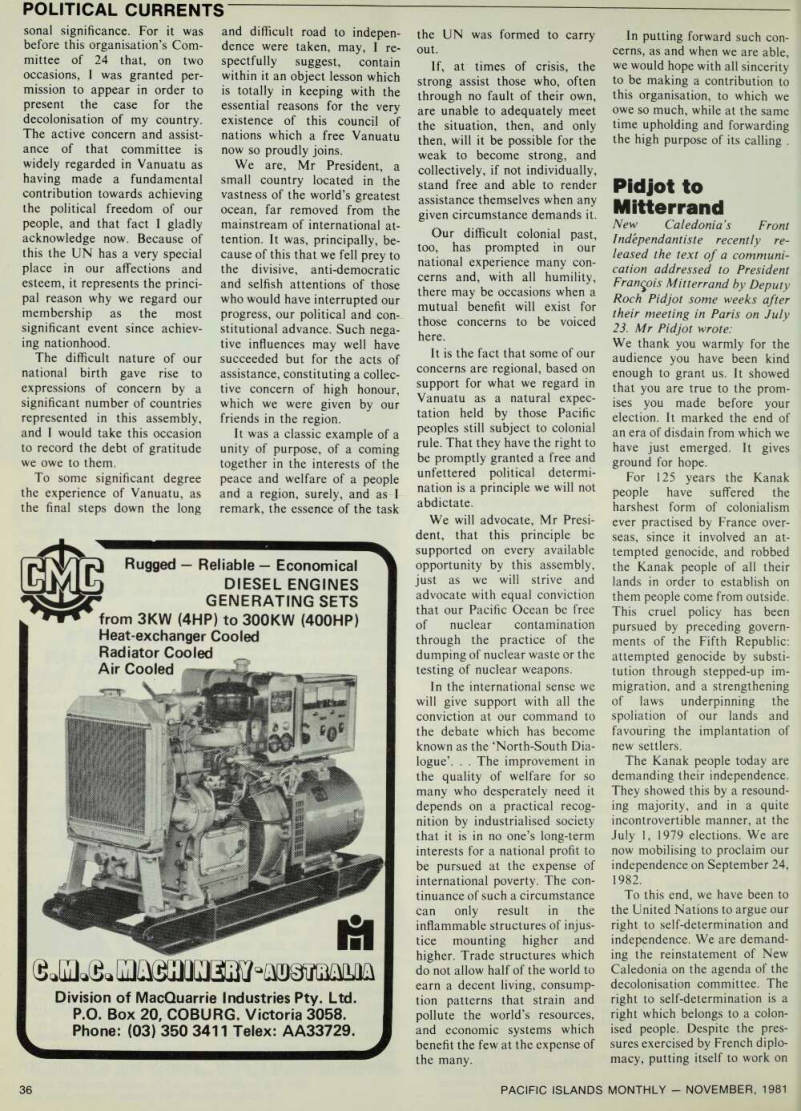
lambakey Okuk
Walter Lini
sonal significance. For it was before this organisation’s Com mittee of 24 that, on two occasions, I was granted per mission to appear in order to present the case for the decolonisation of my country.
The active concern and assist ance of that committee is widely regarded in Vanuatu as having made a fundamental contribution towards achieving the political freedom of our people, and that fact I gladly acknowledge now. Because of this the UN has a very special place in our affections and esteem, it represents the princi pal reason why we regard our membership as the most significant event since achiev ing nationhood.
The difficult nature of our national birth gave rise to expressions of concern by a significant number of countries represented in this assembly, and I would take this occasion to record the debt of gratitude we owe to them.
To some significant degree the experience of Vanuatu, as the final steps down the long
and difficult road to indepen dence were taken, may, I re spectfully suggest, contain within it an object lesson which is totally in keeping with the essential reasons for the very existence of this council of nations which a free Vanuatu now so proudly joins.
We are, Mr President, a small country located in the vastness of the world’s greatest ocean, far removed from the mainstream of international at tention. It was, principally, be cause of this that we fell prey to the divisive, anti-democratic and selfish attentions of those who would have interrupted our progress, our political and con stitutional advance. Such nega tive influences may well have succeeded but for the acts of assistance, constituting a collec tive concern of high honour, which we were given by our friends in the region.
It was a classic example of a unity of purpose, of a coming together in the interests of the peace and welfare of a people and a region, surely, and as I remark, the essence of the task
the UN was formed to carry out.
If, at times of crisis, the strong assist those who, often through no fault of their own, are unable to adequately meet the situation, then, and only then, will it be possible for the weak to become strong, and collectively, if not individually, stand free and able to render assistance themselves when any given circumstance demands it.
Our difficult colonial past, too, has prompted in our national experience many con cerns and, with all humility, there may be occasions when a mutual benefit will exist for those concerns to be voiced here.
It is the fact that some of our concerns are regional, based on support for what we regard in Vanuatu as a natural expec tation held by those Pacific peoples still subject to colonial rule. That they have the right to be promptly granted a free and unfettered political determi nation is a principle we will not abdictate.
We will advocate, Mr Presi dent, that this principle be supported on every available opportunity by this assembly, just as we will strive and advocate with equal conviction that our Pacific Ocean be free of nuclear contamination through the practice of the dumping of nuclear waste or the testing of nuclear weapons.
In the international sense we will give support with all the conviction at our command to the debate which has become known as the ‘North-South Dia logue’. . . The improvement in the quality of welfare for so many who desperately need it depends on a practical recog nition by industrialised society that it is in no one’s long-term interests for a national profit to be pursued at the expense of international poverty. The con tinuance of such a circumstance can only result in the inflammable structures of injus tice mounting higher and higher. Trade structures which do not allow half of the world to earn a decent living, consump tion patterns that strain and pollute the world’s resources, and economic systems which benefit the few at the expense of the many.
In putting forward such con cerns, as and when we are able, we would hope with all sincerity to be making a contribution to this organisation, to which we owe so much, while at the same time upholding and forwarding the high purpose of its calling .
Pidjot to
Mitterrand
New Caledonia’s Front Independantiste recently re leased the text of a communi cation addressed to President Francois Mitterrand by Deputy Roch Pidjot some weeks after their meeting in Paris on July 23. Mr Pidjot wrote: We thank you warmly for the audience you have been kind enough to grant us. It showed that you are true to the prom ises you made before your election. It marked the end of an era of disdain from which we have just emerged. It gives ground for hope.
For 125 years the Kanak people have suffered the harshest form of colonialism ever practised by France over seas, since it involved an at tempted genocide, and robbed the Kanak people of all their lands in order to establish on them people come from outside.
This cruel policy has been pursued by preceding govern ments of the Fifth Republic: attempted genocide by substi tution through stepped-up im migration, and a strengthening of laws underpinning the spoliation of our lands and favouring the implantation of new settlers.
The Kanak people today are demanding their independence.
They showed this by a resound ing majority, and in a quite incontrovertible manner, at the July 1, 1979 elections. We are now mobilising to proclaim our independence on September 24, 1982.
To this end, we have been to the United Nations to argue our right to self-determination and independence. We are demand ing the reinstatement of New Caledonia on the agenda of the decolonisation committee. The right to self-determination is a right which belongs to a colon ised people. Despite the pres sures exercised by French diplo macy, putting itself to work on
behalf of the Caledonian colonialists, the General As sembly of the United Nations recently declared its de colonisation programme, affirm ing that an influx of immigrants can only be considered ‘a major obstacle to a genuine exercise of the right to self-determination’.
Giscard d’Estaing’s France was one of the few countries not to subscribe to this declaration.
This international activity of ours has brought us support from many quarters, including the Asia-Pacific Conference of the Socialist International. As early as 1979 the South Pacific states, at a meeting of their Forum in Honiara, acknow ledged our rights. We are at present working with our brother Melanesian countries of the Pacific, all of which have become independent, to try to ensure that the next meeting of the South Pacific Forum gives even more explicit backing to our claims.
We have succeeded at last in having New Caledonia’s Terri torial Assembly acknowledge the right to tribal property, which is inherent in our per sonal status as defined by the French Constitution. The measures of pre-emption and expropriation foreshadowed by the land law passed by the Parliament also acknowledge our land claims. The Melan esian tribes are at present preparing to recover the lands of which they have been robbed.
The recovery of all New Caledonia, our motherland, is the basic act of the Kanak people in their accession to independence. We understand the obstacles that we will face, and we understand the colons who were permitted by the former regime to arm them selves against us: our brothers Kamouda, Daye, and Kutu have been shot down at point blank range by our political adversaries. Such acts of intimi dation are no longer enough to break our resolve. We shall occupy the lands that have been taken from us.
The Socialist Party in November 1979 was able to hear our just demands, and it identified itself with our aim of guaranteeing fundamental hu man rights. The joint com
munique we published at that time showed that the party understood our position. You yourself on November 23 1979, directing questions at Mr Barre’s government, rebutted the argument that the Kanak population was a minority, and demonstrated your awareness of the confrontationist situation in which we were placed.
So we were surprised by the recent remarks of your young secretary of state with respons ibility for overseas matters (Henri Emmanuelli). No doubt unsettled by his new office, he forsook the position of his party by setting aside the right to self determination of overseas peoples, and emphasising the significance of the results of the recent elections. You yourself on the other hand during the election campaign condemned the conditions under which uni versal suffrage operates in New Caledonia.
During the campaign you recalled the battles that we have fought together against colonialism, affirmed your de sire to carry on these battles, and proposed that we should get together as soon as possible to study the political steps that are to be taken. All this gave rise to wild hopes in the hearts of the Kanak people at the time of your election.
We ask that the right of peoples to run their own affairs, which has been presented as the axis of your policy, be recog nised in relation to the Kanak people, towards whom France bears a direct responsibility.
We ask that such recognition act as the nourishment of ‘another’ policy, one which is the opposite of the policy to which we have been subjected in recent years.
We expect that New Caledonia’s accession to inde pendence, which will certainly occur in the course of your seven-year presidential term, will be attended by a minimum of confrontations. It will result from the solidarity of peoples who have chosen Socialism, in which all the peoples of the Pacific will find their liberation.