A jaundiced
pp. 25-32 · Read in the full issue

Tropicalities
A jaundiced look at Captain Cook
‘NOTHING seems to be sacred any more. Generations of Aus tralians have been brought up to revere the memory of Captain Cook, the four-square, prag matic and efficient sailor who put the nation on the map. Or did he? According to a book soon to be published, Cook was nothing much more than a crazed bully whose record of flogging his sailors made Bligh seem like an angel of mercy.
Moreover, the great man pun ished natives who crossed his path with Vietnam-style search and-destroy operations. The author, Australian journalist Jillian Robertson, asserts that Cook plagiarised his maps, bungled the scientific work in volved with tracking the transit of Venus, and, far from having an affection for Australia, posi tively disliked the place. The decision to make the country a dumping ground for unwanted convicts, she claims, stems from Cook’s inadequate exploration and lack of enthusiasm for Australia. Rather than a foun der of the nation, Cook, she argues, was a founderer .. .’
The Sydney Morning Herald editorial of September 29, 1981, opened with these arrest ing words. It was commenting on a report from its London correspondent, Margaret Jones, which had appeared the day before.
Ms Jones’ article introduced the book The Captain Cook Myth, scheduled for October publication in London. The author has worked in Britain and the United States, and now lives in Britain. She claims that the hard facts about the Cook ‘myth’ struck her when she was researching material on the life of Sir Joseph Banks, the botan ist on the Endeavour.
Margaret Jones writes: The facts about Cook and his
voyages are clearly in contra diction to the mythology which had evolved around the man to whom, it was widely believed, Australia owed its very exist ence.
The truth is, says Jillian Robertson, that Captain Cook was completely uninterested in Australia, and had little or no faith in its possibilities. In nearly seven years in the Pacific, he visited New Zealand five times, Tahiti four times and mainland Australia once.
His character, she believes, was no more to be admired than his judgment. Most Australians are brought up to see Cook as an austere and dedicated man, a working-class lad who made good by sheer hard slog, and an unusually benign ship’s master.
In fact, there were 60 flog gings on the Endeavour in two years, compared to 11 in 14
months on the Bounty under Captain William Bligh. Cook’s floggers used a cat-o’-nine-tails, each of the nine strands having three knots. As commanding officers were authorised to order 24 strokes (each producing nine cuts), the injuries inflicted could be frightful.
Jillian Robertson says that when ‘punishing’ island chiefs and others, Cook went well beyond the 24-stroke limit, and she quotes the case of one chief flogged until ‘his skin came away in shreds’.
On his last voyage, Cook had men’s ears cropped, and their
arms slashed with knives. When islanders near Tahiti stole a goat, Cook had his marines burn every hut in the village and destroy all canoes which could be found.
So much for the myth of the kindly captain. Jillian discounts stories that Cook may have contracted syphilis (he was too cold and austere for promis cuity). However, she quotes a theory that his diet may have been to blame.
Cook is always credited with keeping his crew free of scurvy by insisting they gather up and eat wild greens, wherever poss ible. He himself ate wild celery, wild spinach and the cresses, and excessive quantities of spin ach are believed to produce a niacin deficiency leading to mental disturbance.
She says his murder in Hawaii was undoubtedly
Cook’s own doing. His death was brought about by his uncon trollable temper and he had no one but himself to blame. At Kealakekua Bay, there had been trouble over thieving, and Cook went ashore to take a hostage, announcing that ‘they’ (the islanders) ‘will not stand the fire of a single musket’.
When a fracas broke out, Cook began shooting, but within min utes he and four marines were dead, and the rest of the party had fled back to the ship .. .
Jillian Robertson notes that Cook was not even the first Englishman to set foot on Aus
tralian soil. This honour belongs to William Dampier, who visited Australia twice, once in 1688, and again in 1699. Jillian Robertson points out with acerbity that in 1988, the bicentenary of European settle ment will coincide with the tricentenary of Dampier’s first visit ‘but, as usual, Dampier will be ignored’. (End of quo tation from Margaret Jones.) Jillian Robertson has ideas as to why Australians have turned Captain Cook into one of their super-heroes. She writes at one point: ‘The glorification of Cap tain Cook in Australia has something to it of the irony of Anzac Day, the celebration of what was essentially a horrendously mismanaged de bacle. Australians seem so des perate for things to glorify that the facts about almost anything can be twisted to fit the need.’
And again: ‘He was the independent chap, of modest origins, unashamedly unsophis ticated, seeking his own for tune, breaking down barriers and paying and making his own way, the embodiment of both the new social mobility of Australians and their character ideals.’
Let us leave the last word to the SMH editorialist with whom we began. The September 29 editorial closed with the words: ‘While this debunking of Captain Cook needs to be fully explored before it is accepted or taken too seriously, the fact that a national icon has been savagely scrutinised is significant. For the way we write the lives of our great men tells more about ourselves than it does about the people under investigation.’
Australia’s own
‘Paunch Corps’?
Australia has announced the establishment of a new form of overseas development assist ance.
The Australian Executive Service Overseas Program will be administered by the Austra lian Development Assistance Bureau. A spokesman said that the objective of the programme was to assist the economic growth of developing countries by using the services of both retired and active business executives who would make a voluntary contribution of their
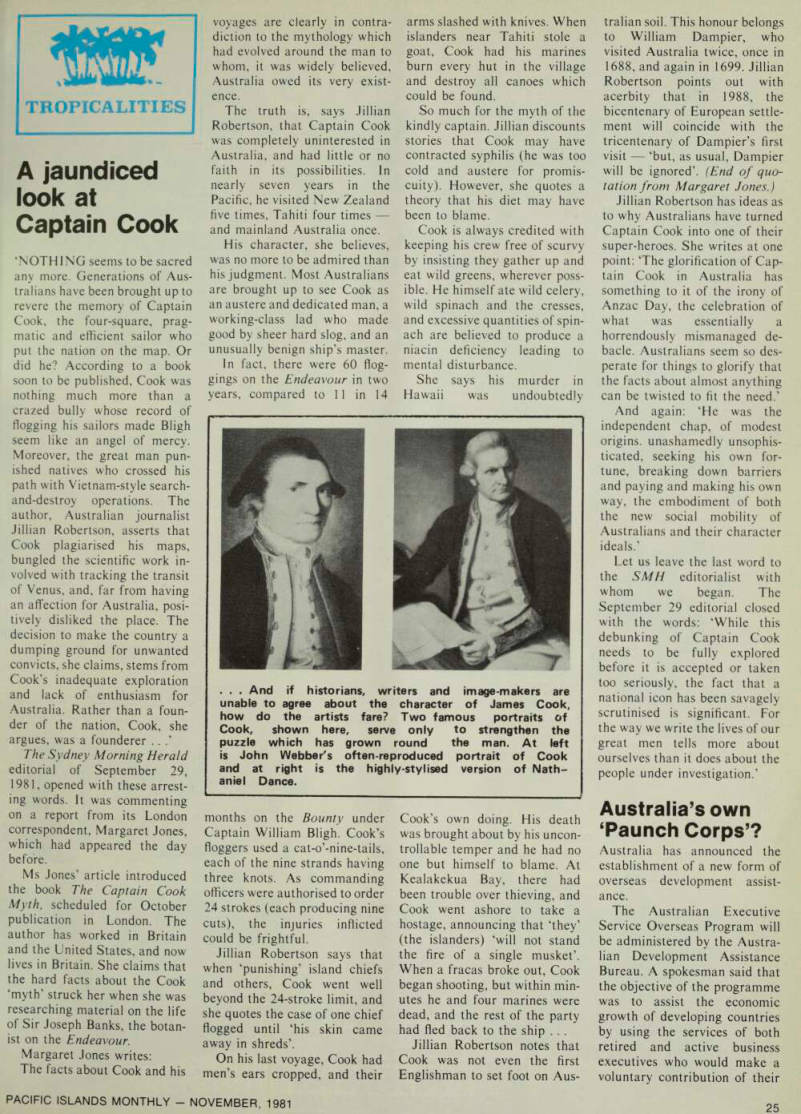
. . . And if historians, writers and image-makers are unable to agree about the character of James Cook, how do the artists fare? Two famous portraits of Cook, shown here, serve only to strengthen the puzzle which has grown round the man. At left is John Webber's often-reproduced portrait of Cook and at right is the highly-stylised version of Nath aniel Dance.
expertise and experience to enterprises in those countries.
He said that the programme would initially be on a trial basis when the Confederation of Aus tralian Industry (CAI) would be responsible for its organis ation and management. The CAI was examining how best to use existing contacts estab lished through various business co-operation committees.
Volunteers would be placed with business and community organisations for assignments lasting from a minimum of two months to a maximum of six.
The programme would meet the costs of their economy air fares to and from their placements, and local enterprises would pay for accommodation, meals and out-of-pocket expenses.
As well as the economic benefits, the programme would help strengthen co-operation and understanding between Australians and the peoples of developing countries.
A similar programme launched by the Canadian Gov ernment to make use of the skills of retired executives soon earned the irreverent title of ‘the Paunch Corps’.
After Hokule’
Hawaiiki-Nui
Under construction at Papara, Tahiti, is a double-hulled Polynesian sailing canoe the Hawaiiki-Nui whose mission in life is to make a voyage from Tahiti to New Zealand. The voyage, to take place next year, will mark the 1000th anniver sary of the discovery of New Zealand by Polynesians at Aotearoa.
The canoe is the property of Francis Cowan, and the two 20-metre, 2.5-tonne hollowed Totara logs which will form her hulls were transported from New Zealand by the Bounty , a freighter belonging to the Tahiti-based transport company J. A. Cowan et fils.
Francis Cowan and Matahi Brightwell will be responsible for construction. After navigational trials in Tahitian waters, the canoe will make its official departure from the Taputapuatea Marae at Raiatea.
How the Fijians
fight ...
The small but tough Fijian army, blooded in Lebanon and now preparing for new peace keeping duties in Sinai, has brought to the Middle East a new style of fighting in that arid area half a world away from the lush South Pacific.’
So writes Robert Trumbull, veteran reporter on Pacific affairs, in The New York Times. Trumbull paid a visit to Fiji in August. Trumbull goes on; ‘For example, said the army commander. Brigadier lan Thorne of New Zealand, in stead of firing their rifles, the Fijians would rather swing them like the war clubs of their ancestors. ‘Similarly, he said, they like to hurl a hand grenade at an enemy without first pulling the
firing pin, thus making it a steel equivalent of the traditional “throwing club’’ with which earlier Fijian warriors stunned an opponent before closing in with the larger bludgeon for the kill.
The Fijian Government, which has had 600 soldiers in Lebanon since 1978 as part of a United Nations peacekeeping force, has agreed to send a 500-member infantry battalion to Sinai . . . ‘Fijian experience in modern warfare began with a political leader named Lala Sukuna, later knighted by the British king for service to the empire. ‘Sir Lala, as he is called now, tried to enlist in the British army at the outset of World War I, was rejected, joined the French Foreign Legion, was discharged after being seriously wounded, applied to the British army again and was accepted. ‘About the same time. Briga dier Thorne had said, large numbers of Fijians joined New Zealand’s army posing as
Maoris, and fought against the Germans.
To bolster the disguise, he said, many of the Fijian volun teers adopted British surnames common among Maoris of mixed-race, like Smith and Brown, that survive in prominent Fijian families today.
The Fijians gained renown as jungle fighters against the Japanese in World War 11, serving under American com mand in the Solomon Islands campaign, and against commu nist guerilla insurgents in Malaya, now part of Malaysia, in the 19505. ‘Sir Penaia Ganilau, who commanded the Fijian troops in Malaya and is now deputy prime minister of Fiji, recalled that the islanders had killed more than 10 guerillas for every Fijian lost in that 12-year cam paign. ‘Palestinian intruders into the area guarded by the Fijian peacekeeping units in southern Lebanon around Tyre have con fronted the Pacific Island soldiers with cultural traits as strange to them as theirs are to the Arabs’, said Brigadier Thorne, a retired New Zealand army officer who took command of Fiji’s army three years ago on contract.
An Arab stopped at a checkpoint may become upset, strike the Fijian soldier and be carried away with a fractured jaw, Brigadier Thorne said.
Four or five days later, there’s a retaliatory attack on the Fijian post. This puzzles the Fijians, who are accustomed to settling differences on the spot.
Thirteen members of the Fijian force have lost their lives during the three years of duty in Lebanon. Brigadier Thorne be lieves that the Fijians, who have been under orders to fire back when attacked, have inflicted many more casualties upon those who attacked them, but said that it is impossible to keep score.
By a smidgen in
the Widgeon
A Sea Bee Air Widgeon plane piloted by Norman Sansom made a dicey flight in September to bring an emerg ency patient from Tuvalu’s
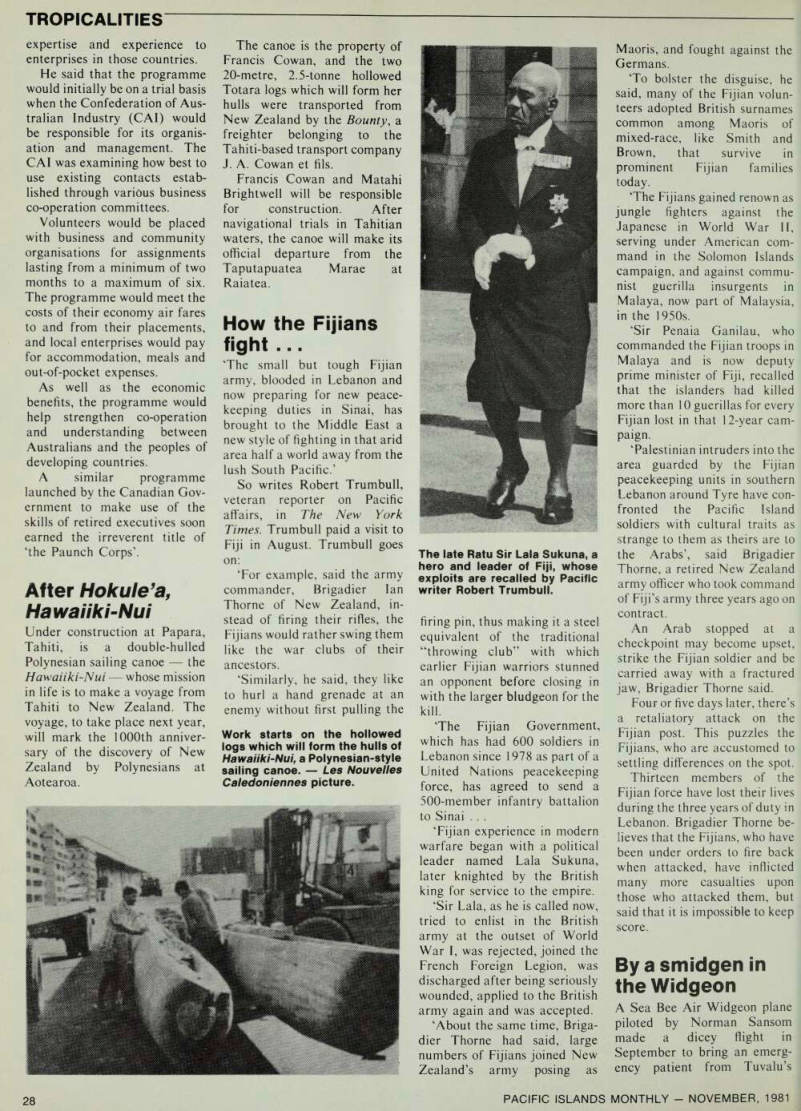
Work starts on the hollowed logs which will form the hulls of Hawaiiki-Nui, a Polynesian-style sailing canoe. - Les Nouvelles Caledoniennes picture.
The late Ratu Sir Lala Sukuna, a hero and leader of Fiji, whose exploits are recalled by Pacific writer Robert Trumbull.
Nukufetau Island to hospital on Funafuti.
Earlier in the day Mr Sansom had had to cancel a scheduled flight to Nui due to strong easterlies which, blowing across Funafuti’s grass airstrip, made take-offs and landings risky.
What’s more the sky was heavily overcast.
However, when called by Dr Tekie losefa with an inquiry as to whether a flight would be possible, Mr Sansom after much reflection said he would give it a try. It was already after 4 pm. The flight to and from Nukufetau was un eventful, but the problem was he had only about half an hour’s daylight flying time left. It was already almost dark when, about 6 pm, the Widgeon drone was heard over Fogafale. The plane circled the main islet twice before coming in to land on the Funafuti lagoon, without landing lights and head-on into the still strong easterlies.
The police firetruck and am bulance were there, beaming their lights into the lagoon. The patient was swiftly transferred to the ambulance and whisked off to hospital.
One more happy episode in the endless saga of small aircraft, Pacific Islands, avi ation. • Good news for Tuvalu avi ation was the arrival in September of Sea Bee Air’s Grumman Goose. The ‘big’ 10-seater plane will enter the trial service inaugurated by the company last year under agree ment with the Tuvalu Govern ment. Plans are being drawn up ;o put the Grumman Goose into service to countries beyond Fuvalu.
World congress of
disabled people
Delegates from Pacific Island countries are being invited to ittend the first world congress )f Disabled Peoples Inter lational which is to be held in Singapore from November 29. fhe congress will also mark the ormal founding of Disabled
Copies International, following
series of regional meetings vhich have already been held.
An Australian, Mr Gustav Rebels from the Sydney suburb f Eastern Creek, has been
organising arrangements for the Pacific delegation and has been liaising with disabled people’s groups in Papua New Guinea and Fiji. Mr Gebels said that the integration of handicapped people into normal society had only recently come under strong examination in many of the Island communities.
Much had yet to be done in terms of material progress and community attitudes, but the move had started. Mr Gebels said that the newly-emerging Disabled Peoples International hoped to become a major com munity force in the Islands region. He described it as ‘an organisation with a difference, an organisation of handicapped people not for handicapped people’.
Ratu Sir George
gets a football
It’s not often that yachtsmen arrive in Fiji with rugby foot balls under their arms.
But when Rear-Commodore Geoff Foster of Sydney, Austra lia’s, Middle Harbour Yacht Club visited Fiji recently, it was a very special football for a very special person.
The football was
subsequently presented by Rear-Commodore Foster, and Warwick Davis, promotions manager of Tooth & Co Ltd, to His Excellency, the Governor- General of Fiji, Ratu Sir George Cakobau.
The football had been signed back in Australia by the Austra lian and French rugby teams before the First Test played at Ballymore, Brisbane. It was taken to Fiji as a special present to Ratu Sir George, a noted former Fijian rugby player.
Ratu Sir George first played rugby in Sydney when a school boy at Newington College in the GPS Competition, and he rep resented Fiji in rugby in 1938 and 1939, and cricket in 1945.
He led the Fiji team which toured New Zealand, the only unbeaten rugby team from any nation ever to tour New Zea land. He also represented the government of Fiji on rugby tours of Australia in 1952 and 1954, in 1961 and in 1969.
At present Ratu Sir George is patron of the Fiji Rugby Union, while his former team-mate in
the prewar tour of New Zea land, Ratu Sir Penaia Ganilau, who is now deputy prime minis ter of Fiji, is the president of the Fiji Rugby Union.
Indonesia, PNG
hit drug-runners
Indonesia’s 750-km land border with Papua New Guinea has been closed to foreigners in a bid to block a drug corridor between the two countries.
The closure, which has the backing of the PNG govern ment, means that foreigners wanting to cross from the Indonesian province of Irian Jaya into PNG can only do so by air or sea. The move follows regular reports that Asian drug couriers heading for the lucra tive Australian and New Zea land markets have been making land crossings of the border in recent months.
The couriers are said to have been dropped by boat in a remote region of southern Irian Jaya to walk undetected across the border into the equally remote Western Province of PNG. There are no permanent passport or customs checkpoints on either side of the border in this area.
The closest checkpoint in Irian Jaya is at the town of Merauke, about 80 km west of the border, while the nearest in PNG is the seaport of Daru, about 270 km east.
The border closure was an nounced in the Irian Jaya capi tal, Jayapura, by the province’s governor and former Indonesian ambassador to PNG, General Busjiri Suryowinoto.
A PNG government official said air and sea travel between Irian Jaya and PNG would not be affected, nor would the closure apply to villagers living on the border. He said both PNG and Indonesia had be come ‘increasingly concerned’ about drug trafficking between the two countries in remote areas. They had agreed to work together in future to prevent illegal border crossings.
The official said it was be lieved a wide range of drugs worth millions of dollars was being transported across the border including cannabis, hashish oil and buddha sticks. ‘The drugs are almost certainly
Ratu Sir George Cakobau, Governor-General of Fiji and once a noted rugby player, receives the internationally autographed football from Warwick Davis.
earmarked for the Australian and New Zealand markets,’ the official said.
Tt appears that after crossing from Irian Jaya into PNG undetected, the couriers are unloading their caches on to boats waiting to take them across Torres Strait to Austra lia. By island-hopping, you need only a 5 m aluminium dinghy to cross the Strait safely. We also have reports of mysterious planes in the area, so it seems likely that the drugs are also being moved to Australia by air from isolated airstrips in PNG.’
The official said PNG’s sur veillance of the Irian Jaya border was severely hampered by a lack of manpower. The border region was also rugged and remote, which made patrol ling difficult.
PNG Foreign Minister Noel Levi said drug trafficking was occurring on a ‘sizeable scale’ on both sides of the border. ‘There are a lot of places in the Western Province alone from which drugs could be moved to
Australia,’ he said.
Michael
Prain in Port Moresby.
50th anniversary
of PNG mission
From August 1981 through to February 1982, the Asia Pacific Christian Mission and the national church which grew from it, the Evangelical Church of Papua, are celebrating 50 years’ service in Papua New Guinea.
Known in its initial years as the Unevangelised Fields Mission, the mission went to the more remote areas of the West ern Province, up the mighty Fly River and along the Ok Tedi and Ok Mari, and in 1950 was the first mission to go into the Southern Highlands, establish ing its first base at Lake Kutubu.
In the Western Province the mission has two of the three or four resident doctors, conducts the only two medical training schools (the Balimo School of Nursing and the Rumginae School for Aid Post Orderlies), and is responsible for the health care of half the population of the Province.
A large agro-nutrition five year project is under way at Rumginae up near the Irian
Jaya border sponsored by World Vision and the Depart ment of Minerals and Energy, and administered by the Mission. The high school at Awaba has an enrolment of 400 and a national as principal, Frank Medu.
In the church field, the Gogodala Christian Training Centre at Mapodo is under the principalship of Pastor Sika Galiapa, a graduate of the Christian Leaders’ Training College.
In the Southern Highlands Province the mission conducts the Dauli Teachers’ College.
The 50 years of service are being celebrated by the use of special logos on airletters, writ ing pads, greeting cards, posters and T-shirts, the production of a cassette tape of singing, entitled Songs from the E.C.P., a glossy book of pictures in colour, and special weekends of sports and services in the various church areas.
These logos were the winners in a special 50th anniversary competition held among the young people of the Southern Highlands and Western Prov inces.
Reviving Tonga’s
kalias
Fifty years or so ago kalias were a familiar sight in Tonga’s outer islands, skimming across the waves on fishing trips. They were gradually replaced with power boats.
But with spiralling fuel costs cutting deeply into all power boat fishing operations, re searchers have developed a prototype vessel that, like the kalia, relies on sails.
If this vessel is accepted by island fishermen it could mean a revolution in the Pacific.
The new wind-powered fish ing vessel is the Fafa-ki-tahi (Feeler of the waters), a cata maran developed and built by the Tongan Fisheries Depart ment, the United Nations Food and Agriculture Organisation (UNFAO) and the Foundation for the Peoples of the South Pacific (FSP) with funds from the United States Government
(Usaid).
Besides this catamaran, this joint effort has also produced various other prototype fishing vessels that are currently being used successfully in Vavau and Haapai by local fishermen.
The Fafa-ki-tahi was recently in Suva, Fiji where it was demonstrated to delegates to a rural technology workshop.
The Fafa-ki-tahi has been specially designed for off-shore fishing in 40 to 200 fathoms.
She is 10 m long, 5 m wide, and draws 1.2 m, and is ideally suited for island fishermen be cause she operates at little cost.
She has a 30 hp engine used for manoeuvring in and out of harbour.
The Fafa-ki-tahi, fully equip ped with fishing gear and other accessories, cost about SUSIIOOO, reasonably inex pensive when one considers that it can carry a crew of four to six and up to three tonnes of fish.
The catamaran has a cabin in each hull, with a galley and a bed in one and a radio chartroom and bed in the other.
According to the skipper for its trip to Fiji, Captain Malakai Tapea-lava, it is a very stable vessel and should be ideal for fishing. It sailed from Nukualofa to Suva in 80 hours on its maiden voyage, and returned in 11 days fighting rough seas and a headwind most of the way.
Coral, shells
threatened
Commercial exploitation is threatening the existence of coral and shells in various parts of the world, according to Susan Wells, a Cambridge ecologist, who delivered the warning at a conference of the International Union for Conservation and
Natural Resources held re cently in the Philippines.
She was in the country on a Winston Churchill Memorial Trust Travelling Fellowship to investigate the shell and coral trade. She also visited Papua New Guinea as part of her investigations.
Until commercial exploi tation of coral and shells is regulated and reserves are cre ated to provide protection of the habitat as well as to breeding populations of commercially valuable species, it is impossible to say what damage may be occurring by the over-collection of these species, Miss Wells told the conference.
In many countries the trade is illegal but because of the cur rent fashion for shell lampshades and other orna ments, it continues to flourish, even increasing in some cases.
Many shells and corals are prized by collectors too because they are rare or unusual, she said.
Coral is used as a decorative building material in the Philippines, but its removal from the reef usually in its live and soft state has already upset the natural ecol ogy of the area.
This is one area where the ban on exporting coral is openly flouted,’ said Miss Wells. Tt is difficult to predict the full impact of the trade because more needs to be known about the natural history of the coral and shell fish. But there are signs of serious over-collecting.
For instance, the really large giant clams have disappeared from the waters and fishermen are now going to the South China Sea to trade for them.’
During her visit to PNG, Miss Wells found that strenu ous efforts were being made to preserve its wildlife. She found a project aimed at farming shell fish by controlling and manag ing their collection. She thinks a similar scheme would allow the shell trade in the Philippines to continue, perhaps with more use being made of shell fish flesh. Miss Wells compiles in formation on endangered in vertebrates at the World Wildlife Fund’s Species Con servation Monitoring Unit in Cambridge. Christine Bryant, London Press Service.
One of the winning logos of the Asia Pacific Christian Mission.