Many cases,
pp. 22-23 · Read in the full issue
Pollution: Many cases, one cure
After a full 15 years of assurances from assorted cabinet ministers, governors, admirals and generals that there are absolutely no pollution problems of any kind in French Polynesia, it came as quite a shock when the local mass media informed us recently that our waters are, in fact, very troubled indeed. The names of some people who have been fishing in them all this time with complete impunity even appeared in large letters in newspaper headlines. As might have been expected, they turned out to be staunch supporters of the old regime of Giscard d’Estaing.
The first grubby problem to be brought to our attention concerned Outumaoro Bay on Tahiti’s west coast, where the
230-room, French-owned, Maeva Hotel is situated. When it opened in 1969 it was called the Maeva Beach Hotel, in order to stress the marvellous swimming and bathing facilities it offered to its guests and the hotel’s advertisements and brochures have ever since promoted the image of an unspoiled paradise cove.
The only person who from the start objected to the hotel’s name was the then governor. He thought ‘beach’ was an undesirable foreign word, totally uncalled-for in view of the fact that those responsible had available to them the splendid French word ‘plage’. But after many heroic, behind-the-scenes tussles, commercial considerations proved weightier than the governor’s purist Gallic views.
Then, a few years ago, the hotel owners discreetly began omitting the word ‘beach’ from their letterheads, brochures and signposts. Although nobody was prepared to admit it at the time, the reason for this change was that the lagoon had become so heavily polluted that hotel guests almost risked their lives by bathing in it. That, at any rate, was the view of the local health authorities who, having analysed the water, found ‘bugs’ in it enough to cause a risk of guests contracting the following impressive tally of diseases: typhus, paratyphoid fever, gastro
enteritis, poliomyelitis, hepatitis, otitis, angina pectoris, con junctivitis, eczema, and a number of other disorders of the skin.
Of course, something had to be done quickly to protect the reputation of the hotel, and, more generally, of French Polynesia as a tourist paradise. So the new governor suppressed the report, and all the local mass media followed suit, feeling that this was the proper and patriotic thing to do.
What eventually brought the whole scandalous business into the open in September of this year was not so much pangs of conscience as the fact that the pollution had by then reached such proportions that more efficient means of combating it had to be devised.
The hotel owners’ solution was to get rid of the artificial islet which had 10 years before been obligingly built in the bay by the Tahiti Tourist Board for use by the hotel’s sun-loving guests.
The owners argued that the islet was obstructing the free circulation of the waters of the lagoon. The Tourist Board, for its part, thought the hotel should equip itself with a bigger sewage purification plant, pointing out that the existing one had been under-sized from the start. It’s our guess that neither of these measures will have much effect.
That guess is based on the sound assumption that nobody is going to dare to place the whole pollution problem in its true perspective and that, in Tahiti, means a social, economic and political perspective.
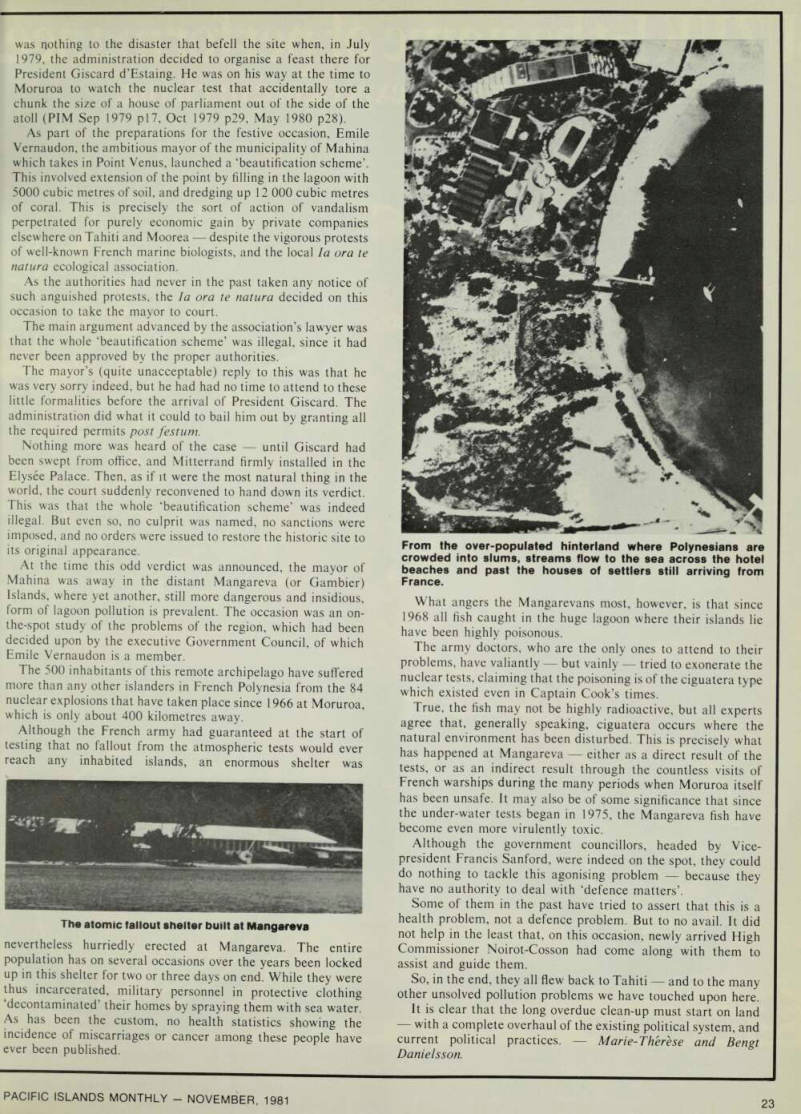
What has happened over the past 15 years is simply this: the whole beach area for 15 kilometres or so on either side of Papeete has been swamped with new French settlers, and with Polynesian immigrants from the Tuamotus, Marquesas, Aus trals and Leeward Islands, creating a population density in the neighbourhood of 1000 persons per square kilometre! To make room for all the fetid slums and splendid mansions often to be found side by side required to house all these newcomers (not to mention the proliferating Tahitian-born Polynesians), the vegetation has been ruthlessly slashed, and large-scale erosion has set in. So, all the loose top soil, all the sewage, and all the pesticides, keep on flowing down into the lagoon.
What is needed, therefore, is a new and more restrictive set of immigration policies policies which can only be drawn up and applied by a strong, independent, or semi-independent, Polynesian government.
A second pollution scandal, which has besmirched the French administration, and some local political leaders, even more seriously blew up only a few days after the row over the Maeva (No Beach) Hotel.
Occupying centre-stage this time was the most sacred and celebrated of all historical sites in Tahiti; Point Venus and Matavai Bay, where Wallis, Cook, Bligh, and the first London Missionary Society pastors stepped ashore and established their headquarters.
Since the end of World War 11, the point has suffered gradual disfigurement through the erection on it of a row of unsightly corrugated iron-roofed houses. This has been bad enough, but it
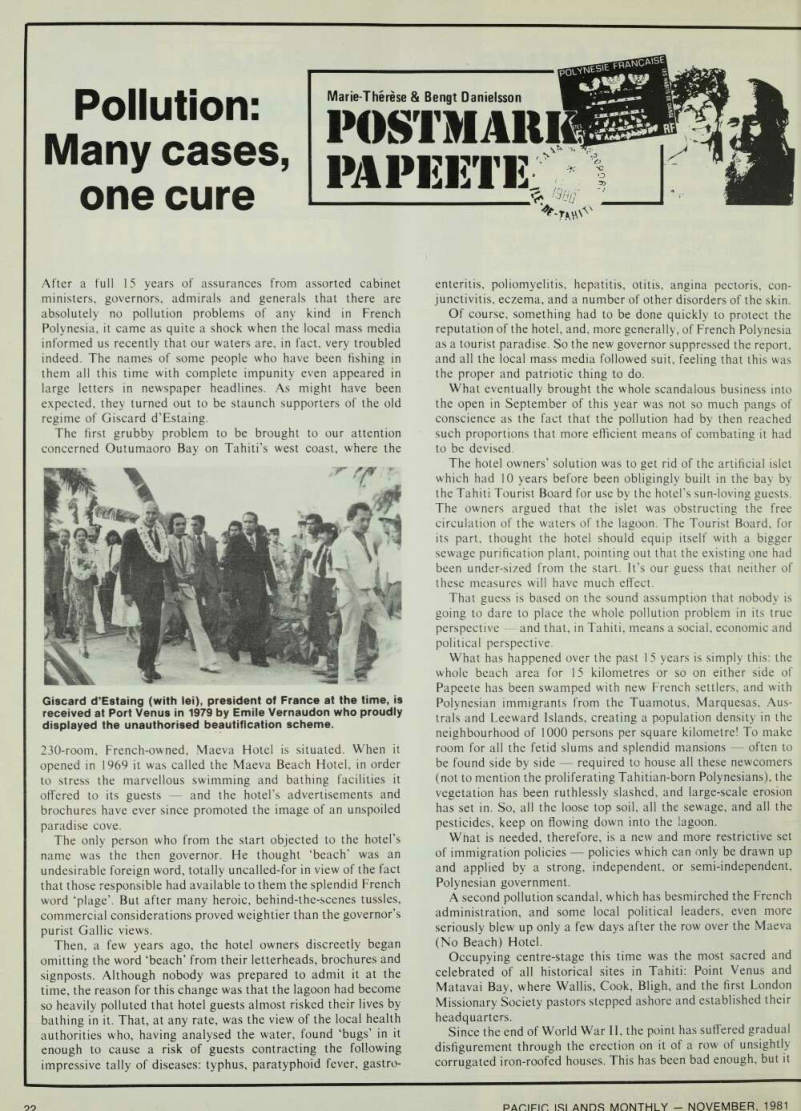
Giscard d’Estaing (with lei), president of France at the time, is received at Port Venus in 1979 by Emile Vernaudon who proudly displayed the unauthorised beautification scheme.
was nothing to the disaster that befell the site when, in July 1979, the administration decided to organise a feast there for President Giscard d’Estaing. He was on his way at the time to Moruroa to watch the nuclear test that accidentally tore a chunk the size of a house of parliament out of the side of the atoll (PIM Sep 1979 p 17, Oct 1979 p 29. May 1980 p2B).
As part of the preparations for the festive occasion, Emile Vernaudon, the ambitious mayor of the municipality of Mahina which takes in Point Venus, launched a ‘beautification scheme’.
This involved extension of the point by filling in the lagoon with 5000 cubic metres of soil, and dredging up 12 000 cubic metres of coral. This is precisely the sort of action of vandalism perpetrated for purely economic gain by private companies elsewhere on Tahiti and Moorea despite the vigorous protests of well-known French marine biologists, and the local la orate natura ecological association.
As the authorities had never in the past taken any notice of such anguished protests, the la orate natura decided on this occasion to take the mayor to court.
The main argument advanced by the association’s lawyer was that the whole ‘beautification scheme’ was illegal, since it had never been approved by the proper authorities.
The mayor’s (quite unacceptable) reply to this was that he was very sorry indeed, but he had had no time to attend to these little formalities before the arrival of President Giscard. The administration did what it could to bail him out by granting all the required permits post festum.
Nothing more was heard of the case until Giscard had been swept from office, and Mitterrand firmly installed in the Elysee Palace. Then, as if it were the most natural thing in the world, the court suddenly reconvened to hand down its verdict.
This was that the whole ‘beautification scheme’ was indeed illegal. But even so, no culprit was named, no sanctions were imposed, and no orders were issued to restore the historic site to its original appearance.
At the time this odd verdict was announced, the mayor of Mahina was away in the distant Mangareva (or Gambier) Islands, where yet another, still more dangerous and insidious, form of lagoon pollution is prevalent. The occasion was an on the-spot study of the problems of the region, which had been decided upon by the executive Government Council, of which Emile Vernaudon is a member.
The 500 inhabitants of this remote archipelago have suffered more than any other islanders in French Polynesia from the 84 nuclear explosions that have taken place since 1966 at Moruroa, which is only about 400 kilometres away.
Although the French army had guaranteed at the start of testing that no fallout from the atmospheric tests would ever reach any inhabited islands, an enormous shelter was
nevertheless hurriedly erected at Mangareva. The entire population has on several occasions over the years been locked up in this shelter for two or three days on end. While they were thus incarcerated, military personnel in protective clothing decontaminated’ their homes by spraying them with sea water.
As has been the custom, no health statistics showing the incidence of miscarriages or cancer among these people have ever been published.
What angers the Mangarevans most, however, is that since 1968 all fish caught in the huge lagoon where their islands lie have been highly poisonous.
The army doctors, who are the only ones to attend to their problems, have valiantly but vainly tried to exonerate the nuclear tests, claiming that the poisoning is of the ciguatera type which existed even in Captain Cook’s times.
True, the fish may not be highly radioactive, but all experts agree that, generally speaking, ciguatera occurs where the natural environment has been disturbed. This is precisely what has happened at Mangareva either as a direct result of the tests, or as an indirect result through the countless visits of French warships during the many periods when Moruroa itself has been unsafe. It may also be of some significance that since the under-water tests began in 1975, the Mangareva fish have become even more virulently toxic.
Although the government councillors, headed by Vice president Francis Sanford, were indeed on the spot, they could do nothing to tackle this agonising problem because they have no authority to deal with ‘defence matters’.
Some of them in the past have tried to assert that this is a health problem, not a defence problem. But to no avail. It did not help in the least that, on this occasion, newly arrived High Commissioner Noirot-Cosson had come along with them to assist and guide them.
So, in the end, they all flew back to Tahiti and to the many other unsolved pollution problems we have touched upon here.
It is clear that the long overdue clean-up must start on land with a complete overhaul of the existing political system, and current political practices. Marie-Therese and Bengt Danielsson.
The atomic fallout shelter built at Mangareva
From the over-populated hinterland where Polynesians are crowded into slums, streams flow to the sea across the hotel beaches and past the houses of settlers still arriving from France.