Noumea
p. 21 · Read in the full issue
What future in store for New Caledonia?
Dariel Tandiell's
Notebook
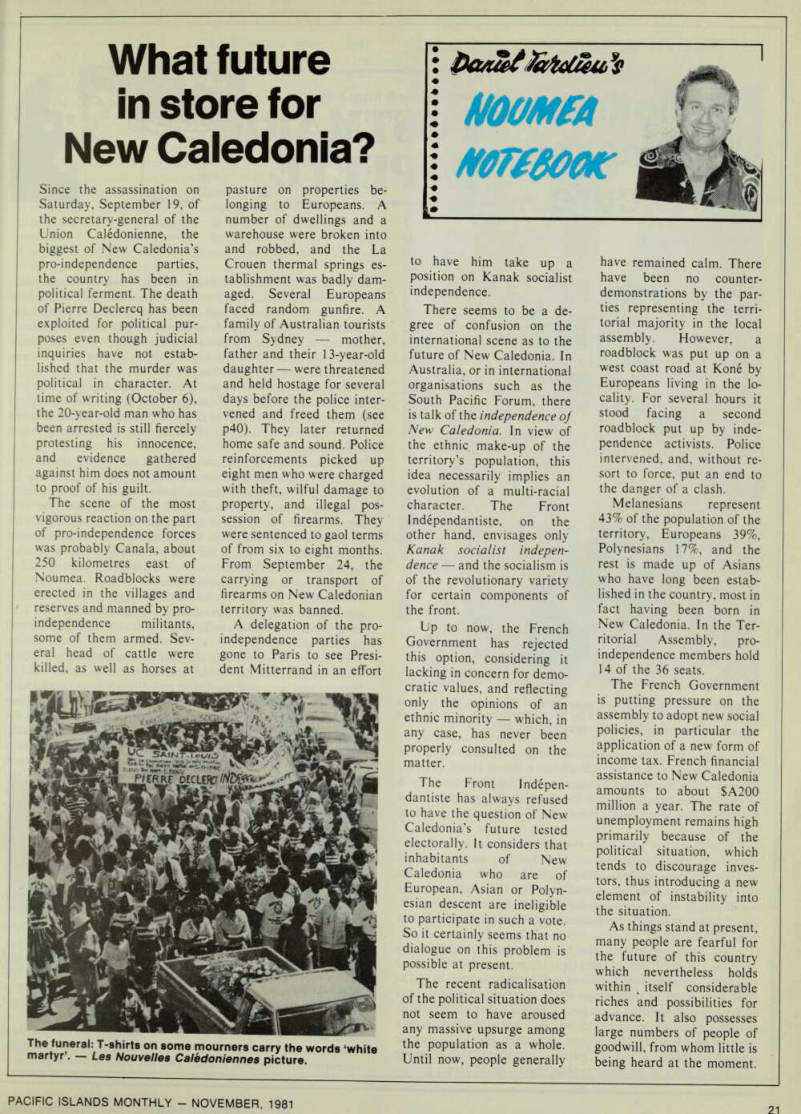
Since the assassination on Saturday, September 19, of the secretary-general of the Union Caledonienne, the biggest of New Caledonia’s pro-independence parties, the country has been in political ferment. The death of Pierre Declercq has been exploited for political pur poses even though judicial inquiries have not estab lished that the murder was political in character. At time of writing (October 6), the 20-year-old man who has been arrested is still fiercely protesting his innocence, and evidence gathered against him does not amount to proof of his guilt.
The scene of the most vigorous reaction on the part of pro-independence forces was probably Canala, about 250 kilometres east of Noumea. Roadblocks were erected in the villages and reserves and manned by pro independence militants, some of them armed. Sev eral head of cattle were killed, as well as horses at
pasture on properties be longing to Europeans. A number of dwellings and a warehouse were broken into and robbed, and the La Crouen thermal springs es tablishment was badly dam aged. Several Europeans faced random gunfire. A family of Australian tourists from Sydney mother, father and their 13-year-old daughter were threatened and held hostage for several days before the police inter vened and freed them (see p4O). They later returned home safe and sound. Police reinforcements picked up eight men who were charged with theft, wilful damage to property, and illegal pos session of firearms. They were sentenced to gaol terms of from six to eight months.
From September 24, the carrying or transport of firearms on New Caledonian territory was banned.
A delegation of the pro independence parties has gone to Paris to see Presi dent Mitterrand in an effort
to have him take up a position on Kanak socialist independence.
There seems to be a de gree of confusion on the international scene as to the future of New Caledonia. In Australia, or in international organisations such as the South Pacific Forum, there is talk of the independence oj New Caledonia. In view of the ethnic make-up of the territory’s population, this idea necessarily implies an evolution of a multi-racial character. The Front Independantiste, on the other hand, envisages only Kanak socialist indepen dence and the socialism is of the revolutionary variety for certain components of the front.
Up to now, the French Government has rejected this option, considering it lacking in concern for demo cratic values, and reflecting only the opinions of an ethnic minority which, in any case, has never been properly consulted on the matter.
The Front Indepen dantiste has always refused to have the question of New Caledonia’s future tested electorally. It considers that inhabitants of New Caledonia who are of European, Asian or Polyn esian descent are ineligible to participate in such a vote.
So it certainly seems that no dialogue on this problem is possible at present.
The recent radicalisation of the political situation does not seem to have aroused any massive upsurge among the population as a whole.
Until now, people generally
have remained calm. There have been no counter demonstrations by the par ties representing the terri torial majority in the local assembly. However, a roadblock was put up on a west coast road at Kone by Europeans living in the lo cality. For several hours it stood facing a second roadblock put up by inde pendence activists. Police intervened, and, without re sort to force, put an end to the danger of a clash.
Melanesians represent 43% of the population of the territory, Europeans 39%, Polynesians 17%, and the rest is made up of Asians who have long been estab lished in the country, most in fact having been born in New Caledonia. In the Ter ritorial Assembly, pro independence members hold 14 of the 36 seats.
The French Government is putting pressure on the assembly to adopt new social policies, in particular the application of a new form of income tax. French financial assistance to New Caledonia amounts to about SA2OO million a year. The rate of unemployment remains high primarily because of the political situation, which tends to discourage inves tors, thus introducing a new element of instability into the situation.
As things stand at present, many people are fearful for the future of this country which nevertheless holds within itself considerable riches and possibilities for advance. It also possesses large numbers of people of goodwill, from whom little is being heard at the moment.
The funeral: T-shirts on some mourners carry the words ‘white martyr’. - Lea Nouvelles Caledoniennes picture.