Who was Pierre Declercq?
p. 19 · Read in the full issue
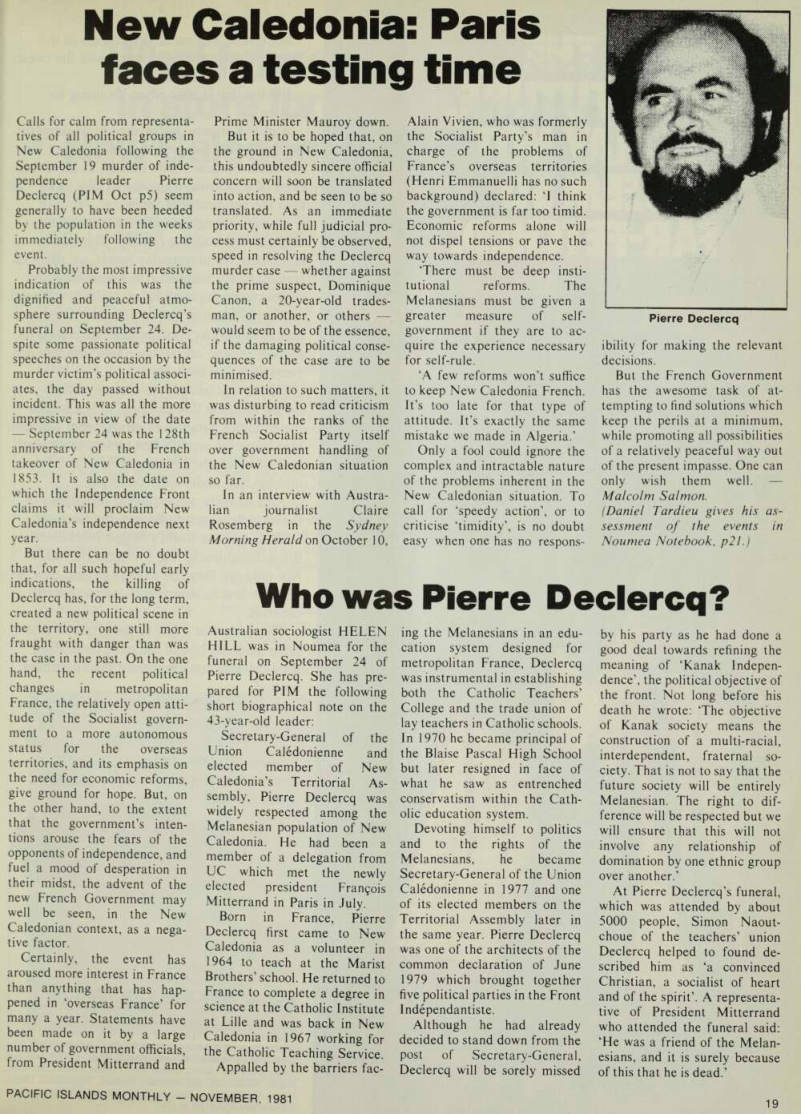
Australian sociologist HELEN HILL was in Noumea for the funeral on September 24 of Pierre Declercq. She has pre pared for PIM the following short biographical note on the 43-year-old leader: Secretary-General of the Union Caledonienne and elected member of New Caledonia’s Territorial As sembly, Pierre Declercq was widely respected among the Melanesian population of New Caledonia. He had been a member of a delegation from UC which met the newly elected president Francis Mitterrand in Paris in July.
Born in France, Pierre Declercq first came to New Caledonia as a volunteer in 1964 to teach at the Marist Brothers’ school. He returned to France to complete a degree in science at the Catholic Institute at Lille and was back in New Caledonia in 1967 working for the Catholic Teaching Service.
Appalled by the barriers fac
ing the Melanesians in an edu cation system designed for metropolitan France, Declercq was instrumental in establishing both the Catholic Teachers’
College and the trade union of lay teachers in Catholic schools.
In 1970 he became principal of the Blaise Pascal High School but later resigned in face of what he saw as entrenched conservatism within the Cath olic education system.
Devoting himself to politics and to the rights of the Melanesians, he became Secretary-General of the Union Caledonienne in 1977 and one of its elected members on the Territorial Assembly later in the same year. Pierre Declercq was one of the architects of the common declaration of June 1979 which brought together five political parties in the Front Independantiste.
Although he had already decided to stand down from the post of Secretary-General, Declercq will be sorely missed
by his party as he had done a good deal towards refining the meaning of ‘Kanak Indepen dence’, the political objective of the front. Not long before his death he wrote: The objective of Kanak society means the construction of a multi-racial, interdependent, fraternal so ciety. That is not to say that the future society will be entirely Melanesian. The right to dif ference will be respected but we will ensure that this will not involve any relationship of domination by one ethnic group over another.’
At Pierre Declercq’s funeral, which was attended by about 5000 people, Simon Naout choue of the teachers’ union Declercq helped to found de scribed him as ‘a convinced Christian, a socialist of heart and of the spirit’. A representa tive of President Mitterrand who attended the funeral said: ‘He was a friend of the Melan esians, and it is surely because of this that he is dead.’