New Caledonia: Paris
p. 19 · Read in the full issue
faces a testing time
Calls for calm from representa tives of all political groups in New Caledonia following the September 19 murder of inde pendence leader Pierre Declercq (PIM Oct p 5) seem generally to have been heeded by the population in the weeks immediately following the event.
Probably the most impressive indication of this was the dignified and peaceful atmo sphere surrounding Declercq’s funeral on September 24. De spite some passionate political speeches on the occasion by the murder victim’s political associ ates, the day passed without incident. This was all the more impressive in view of the date September 24 was the 128th anniversary of the French takeover of New Caledonia in 1853. It is also the date on which the Independence Front claims it will proclaim New Caledonia’s independence next year.
But there can be no doubt that, for all such hopeful early indications, the killing of Declercq has, for the long term, created a new political scene in the territory, one still more fraught with danger than was the case in the past. On the one hand, the recent political changes in metropolitan France, the relatively open atti tude of the Socialist govern ment to a more autonomous status for the overseas territories, and its emphasis on the need for economic reforms, give ground for hope. But, on the other hand, to the extent that the government’s inten tions arouse the fears of the opponents of independence, and fuel a mood of desperation in their midst, the advent of the new French Government may well be seen, in the New Caledonian context, as a nega tive factor.
Certainly, the event has aroused more interest in France than anything that has hap pened in ‘overseas France’ for many a year. Statements have been made on it by a large number of government officials, from President Mitterrand and
Prime Minister Mauroy down.
But it is to be hoped that, on the ground in New Caledonia, this undoubtedly sincere official concern will soon be translated into action, and be seen to be so translated. As an immediate priority, while full judicial pro cess must certainly be observed, speed in resolving the Declercq murder case whether against the prime suspect, Dominique Canon, a 20-year-old trades man, or another, or others would seem to be of the essence, if the damaging political conse quences of the case are to be minimised.
In relation to such matters, it was disturbing to read criticism from within the ranks of the French Socialist Party itself over government handling of the New Caledonian situation so far.
In an interview with Austra lian journalist Claire Rosemberg in the Sydney Morning Herald on October 10,
Alain Vivien, who was formerly the Socialist Party’s man in charge of the problems of France’s overseas territories (Henri Emmanuelli has no such background) declared: I think the government is far too timid.
Economic reforms alone will not dispel tensions or pave the way towards independence.
There must be deep insti tutional reforms. The Melanesians must be given a greater measure of self government if they are to ac quire the experience necessary for self-rule. ‘A few reforms won’t suffice to keep New Caledonia French.
It’s too late for that type of attitude. It’s exactly the same mistake we made in Algeria.’
Only a fool could ignore the complex and intractable nature of the problems inherent in the New Caledonian situation. To call for ‘speedy action’, or to criticise ‘timidity’, is no doubt easy when one has no respons-
ibility for making the relevant decisions.
But the French Government has the awesome task of at tempting to find solutions which keep the perils at a minimum, while promoting all possibilities of a relatively peaceful way out of the present impasse. One can only wish them well.
Malcolm Salmon. {Daniel Tardieu gives his as sessment of the events in Noumea Notebook, p 21.)
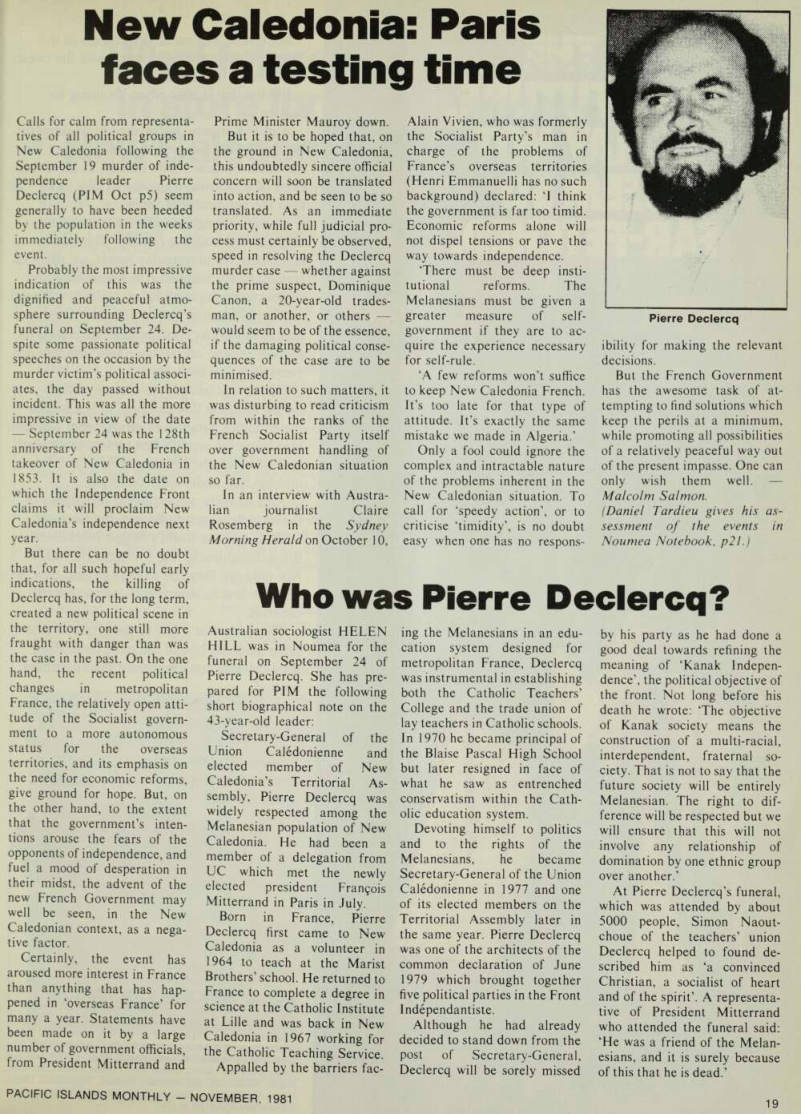
Pierre Declercq