A strong ‘Pacific Lobby’ - but
pp. 11-18 · Read in the full issue

Commonwealth Heads Of Government Meeting
A strong ‘Pacific Lobby’ - but how much did it achieve?
Journalist SUE GREEN was in Melbourne for RIM at the Commonwealth Heads of Government Meeting (CHOGM) from September 30-October 7. Her report below pulls together the story of the activity of the ‘Pacific Lobby’ formed by the seven Pacific Island states represented at the conference, their successes, and their continuing doubts as to whether, in the long run, the meeting will have much effect on how the nations concerned will behave in the future.
The Commonwealth Heads of Government Meeting (CHOGM) in Melbourne last month saw the development of a strong and fairly successful Pacific lobby which Pacific leaders say has set the trend for such conferences in future. But for those leaders the real test of their lobby and of CHOGM itself is yet to come.
The Pacific leaders met regu larly. They lobbied those from other parts of the world to have Pacific issues put before the conference. They say they suceeded: the final com munique, with its sections on the law of the sea convention, opposition to nuclear tests and dumping nuclear waste reflects that.
But whether those words are more than just words will only be seen by Commonwealth ac tions now that the leaders are back home in their own countries, facing their domestic problems again. Some Pacific leaders are less than hopeful about the likely results.
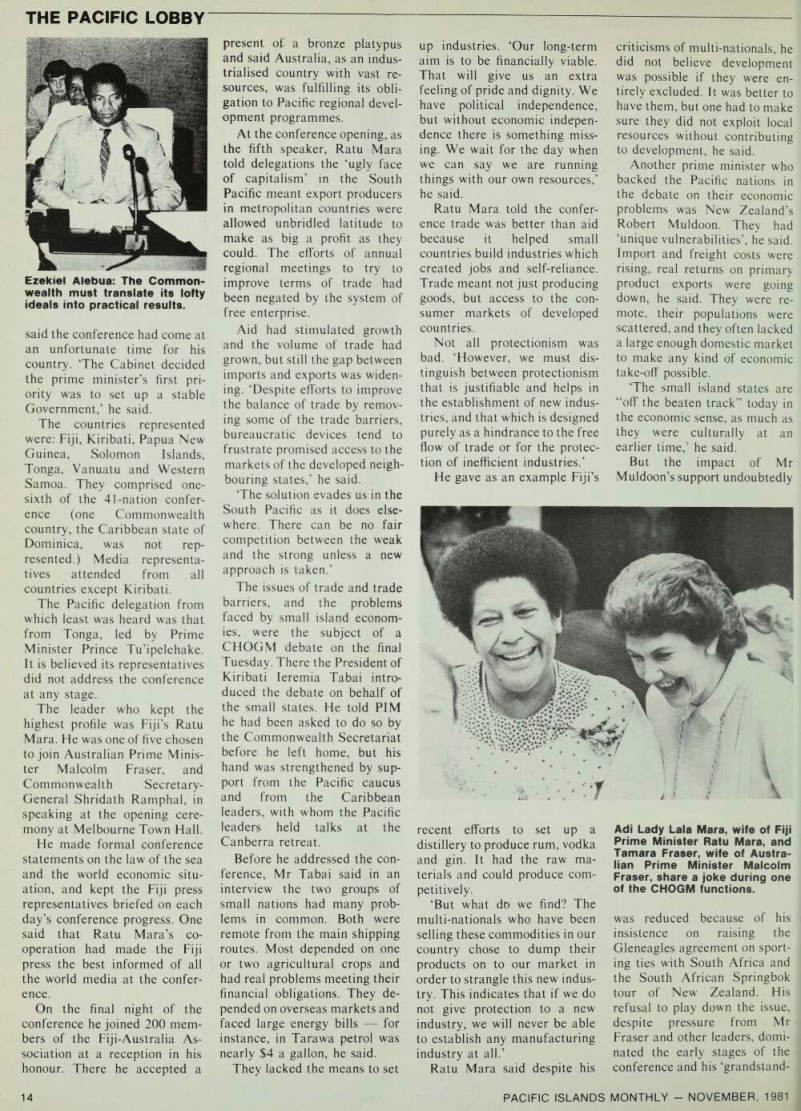
The leader of the Solomon Islands delegation, Foreign Affairs Minister Ezekiel Alebua, summed up the doubts in a hard-hitting statement issued towards the end of the conference. In it he said he was disappointed at Commonwealth progress since the communique from the last CHOGM in Zambia in 1979. What was needed was for CHOGM to ?ive the Commonwealth Sec
retariat the means to translate ‘lofty objectives into concrete, practical results’.
He told PIM he hoped other Commonwealth leaders had taken his statement as a strong stand. ‘I hope they can do something about it. . . Knowing what these kinds of meetings and conferences are like, I came here in the high hope of putting the view of my country. I think I have managed to do that.’
Fiji’s Prime Minister Ratu Sir Kamisese Mara was also critical of the lack of progress since the last CHOGM. The economic situation of the world was worse, but ‘what is glaring, however, is that we have done very little to find effective solutions,’ he said in his confer
ence speech on the world economic situation. ‘All the talks so far have been full of philosophies and good intentions, but there has been very little in terms of real practical action. Unfortunately in Fiji we cannot afford the luxuries of philosophies and good intentions alone.’
But after the Melbourne communique he told journalists Pacific countries had made more impact there than at any other Commonwealth meeting.
On the last day of the latest CHOGM, Vanuatu’s Prime Minister, Father Walter Lini, summed up his disappointment in an interview with PIM: ‘I think there is not a single thing which the South Pacific Island
nations and the whole of the Commonwealth can point to and say, “this was done in Melbourne”.’
Seven Pacific Island nations were represented at the meet ing, which ran from Wednesday September 30 to Wednesday October 7. The formal talks took place in Mel bourne’s Royal Exhibition buildings and there was a week end retreat in Canberra. All leaders had audiences with the Queen on board the Royal yacht, Britannia.
All the Pacific countries were represented by heads of govern ment except Solomon Islands, New Prime Minister Solomon Mamaloni did not attend. The delegation leader, Mr Alebua,
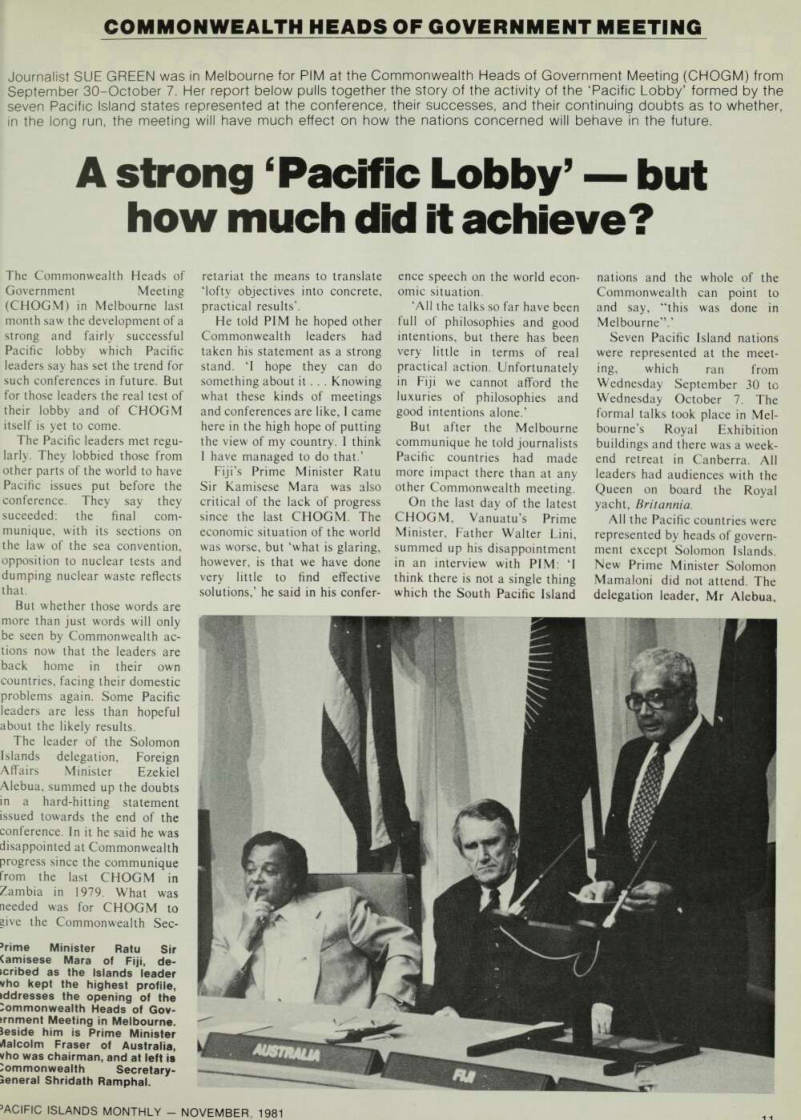
Prime Minister Ratu Sir Kamisese Mara of Fiji, de [?]cribed as the Islands leader [?]ho kept the highest profile, [?]ddresses the opening of the Commonwealth Heads of Gov [?]rnment Meeting in Melbourne. [?]eside him is Prime Minister Malcolm Fraser of Australia, [?]ho was chairman, and at left is
Commonwealth Secretary-
General Shridath Ramphal.
said the conference had come at an unfortunate time for his country. ‘The Cabinet decided the prime minister’s first pri ority was to set up a stable Government,’ he said.
The countries represented were: Fiji, Kiribati, Papua New Guinea, Solomon Islands, Tonga, Vanuatu and Western Samoa. They comprised one sixth of the 41-nation confer ence (one Commonwealth country, the Caribbean state of Dominica, was not rep resented.) Media representa tives attended from all countries except Kiribati.
The Pacific delegation from which least was heard was that from Tonga, led by Prime Minister Prince Tu’ipelehake.
It is believed its representatives did not address the conference at any stage.
The leader who kept the highest profile was Fiji’s Ratu Mara. He was one of five chosen to join Australian Prime Minis ter Malcolm Fraser, and Commonwealth Secretary- General Shridath Ramphal, in speaking at the opening cere mony at Melbourne Town Hall.
He made formal conference statements on the law of the sea and the world economic situ ation, and kept the Fiji press representatives briefed on each day’s conference progress. One said that Ratu Mara’s co operation had made the Fiji press the best informed of all the world media at the confer ence.
On the final night of the conference he joined 200 mem bers of the Fiji-Australia As sociation at a reception in his honour. There he accepted a
present of a bronze platypus and said Australia, as an indus trialised country with vast re sources, was fulfilling its obli gation to Pacific regional devel opment programmes.
At the conference opening, as the fifth speaker, Ratu Mara told delegations the ‘ugly face of capitalism’ in the South Pacific meant export producers in metropolitan countries were allowed unbridled latitude to make as big a profit as they could. The efforts of annual regional meetings to try to improve terms of trade had been negated by the system of free enterprise.
Aid had stimulated growth and the volume of trade had grown, but still the gap between imports and exports was widen ing. ‘Despite efforts to improve the balance of trade by remov ing some of the trade barriers, bureaucratic devices tend to frustrate promised access to the markets of the developed neigh bouring states,’ he said. ‘The solution evades us in the South Pacific as it does else where. There can be no fair competition between the weak and the strong unless a new approach is taken.’
The issues of trade and trade barriers, and the problems faced by small island econom ies, were the subject of a CHOGM debate on the final Tuesday. There the President of Kiribati leremia Tabai intro duced the debate on behalf of the small states. He told PIM he had been asked to do so by the Commonwealth Secretariat before he left home, but his hand was strengthened by sup port from the Pacific caucus and from the Caribbean leaders, with whom the Pacific leaders held talks at the Canberra retreat.
Before he addressed the con ference, Mr Tabai said in an interview the two groups of small nations had many prob lems in common. Both were remote from the main shipping routes. Most depended on one or two agricultural crops and had real problems meeting their financial obligations. They de pended on overseas markets and faced large energy bills for instance, in Tarawa petrol was nearly $4 a gallon, he said.
They lacked the means to set
up industries. ‘Our long-term aim is to be financially viable.
That will give us an extra feeling of pride and dignity. We have political independence, but without economic indepen dence there is something miss ing. We wait for the day when we can say we are running things with our own resources,’ he said.
Ratu Mara told the confer ence trade was better than aid because it helped small countries build industries which created jobs and self-reliance.
Trade meant not just producing goods, but access to the con sumer markets of developed countries.
Not all protectionism was bad. ‘However, we must dis tinguish between protectionism that is justifiable and helps in the establishment of new indus tries, and that which is designed purely as a hindrance to the free flow of trade or for the protec tion of inefficient industries.’
He gave as an example Fiji’s
criticisms of multi-nationals, he did not believe development was possible if they were en tirely excluded. It was better to have them, but one had to make sure they did not exploit local resources without contributing to development, he said.
Another prime minister who backed the Pacific nations in the debate on their economic problems was New Zealand’s Robert Muldoon. They had ‘unique vulnerabilities’, he said.
Import and freight costs were rising, real returns on primary product exports were going down, he said. They were re mote, their populations were scattered, and they often lacked a large enough domestic market to make any kind of economic take-off possible. ‘The small island states are “off the beaten track” today in the economic sense, as much as they were culturally at an earlier time,’ he said.
But the impact of Mr Muldoon’s support undoubtedly
recent efforts to set up a distillery to produce rum, vodka and gin. It had the raw ma terials and could produce com petitively. ‘But what do we find? The multi-nationals who have been selling these commodities in our country chose to dump their products on to our market in order to strangle this new indus try. This indicates that if we do not give protection to a new industry, we will never be able to establish any manufacturing industry at all.’
Ratu Mara said despite his
was reduced because of his insistence on raising the Gleneagles agreement on sport ing ties with South Africa and the South African Springbok tour of New Zealand. His refusal to play down the issue, despite pressure from Mr Fraser and other leaders, domi nated the early stages of the conference and his ‘grandstand
Ezekiel Alebua: The Common wealth must translate its lofty ideals into practical results.
Adi Lady Lala Mara, wife of Fiji Prime Minister Ratu Mara, and Tamara Fraser, wife of Austra lian Prime Minister Malcolm Fraser, share a joke during one of the CHOGM functions.
ing’ is believed to have alien ated many Commonwealth leaders, including those from the Pacific.
In a thinly veiled attack on Mr Muldoon, Mr Alebua said he was discouraged at the way important development matters were being pushed aside by CHOGM to make way for ‘grandstand’ issues.
Ratu Mara told journalists there was general dissatis faction with Mr Muldoon. The leaders felt he was beaming his statements to his electorate (New Zealanders go to the polls this month) and could not care less what the reactions of the Commonwealth members were, he said.
Mr Muldoon called for more Commonwealth assistance to small nations through increased contributions to the Common wealth Fund for Technical Co operation. That call was echoed by the PNG Prime Minister, Sir Julius Chan. He said Common wealth leaders would have done one useful and solid piece of work if they put the fund’s finances on a sound basis again. ‘lt is a short-sighted policy to save very small amounts of money by cutting back contri butions if the result is to cripple an organisation which is necess ary to give substance to the ideals of Commonwealth co operation,’ Sir Julius said.
PNG had already increased its contribution and he urged CHOGM to accept a report which asked that all members do so.
Mr Alebua said the sec retariat should be given the resources to convene working sessions of donor countries and developing Island states three or four times a year, so their needs could be matched with the donors’ money and exper tise.
He said the secretariat should provide a multi disciplinary task force to deal quickly with problems as they arose. For instance, a country needing fisheries help could be sent a fisheries expert, an indus tries expert and a legal draftsman.
The final communique backed the case put by the leaders of the small nations. In it the leaders ‘noted with con cern’ the problems faced by
those countries and said more needed to be done than the special action programme ap proved at the Lusaka CHOGM. ‘Heads of Government noted the offer by Australia to fund appropriate facilities in New York to enable Pacific Island states not presently represented to maintain representation in
file United Nations. They also noted the initiative within the Pacific to establish a regional advisory service. (A move the South Pacific Forum wanted put before CHOGM.) The Gov ernments concerned agreed to consult to formulate more de tailed proposals.’
Sir Julius’ call for more money for the CFTC was taken up and the leaders agreed that by 1983-84 its activities should be back to the 1978-79 level, and that this should be a basis for future growth. They said it seemed members were pre pared to make the money avail able. To help raise money for the fund they agreed to a special Commonwealth stamp issue every five years, the first to be in 1983.
The energy problems of the Pacific states were also ac knowledged. Oil prices should
be set so as to avoid sudden steep price rises and at levels which would encourage pro duction and conservation, the leaders said. Special arrange ments should be worked out for low-income countries, and con cessions extended to them, the leaders decided.
More money was needed for energy development in develop ing countries but so far no agreement had been reached on a way of providing it, the communique said. So it sup ported a plan to set up an energy affiliate within the World Bank.
Closely linked with the prob lems faced by the small Island economies are the problems faced by developing countries throughout the world. There was debate on that issue, and the gap between rich and poor, known as the ‘North-South dia logue’.
Sir Julius Chan said the position of the poorest Third World countries had worsened dramatically in the past two years. There was danger that talk about whether their prob lems were the poor countries’ own fault, or the fault of the workings of the international system, could become a ‘dia logue of the deaf a phrase he repeated when addressing a Commonwealth Press Union dinner on the subject.
Developing countries had to adjust to changes in the world economy. Even small swings in commodity prices had a big effect on export earnings, gov ernment revenue and the level of economic activity. An example of that was the recent cutback in production sched ules by Bougainville Copper, which faced the PNG Govern ment with a loss of up to 40 or 50 million kina a year.
Adjustment should not just be cutting back, it should be positive, leading to the develop ment of new industries and exports. But poor, under developed countries had no hope of doing that on their own resources alone, Sir Julius said.
Sir Julius welcomed the Mel bourne Declaration which was issued by Mr Ramphal on behalf of the leaders on the Sunday afternoon of the retreat.
It called for determined action both nationally and inter
nationally to reduce inequalities of wealth and opportunity in the world.
It called on the leaders of all countries to join in advancing the dialogue between developed and developing countries, and to make a commitment to prompt, practical and effective world action. Sir Julius asked that the declaration be sent to every world leader.
Immediately it was issued the declaration became the subject of controversy. Most of it centred on Mr Muldoon who criticised its timing and con tent. He said he had not been told it was to be released on Sunday afternoon and he called its statements ‘pious platitudes’.
Sir Julius disagreed, saying: ‘This is wrong, we need both words and deeds. We need the right words to point us in the right direction, and the Mel bourne Declaration provides those. But we also require deeds to match. In the end, the success or failure of CHOGM will be judged on whether it has made any actual difference to the way the governments of individual member countries behave in the future.’
Mr Lini said he did not disagree with the declaration, but thought the way it was done was open to criticism. T think the way it was done is open to criticism by other members of the Commonwealth who may perhaps suspect a deliberate attempt on behalf of the Aus tralian Government to force some of its own thinking on them. After all, they would be placed in a difficult position if they were to reject it because it was drafted by the host govern ment,’ he told PIM.
The communique also sup ported issues specifically re lated to the Pacific, which the South Pacific Forum had de cided to put before CHOGM and which the Pacific leaders had been lobbying hard for. It supported the right to self determination for all people of the region and welcomed the Forum decision to send a mission to France to discuss the future of New Caledonia. (That mission, headed by Ratu Mara, is to go in November. President Mitterrand has agreed to meet it.) Outside the conference, Ratu
Papua New Guinea Prime Minis ter Sir Julius Chan arrives in Melbourne for the Common wealth summit. ‘Don’t let the plight of the Third World lead to a dialogue of the deaf,’ he warned.
Mara warned that events in New Caledonia, particularly following the September mur der of Independence Front secretary-general Pierre Declercq, were beginning to re semble a ‘mini-Algeria’.
The murder created an Algeria-type situation where people were being discouraged from taking a particular line.
But it also forced the French Government to focus more clearly on the independence issue, he said.
CHOGM also supported the South Pacific countries’ call for an immediate end to nuclear tests in the region, and the Forum resolution which op posed dumping and storage of nuclear waste in the Pacific.
A key Pacific issue at CHOGM was the law of the sea. Throughout the conference Pacific leaders worked to have the meeting raise the problem of the draft convention which ran into trouble when the new US administration pulled out its negotiating team and said a total re-think was necessary (PIM Jun p 59). The final com munique did not specifically name the USA as the main obstacle to completing the con vention, but it did include a special section on the subject.
It said: ‘Heads of Govern ment stressed the importance they attached to securing at an early date a comprehensive and widely accepted convention on the law of the sea. ‘They observed that such a convention would enhance the prospects for peace and security in the world. It would define the rights of coastal states and other users of the sea; assist rational exploitation and man agement of the living and non living resources of the oceans; provide increased protection for the marine environment; give practical effect to the principle that the resources of the seabed beyond national jurisdiction are the common heritage of man kind, and permit all states to participate in the exploitation of those resources, either di rectly through national oper ators, or indirectly through the Enterprise.’
Negotiations had reached an advanced stage, but heads of government ‘recorded with dis quiet’ developments in the last
two sessions. They hoped the conference on the law of the sea would finish its work next year, the communique said.
That section, and the thinly veiled criticism of the US, marked a victory for all Pacific leaders, and for their regional caucus. But it was a particular victory for Fiji’s Ratu Mara.
He was the first speaker to raise the issue. He took the chance offered by the opening ceremony to put it before all delegations and the world press.
The next day he followed up with a statement to the confer ence on the law of the sea. He said that despite the text having been widely agreed, with the leading participation of the three US negotiators, the pres-
ent administration in Washing ton decided in March to review the entire text.
He asked CHOGM to en dorse the law of the sea confer ence’s wish for the US to join again ‘on a realistic basis’, and for the work to be finished next year. Those comments were backed by Mr Muldoon, who said he hoped, after his recent talks with President Reagan, the US would set aside dom estic concerns to complete the international treaty.
But it was the Solomon Islands delegation leader who voiced the toughest criticism of the US for holding up the convention. He said of the US decision to delay signing until after its own policy review: ‘lt is difficult not to see this action as that of a superpower selfishly defending its own interests against the mutual interests of the wider world community.’
The heads of government had taken a positive line. But as with other issues, the real test would be action.
An issue which, before the conference, threatened to div ide it, was Australia’s treatment of the Aborigines. Mr Lini said he was going to raise a contro versial World Council of Churches report which at tacked racism in Australia.
He said he was determined to do so despite criticism from Australian Government back bencher Roger Shipton. Mi Shipton, chairman of the parlia mentary foreign affairs and defence committee, said Mr Lini was running a risk of being seen as ungrateful for Austra lian aid.
Mr Lini raised the report with Mr Fraser before the conference. It is believed he told other Pacific leaders he was
happy with the assurances he was given. Ratu Mara and Sir Julius Chan both said they did not know enough about the issue to get involved.
In the formal conference sessions Mr Lini did not raise the issue. It was another Pacific leader, Western Samoa’s Tupuola Efi, who took it up. ‘A lot of people were very happy that I raised it. This meeting has given the WCC report publicity which will probably aid the cause of the Aborigines,’ he said. Mr Fraser had said he would do all he could and he was to be believed because of his human rights initiatives in other parts of the world.
When Mr Ramphal was asked at a press briefing what the Western Samoa leader had said he described it as a
‘virtuoso performance’. The contribution was ‘quite brilliant’ and he could not do justice to it in attempting to describe it, he said.
On the last day of the meet ing Mr Lini told PIM he did not feel he had backed down on the Aboriginal issue. T have taken almost every step that I under took to take in my remarks in Port-Vila,’ he said. He had raised it with Mr Fraser, he had answered questions from the media, from church leaders and solidarity groups, and he had raised it with other Pacific leaders, he said.
But it was not ‘the end of the road’ for the Aborigines, he said. The Australian Govern ment would be in a difficult position if the Commonwealth approved a programme worked out by the Aboriginal people.
That step was premature. But now all Commonwealth leaders were aware it was a serious issue, and would be keeping an eye on it. What happened next depended on what was done in Australia and in the region, he said.
The Pacific leaders predicted that the lobby they formed at the Melbourne CHOGM would set a precedent for future con ferences. They had achieved much in talks in the back corridors, said Mr Alebua, re fusing to elaborate.
Mr Tabai said: ‘There is always the feeling in bigger organisations like this that the small island states will be swept away. But in the world we are in now, and with the number of independent countries around the world, we cannot afford to just leave one or two countries to talk for the rest of mankind.
Those days are gone.’
But both the leaders, rep resentatives of two of the smallest nations at CHOGM, agreed that whether anything positive resulted from the con ference could only be judged by the actions of the member states between now and the next conference, to be held in India.
If nothing else, CHOGM helped some delegations find out some fairly basic facts about the Pacific, Mr Tabai told PIM. ‘ln fact,’ he added, ‘mem bers of several delegations actu ally asked me where Kiribati is . . .’
New Zealand Prime Minister Robert Muldoon, whose out spoken attitudes were a feature of the Commonwealth talks, and PNG Prime Minister Sir Julius Chan.